Carriageworks: Sydney's Most Ambitious Arts Precinct
Carriageworks occupies a vast former railway workshop in Eveleigh, running contemporary art exhibitions, live performances, and one of Sydney's best weekly farmers markets. It is free to enter on most days, and the industrial architecture alone justifies the trip.
Quick Facts
- Location
- 245 Wilson Street, Eveleigh NSW 2015 (inner west, near Newtown)
- Getting There
- Redfern Station (8-min walk); buses 422, 423, 426, 428, 370, 352 stop on City Road (5-min walk)
- Time Needed
- 1–3 hours for exhibitions; half a morning for the Saturday Farmers Market
- Cost
- Free general entry; event tickets vary by performance or exhibition
- Best for
- Contemporary art lovers, architecture enthusiasts, food market regulars, live performance audiences
- Official website
- carriageworks.com.au
What Carriageworks Actually Is
Carriageworks is a multi-arts centre built inside the former Eveleigh Railway Workshops, a complex of brick and iron sheds constructed between 1880 and 1889. For most of the 20th century these buildings built and maintained locomotive engines and carriages for New South Wales railways. When that industrial function ended, the site sat dormant for years before reopening as a cultural precinct in 2007. Today the complex hosts everything from experimental theatre and contemporary dance to large-scale visual art installations, film screenings, and one of Sydney's most respected farmers markets.
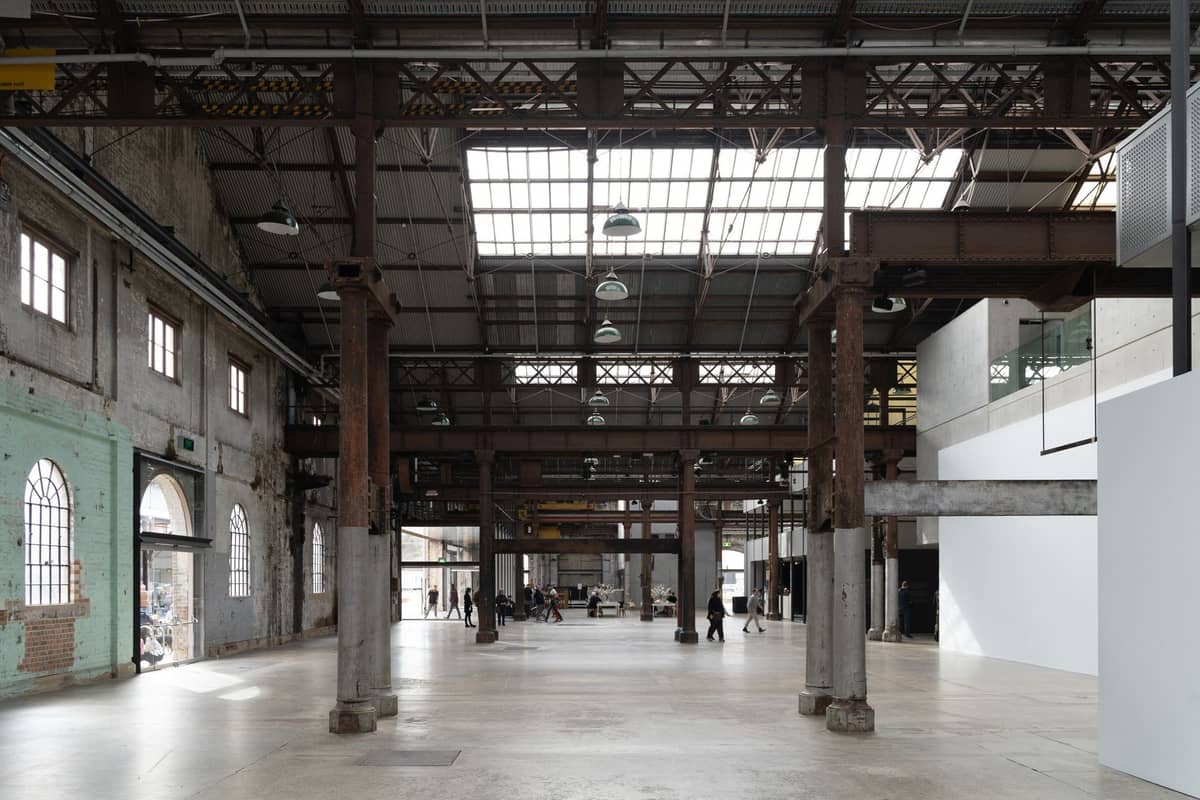
What sets Carriageworks apart from most Sydney arts venues is its ambition and its scale. The main Bay 17 shed provides a large-scale space for exhibitions and performances. The industrial bones of the building are not hidden or softened: exposed brick, riveted iron columns, and original timber flooring are left exactly as found, and the artistic programming tends to match that rawness in mood.
ℹ️ Good to know
General opening hours are Wednesday to Sunday, 10am to 5pm, but hours extend on event nights. Always check the specific event listing on the official website before visiting, particularly for evening performances or the Saturday Farmers Market (8am–1pm).
The Building: A Piece of Industrial History
The Eveleigh Railway Workshops were among the most significant industrial sites in colonial New South Wales. By the 1900s several thousand people worked here, building and maintaining locomotive engines and carriages for the expanding rail network. The workshops were a centre of organised labour in Sydney, and the surrounding neighbourhood carries that working-class history in its grain.
Walking into Bay 17 for the first time produces a specific kind of architectural surprise. You step through what looks like an ordinary industrial doorway, and then the full volume of the space opens above you: a barrel-vaulted nave of corrugated iron, supported by cast-iron columns painted in institutional green, with long rows of windows set high in the walls. On a clear day, the light falls in diagonal bars across the concrete floor. On grey days the space turns monochrome and quietly dramatic. Neither condition is wrong for an art venue.
The heritage fabric of the building is protected, which places real constraints on what can be built inside it. Temporary installations must be freestanding or suspended from designated rigging points. This limitation has, paradoxically, produced some of the most inventive exhibition design in Sydney, as artists and architects work around the building rather than against it.
Tickets & tours
Live prices and dates from our booking partner. If you book, we may earn a commission at no extra cost to you.
The Rocks historic walking tour
From 20 €Instant confirmationFree cancellationBeginner surf lesson at Bondi Beach
From 79 €Instant confirmationFree cancellationSydney whale-watching cruise with breakfast or lunch
From 62 €Instant confirmationFree cancellationBlue Mountains Waterfalls Full-Day Tour with Lunch and Dinner
From 171 €Instant confirmationFree cancellation
Visiting on a Regular Day: Exhibitions and the Daytime Atmosphere
On a Wednesday or Thursday afternoon Carriageworks is genuinely quiet. The main bay might hold one large installation, and you can spend an hour inside it without being jostled or rushed. Staff are present but unobtrusive. The venue sells coffee from a small counter near the entrance, and the smell of it drifts into the main exhibition space in a way that feels oddly domestic inside such an enormous shed.
The programming calendar shifts constantly. Carriageworks does not maintain a permanent collection in the way a traditional gallery does; instead it commissions and presents new work across visual art, performance, and hybrid forms. In any given month you might find a major installation by an internationally recognised artist, a season of contemporary dance, an independent theatre production, or a food and design fair. Checking the website before you visit is not optional advice — it is genuinely necessary, because the experience changes completely depending on what is on.
If you are building an itinerary around Sydney's contemporary arts scene, Carriageworks pairs naturally with a visit to the Museum of Contemporary Art Australia near Circular Quay, though the two venues have very different registers. The MCA is polished and harbour-facing; Carriageworks is rough-edged and inner-city. Both are worth your time.
The Saturday Farmers Market: The Other Reason to Come
Every Saturday morning from 8am to 1pm, the hardstand and surrounding spaces outside Carriageworks fill with one of Sydney's most well-curated food markets. This is not a tourist-facing craft fair. The Carriageworks Farmers Market operates on a strict producer-only policy, meaning every stall is run by the person who grew, raised, caught, or made the product. Conversations with stallholders tend to be genuine and informative rather than scripted.
The market draws a loyal local crowd from Newtown, Erskineville, and the surrounding streets, along with food professionals from across the city. By 9am on a Saturday the coffee queue stretches past the bread stall; by 11am the best produce is gone. Arriving close to opening time is not vanity — it makes a practical difference to what you find. Bring a bag, bring cash (though most stalls accept card), and plan to eat breakfast there.
The market is one of the reasons Carriageworks anchors the cultural life of the inner west. For more on the neighbourhood surrounding it, the guide to Newtown and the Inner West covers King Street eating options and the local character of the area.
💡 Local tip
Saturday market regulars recommend arriving by 8:30am if you want the best selection of bread, pastries, and seasonal vegetables. By 11am the market is at its most crowded and the premium items are typically sold out.
Evening Events: A Different Place After Dark
Carriageworks transforms substantially after dark. The industrial space, which reads as cool and contemplative in daylight, becomes charged and atmospheric under artificial light. Evening events range from sold-out dance and theatre productions to music performances, large-scale parties, and multi-day festivals. The venue has a licensed bar, and on event nights the crowd skews younger and the energy is noticeably different from the midweek daytime atmosphere.
If you are visiting Sydney and want to experience one event that is genuinely reflective of the city's contemporary arts culture rather than its tourist infrastructure, booking a Carriageworks evening performance is among the better choices you can make. Tickets sell out for major productions, particularly during Sydney's festival season in January and February. Book in advance through the official website.
Carriageworks is one of the key venues for Vivid Sydney and other city-wide arts events. The Vivid Sydney guide has full details on the annual light and ideas festival, which sometimes extends to inner-west venues.
Getting There and Getting Around the Site
The most straightforward approach is to take a train to Redfern Station and walk the eight minutes south through the residential streets toward Wilson Street. The walk is flat and passes through a neighbourhood worth seeing in its own right: federation-era terraces, corner pubs, and community gardens that reflect the area's working-class history and its more recent creative-class influx.
Macdonaldtown Station is slightly further at around ten minutes, and Newtown Station adds another five minutes to the walk but puts you on King Street, which means you can combine the visit with lunch or coffee along that strip. Bus routes 422, 423, 426, 428, 370 and 352 stop on City Road near the University of Sydney, roughly a five-minute walk from the entrance. Driving is possible but parking in the immediate area is limited; rideshare drop-off and accessible parking entry are at 229 Wilson Street.
Accessibility inside the venue is generally good. A street-level ramp leads to the main entrance, venues have level access throughout, and accessible toilets are in the main building. Redfern Station is the nearest accessible station, though note that platforms 11 and 12 there are stair and escalator access only, so check platform assignments before relying on it.
⚠️ What to skip
Redfern Station platforms 11 and 12 do not have step-free access. If you require wheelchair access, check which platform your train uses before travelling, or alight at a fully accessible station and take another route.
Who This Place Is Not For
Carriageworks rewards visitors who are comfortable with uncertainty. If you prefer attractions with a clear, fixed experience — a permanent collection you can expect regardless of when you visit, or a predictable format — this venue will feel frustratingly variable. The programming shifts, some events require booking in advance, and there are days when the main space is being set up for an installation or is between shows, leaving relatively little to see.
Families with very young children will find the space manageable during daytime exhibitions but potentially difficult during evening events where crowd density is high and noise levels are significant. The concrete floors, while authentic, make stroller navigation straightforward but long visits physically tiring. The Saturday market, by contrast, is genuinely family-friendly in the morning hours before crowds peak.
Travellers focused on Sydney's classic harbour attractions, like the Sydney Opera House or the Royal Botanic Garden, will find Carriageworks represents a different register of city entirely. It is not better or worse, just different: inner-city, industrial, and very specifically Sydney rather than the Sydney of postcards.
Insider Tips
- Check the Carriageworks website the week of your visit, not just when you book. Programming changes fast, and what is on during setup or strike days looks nothing like a full exhibition or performance.
- The Saturday Farmers Market is best visited before 9:30am. The bread from the artisan bakery stalls sells out early, and the crowd is manageable at that hour in a way it simply is not by 11am.
- If you are visiting for an evening event, arrive 20–30 minutes early. The walk from Redfern through the residential streets is straightforward in daylight but slightly less legible at night for first-time visitors, and the bar queue inside can be long before shows.
- The building is largely unheated in winter. Even in Sydney's mild winters, the vast volume of Bay 17 retains cold air, and a layer you can add or remove makes a real difference to comfort during a long exhibition visit.
- For photography, overcast days produce the most even light inside Bay 17 because the clerestory windows eliminate the harsh diagonal shadows that sunny days create. If you want architectural shots, cloudy mornings are better than bright afternoons.
Who Is Carriageworks For?
- Contemporary art and performance lovers who want programming beyond the mainstream institutional circuit
- Food-focused travellers who prioritise producer-direct markets over tourist food halls
- Architecture enthusiasts interested in adaptive reuse of industrial heritage buildings
- Locals and visitors who want to experience the cultural texture of Sydney's inner west rather than its harbour-side face
- Evening entertainment seekers looking for theatre, dance, or music in an unconventional venue
Nearby Attractions
Other things to see while in Newtown & the Inner West:
- Chau Chak Wing Museum
The Chau Chak Wing Museum brings together the University of Sydney's Nicholson, Macleay, and University Art collections in a single, purpose-built space on the Camperdown campus. Entry is free, the breadth of objects is genuinely surprising, and the experience sits well outside the usual tourist trail.
- Glebe Markets
Every Saturday from 10am to 4pm, the grounds of Glebe Public School fill with stalls selling vintage clothing, handmade jewellery, records, books, and street food. Free to enter and genuinely eclectic, Glebe Markets is one of Sydney's most enduring weekly rituals.
- White Rabbit Gallery
White Rabbit Gallery in Chippendale houses one of the world's most significant private collections of 21st-century Chinese contemporary art, and admission is entirely free. Spread across multiple floors of a converted building, each exhibition draws from a collection that spans painting, sculpture, textile, video, and installation work made after the year 2000.
Planning a trip? Discover personalized activities with the Nomado app.