Calle Ocho (SW 8th Street): Walking the Soul of Little Havana
Calle Ocho is the main artery of Little Havana, Miami's Cuban-American cultural hub. Running through the heart of the neighborhood, this free, walkable street delivers cigars rolled by hand, strong espresso at walk-up ventanillas, domino players under open skies, and a Walk of Fame honoring Latin icons — all without an admission ticket.
Quick Facts
- Location
- SW 8th Street, Little Havana, Miami, FL 33135. Core stretch: roughly SW 12th Ave to SW 17th Ave
- Getting There
- Miami-Dade Transit Metrobus routes serve SW 8th St; rideshare from Downtown takes roughly 10 minutes
- Time Needed
- 1.5 to 3 hours for a relaxed walk; longer if you stop for a meal or guided tour
- Cost
- Free to walk. Individual venues (restaurants, cigar shops, Tower Theater) charge their own rates
- Best for
- Cuban-American culture, food, street photography, history, and slow neighborhood walks
What Calle Ocho Actually Is
Calle Ocho, the local name for Southwest 8th Street, is the central thoroughfare of Little Havana, Miami's primary Cuban-American neighborhood. The street itself is a working city road, not a pedestrianized tourist zone, and that distinction matters. Traffic rolls through continuously. Trucks idle outside botanicas. Buses discharge commuters at stops painted with roosters. The stretch between SW 12th Avenue and SW 17th Avenue is the most visited section, but the cultural texture extends further in both directions.
Little Havana took shape in the 1960s when waves of Cuban exiles, many having fled following the 1959 revolution, settled west of Downtown Miami. They opened restaurants, cigar factories, and social clubs along SW 8th Street, replicating as much as possible the rhythms of Havana. More than six decades later, the street has evolved. Central American and other Latin American communities have added their presence, and gentrification has touched the edges. But the core of Calle Ocho remains one of the most culturally specific neighborhoods in any American city.
💡 Local tip
The most rewarding stretch for first-time visitors runs roughly from SW 12th Avenue to SW 17th Avenue. Start at Domino Park (Máximo Gómez Park) around SW 15th Avenue and walk in either direction from there.
How the Street Changes Throughout the Day
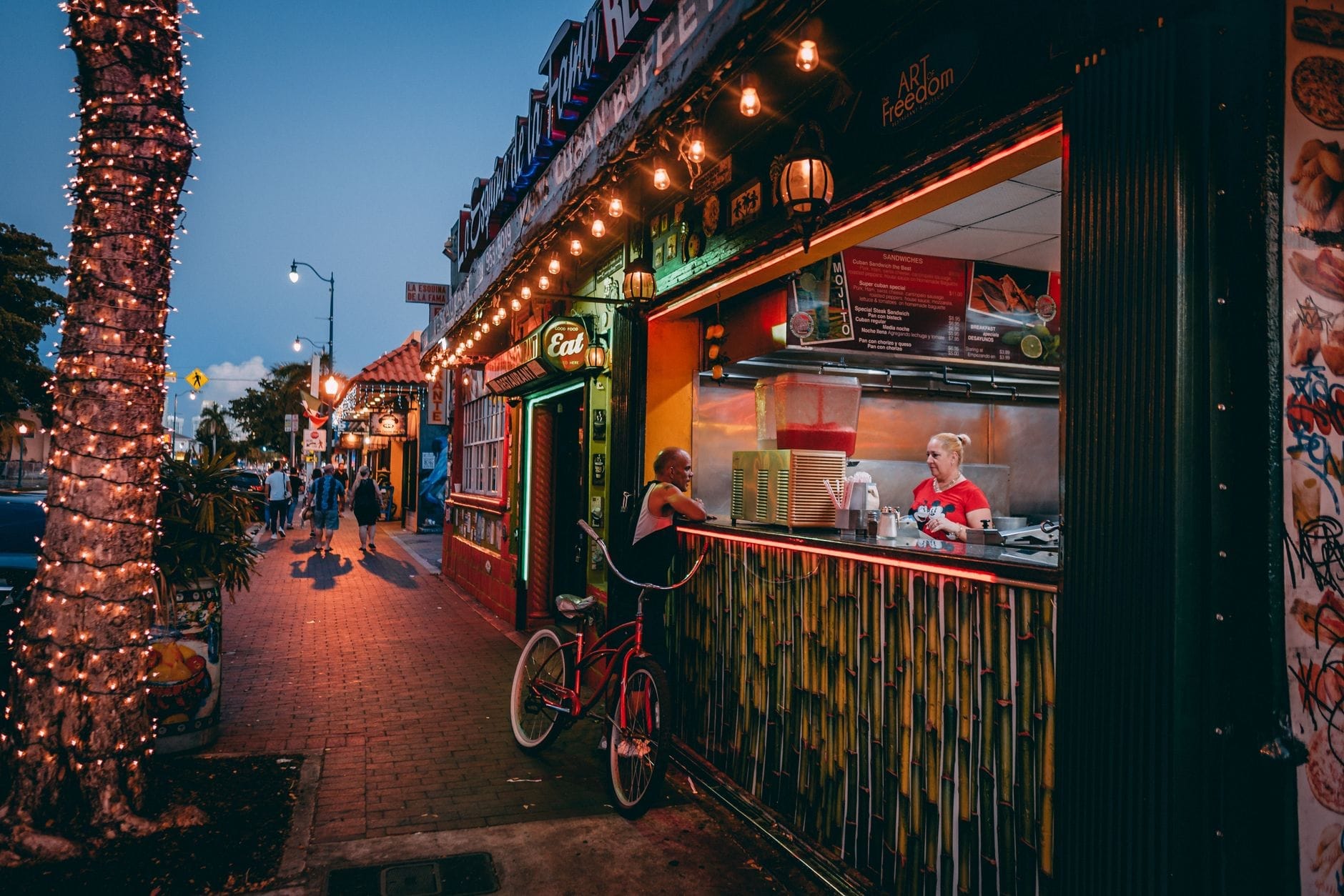
Early morning on Calle Ocho belongs to regulars, not tourists. By 7 a.m., walk-up ventanillas (small espresso windows) attached to Cuban bakeries are already doing steady business. Regulars order café con leche or cortadito, stand at a small ledge, drink in a few minutes, and move on. The smell of strong espresso and pan cubano (Cuban bread, soft on the inside, with a crackly crust) drifts into the sidewalk. If you want to experience the street in its least performative state, this is the hour.
By mid-morning, the tourist rhythm starts. Cigar shops open their roll-up doors, releasing the earthy, woody smell of curing tobacco. The Calle Ocho Walk of Fame stars — embedded in the sidewalk between SW 12th and SW 17th Avenues and honoring Latin American and Hispanic artists, musicians, and cultural figures — are cleanest and easiest to photograph before foot traffic accumulates. The 6-foot rooster sculptures that mark the street are best seen without crowds pressing past them.
Afternoons are the liveliest but also the most crowded. Domino Park, officially Máximo Gómez Park near SW 15th Avenue, draws older Cuban men for afternoon games. The sound of tiles clicking on concrete tables is a genuine ambient constant. Weekend afternoons bring live music outside some bars. The sidewalk fills, conversations spill out of open restaurant doors, and the street functions as it was designed to: a community meeting point. Summer afternoons bring heavy humidity and afternoon thunderstorms typical of Miami's wet season (May through October), so carrying a small umbrella or planning indoor stops between 2 and 4 p.m. is practical.
Tickets & tours
Hand-picked options from our booking partner. Prices are indicative; availability and final rates are confirmed when you complete your booking.
Everglades admission ticket with airboat ride and wildlife show
From 24 €Instant confirmationFree cancellationKey West day trip with glass bottom boat ride
From 110 €Instant confirmationFree cancellationEverglades airboat ride with Biscayne Bay boat tour and transportation
From 67 €Instant confirmationFree cancellationGrand Bahama tour with optional Pig Beach visit
From 309 €Instant confirmationFree cancellation
The Walk of Fame and Street Landmarks
The Calle Ocho Walk of Fame spans the core pedestrian stretch and is often compared to the Hollywood Walk of Fame, though it is specifically dedicated to Latin American and Hispanic cultural figures. Stars are set into the sidewalk and include names recognizable to anyone with knowledge of Latin music, film, and sport. Unlike Hollywood's version, this one is embedded in a functional neighborhood rather than a commercial entertainment district, which gives the stars an oddly understated quality: you might step on Celia Cruz's star while checking your phone.
The rooster sculptures along the street are emblems of Cuban pride, each standing about 6 feet tall, colorfully painted, and placed at intervals through the corridor. They are photo subjects but also cultural markers, rooted in the significance of roosters in Cuban folklore and the island's agricultural history. Just off Calle Ocho, the Domino Park (Máximo Gómez Park) is arguably the single most iconic site in Little Havana: a small, fenced park where dominoes have been played publicly for decades.
The Tower Theater on Calle Ocho is a restored 1926 cinema that originally served as a community gathering point and later became one of the first venues in the U.S. to show Spanish-language films to newly arrived Cuban immigrants. It now operates as a cultural venue managed by Miami Dade College and screens independent and foreign films. It is worth a look at the exterior even if you are not catching a screening.
Food and Drink: What to Order and Where
Calle Ocho is not a place to eat expensively. The food culture here is rooted in practicality and flavor rather than presentation. Cuban sandwiches, pressed with ham, roasted pork, Swiss cheese, pickles, and mustard on Cuban bread, are available at multiple spots. Ropa vieja (shredded braised beef), picadillo, and lechón asado (roast pork) appear on lunch menus alongside black beans and rice. Portions are generous and prices are generally reasonable by Miami standards.
The ventanilla espresso culture is genuinely distinct. Ordering a café cubano (a shot of espresso sweetened with demerara sugar whipped into the grounds before brewing) from a walk-up window while standing on the sidewalk is an experience that connects directly to the Cuban immigrant tradition. It costs well under two dollars at most spots. For a broader overview of what to eat and drink across the neighborhood and city, the Miami Cuban food guide covers the essential dishes and recommended spots in depth.
ℹ️ Good to know
Many of the most atmospheric Cuban restaurants on Calle Ocho are cash-friendly but do accept cards. Prices in this neighborhood remain lower than comparable spots in South Beach or Brickell, making it a natural stop for budget-conscious visitors.
Practical Information: Getting There and Getting Around
Calle Ocho is a public city street, generally accessible 24 hours year-round, with no admission fee. Sidewalks along the main stretch are level and paved, making the walk accessible for strollers and wheelchairs; individual businesses vary, so confirm accessibility directly with specific venues before visiting.
Miami-Dade Transit Metrobus routes, such as Route 8 along SW 8th Street, serve SW 8th Street; check current route information on the Miami-Dade Transit website before your visit as schedules change. Rideshare (Uber, Lyft) from Downtown Miami or Brickell takes roughly 10 minutes outside peak traffic and is often the simplest option. Driving and parking on or near the street is possible but can be competitive on weekends and during events. For a full overview of transit options across the city, see the getting around Miami guide.
Comfortable walking shoes are useful since the most rewarding way to explore Calle Ocho is on foot. Wear light, breathable clothing year-round; Miami's tropical climate means even winter days can reach the mid-70s°F (around 24°C). In summer, temperatures push into the high 80s°F (above 30°C) with significant humidity. Afternoon rain showers during the wet season (May through October) are common and usually brief.
Photography Tips and Honest Assessment
Calle Ocho photographs well at almost any hour, but morning light before 10 a.m. is best for the Walk of Fame stars and rooster sculptures, before foot traffic complicates compositions. The ventanilla windows make strong subjects: the contrast between the worn tile counters, small paper cups, and the steady rhythm of transactions carries genuine documentary interest. Cigar rollers working by shop windows are frequently willing to be photographed but appreciate acknowledgment; buying a single cigar from the shop is a reasonable courtesy.
An honest note on expectations: Calle Ocho is sometimes portrayed in travel media as a more perfectly preserved Cuban enclave than it currently is. Chain businesses and new construction have altered sections of the street. The cultural experience is real, but it is embedded in a working-class Miami neighborhood rather than a curated museum. That is actually what makes it worth visiting. For travelers interested in the broader neighborhood and what lies just beyond the main commercial strip, the Little Havana neighborhood guide provides essential context.
⚠️ What to skip
The annual Calle Ocho Music Festival, one of the largest Latin music street festivals in the United States, draws enormous crowds to this corridor and surrounding streets. If your visit coincides with it (typically held in March), expect road closures, high noise levels, and significantly altered access to shops and restaurants. Check event dates on calleocho.com before planning.
Who Should Consider Skipping It
Travelers primarily interested in beaches, nightlife, or contemporary art will likely find Calle Ocho a detour rather than a priority. The street does not offer much after dark beyond a few bars; it is fundamentally a daytime and late-afternoon destination. Those expecting a pristine, Instagram-ready street with uniform aesthetics may find its working-city reality less photogenic than anticipated. If your time in Miami is limited to a day or two and you are focused on South Beach, the Art Deco Historic District or Wynwood may compete more directly with your priorities. But if you have three or more days and any interest in Cuban history, Latin American culture, or simply eating well without spending much, Calle Ocho deserves a morning or afternoon.
Insider Tips
- Order your espresso from a walk-up ventanilla rather than sitting inside a restaurant. The sidewalk-window ritual is specific to this tradition and costs a fraction of what café-style service charges.
- Visit Máximo Gómez Park (Domino Park) on a weekday afternoon rather than a weekend for a more authentic, less observed atmosphere. The players are there regardless of tourist traffic, but the dynamic shifts noticeably when tour groups arrive.
- The Calle Ocho Walk of Fame stars are easiest to read and photograph before 10 a.m., when morning light falls at a low angle and foot traffic is minimal. Afternoon shadows and worn surfaces make many stars harder to read.
- Several cigar shops on the strip have master rollers (torcedores) who work in-window specifically to demonstrate the craft. These are legitimate artisans, not theatrical props. A single hand-rolled cigar purchased directly is an honest souvenir that supports the craftsperson.
- If you want to eat well and cheaply, walk one or two blocks off the main tourist corridor of SW 12th to SW 17th Avenue. Spots catering primarily to neighborhood residents rather than visitors tend to have lower prices and longer menus.
Who Is Calle Ocho (SW 8th Street) For?
- Travelers interested in Cuban-American history and immigration narratives
- Food travelers seeking affordable, authentic Cuban and Latin American cooking
- Street photographers drawn to layered, documentary urban subjects
- Visitors on a budget looking for a full cultural half-day without admission fees
- Anyone on a 3-plus day Miami itinerary wanting contrast from the beach-and-nightlife circuit
Nearby Attractions
Other things to see while in Little Havana:
- Domino Park (Máximo Gómez Park)
Officially named Máximo Gómez Park but universally known as Domino Park, this just-under-an-acre public space on Calle Ocho has been the social heartbeat of Little Havana since 1976. It is where Cuban exiles, their descendants, and curious visitors gather daily over domino tiles, strong coffee, and rapid-fire Spanish conversation.
- Tower Theater
Standing on Calle Ocho since 1926, Tower Theater is one of Miami's most storied cultural venues. Its distinctive marquee tower anchors Little Havana's main street and its programming connects cinema, history, and Cuban-American identity in a single intimate space.