Domino Park (Máximo Gómez Park): Little Havana's Living Room
Officially named Máximo Gómez Park but universally known as Domino Park, this just-under-an-acre public space on Calle Ocho has been the social heartbeat of Little Havana since 1976. It is where Cuban exiles, their descendants, and curious visitors gather daily over domino tiles, strong coffee, and rapid-fire Spanish conversation.
Quick Facts
- Location
- 801 SW 15th Ave, Miami, FL 33135 (corner of SW 8th St / Calle Ocho and 15th Ave), Little Havana
- Getting There
- Free parking behind the park; metered street parking on SW 8th St. Miami-Dade Transit Metrobus routes serve Calle Ocho. Steps from the Little Havana Visitor Center.
- Time Needed
- 20–45 minutes to observe; longer if you join a game or explore the surrounding block
- Cost
- Free to enter and observe. Club membership (for players over 55 and Miami residents) is free with a club card.
- Best for
- Cultural immersion, street photography, understanding Cuban-American community life
- Official website
- www.miamiandbeaches.com/l/outdoor-experiences/domino-park/5611
What Domino Park Actually Is
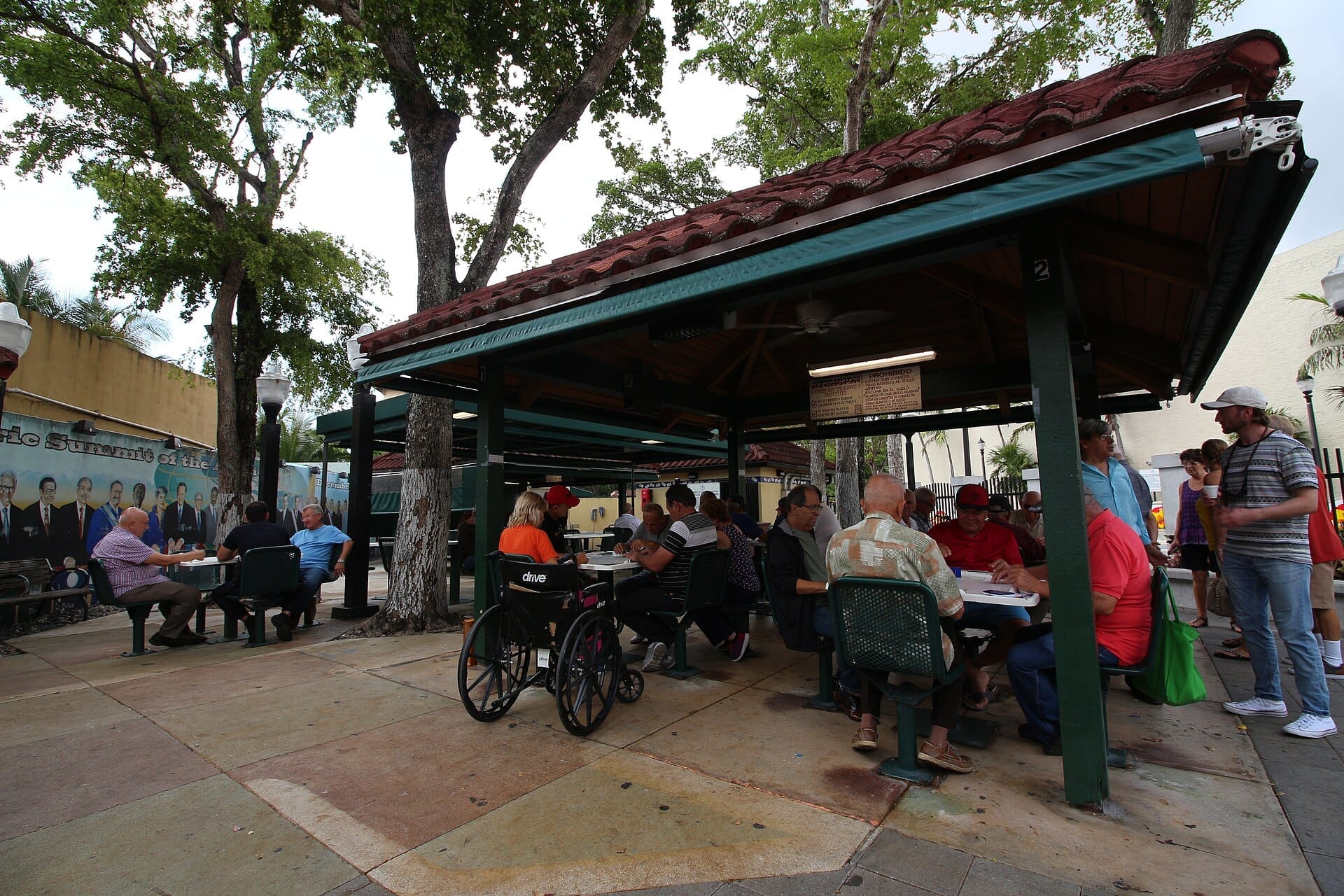
Máximo Gómez Park occupies barely an acre at the corner of SW 8th Street and 15th Avenue in Little Havana. Its official name honors the Dominican-born Cuban independence general, but nobody in the neighborhood calls it that. Everyone calls it Domino Park, and once you arrive, the reason is immediately obvious: rows of concrete tables, each one worn smooth by decades of tile play, where men and women sit opposite each other in focused silence broken only by the sharp crack of a domino being placed and the burst of commentary that follows.
Established in 1976, the park was conceived as a dedicated gathering space for the Cuban exile community that had transformed this stretch of Southwest Miami into a cultural enclave. It was never designed to be a tourist attraction. It was designed to give people somewhere to go, somewhere familiar, somewhere that functioned as a village square in a city that otherwise moves fast and sprawls wide. That original purpose has never changed, which is exactly what makes the place worth visiting.
ℹ️ Good to know
Hours are reported as daily 7:30 a.m. to 9:00 p.m., but as a public city park, hours can vary. Confirm locally before planning your visit around a specific time window.
The Feel of the Place at Different Hours
Arrive before 9 a.m. and you catch the park in its quietest, most unguarded state. A few regulars settle in at the tables while the morning light is still low and soft, the smell of café cubano drifting from nearby storefronts on Calle Ocho. The conversations at this hour are unhurried, punctuated by long silences between moves. Traffic on SW 8th Street is light enough that you can hear the tiles clicking clearly.
By late morning, the tables fill up and the atmosphere shifts into a higher gear. Multiple games run simultaneously, and the spectator benches along the perimeter start filling with regulars who rotate in and out of seats. The air carries layers of sound: rapid Cuban Spanish, the occasional laugh, the particular dry slap of a bone domino on concrete. Vendors and nearby cafeterias serve pastelitos and espresso in small plastic cups. If you want to photograph the games, this late-morning window offers good natural light and the fullest activity before the midday heat settles in.
On summer afternoons, temperatures can push above 90°F (32°C) and the humidity is real. The park has very little shade beyond the covered game tables, which makes a late-afternoon visit in July or August uncomfortable for anyone who is just standing and watching. In the dry season, roughly November through April, afternoons here are genuinely pleasant and the light for photography is warm and golden from around 3 p.m. onward.
💡 Local tip
The most atmospheric window for a visit is a weekday morning between 9 a.m. and noon, when locals dominate and the pace is natural rather than performance-oriented.
Tickets & tours
Hand-picked options from our booking partner. Prices are indicative; availability and final rates are confirmed when you complete your booking.
Everglades admission ticket with airboat ride and wildlife show
From 24 €Instant confirmationFree cancellationKey West day trip with glass bottom boat ride
From 110 €Instant confirmationFree cancellationEverglades airboat ride with Biscayne Bay boat tour and transportation
From 67 €Instant confirmationFree cancellationGrand Bahama tour with optional Pig Beach visit
From 309 €Instant confirmationFree cancellation
History and Cultural Significance
Little Havana developed primarily through waves of Cuban migration following the 1959 revolution, and SW 8th Street became its main artery. Businesses, cafeterias, cigar shops, and social clubs concentrated here, recreating elements of Havana's urban culture in a South Florida setting. Domino Park formalized something that was already happening organically in the neighborhood: groups of men gathering to play dominoes as they had done in Cuba, on sidewalks and in plazas, as a way of maintaining social bonds under conditions of exile.
The park is named for Máximo Gómez y Báez (1836–1905), the Dominican-born general who served as a key military leader during Cuba's wars of independence against Spain. His name above the entrance connects the space explicitly to Cuban national identity and the independence struggle, framing the social activity inside as something with deeper historical roots than a casual game of tiles.
Today, the park sits at the center of a neighborhood that has evolved considerably since the 1970s. Younger generations, non-Cuban Latin Americans, and new arrivals have changed the demographic texture of Little Havana. Some of the original exile generation has aged or passed away, and the question of cultural continuity is something the community actively discusses. A 2025 WLRN report examined how Domino Park functions as a gathering point for broader Latino communities, not only Cuban Americans. That evolution makes the park even more interesting as a snapshot of Miami's changing identity. For deeper context on the neighborhood, the Little Havana neighborhood guide covers the full street, its food scene, and its cultural institutions.
What You Can Actually Do Here
For most visitors, Domino Park is an observation experience rather than a participatory one. The tables are used by regulars, and jumping uninvited into a game is not how it works. There is no signup sheet or ticket counter. The social dynamics are governed by familiarity and long-standing relationships among the players. If you are invited to watch closely or sit down, accept graciously. If not, the benches around the perimeter offer clear sightlines and are perfectly designed for spectating.
Visitors over 55 who are serious about playing and are Miami residents can apply for a free club membership card, which grants access to the games as a recognized member. This is not something you arrange on arrival but involves registering with the club. For younger visitors or those passing through, respectful observation and conversation with the people on the outer benches tends to be the realistic experience.
Combine a visit here with a walk along Calle Ocho, which runs directly outside the park entrance. Within a few blocks you will find Cuban bakeries, hand-rolled cigar shops, Latin record stores, and the Walk of Fame stars embedded in the sidewalk honoring Latin music legends. The full stretch rewards a slow walk of an hour or more.
Photography Notes and Practical Etiquette
The park is small enough that there is no such thing as being discreet with a camera. Players and regulars are used to being photographed, particularly since tourism to Little Havana has grown significantly over the past decade. That said, pointing a long lens directly at someone's face mid-game without any acknowledgment reads as rude in most cultures and this one is no exception. Making brief eye contact, a small nod, and waiting a beat goes a long way.
The covered concrete tables create a mix of deep shade and bright ambient light, which can challenge automatic exposure. If you are shooting in the late morning, position yourself so the light comes from the open sky behind you rather than creating backlit silhouettes. Phone cameras handle this well in HDR mode. Early morning before 9 a.m. offers the softest, most even light on the tables and faces.
⚠️ What to skip
Domino Park is a genuinely functional community space, not a staged cultural exhibit. Treat it accordingly: speak quietly, do not interrupt games mid-play, and avoid occupying spectator benches in large groups that crowd out the regulars.
Getting There and Nearby
The park sits directly on SW 8th Street (Calle Ocho) at 15th Avenue. Metered street parking lines 8th Street. Miami-Dade Transit Metrobus routes serve the Calle Ocho corridor, making it accessible without a car. The Little Havana Visitor Center is steps away and worth a stop for neighborhood maps and information on upcoming events including the annual Calle Ocho Festival.
If you are building a full Little Havana afternoon, plan to arrive at Domino Park first, then continue east or west along Calle Ocho toward restaurants and the Tower Theater. The Tower Theater at 1508 SW 8th Street is a beautifully restored 1920s cinema that now screens independent and Latin films, and its facade is one of the most photographed on the street. For a broader sense of how to pace a day in this part of Miami, the Miami Cuban food guide maps out the best spots to eat within walking distance.
Who Should Skip This
If you are looking for a polished attraction with organized programming, interpretive signage, or air-conditioned comfort, Domino Park will disappoint. It is an outdoor concrete park in a South Florida climate with limited shade and no visitor infrastructure beyond benches and walkways. On weekends, the tourist-to-local ratio skews noticeably higher, which dilutes the very thing that makes the park interesting.
Families with young children can visit, but there is nothing specifically designed for kids here. The attraction is the human activity, which is primarily interesting to adults with curiosity about community culture, Cuban-American history, or social rituals. In summer, the heat makes a prolonged stay uncomfortable, especially for anyone sensitive to high humidity.
Insider Tips
- Weekday mornings draw the most committed regulars and the fewest tourists. If you want to see the park functioning as a genuine community space rather than a backdrop for selfies, aim for a Tuesday or Wednesday before noon.
- The cafeterias and ventanitas (walk-up windows) within a block of the park on Calle Ocho serve authentic café cubano and croquetas at very low prices. Buy a coffee and drink it on the spectator bench for the full neighborhood experience.
- The dominoes played here are double-nine sets with a Cuban scoring variant. Even a basic familiarity with the rules makes watching the games significantly more engaging. A quick five-minute read before you arrive pays off.
- During the annual Calle Ocho Festival, the park and surrounding blocks are transformed and the regular daily rhythm completely changes. If you want to see Domino Park as it actually functions, avoid festival weekend.
- Free parking behind the park fills quickly on weekends. On weekdays before 10 a.m., you will almost always find a spot without circling.
Who Is Domino Park (Máximo Gómez Park) For?
- Travelers interested in Cuban-American history and culture beyond the surface level
- Street photographers looking for unscripted, genuine human scenes
- Solo travelers who are comfortable with slow, observational experiences
- Anyone building a full Calle Ocho walking itinerary
- Visitors who want a free, unhurried contrast to Miami's resort-and-beach circuit
Nearby Attractions
Other things to see while in Little Havana:
- Calle Ocho (SW 8th Street)
Calle Ocho is the main artery of Little Havana, Miami's Cuban-American cultural hub. Running through the heart of the neighborhood, this free, walkable street delivers cigars rolled by hand, strong espresso at walk-up ventanillas, domino players under open skies, and a Walk of Fame honoring Latin icons — all without an admission ticket.
- Tower Theater
Standing on Calle Ocho since 1926, Tower Theater is one of Miami's most storied cultural venues. Its distinctive marquee tower anchors Little Havana's main street and its programming connects cinema, history, and Cuban-American identity in a single intimate space.