Brooklyn Navy Yard: Inside NYC's Most Ambitious Industrial Comeback
A roughly 225-acre former U.S. Navy shipyard turned urban manufacturing campus, the Brooklyn Navy Yard blends two centuries of American industrial history with a living community of makers, artists, and innovators. Access is controlled, but for curious visitors willing to plan ahead, it offers one of the most distinctive experiences in New York City.
Quick Facts
- Location
- 63 Flushing Avenue, Brooklyn, NY 11205 (northwest Brooklyn, bounded by the East River to the north)
- Getting There
- Multiple MTA bus routes along Flushing Ave and Navy St; walkable from Downtown Brooklyn and Williamsburg subway stations. Confirm current routes via MTA.
- Time Needed
- 2–3 hours for a guided tour; longer if visiting specific tenant venues
- Cost
- No general admission; tour and venue fees vary by operator — check current pricing directly with providers
- Best for
- History enthusiasts, architecture buffs, urban design fans, and anyone curious about how cities reinvent industrial land
- Official website
- www.brooklynnavyyard.org
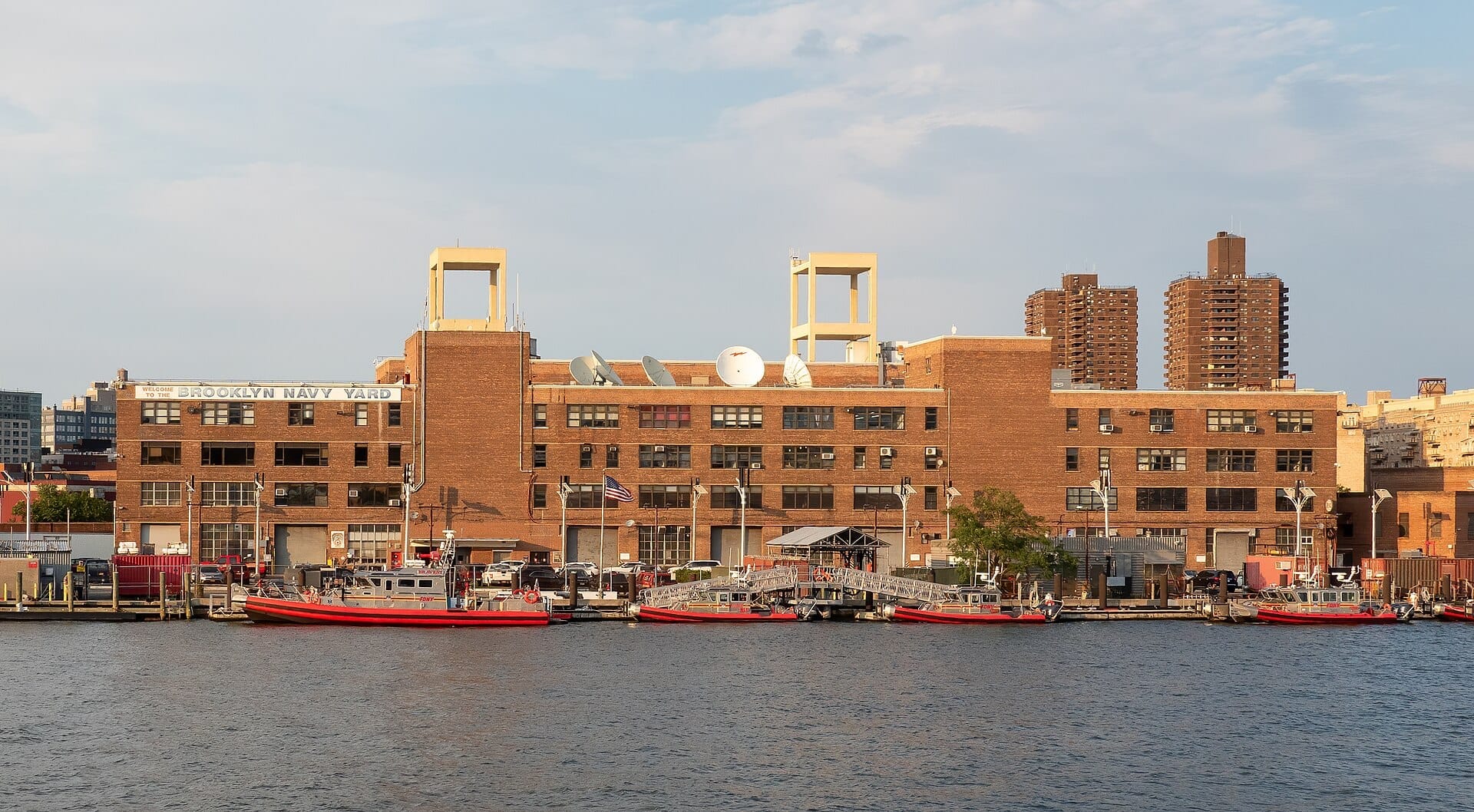
What the Brooklyn Navy Yard Actually Is
The Brooklyn Navy Yard is not a museum, not a park, and not a tourist attraction in the conventional sense. It is a working industrial campus: roughly 225 acres of dry docks, 19th-century brick buildings, rooftop farms, high-tech fabrication shops, and film production studios, all operating behind a secured perimeter in northwest Brooklyn. That distinction matters before you plan a visit.
Established in 1801 as the United States Navy Yard, New York, the site operated as one of the most consequential shipyards in American history from 1801 until its decommissioning in 1966. The USS Monitor, the ironclad that changed naval warfare, was built here. So was the USS Arizona, sunk at Pearl Harbor, and the USS Missouri, on whose deck Japan signed the surrender that ended World War II. At its World War II peak, roughly 70,000 people worked across the Yard in round-the-clock shifts, making it among the largest industrial employers in the country.
The Navy decommissioned the Yard in 1966, and the City of New York eventually took ownership. After decades of uneven industrial use, the Brooklyn Navy Yard Development Corporation (BNYDC) began a sustained transformation into a modern manufacturing hub. Today more than 550 businesses operate here, employing thousands of people across industries from woodworking and metalwork to food production, fashion design, and film.
ℹ️ Good to know
General public access to the Brooklyn Navy Yard is restricted. You cannot simply walk in and explore. Visitor access is structured through organized tours, specific tenant venues, or scheduled public events. Always confirm access options with the official site or a tour operator before visiting.
Getting There and Getting In
The Yard's administrative address is 63 Flushing Avenue, Brooklyn, NY 11205. The campus is generally described as bounded by Navy Street to the west, Flushing Avenue to the south, Kent Avenue to the east, and the East River to the north. Those boundaries define a significant chunk of northwest Brooklyn, and the perimeter has multiple gates, not all of which are open to visitors.
By subway, the most practical approach is to travel to Downtown Brooklyn or Williamsburg and walk to the Flushing Avenue perimeter — the distance varies depending on which station you use. Multiple MTA bus lines serve Flushing Avenue and Navy Street directly, which is useful if you want to avoid a 10-15 minute walk from the nearest subway. Confirm current routes through the MTA before traveling. For transit context across Brooklyn, the getting around New York City guide covers subway and bus logistics in more detail.
Rideshare and taxi drop-off works well here. Given the campus scale and the time you might spend between buildings, it is sometimes the most practical option, especially with the Flushing Avenue entrance being easy to communicate to drivers. Parking exists but the area's industrial street grid can be confusing on a first visit.
💡 Local tip
When booking a guided tour, your confirmation will typically specify which gate to enter through and where to meet your guide. Arriving at the wrong entrance can cost you significant time since gates are not interchangeable for visitors.
Tickets & tours
Hand-picked options from our booking partner. Prices are indicative; availability and final rates are confirmed when you complete your booking.
Statue of Liberty, Ellis Island, and Brooklyn Bridge Happy Hour Cruise
From 49 €Instant confirmationFree cancellationChristmas lights tour in Dyker Heights, Brooklyn
From 48 €Instant confirmationFree cancellationNew York Brooklyn Bridge and DUMBO food-tasting guided tour
From 89 €Instant confirmationFree cancellationBrooklyn Bridge and DUMBO neighborhood walking tour
From 42 €Instant confirmationFree cancellation
Guided Tours: The Core Visitor Experience
For most visitors, a guided history tour is the primary way to experience the Brooklyn Navy Yard with any depth. Turnstile Tours, which has operated tours of the Yard for years, offers history-focused walking and bus tours that take you through dry docks, historic building exteriors, and industrial corridors that are otherwise inaccessible. Tours vary in format and duration, and prices are set by the operator, so check current availability and fees directly with the tour provider.
What a good tour delivers is hard to replicate independently: the sense of scale. Standing at the edge of a dry dock that once held a battleship, surrounded by weathered brick structures built in the 1850s, with the Manhattan skyline framed to the west, is a genuinely striking experience. The Yard does not look like the rest of Brooklyn. It has an industrial grammar all its own — wide, low-slung, functional, built for the movement of enormous things.
The Brooklyn Navy Yard also periodically holds public programming, open studios, and community events that allow broader access to individual buildings and tenant workshops. BNYDC's official site lists upcoming events and is the most reliable source for current programming. These events are worth tracking if you want access to the creative and manufacturing tenants rather than purely the historical infrastructure.
Building 92: The Yard's Visitor and History Center
Building 92 serves as the Brooklyn Navy Yard's visitor center and history exhibition space, positioned at the Flushing Avenue and Carlton Avenue edge of the campus. This is the most accessible public-facing point of entry into the Yard's history, and it is where many guided tours begin. The building itself is a well-restored 19th-century structure, and the ground-floor exhibition traces the Yard's arc from federal shipyard to urban manufacturing campus using artifacts, photographs, and archival material.
Even visitors with limited time can benefit from starting here. The scale models and photographic archives inside give context that makes the surrounding industrial landscape legible. A photograph of 70,000 workers crowding the Yard's piers during World War II does something a verbal explanation cannot. Hours and admission details for Building 92 should be confirmed directly with BNYDC, as programming and access policies have changed over time.
💡 Local tip
Arrive at Building 92 at least 15 minutes before your tour begins. The security check-in process at the gate takes time, and the building's exhibition is worth a few minutes on its own before heading out into the campus.
The Physical Experience: What the Yard Feels Like
The Brooklyn Navy Yard is not photogenic in the way that, say, the Brooklyn Bridge or DUMBO waterfront are photogenic. It is industrial in texture and mood: wide asphalt roads built for trucks and equipment, corrugated metal loading bays alongside Federal-era masonry buildings, the low sound of fabrication machinery from behind closed doors. In summer, the heat radiates off the pavement and the air carries the faint metallic smell of active workshops. In winter, the wind off the East River cuts across the open yards with no natural windbreak.
Morning visits, particularly during weekdays, give you the Yard in its most active state. Trucks move through the gates, workers arrive at studios and workshops, and there is a genuine sense of a place at work. The contrast between the preserved 19th-century building stock and the contemporary creative industries operating inside them is most visible at these hours. On weekend mornings, the Yard is considerably quieter, which can make the scale feel more contemplative but also less alive.
Photography is possible on tours, though specific restrictions may apply inside certain buildings or near security-sensitive areas. The dry docks, the external facades of the historic commandant's house, and the view across to the East River toward DUMBO and Brooklyn Heights are among the more compelling visual subjects. Wear comfortable, flat shoes: the Yard's roads and older surfaces are uneven in places.
Historical Context: Why This Place Matters
The Brooklyn Navy Yard's significance in American industrial and military history is difficult to overstate. Established in 1801 under federal authority, it predates most of what we recognize as modern Brooklyn. For the next century and a half it served as one of the primary sites of U.S. naval power, building ships that shaped American history at key turning points: the Civil War, both World Wars, and the transition from sail to steam to steel.
The Yard also shaped Brooklyn's working-class identity. Generations of Brooklyn families had members who worked within these gates, in trades ranging from ironworking and carpentry to engineering and machining. The abrupt decommissioning in 1966 — part of a broader federal reduction of domestic naval infrastructure — devastated the surrounding neighborhoods economically and contributed to the decline that affected much of North Brooklyn through the 1970s and 1980s.
The current reinvention as a manufacturing and creative industries campus represents one of the more studied examples of adaptive industrial reuse in American urban planning. Visitors interested in how New York City uses and transforms its built environment will find the Yard a useful complement to other sites of industrial reinvention, including the High Line in Manhattan and the broader waterfront transformation along Brooklyn Bridge Park.
Who This Experience Is and Is Not For
The Brooklyn Navy Yard rewards visitors who bring genuine curiosity about industrial history, urban economics, or the architecture of large-scale American civic infrastructure. If you find yourself interested in how cities work at the scale of production rather than consumption, the Yard is genuinely absorbing.
It is a poor fit for visitors expecting a polished tourist experience with clear signage, open public spaces, and on-demand access. There are no cafes at every corner, no gift shops in every building, and no ability to simply arrive and wander. Visitors with mobility concerns should contact BNYDC directly before booking a tour, as the campus involves uneven terrain and distances between buildings that are not trivial. The Yard is also not a destination for young children unless a specific family-oriented event is being held.
First-time visitors to New York City who are working through the more central sites first may want to save the Yard for a return trip or a dedicated Brooklyn day. If you are building a Brooklyn itinerary and want historical and cultural depth alongside the Yard, pairing it with the Brooklyn Museum or a walk through Brooklyn Heights makes for a coherent day.
Insider Tips
- Book guided tours well in advance, particularly on weekends and during summer. Turnstile Tours and similar operators often sell out popular history tours weeks ahead.
- Check BNYDC's event calendar directly at brooklynnavyyard.org rather than relying on third-party ticketing platforms, which do not always reflect the full programming schedule or most current availability.
- The view of the East River and Manhattan from the northern section of the Yard, accessible on some tours, is significantly less crowded and more industrial in character than anything you will see from the tourist waterfront in DUMBO — and arguably more interesting for that reason.
- If you are specifically interested in the tenants rather than the history, some Brooklyn Navy Yard businesses have their own open-studio or showroom hours independent of organized Yard tours. Searching individual tenants before your visit can open up access to woodworking studios, design shops, and food production facilities not covered by standard tours.
- Dress for the industrial environment: closed-toe shoes are strongly recommended, and in any season, an extra layer is useful given the wind exposure near the waterfront sections of the campus.
Who Is Brooklyn Navy Yard For?
- American military and industrial history enthusiasts who want to see where the USS Missouri and USS Arizona were built
- Architecture and urban design visitors interested in adaptive reuse of large-scale civic infrastructure
- Brooklyn explorers looking beyond the standard food-and-shopping itinerary into the borough's working history
- Photographers interested in industrial texture, brick and steel architecture, and non-touristic views of the East River and Manhattan
- Professionals and students in urban planning, manufacturing, or creative industries curious about a major real-world case study
Nearby Attractions
Combine your visit with:
- Jamaica Bay Wildlife Refuge
Tucked into the southern edge of Queens, Jamaica Bay Wildlife Refuge is the only wildlife refuge in the National Park System managed by the National Park Service. Free to enter and open year-round, it offers salt marshes, brackish ponds, and migratory bird sightings just a subway ride from Midtown Manhattan.
- SoHo Shopping District
SoHo is Lower Manhattan's grid of 19th-century cast-iron loft buildings, now home to flagship retail, independent boutiques, and art galleries spread across roughly 26 blocks. Free to enter and walkable in an afternoon, it rewards visitors who come curious about both shopping and architectural history.