Bluffer's Park and Beach: Where Toronto's Cliffs Meet the Lake
Bluffer's Park and Beach sits at the base of the Scarborough Bluffs, a towering 15-kilometre stretch of cliffs that rise over 90 metres above Lake Ontario. It is one of Toronto's most geologically dramatic landscapes, offering a free sandy beach, calm harbour waters, and jaw-dropping cliff views that feel far removed from the city above.
Quick Facts
- Location
- 1 Brimley Road South, Scarborough, Toronto, ON M1M 3W3
- Getting There
- TTC Line 2 to Kennedy Station, then Bus 12A (weekdays) or Bus 201 to Bluffer's Park Loop (weekends/holidays, early May–early October)
- Time Needed
- 2–4 hours for beach, walk, and views
- Cost
- Free park entry; paid parking (CAD, rates vary by season)
- Best for
- Nature lovers, photographers, families, summer beach days
What Makes Bluffer's Park Worth the Trip
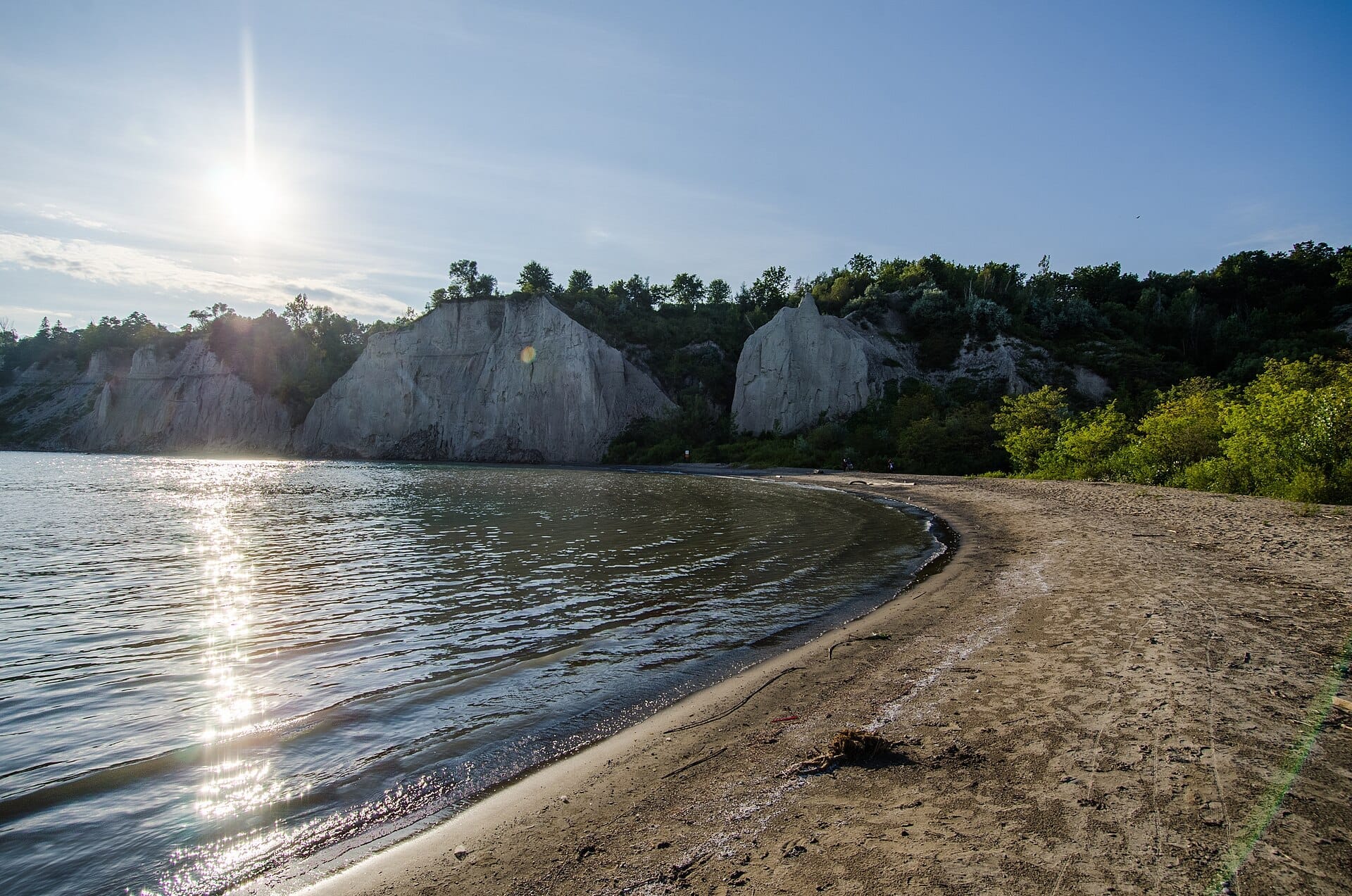
Bluffer's Park and Beach occupies a narrow strip of land that was deliberately created to give Torontonians access to the base of the Scarborough Bluffs. The cliffs themselves are a glacial landform left behind by retreating ice sheets roughly 12,000 years ago, and they remain one of the most visually striking natural features in Toronto. Standing on the beach and looking up at pale clay and sand walls rising more than 90 metres overhead is a genuinely disorienting experience for first-time visitors, many of whom had no idea terrain this dramatic existed within city limits.
The park is part of a chain of 11 City of Toronto parks that run along the 15-kilometre bluff system. Bluffer's Park is the only one that sits at the lake's edge, connected to the shoreline via the long descent down Brimley Road South. Every other park in the system sits on the clifftop. That lake-level position is what makes Bluffer's Park unique: it is the one place where you can touch the water and look back up at the full height of the escarpment.
💡 Local tip
The weekend and holiday Bus 201 runs directly from Kennedy Station to the Bluffer's Park Loop from early May through early October. On weekdays, take Bus 12A to Kingston Road at Brimley Road West and walk about 20 minutes downhill. Factor in that return walk uphill before you arrive.
The Landscape: Cliffs, Harbour, and Sand
The beach at Bluffer's Park is a calm, protected stretch of sand tucked behind a small breakwater harbour. The harbour was constructed when the park was developed, and its enclosed geometry means the water is noticeably calmer than you would find on open Lake Ontario shores. On summer weekdays, the water is clear enough near the edges to see the sandy bottom, and kayakers often paddle circuits around the harbour arms. The colour of the lake here shifts from pale green close to the beach to deep blue-grey further out, with the bluff walls providing a backdrop that no other Toronto beach can replicate.
The cliff faces are composed of layers of glaciolacustrine sediment: alternating bands of grey clay, tan silt, and sandy orange-brown deposits that record successive lake levels and glacial advances. They are actively eroding. Visitors sometimes notice fresh slump marks and debris fans at the base of the steepest sections, which is worth keeping in mind when positioning yourself close to the cliff foot. The City of Toronto maintains warning signage in these areas, and it is prudent to observe them.
⚠️ What to skip
Do not climb or stand at the base of the cliff faces. Active erosion means sections can calve without warning. Stay on designated paths and observe all posted warning signs.
The park connects visually and ecologically to the broader Scarborough Bluffs parklands above. For visitors who want the full picture, it is worth combining a lake-level visit to Bluffer's Park with a clifftop visit to see the views from above, which are entirely different in character.
Tickets & tours
Live prices and dates from our booking partner. If you book, we may earn a commission at no extra cost to you.
Toronto Old Town: Dark Side Exploration Game and Tour
From 12 €Instant confirmationFree cancellationLEGOLAND Discovery Centre Toronto tickets
From 16 €Instant confirmationFree cancellationToronto 'Little Canada' entrance tickets
From 27 €Instant confirmationFree cancellationNiagara Falls evening tour with boat, dinner and Illumination Tower
From 77 €Instant confirmationFree cancellation
How the Experience Changes by Time of Day
Early morning at Bluffer's Park, roughly 7 to 9 a.m., is quieter than most people expect for a beach this close to a major city. The light on the bluff faces at that hour is warm and raking, which picks out the layered strata in sharp relief. Cormorants and ring-billed gulls are typically active on the harbour walls, and the water is often glassy before any wind picks up. If you are visiting primarily to photograph the cliffs, early morning on a clear day in late spring or early autumn gives you the best combination of angle, light, and manageable crowds.
By mid-morning on a weekend in July or August, the park fills noticeably. Families with children occupy the beach, boats move in and out of the marina, and the parking lot begins to fill. The beach is genuinely enjoyable at this point, but do not expect solitude. Water quality at the beach is sampled daily from June 1 through September 15, with results published through the City of Toronto and the Swim Guide, so check conditions before swimming rather than assuming the water is clear.
Late afternoon, from around 4 p.m. onward, brings a quality of light that is particularly good for photography: the cliffs face roughly south-southeast, so late afternoon sun lights them obliquely. The crowds begin to thin after about 5 p.m. on most summer evenings, and the walk along the beach with the cliffs glowing in low sun is one of those Toronto moments that tends to surprise visitors who associate the city entirely with its downtown skyline.
Getting There and Getting Around the Park
Bluffer's Park is located at the bottom of Brimley Road South in Scarborough, a part of Toronto that is geographically east and removed from the downtown core. By TTC, the most practical route on weekdays is to take Line 2 (Bloor-Danforth) to Kennedy Station, board Bus 12A toward Kingston Road, and disembark at Kingston Road at Brimley Road West. From there, the walk south down Brimley Road to the park entrance is approximately 20 minutes on a moderately steep downhill gradient. That walk becomes uphill on the return, which is worth noting if you are visiting with young children or anyone with mobility considerations.
On weekends and holidays from early May through early October, the 201 bus provides direct service from Kennedy Station to the Bluffer's Park Loop, which is a considerably more convenient option. If you are visiting on a summer weekend, this route is straightforward and eliminates the long walk. By car, the park is reached via the Brimley Road South terminus at Lake Ontario, with paid parking lots available at the park. Parking costs are set by the City of Toronto and vary by season; confirm current rates at the entrance or through the City's website before your visit.
For those combining Bluffer's Park with other parts of Scarborough, the broader Scarborough district has its own rhythm and character that rewards a half-day or full-day exploration rather than a quick stop.
What to Bring and Practical Considerations
The park provides washroom and change-room facilities, which are seasonal, as well as picnic areas. Food options at the park itself are limited, so bringing your own picnic supplies is the practical choice. The beach is sandy and suitable for bare feet near the water, but the path areas and upper sections of the park are better suited to closed footwear. If you are planning to walk any of the connecting trails, light hiking shoes are worth wearing over sandals.
Sun exposure at the beach is significant on clear summer days: the cliff wall reflects additional heat and light onto the sand, and there is limited natural shade on the beach itself. Sunscreen, a hat, and water are essentials rather than optional. The park is generally accessible by car to the lake-level facilities, though visitors with mobility needs should contact the City's 311 service before visiting to confirm current accessibility provisions, as detailed information is not listed on the City's main park page.
ℹ️ Good to know
Beach water quality is sampled daily between June 1 and September 15. Check current swim advisories via the City of Toronto or the Swim Guide website before entering the water.
Photography at Bluffer's Park
The cliffs at Bluffer's Park are among the most photogenic natural subjects in the Toronto area, and the park is well-suited for a range of photographic styles. Wide-angle compositions looking back from the water give a sense of the cliff scale that telephoto shots compress. The layered strata in the cliff faces reward closer detail work, particularly after rain when the contrasting bands of grey, tan, and ochre are most saturated. Early morning and late afternoon light are consistently better than midday, when the overhead sun flattens the texture of the cliff surfaces.
For travellers interested in finding the best viewpoints across Toronto, the best views in Toronto guide puts Bluffer's Park in the context of other high-impact visual destinations across the city, including both natural and urban perspectives.
Winter visits produce a completely different set of images. When Lake Ontario partially freezes along the shore, ice forms at the base of the cliffs in irregular, layered sheets. The combination of white and grey ice, pale bluff faces, and the low-angle winter sun creates a stark, almost monochromatic scene. The beach and most amenities are closed in winter, but the park road and the visual access to the cliffs remain. Dress appropriately: the wind off the lake in January and February is considerably colder than temperatures inland.
Who Should Temper Their Expectations
Bluffer's Park is not a sophisticated cultural destination, and visitors who prioritize art, architecture, food, or nightlife will find nothing here to interest them. The beach, while scenic, is a city beach: it gets crowded on summer weekends, the harbour is small, and the surrounding park infrastructure is functional rather than designed for luxury. Visitors who arrive expecting a remote or wild landscape should also recalibrate: this is a well-used municipal park, with parking lots, portable facilities in peak season, and the general texture of a popular urban green space.
Those who want a waterfront experience closer to downtown Toronto, with more dining and cultural options nearby, may find Harbourfront Centre a more practical fit for a shorter visit.
Insider Tips
- Check the weekend 201 bus schedule before your visit and plan your arrival time around it. Missing the last bus back to Kennedy Station means a 20-minute uphill walk on Brimley Road South, which catches many visitors off guard.
- The best unobstructed view of the full cliff height is from the east end of the beach, where you can look west along the bluff face with the water in the foreground. This is the composition most people miss because they walk straight to the nearest patch of sand.
- Arrive before 9 a.m. on summer weekends if you want the beach largely to yourself and the light on the cliffs at its most dramatic. The parking lot begins filling from about 10 a.m. onward.
- Pack your own food. Picnic tables are plentiful, and the setting is considerably more pleasant for lunch than rushing back to Scarborough's commercial strips for options. There is no food vendor reliably operating at the park.
- In late April and early October, the park is often uncrowded and the light is exceptional. The water is too cold for swimming at these times, but the experience of the cliffs without summer crowds is distinctly different and worth the trade-off.
Who Is Bluffer's Park & Beach For?
- Nature and landscape photographers seeking dramatic glacial cliff subjects in an urban setting
- Families wanting a free, sandy beach on Lake Ontario without paying for a resort town
- Geology and natural history enthusiasts interested in glaciolacustrine landforms
- Visitors combining a Scarborough day-trip with clifftop views at the upper bluff parks
- Cyclists and walkers looking for a scenic endpoint on a longer Lake Ontario shoreline route
Nearby Attractions
Other things to see while in Scarborough:
- Guild Park and Gardens
Guild Park and Gardens in Scarborough preserves dozens of architectural fragments salvaged from demolished Toronto buildings, set across a blufftop park overlooking Lake Ontario. Free to enter year-round, it combines genuine heritage interest with peaceful walking paths and one of the city's more unusual green spaces.
- Rouge National Urban Park
Spanning over 79 square kilometres across Toronto's eastern edge, Rouge National Urban Park is Canada's first national urban park. Free to enter and open every day of the year, it packs forests, wetlands, agricultural land, beaches, and over 1,700 species of plants and animals into a landscape that feels genuinely removed from the city around it.
- Scarborough Bluffs
Stretching 15 kilometres along the eastern shore of Lake Ontario, the Scarborough Bluffs are one of Toronto's most striking natural features. Formed from glacial sediment deposited over 12,000 years ago, the chalk-white and ochre cliffs rise more than 90 metres above the water. Entry is free, the views are genuinely impressive, and the contrast with the downtown skyline couldn't be greater.
- Toronto Zoo
Set on 710 acres beside Rouge National Urban Park in Scarborough, the Toronto Zoo is the largest zoo in Canada, home to over 5,000 animals across 500 species. It rewards a full day of exploration, but the sheer scale demands some planning.
Planning a trip? Discover personalized activities with the Nomado app.