Aragon Ballroom: Chicago's Historic Concert Palace
Opened in 1926 as a glamorous dance hall, the Aragon Ballroom at 1106 W Lawrence Ave has outlasted trends, fads, and entire musical eras to remain one of Chicago's most storied live music venues. With a capacity of up to about 4,900 and a Moorish interior that belongs in a different century, it rewards any music fan willing to make the trip to Uptown.
Quick Facts
- Location
- 1106 W Lawrence Ave, Chicago, IL 60640 (Uptown neighborhood)
- Getting There
- Lawrence CTA Red Line station, one block east
- Time Needed
- 3–4 hours for a full concert; 30 minutes if exploring the exterior and lobby
- Cost
- Ticket prices vary by event; check Live Nation or the official site for current listings
- Best for
- Live music fans, architecture enthusiasts, nightlife seekers, Chicago history buffs
- Official website
- www.aragonballroomchicago.com
What the Aragon Ballroom Actually Is
The Aragon Ballroom is a large-capacity live music venue in Chicago's Uptown neighborhood, operating since 1926 at the corner of Lawrence and Winthrop Avenues. It holds up to roughly 4,800–4,900 guests and is currently operated by Live Nation, sometimes appearing in listings as the Byline Bank Aragon Ballroom following a naming-rights agreement. Whatever name appears on your ticket, the building itself is the draw: a Spanish-Moorish Revival interior that looks closer to an outdoor Andalusian courtyard than a concert hall, complete with a ceiling designed to simulate a night sky.
This is not a small club or an intimate showcase room. The Aragon hosts national and international touring acts across rock, metal, hip-hop, Latin music, and electronic genres. Its floor is standing-room, its balconies offer a more relaxed vantage point, and its age means the acoustics reflect the quirks of a 1920s dance hall rather than a purpose-built modern venue. That combination of architectural grandeur and acoustic imperfection is precisely what makes it memorable.
ℹ️ Good to know
Access to the Aragon Ballroom is event-based only. There are no regular daytime visiting hours listed on the official site. Plan your visit around a specific show.
Architecture and History: A Moorish Fantasy in Uptown
When the Aragon opened in 1926, Uptown was one of Chicago's most commercially energetic neighborhoods, a dense entertainment district drawing residents from across the city. The ballroom was designed in the Spanish-Moorish Revival style, a theatrical architectural language popular in the 1920s that borrowed heavily from Islamic Spain: horseshoe arches, ornate tile work, and a vaulted interior decorated to suggest open-air courtyards under a starlit sky. The ceiling effect, achieved with painted plaster and embedded lights, is the single detail most visitors mention first.
The building's original purpose was ballroom dancing, and the design served that function: a large, sprung wooden dance floor surrounded by arched galleries, with enough floor space to accommodate thousands of couples moving to big band orchestras. By the mid-20th century the ballroom had cycled through various uses, including a brief period as a boxing venue and later a concert hall, before settling into its current role as a general-purpose live music space.
For travelers interested in the broader context of Chicago's architectural heritage, the Chicago Architecture Center maintains resources on the Aragon's design history and can provide deeper background on the Spanish-Moorish Revival style that shaped the building.
Nearly 100 years of continuous operation in the same building is genuinely rare for a large entertainment venue. The walls have absorbed the sound of Glenn Miller-era dance orchestras, 1970s rock concerts, punk shows, Latin ballroom nights, and contemporary touring productions. The layered sense of time is palpable even before the first act takes the stage.
Tickets & tours
Hand-picked options from our booking partner. Prices are indicative; availability and final rates are confirmed when you complete your booking.
Go City | Chicago All-Inclusive Pass
From 127 €Instant confirmationFree cancellationiFLY Chicago Lincoln Park indoor skydiving experience
From 126 €Instant confirmationFree cancellationiFLY Chicago Rosemont indoor skydiving tickets
From 117 €Instant confirmationFree cancellationChicago lakefront neighbourhood bike tour
From 18 €Instant confirmationFree cancellation
The Experience of Attending a Show
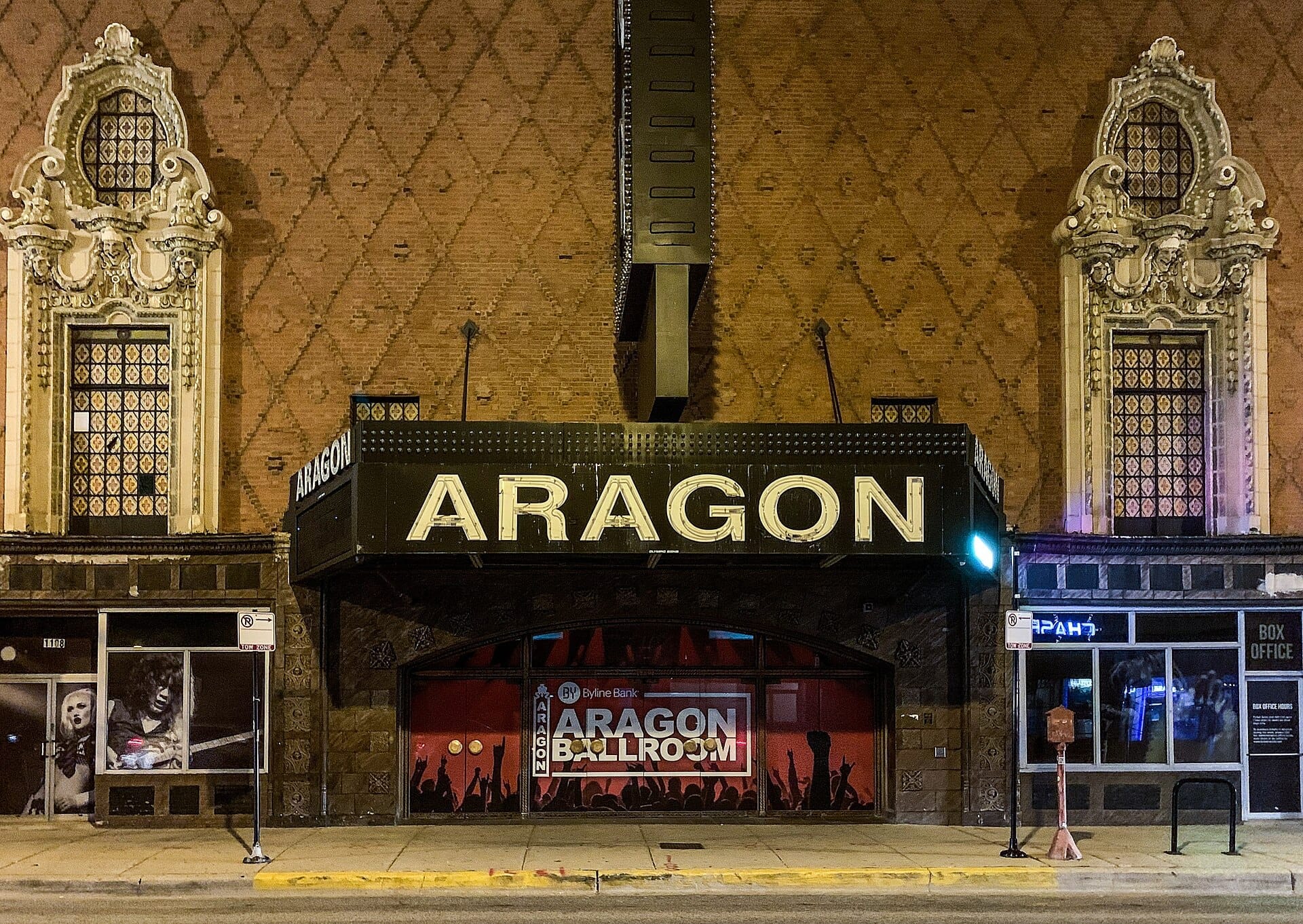
Arriving at the Aragon on a show night, the building announces itself clearly from the street: a wide terracotta facade with marquee signage that has not changed dramatically in design since the mid-20th century. The surrounding block on Lawrence Avenue has the low-rise commercial texture typical of Uptown, with the ballroom occupying a conspicuous footprint at the corner. On busy show nights, the queue extends along Winthrop, and the smell of food from nearby spots mingles with evening air before doors open.
Inside, the transition is striking. The lobby feeds into the main hall, and the interior scale takes a moment to register. The painted ceiling and arched galleries create the impression of being outdoors in a courtyard rather than inside a Chicago building. At full capacity, the noise and heat of nearly 5,000 people fill the space quickly, and the standing floor can feel dense well before showtime. The balcony sections offer more breathing room and cleaner sightlines toward the stage, at the cost of some atmosphere.
Sound quality varies significantly depending on your position. The center of the floor, mid-distance from the stage, typically offers the clearest mix. Near the back of the floor, reflections from the high ceiling can cause some muddiness, particularly for bass-heavy performances. The balconies have their own acoustic character, slightly more controlled but physically distant. None of this is unusual for a building of this age and scale, but it is worth factoring into where you choose to stand or sit.
💡 Local tip
For standing-room shows, arrive 30–45 minutes before the listed door time to secure a comfortable position on the floor. The center-left section roughly 30 feet from the stage tends to offer good sound and sightlines without the crush of the front rail.
Getting There and Navigating the Neighborhood
The Aragon Ballroom sits one block west of the Lawrence CTA Red Line station, making it one of the most straightforwardly transit-accessible large venues in Chicago. The walk from the station to the venue entrance is under five minutes along Lawrence Avenue. From the Loop, the Red Line northbound takes roughly 20–30 minutes to reach Lawrence, depending on service.
Uptown and the adjacent Andersonville area are covered in more detail in the Andersonville and Uptown neighborhood guide, which also covers dining and bar options for before or after a show.
Street parking exists in the surrounding residential blocks, but on high-capacity show nights it fills quickly. Rideshare pickup and dropoff works smoothly on Winthrop Avenue, with less congestion than Lawrence itself. Plan for 15–20 minutes of wait time on the app after a major show ends, as demand surges immediately.
⚠️ What to skip
Lawrence Avenue between the L stop and the venue can feel sparse late at night after a show. Travel in a group or arrange your rideshare pickup before exiting the venue. Standard urban awareness applies.
Practical Details for Show Nights
Tickets are purchased through Live Nation or the official Aragon Ballroom website, with prices varying by artist and ticket tier. There are no fixed published admission prices, so check current event listings directly. The venue operates a bag policy that is typically enforced at door: small bags are permitted but large backpacks and bags are often prohibited. Confirm current policy before your visit, as it can tighten for specific events.
The Aragon has multiple bars serving standard concert-venue drinks. Concession pricing follows large-venue norms in Chicago: expect to pay significantly above retail for beer, cocktails, and non-alcoholic drinks. There is no notable food operation inside beyond snacks, so eating before arrival is advisable. Several restaurants and bars operate within a few blocks on Lawrence and Broadway.
For accessibility needs, the venue asks guests to contact aragonhelp@livenation.com or call (773) 561-9500 ahead of the show to arrange accommodations. The building's age means its accessibility infrastructure is not equivalent to a purpose-built modern arena, so advance communication is strongly recommended rather than optional.
If you are planning a broader Chicago nightlife evening, the Chicago nightlife guide covers the city's live music landscape from small clubs to large venues, providing useful context for how the Aragon fits into the overall scene.
Photography, Aesthetics, and What the Space Looks Like Empty
The interior of the Aragon is genuinely photogenic, and the ceiling in particular photographs well from the balconies with a wide-angle lens. During a show, the combination of stage lighting, crowd density, and atmospheric architecture creates vivid imagery. Be aware that many artists and promoters enforce no-professional-camera policies (interchangeable lens cameras), though phone photography is generally permitted. Confirm the specific policy for your event when tickets are purchased.
The Aragon's exterior contributes to the architectural character of Uptown, which retains more 1920s and 1930s entertainment-district fabric than most Chicago neighborhoods. Travelers with a deep interest in Chicago's architectural legacy might pair a show visit with the Chicago Architecture Foundation River Cruise for a broader perspective on the city's built heritage.
Honest Assessment: Is It Worth Going?
The Aragon Ballroom is worth attending for the right event. If an artist you want to see is playing there, the combination of the architecture, the history, and the energy of a near-5,000-person crowd makes it a more interesting experience than a comparably sized generic venue. The Spanish-Moorish interior is not decorative filler: it genuinely changes the emotional character of a concert.
However, the Aragon is not an attraction to visit on its own merits as a tourist destination. Without a show, there is nothing to see inside. The neighborhood is worth exploring, and the exterior is architecturally interesting, but a deliberate day-trip to look at the facade would exhaust its appeal quickly. This is an event venue first and a historical building second.
Sound quality, as noted, is inconsistent. If pristine audio fidelity is your priority, a newer venue will serve you better. If you are willing to trade some acoustic precision for the experience of hearing music in a room that has hosted nearly a century of live performance, the Aragon more than delivers.
Insider Tips
- The balcony fills up fast for general-admission shows. If you want a seat with a view rather than a standing spot on the floor, get to the venue early and head directly upstairs before the floor fills.
- The venue's coat check operates on show nights and is worth using in winter. The floor gets warm quickly even when outdoor temperatures are well below freezing.
- Check whether your show has an opener you want to catch. The Aragon's stage is large enough that opening acts often use full production, and the lower crowd density early in the night gives a cleaner view of the interior architecture.
- The Lawrence Red Line station runs 24 hours, so getting home by train after a late show is viable without relying on a surge-priced rideshare. Check service frequency for the late-night schedule before you go.
- For shows where standing on the floor feels too intense, the arched galleries at balcony level offer partially obstructed but more relaxed sightlines and a better view of the decorated ceiling.
Who Is Aragon Ballroom For?
- Live music fans attending a specific touring act at the venue
- Architecture and design enthusiasts interested in 1920s Spanish-Moorish Revival interiors
- Chicago history buffs exploring the city's Jazz Age entertainment legacy
- Nightlife visitors looking for a large-scale concert experience with genuine character
- Travelers building a full evening in Uptown combining dinner on Lawrence Avenue with a show
Nearby Attractions
Other things to see while in Andersonville & Uptown:
- Andersonville Shopping District
Stretching along N. Clark Street between roughly 4800 and 5800 North, the Andersonville Shopping District is Chicago's most coherent neighborhood shopping strip. No chains, no admission fees, just a walkable lineup of independent boutiques, bookshops, vintage dealers, and specialty food stores set inside early-20th-century storefronts.
- Argyle Street (Little Vietnam)
Argyle Street in Chicago's Uptown neighborhood is the heart of the city's Vietnamese and Southeast Asian community. Free to explore, rich in food, history, and everyday neighborhood character, it rewards curious visitors with some of the most affordable and authentic eating in Chicago.
- Green Mill Cocktail Lounge
Dating back to 1907 and listed on the National Register of Historic Places as part of the Uptown Square Historic District, the Green Mill Cocktail Lounge in Chicago's Uptown neighborhood is one of the country's most atmospheric jazz bars. Live music plays seven nights a week inside an interior that looks almost exactly as it did during Prohibition. Cash only, no reservations.