Amsterdam Schiphol Airport: Complete Traveller's Guide
Amsterdam Airport Schiphol (AMS) is one of Europe's largest and busiest international hubs, sitting just 9 km southwest of the city centre. This guide covers the airport layout, how to get into Amsterdam, security rules, facilities, and what to expect at peak times.
Tickets & tours
Live prices and dates from our booking partner. If you book, we may earn a commission at no extra cost to you.
TL;DR
- Amsterdam Airport Schiphol (IATA: AMS) is the Netherlands' main international airport, located about 9 km southwest of Amsterdam city centre in the municipality of Haarlemmermeer.
- Schiphol uses a single-terminal concept with multiple departure halls, so most connections stay within one building — no inter-terminal shuttle needed.
- The fastest way into Amsterdam is the direct train from Schiphol Station (directly under the terminal) to Amsterdam Centraal, taking roughly 15-20 minutes.
- Liquids in hand luggage are limited to 100 ml containers in a 1-litre bag — this rule was reinstated in September 2024. Check getting around Amsterdam for onward transport options once you arrive.
- Summer months and holiday season starts see the heaviest crowds; arriving early for check-in and security is strongly advised.
Key Facts: What Makes Schiphol Unique
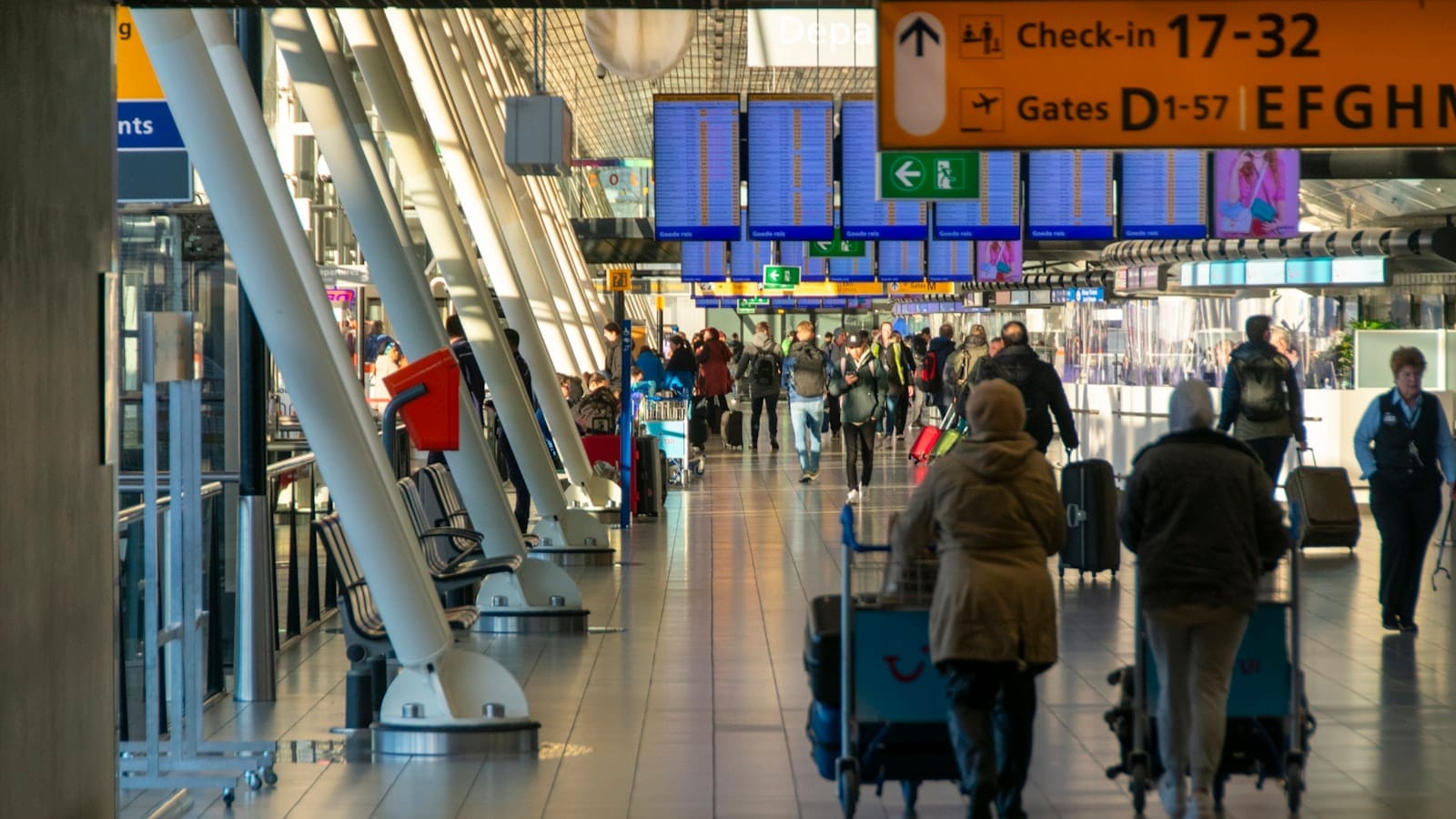
Amsterdam Airport Schiphol is not just a transit point — it is an engineering curiosity. The airport sits more than four metres below sea level, built on the reclaimed bed of the former Haarlemmer Lake. The first aircraft landed here in 1916, and the site has been in continuous use ever since. Today it covers 2,787 hectares and is classified as a Dutch national 'Mainport': a strategic hub where air, rail, road, and logistics infrastructure converge in one place.
In recent years, Schiphol has handled tens of millions of passengers annually across roughly 104 airlines flying to 332 direct destinations in 97 countries. About 71% of that traffic is intra-European, with the remaining 29% intercontinental. Air France-KLM is the dominant carrier. The scale matters practically: Schiphol is one of Europe's four major hub airports alongside London Heathrow, Paris CDG, and Frankfurt, which means connections are frequent but crowds are real.
ℹ️ Good to know
Schiphol is more than 4 metres below sea level — a fact that surprises most first-time visitors. The airport is built on drained lake bed, which is why the surrounding landscape looks flat and the horizon feels unusually wide when you land.
Terminal Layout: One Building, Multiple Departure Halls
One of the most common sources of confusion for first-time travellers is Schiphol's terminal structure. Unlike many large airports that operate multiple separate terminals requiring buses or trains between them, Schiphol uses a single integrated terminal concept. The building is large, but arrivals, departures, and transfers are all housed within one connected structure. Departure piers (such as B, C, D, E, F, G, H and M) are accessible airside, meaning once you clear security, you can walk between most of them without exiting the secure zone, although some areas like low-cost pier M are more restricted.
The ground floor is dedicated to Arrivals: baggage claim, customs, and the public arrivals hall where taxi, train, and bus connections begin. Check-in desks, baggage drop, and the security checkpoints are on the upper level in the Departures area. This vertical split is simple but easy to miss if you follow the flow of the crowd without checking signage. Schiphol's wayfinding is excellent — colour-coded signs in Dutch and English cover every junction.
- Arrivals Hall (Ground Floor) Baggage reclaim, customs, meeting point, train station access, taxi rank, and bus stops are all here.
- Departures (Upper Level) Check-in desks, self-service kiosks, baggage drop counters, and all security lanes.
- Airside (Post-Security) Departure halls D, E, F, G, and H; duty-free shopping, restaurants, lounges, and gate areas.
- Schiphol Plaza The landside retail and food hall connecting the terminal to the train station and hotel; accessible without a boarding pass.
⚠️ What to skip
Do not confuse 'Schiphol has multiple departure halls' with 'Schiphol has multiple terminals'. There is no inter-terminal shuttle. All halls are connected airside. However, walking distances within the airport can be significant — allow at least 15 minutes to reach remote gates after clearing security.
Getting from Schiphol to Amsterdam City Centre
The train is the clear first choice for most travellers. Schiphol has its own railway station directly beneath the terminal, accessed from the Arrivals hall via escalators and lifts. NS (Dutch Railways) runs frequent Intercity services to Amsterdam Centraal in roughly 15-20 minutes. Trains run every 10-15 minutes during the day, less frequently in the early hours. Tickets can be bought at yellow NS machines in the station or via the NS app; contactless OV-chipkaart cards also work. Fares are typically in the range of €5-6 single, though exact prices vary by time and ticket type — always confirm on the NS website before travel.
Bus services connect Schiphol with parts of Amsterdam and surrounding towns not served directly by rail. The Airport Express (Bus 397) runs to Leidseplein and Museumplein, which is useful if you are staying in the southern canal area or near the museum district. Journey time is longer than the train, typically 30-45 minutes depending on traffic, but it deposits you closer to certain accommodation clusters.
Taxis and ride-hailing apps (Uber and Bolt both operate at Schiphol) are available from the designated rank outside Arrivals. Costs are significantly higher than the train — expect fares into central Amsterdam to start from around €35-50 depending on traffic and demand. At peak hours or during events, surge pricing can push this higher. The taxi is worth considering only if you have heavy luggage, are travelling late at night, or are splitting the cost between multiple people.
- Train to Amsterdam Centraal: ~15-20 min, approximately €5-6, every 10-15 min during the day. Best overall option.
- Bus 397 (Airport Express): ~30-45 min, similar fare range to train, stops at Leidseplein and Museumplein. Good for southern Amsterdam stays.
- Taxi or Uber/Bolt: ~25-40 min (traffic-dependent), €35-50+. Best for late arrivals, heavy bags, or group travel.
- Car rental: Available at Schiphol. Not recommended for Amsterdam city exploration — parking is expensive and the city is better navigated by bike or public transport.
Security, Passport Control, and Baggage Rules
Schiphol processed somewhere between 120,000 and 180,000 baggage items on its busiest days — around 40% of that is transfer baggage. Security lanes can build up quickly, particularly in summer and at the start of Dutch school holiday periods. The airport recommends arriving at least 2-3 hours before a long-haul departure and at least 90 minutes for short-haul European flights. These are minimums; in July and August, add an extra 30 minutes to be safe.
The liquid rule is back to standard: Schiphol applies the EU-wide 100 ml limit for liquids in hand luggage. Each container must be 100 ml or under, placed in a single transparent 1-litre resealable bag. There was a period when Schiphol experimented with CT scanners that allowed larger containers, but that policy has been reversed. Do not pack larger liquid bottles in your hand baggage expecting them to pass — they will be confiscated.
Non-EU passport holders travelling into the Schengen Area (which includes the Netherlands) go through passport control on arrival. EU and Schengen-area travellers use automated e-gates. Queues at passport control are generally manageable outside peak summer weekends, but they can stretch considerably in July and August when multiple intercontinental flights land in close succession. Factor this into your connection time if transiting through Schiphol.
✨ Pro tip
If you are transiting at Schiphol without leaving the airport, and both flights are in the Schengen Area, you will not need to clear passport control — you stay airside. Minimum connection time at Schiphol is officially 40 minutes for Schengen-to-Schengen transfers, though 60-90 minutes gives more realistic comfort, especially if your incoming gate is at the far end of a departure hall.
Facilities, Shopping, and What to Do at Schiphol
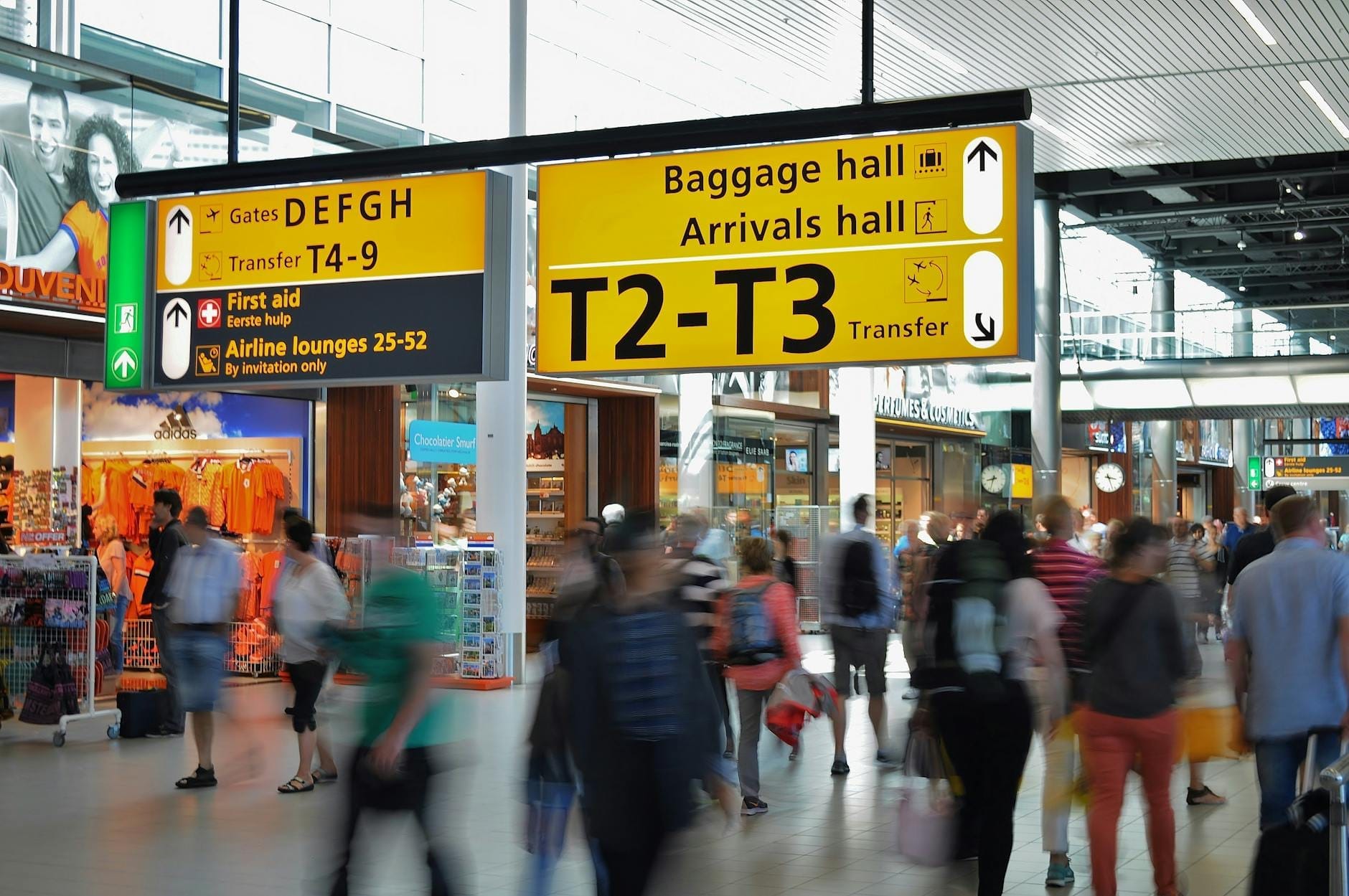
Schiphol Plaza, the landside retail and food area connecting the terminal to the train station, is accessible without a boarding pass. It has a reasonable range of cafes, a supermarket (Albert Heijn, useful for grabbing cheaper food or drinks before heading through security), pharmacies, currency exchange, and tourist information. If you have a long wait before your check-in window opens, this is the practical area to settle in.
Airside, the duty-free and shopping offer is extensive for a European airport: Dutch products like Gouda cheese, stroopwafels, Delft ceramics, and jenever (Dutch gin) fill the retail sections near the departure gates. There is also (when open) a small branch of the Rijksmuseum airside — a rotating selection of Dutch masterworks displayed in a dedicated gallery space, free to view with a boarding pass. It is a genuinely good use of a long layover and one of the more unusual airport experiences in Europe. Speaking of the Rijksmuseum itself, if you have a day in the city, the Rijksmuseum is one of the world's great art museums and well worth planning around.
The Panorama Terrace on the roof of the terminal building is a free outdoor observation deck where you can watch aircraft movements. It tends to be popular with aviation enthusiasts and families. Access is from the airside area once you have cleared security. Lounge access is available through KLM Crown Lounge (business class or SkyTeam Elite Plus), Priority Pass, or day passes purchased at the airport — though day pass costs have risen steeply in recent years, making them poor value for shorter waits.
Seasonal Patterns and When to Expect Crowds
Schiphol mirrors Amsterdam's tourism calendar closely. The city draws peak visitor numbers from April through September, with July and August representing the busiest airport months. In August 2023 alone, Schiphol handled millions of passengers and tens of thousands of flight movements. If you are travelling during Amsterdam's spring season (late March through May), the airport is busy but more manageable than midsummer. April is particularly high-demand around King's Day (late April) and the tulip season.
Winter travel through Schiphol is generally calmer, though fog can cause significant delays between November and February — the low-lying geography makes the airport particularly susceptible. If you are planning a winter visit to Amsterdam, build some buffer into your itinerary in case of morning fog delays. The Amsterdam Light Festival (typically December to January) brings a secondary spike in visitors during what would otherwise be the quietest month.
For travellers using Amsterdam as a gateway to wider European destinations, the train connections from Amsterdam Centraal are excellent. Direct Eurostar services (previously including the Thalys-branded services now integrated into Eurostar) connect to Paris, Brussels, and London. If you are planning a train journey from Amsterdam to Paris or Amsterdam to London by train, these depart from Centraal rather than Schiphol, so factor in the 15-20 minute rail connection from the airport.
💡 Local tip
The cheapest and most reliable way to pre-plan your Amsterdam arrival is to buy your Schiphol-to-Centraal train ticket in advance via the NS app or ns.nl. You can also use a contactless debit or credit card directly on the OV-chipkaart readers at the platform gates for single journeys — no ticket machine queue required.
FAQ
Where is Amsterdam Airport Schiphol on a map?
Schiphol (IATA: AMS) is located about 9 km southwest of Amsterdam city centre, in the municipality of Haarlemmermeer in the province of North Holland. It sits more than 4 metres below sea level on reclaimed land from the former Haarlemmer Lake. On a map of Amsterdam, it appears directly southwest of the city, roughly between Amsterdam and the city of Haarlem.
How long does it take to get from Schiphol to Amsterdam city centre?
By train, Schiphol to Amsterdam Centraal takes approximately 15-20 minutes. Trains run every 10-15 minutes during daytime hours from the station directly beneath the terminal. By taxi or ride-hail, journey time is typically 25-40 minutes depending on traffic, but costs are significantly higher — usually €35-50 or more.
Does Schiphol have multiple terminals?
No. Schiphol operates a single integrated terminal with three departure halls and multiple lettered piers (such as B, C, D, E, F, G, H and M) connected airside. You do not need a shuttle or inter-terminal transport to make a connection — everything is within one building, though walking distances between departure halls can be considerable.
What are the liquid rules at Amsterdam Schiphol Airport?
As of September 2024, Schiphol reverted to the standard EU rule: liquids in hand luggage must be in containers of 100 ml or less, all placed in a single transparent 1-litre resealable bag. Larger containers are not allowed through security regardless of remaining volume.
What is the best time to arrive at Schiphol to avoid queues?
For short-haul European flights, arrive at least 90 minutes before departure; for long-haul intercontinental flights, allow at least 2-3 hours. In July and August, and at the start of Dutch school holiday periods, add an extra 30 minutes on top of these minimums. Early morning departures (before 7am) and evening flights tend to have shorter security queues than mid-morning peaks.
Tickets & tours
Live prices and dates from our booking partner. If you book, we may earn a commission at no extra cost to you.
Planning a trip? Discover personalized activities with the Nomado app.