Museum Villa Stuck: Inside Munich's Most Theatrical Art Nouveau Villa
Built by painter Franz von Stuck in 1898 as both home and artistic statement, Museum Villa Stuck in Bogenhausen is one of Munich's most distinctive cultural addresses. The original reception rooms survive intact, layered with gilded friezes and Pompeiian-style decoration, while contemporary and modern art exhibitions fill the purpose-built studio and extension spaces.
Quick Facts
- Location
- Prinzregentenstraße 60, 81675 Munich (Bogenhausen)
- Getting There
- Tram 17 or Bus 100 to Friedensengel/Villa Stuck; U4 to Prinzregentenplatz; U5 to Max-Weber-Platz
- Time Needed
- 1.5 to 2.5 hours
- Cost
- Full museum €9 / reduced €5; historical rooms only €4 / reduced €2; under 18s free; first Friday of month free (18:00–22:00)
- Best for
- Art nouveau architecture, Symbolist art, contemporary exhibitions, design-focused travelers
- Official website
- www.villastuck.de
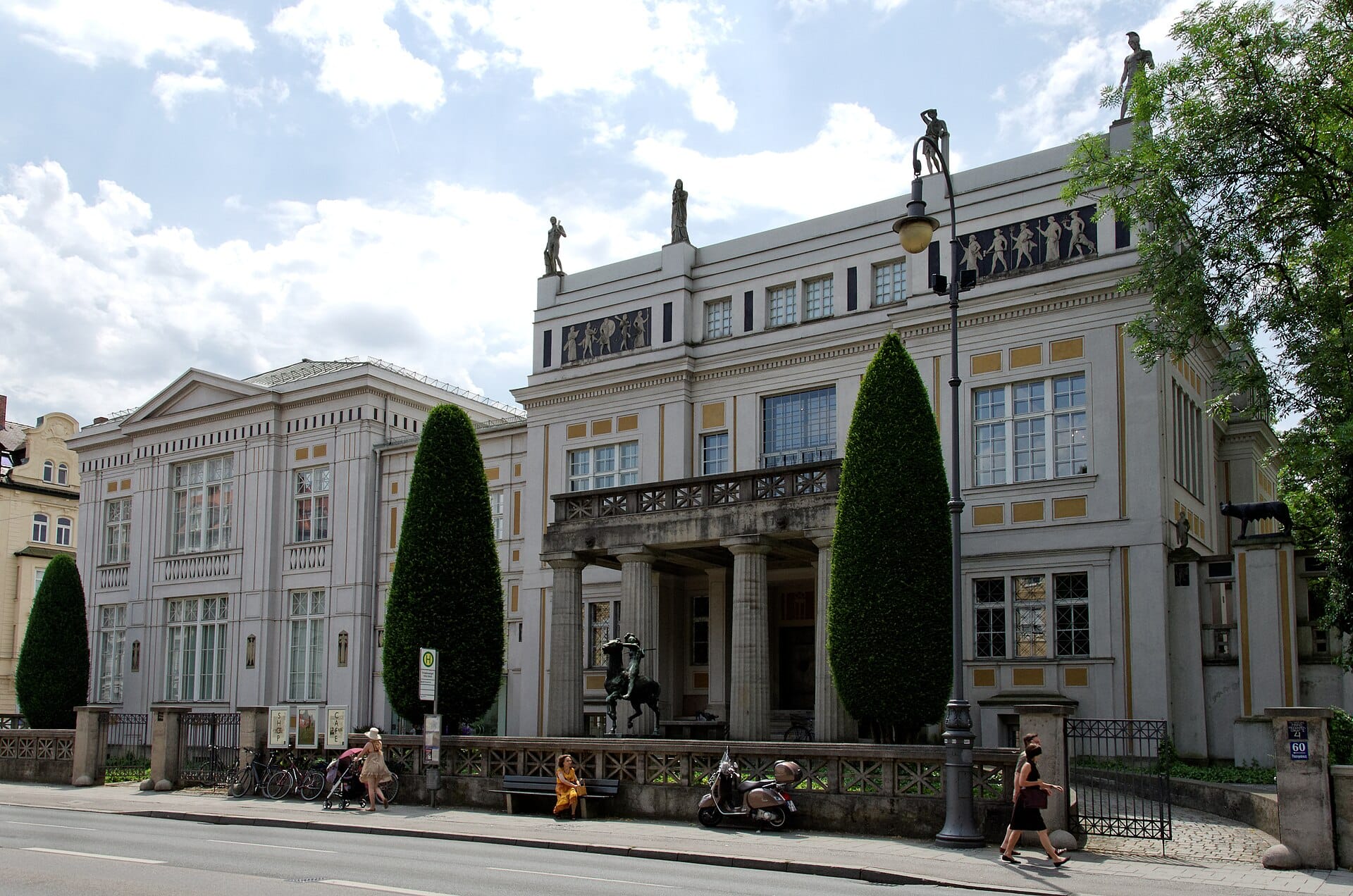
What Museum Villa Stuck Actually Is
Museum Villa Stuck is not a conventional art museum. It is the preserved home, studio, and public gallery of Franz von Stuck (1863–1928), one of the most celebrated German painters of the late 19th century and a co-founder of the Munich Secession. Stuck designed the villa himself between 1897 and 1898, completing it as a unified Gesamtkunstwerk, a total work of art in which architecture, interior decoration, and painting were inseparable. The building opened to the public as a municipal museum of the City of Munich in 1992.
What makes it unusual among Munich's museums is the layering of purposes. You are walking through a functioning contemporary art venue while also touring the preserved private rooms of a fin-de-siècle painter who modeled his home on ancient Rome, Pompeii, and Greek temple architecture, all within a residential villa on one of Munich's most elegant boulevards. That combination is genuinely rare.
ℹ️ Good to know
The museum underwent renovation to improve barrier-free accessibility, with a reopening originally targeted for October 2025. Confirm current opening status, exhibitions and any temporary relocations at villastuck.de before your visit, as reopening dates for projects of this kind often slip.
The Building: Franz von Stuck's Architectural Self-Portrait
Stuck was 34 years old when he designed this villa, already wealthy from the commercial success of his Symbolist canvases depicting sin, temptation, and mythological violence. The building sits on Prinzregentenstraße, the broad ceremonial avenue that runs east from the Isar through Bogenhausen, lined with embassies and late-19th-century neoclassical buildings. The villa's facade is restrained by comparison with its interiors: a compact neoclassical structure with a loggia, stone pilasters, and a garden courtyard.
Inside, the historical rooms are the main event for architecture and design visitors. The entrance hall is finished with geometric coffered ceilings, polished wood, and gilt friezes. The music salon carries heavy Pompeiian red walls set against dark wood paneling. The studio, where Stuck actually painted, is a double-height room with a north-facing skylight, designed to flood the canvas with cold, even light. Stuck displayed his own works within these rooms as permanent decorative elements, so the line between studio and gallery was intentional from the start.
The house was not just a home. Stuck received Munich's artistic and social elite here, and the villa functioned as a kind of stage set for his public persona. His pupils included Wassily Kandinsky and Paul Klee, both of whom passed through his teaching at the Academy of Fine Arts in the same years the house was built. For context on the broader artistic geography of Munich in this period, the Lenbachhaus, home to the Blue Rider collection that Kandinsky helped create, is a natural companion visit.
Tickets & tours
Live prices and dates from our booking partner. If you book, we may earn a commission at no extra cost to you.
Luggage Storage in Munich
From 6 €Instant confirmationFree cancellationOne hour city sightseeing bus tour in Munich
From 21 €Instant confirmationFree cancellationMunich Third Reich walking tour
From 32 €Instant confirmationFree cancellationRomantic Road Day Trip to Rothenburg and Harburg
From 74 €Instant confirmationFree cancellation
The Exhibitions: Symbolism, Contemporary Art, and the Space Between
The museum operates across three connected but distinct zones. The historical rooms on the ground floor preserve the villa as Stuck designed it. A purpose-built studio extension and basement level host temporary exhibitions of modern and contemporary art. These shows rotate several times a year and tend toward the thematic rather than the retrospective, often placing older work in dialogue with contemporary artists. The combination works better in practice than it sounds on paper.
Stuck's own paintings, when displayed, are worth spending time with. His treatment of mythological and allegorical subjects, particularly his recurring image of Sin depicting a woman entwined with a serpent, was reproduced across Europe in the 1890s and made him a household name. Up close, the surfaces are more technically varied than reproductions suggest, with thick impasto passages alongside glassy, enamel-like finishes. The frames, many designed by Stuck himself, are integral to the composition.
If the current temporary exhibition does not interest you, the historical rooms alone justify a visit at the reduced-rate ticket price. That section takes around 45 minutes at a careful pace.
What It Feels Like to Visit: Hour by Hour
The museum opens at 11:00 Tuesday through Sunday, with extended hours until 20:00 on Wednesdays and until 22:00 on the first Friday of each month. Morning visits on weekdays are the quietest: the entrance hall, with its dark timber and gilded ceiling, reads as genuinely intimate when there are few other visitors. The audio guide, if available, is worth taking in the historical rooms, where the density of decorative detail rewards explanation.
Midday on weekends brings school groups and tour parties, particularly to the historical rooms. If you arrive between 13:00 and 14:30 on a Saturday, expect the studio and music salon to feel crowded. The contemporary exhibition spaces, by contrast, tend to stay calm throughout the day.
The first Friday of every month brings a free evening opening from 18:00 to 22:00. These Friday Lates have a different atmosphere: the lower admission barrier draws a younger, less museum-habitual crowd, and the villa's theatrical interiors read differently by artificial light. The gilded friezes and dark walls become more dramatic after dark. If you want to see the building as Stuck likely envisioned it, candlelit and stage-managed, a Friday Late evening is worth planning around.
💡 Local tip
Friday Late (first Friday of every month, 18:00–22:00) offers free admission to all current exhibitions in the museum. Arrive between 18:00 and 19:00 to avoid peak attendance later in the evening.
Getting There and Practical Logistics
The villa sits on Prinzregentenstraße at the number 60, in the Bogenhausen district east of the Isar. From central Munich, the fastest public transport option is Tram 17 or Bus 100 to the Friedensengel/Villa Stuck stop, which deposits you almost directly at the garden gate. The Angel of Peace monument is visible from the stop, providing an easy orientation point. Alternatively, U4 to Prinzregentenplatz or U5 to Max-Weber-Platz both require a short walk of around 10 minutes along Prinzregentenstraße.
The museum is within walking distance of the Haus der Kunst and the southern edge of the Englischer Garten. Combining the two venues makes a full day without requiring any additional transit.
For drivers, two designated disabled parking spaces are located on Ismaninger Straße directly in front of the villa, with one additional space in the inner courtyard accessible via Ismaninger Straße. The courtyard space requires advance registration. A wheelchair is available to borrow on-site. The museum has been undergoing renovation specifically to improve barrier-free access throughout the building.
The museum is open on all public holidays, including Easter Monday and Whit Monday, and remains open on New Year's Eve. It closes on 24 December and on Shrove Tuesday (Faschingdienstag). Always verify current hours at villastuck.de before visiting, particularly around public holidays.
Photography, Context, and What to Bring
The historical rooms photograph well but unevenly. The entrance hall and music salon have dramatic spatial depth and benefit from wide-angle lenses. The studio's north-facing skylight produces flat, even light that works well for detail shots of surface texture in Stuck's paintings. Flash is generally prohibited in museum settings, and the darker rooms require a steady hand or a higher ISO.
There is no strict dress code, but the villa's formal interior creates a slightly more dressed atmosphere than, say, a public park or beer garden. Comfortable shoes are practical: the floors throughout the historical rooms are polished stone and hardwood, and the basement exhibition spaces involve several flights of stairs.
Bogenhausen is one of Munich's quieter residential districts, with relatively few tourist-facing cafes immediately around the museum. For lunch or coffee before or after, the options along Prinzregentenstraße are limited. The area around Haidhausen, just across the Isar, has a denser selection of independent cafes and restaurants within easy walking distance.
Who Will Love This and Who Won't
Museum Villa Stuck rewards visitors who have some interest in either fin-de-siècle European art, art nouveau architecture, or the history of Munich's cultural scene in the late 19th century. For those visitors, it is one of the most coherent and well-preserved artist's house museums in Germany.
It is a harder sell for visitors whose primary interest is Impressionism, Old Masters, or major historical art collections. The Alte Pinakothek and Neue Pinakothek, both in Maxvorstadt, serve that appetite far better. Villa Stuck is specific and stylistically narrow: Symbolism, art nouveau, and whatever temporary exhibition happens to be showing. If that range does not interest you, the scale of the museum means there is little else to fall back on.
Families with children under 10 may find the formal interior and relatively quiet atmosphere restrictive, though children under 18 enter free. For family-oriented museum visits in Munich, the Deutsches Museum offers a far more interactive experience.
⚠️ What to skip
The museum underwent renovation with a reopening originally targeted for October 2025. Some or all spaces may still be closed or relocated. Check villastuck.de for current exhibition and access information before making a dedicated trip.
Insider Tips
- The reduced-rate ticket for the historical rooms only (€4, reduced €2) is worth considering if the current temporary exhibition does not interest you. The Stuck-designed interiors and a selection of his paintings are included at this price.
- The first Friday of every month is free for everyone from 18:00 to 22:00, with access to all current exhibitions. The villa reads differently by evening light, with the gilded and dark-paneled rooms becoming noticeably more atmospheric. Arrive early in the evening to avoid the peak crowd that builds after 20:00.
- If you visit on a weekday morning between 11:00 and 13:00, the historical rooms are usually uncrowded enough to sit quietly in the music salon or studio. That kind of uninterrupted time in a Gesamtkunstwerk interior is genuinely rare in Munich.
- The museum sells an annual pass for €25 (reduced €15), which covers unlimited visits. If you are spending more than a few days in Munich and plan to return for a second temporary exhibition, it pays for itself quickly.
- Combine Villa Stuck with a walk through the Englischer Garten's southern end or a stop at the Haus der Kunst on the same afternoon. All three are within about 10 minutes of each other on or near Prinzregentenstraße, and the combination creates a natural arc through Munich's art history from the 19th century to the contemporary.
Who Is Museum Villa Stuck For?
- Travelers with a specific interest in Symbolist painting or art nouveau architecture
- Design and interiors enthusiasts who want to see a complete fin-de-siècle Gesamtkunstwerk
- Visitors planning a Bogenhausen or Prinzregentenstraße cultural walk
- Evening visitors looking for a free Friday Late cultural outing
- Anyone researching the Munich artistic scene that shaped early 20th-century European modernism
Planning a trip? Discover personalized activities with the Nomado app.