Tiger Cave Temple (Wat Tham Suea): Krabi's Most Rewarding Climb
Tiger Cave Temple, known in Thai as Wat Tham Suea, is a working Buddhist monastery on the outskirts of Krabi Town, famous for its 1,260-step staircase leading to a golden Buddha statue at the top of a limestone peak. The views from the summit stretch across the mangroves, rice paddies, and karst towers that define Krabi Province's inland landscape. It is one of the few attractions in Krabi that combines genuine religious culture with serious physical effort and a genuinely spectacular reward.
Quick Facts
- Location
- 35 Krabi Noi, Mueang Krabi District, Krabi 81000 — approximately 9 km from Krabi Town
- Getting There
- Taxi or songthaew from Krabi Town; some songthaew routes may require a short walk to the entrance. No direct public bus.
- Time Needed
- 2–4 hours (30–45 min up, 20–30 min down, plus time at the base temple and caves)
- Cost
- Free; donations welcome.
- Best for
- Panoramic views, Buddhist culture, active travelers, early-morning photography
- Official website
- krabiwatthamsuea.com/en
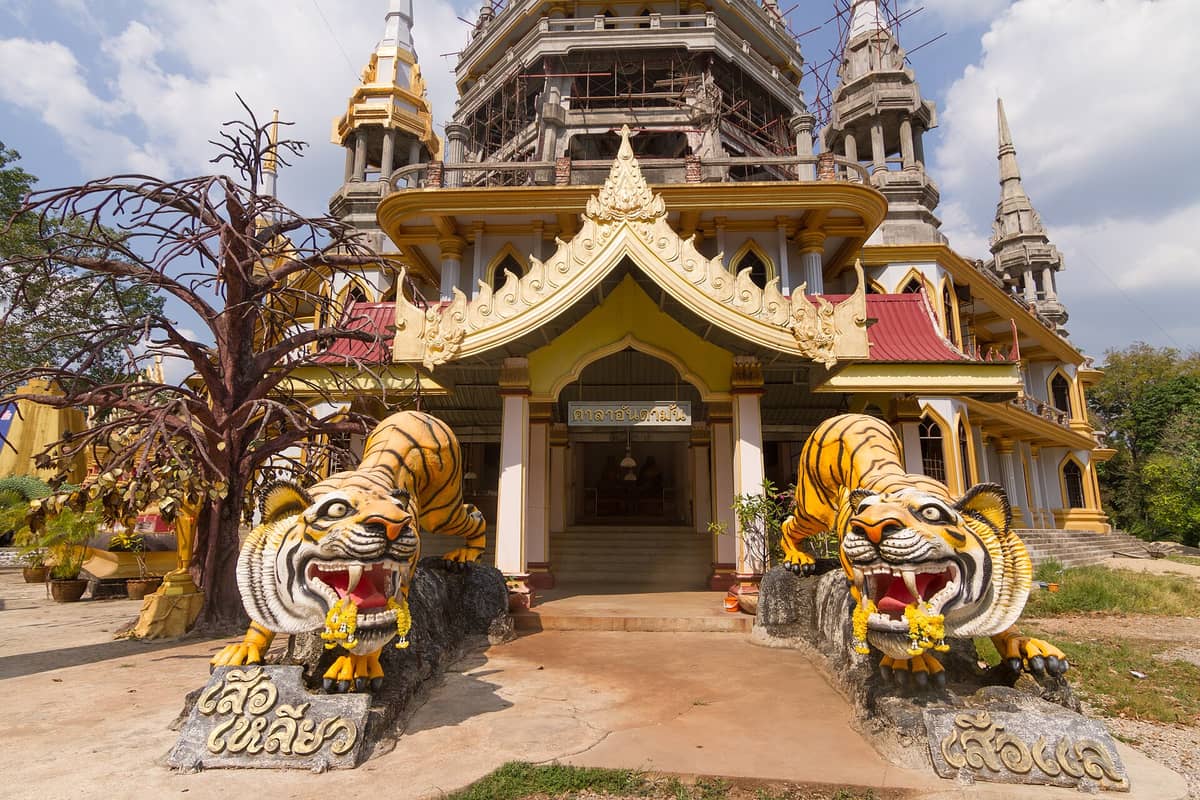
What Tiger Cave Temple Actually Is
Wat Tham Suea is a functioning Buddhist monastery, not a tourist set piece. The site dates to 1975, when it was named Na Ching Monastery; it became Wat Tham Suea in 1990. It has grown into a complex of forest shrines, meditation caves, monk residences, and open-air pavilions spread across a large limestone hill about 9 km northeast of Krabi Town. The name comes from tiger-paw-shaped markings once found in the cave at the base, though no tigers have lived here for generations.
Most visitors come for the summit climb, which ends at a gilded Buddha statue and a smaller shrine perched at the top of a 1,260-step staircase. But the base level is worth at least an hour of your time on its own: the main cave temple, several smaller grotto shrines, and the surrounding jungle paths all belong to an active religious site where monks live, meditate, and walk among the trees.
ℹ️ Good to know
Opening hours are reported as 06:00–18:00 daily. The summit is best reached before 09:00 to avoid peak heat and crowds. Verify current hours locally, as temple schedules can change around major Buddhist holidays.
The Climb: 1,260 Steps and What to Expect
The staircase begins at a clearly marked point near the base temple. The first hundred steps or so are manageable — wide, stone, with a steady rail. Then the angle increases sharply. By the midpoint, you are pulling yourself upward using the handrail, occasionally looking down at a near-vertical drop into the jungle canopy below. The steps are uneven in places, worn smooth in others, and can be slippery after rain.
The ascent takes most visitors between 30 and 50 minutes depending on fitness and how many rest stops they take. There are small platforms along the route where you can pause and catch your breath. Macaque monkeys patrol these rest spots with practiced confidence — they are bold and have learned to associate humans with food. Keep bags closed and do not offer anything to eat.
At the top, the view is the point. On a clear day, the summit opens onto a 360-degree panorama: limestone karsts rising from flat green paddy land, mangrove channels threading toward the sea, and on the clearest mornings, a faint outline of the Andaman coast. The golden Buddha faces outward across this landscape, and small bells ring in the wind around the shrine platform. It is genuinely quiet up here before 09:00.
⚠️ What to skip
The climb is steep enough to be genuinely difficult for anyone with knee problems, vertigo, or low cardiovascular fitness. It is not suitable for young children without close supervision. Wear closed-toe shoes with grip — sandals make the descent significantly more dangerous.
Tickets & tours
Live prices and dates from our booking partner. If you book, we may earn a commission at no extra cost to you.
Jurassic Jungle Kayak and Phra Nang Cave Beach Tour from Krabi
From 742 €Instant confirmationFree cancellationFull-day Four Islands and Emerald Cave tour
From 42 €Instant confirmationFree cancellationDaily Cooking Class at Thai Cookery School in Krabi
From 42 €Instant confirmationFree cancellation7 islands speedboat excursion from Krabi
From 41 €Instant confirmationFree cancellation
The Base Temple and Cave Shrines
Many visitors rush past the base complex in their urgency to reach the summit. That is a mistake. The main cave temple is a large natural cavern containing Buddha images, incense altars, and several large stalactites. Monks meditate here in the early morning, and the smell of incense mixes with the cool, damp air of the rock. The atmosphere is unlike anything at the beach resorts down the coast.
A network of jungle paths extends from the base, leading to smaller caves and forest shrines. These paths are shaded and relatively flat, which makes them a good option for visitors who cannot manage the summit climb. The forest here is dense enough to feel genuinely wild, and the bird calls overhead are constant. For context on what else the inland Krabi landscape offers, the Khao Phanom Bencha National Park to the north protects a larger section of this same limestone forest ecosystem.
Dress code is enforced at the base temple. Shoulders and knees must be covered. Sarongs are sometimes available to borrow or rent at the entrance, but bringing your own is more reliable. Remove shoes before entering any indoor shrine area.
When to Go and How the Experience Changes by Hour
The temple opens at 06:00, and arriving at that hour means starting the summit climb in darkness or early dawn light. This is not just about avoiding heat, though that matters too given that Krabi's daytime temperatures regularly reach 31–34°C. It is about the atmosphere: mist sits in the valleys below, monks are beginning their morning routines, and the summit platform is almost empty. Photography conditions before 08:00 are substantially better, with softer light across the karst landscape.
By 10:00, tour groups from Ao Nang and Krabi Town begin arriving. The staircase becomes a steady stream of people going up and down simultaneously, which slows the pace and diminishes the quiet of the summit. Midday visits between 11:00 and 14:00 are the least comfortable: full sun on a dark stone staircase is genuinely punishing, and the view is often hazier due to heat shimmer.
Late afternoon, from around 15:30 onward, offers a second window with lower temperatures and warmer light. However, the temple closes at 18:00, so you need to calculate descent time carefully. Sunset from the summit is reportedly beautiful, but you should not attempt the descent in darkness. If you are planning a full day around Krabi Town, the temple works well as a morning start before exploring the town's market and riverside in the afternoon.
💡 Local tip
Bring at least 1 liter of water per person for the climb. There are no vendors on the staircase itself. A small amount of water is available at the base, but do not rely on it. A light towel is useful for wiping down at rest platforms.
Getting There from Krabi Town
The temple is approximately 9 km from central Krabi Town, northeast along Route 4034. There is no direct scheduled bus service. The most practical option is a taxi booked through your accommodation or via Grab, which gives you a fixed price and door-to-door convenience. The drive takes roughly 15–20 minutes depending on traffic.
Songthaews (shared pickup trucks that serve as local transport) do run routes in this direction, but not all go directly to the temple entrance. If you take a songthaew, confirm the drop-off point before boarding, as you may need to walk the final stretch. A rented motorbike is a workable option for confident riders: the road is straightforward and parking at the temple is available.
If you are combining the temple with other Krabi Town sights, the Wat Kaew Korawaram temple in town and the Krabi Town Night Market make for a logical same-day combination. Both are in the town center and require no additional transport from your starting point.
Is It Worth the Effort? An Honest Assessment
The short answer is yes, for most active visitors. The summit view is genuinely among the best inland views in Krabi Province, and the combination of religious culture, jungle atmosphere, and physical challenge makes Wat Tham Suea more layered than a standard viewpoint. You will work for the view, and that work is part of what makes it feel earned.
That said, if you are visiting Krabi primarily for beaches and have limited days, this is a half-day commitment that takes you away from the coast. Visitors who dislike stairs, heat, or monkeys will find the experience stressful rather than rewarding. It is also not an attraction for anyone with significant mobility limitations, as there is no accessible route to the summit and the base caves require some uneven walking.
For travelers who want to understand Krabi beyond its coastline, the temple sits alongside inland attractions like the Emerald Pool and Khlong Thom Hot Springs as evidence that the province has a rich interior worth exploring. A well-designed itinerary can balance coast and inland across several days.
Insider Tips
- The monkeys at the mid-staircase rest platforms are persistent. Zip all bag compartments shut before you start climbing, not partway up when a monkey is already eyeing your water bottle.
- If you visit in the rainy season (roughly May through October), bring a compact rain jacket. The summit is exposed, and a brief downpour on the descent makes wet stone steps genuinely hazardous. The base caves, however, are a good wet-weather option regardless of season.
- The forest meditation trail at the base level is rarely crowded even when the staircase is busy. If you arrive and find the main queue already building, start with the cave trail and attempt the summit climb later in the morning when some of the initial rush has moved on.
- There is no official left-luggage facility. If you are traveling with a large backpack, ask your taxi or songthaew driver to wait, or store bags at your accommodation before coming. Climbing with heavy luggage is genuinely unpleasant.
- Dress modestly from the start rather than planning to change at the entrance. The sarong loan system at some temples is not always available, and a refused entry wastes the journey. Light long trousers and a t-shirt with sleeves work in the heat while satisfying dress code requirements.
Who Is Tiger Cave Temple (Wat Tham Suea) For?
- Active travelers willing to trade physical effort for a genuinely panoramic reward
- Travelers interested in working Buddhist monastery culture rather than purely tourist-facing temples
- Photographers prioritizing golden-hour light over the convenience of midday visits
- Visitors building a multi-day Krabi itinerary that balances coastal and inland experiences
- Independent travelers based in Krabi Town looking for a meaningful half-day excursion
Nearby Attractions
Other things to see while in Krabi Town:
- Ao Tha Lane & Mangrove Forest
Ao Tha Lane, also listed officially as Tha Lane Bay, is a tidal bay in Khao Thong Subdistrict where dense mangrove forest meets sheer karst cliffs. The only meaningful way to explore it is by kayak, paddling through narrow channels where the canopy closes overhead and the water turns dark green. It is quieter and less commercialized than most of Krabi's headline attractions.
- Huai To Waterfall
Huai To Waterfall (Nam Tok Huai To) is a multi-tiered cascade tucked inside Khao Phanom Bencha National Park, roughly 20 km north of Krabi Town. A short forest walk leads through dense tropical vegetation to a series of pools fed by cool mountain water, making it one of the most accessible natural retreats on the Krabi mainland.
- Khao Khanab Nam Caves
Two sheer limestone towers rising roughly 100 metres above the Krabi River, Khao Khanab Nam is the geological signature of Krabi Town. A short long-tail boat ride from Chao Fah Pier leads into cave chambers that served as a Japanese military camp in World War II and contain fossilised remains estimated to be millions of years old.
- Khao Phanom Bencha National Park
Khao Phanom Bencha National Park is Krabi's inland rainforest reserve, protecting steep limestone peaks, a dramatic five-tier waterfall, and dense jungle habitat roughly 20 km north of Krabi Town. It rewards early risers with cool air, birdsong, and cascading water, but trails beyond the lower falls require preparation and a degree of fitness.
Planning a trip? Discover personalized activities with the Nomado app.