Te Ara i Whiti – The Lightpath: Auckland's Glowing Elevated Walkway
Te Ara i Whiti (The Lightpath) is an 850-metre walking and cycling route built on a decommissioned motorway off-ramp in central Auckland. Painted a vivid hot pink and lit with colour-changing LEDs after dark, it is one of the most photographed urban infrastructure projects in New Zealand. Entry is free and the path is open to the public year-round.
Quick Facts
- Location
- Nelson Street off-ramp, Auckland CBD – access points near Upper Queen Street / Canada Street and Union Street / Victoria Street West
- Getting There
- Walk from Auckland CBD (10–15 min from Queen Street); Britomart and Aotea bus stops are the nearest public transport hubs
- Time Needed
- 20–40 minutes for a leisurely one-way walk or short loop; longer if you linger for photos or connect to the broader cycling network
- Cost
- Free – no ticket or booking required
- Best for
- Cyclists, evening walkers, photographers, and anyone curious about adaptive urban design
What Is Te Ara i Whiti?
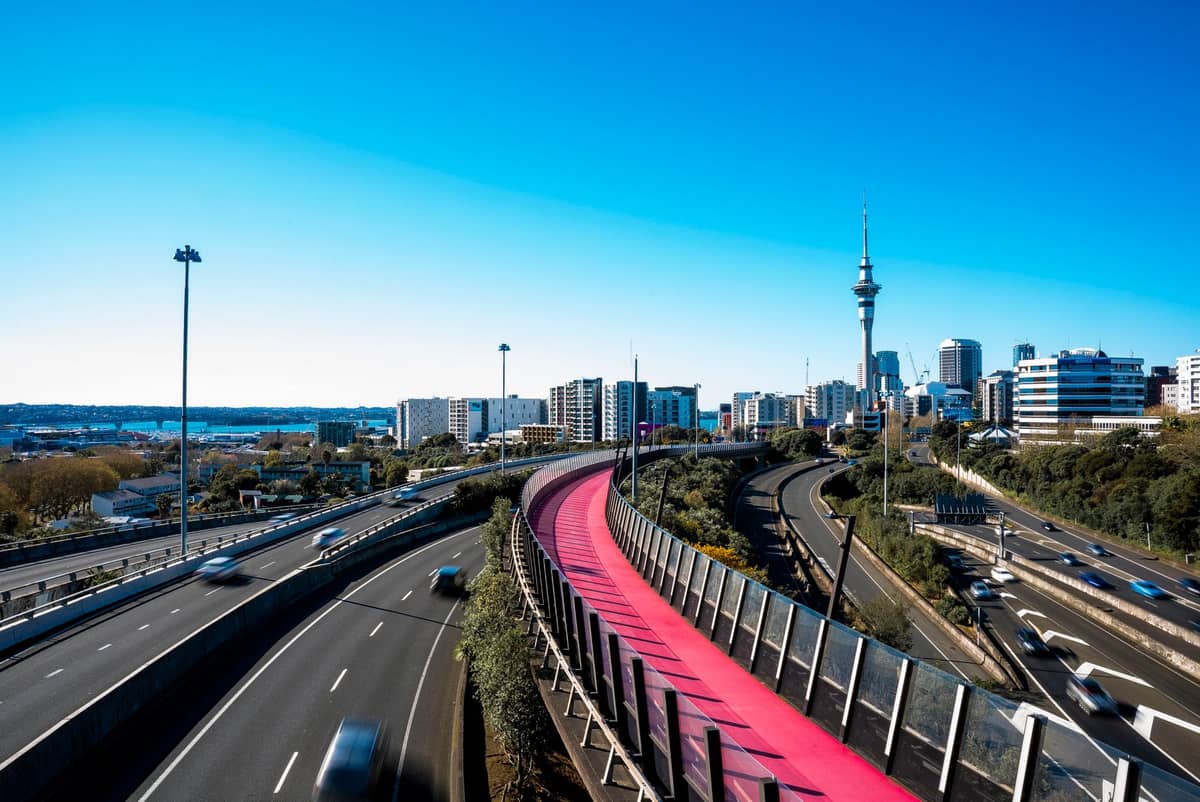
Te Ara i Whiti, which translates from te reo Māori as 'The Lightpath', is a dedicated walking and cycling route running through the heart of Auckland's CBD. What makes it unusual is its origin: the path is built on the former Nelson Street motorway off-ramp, a piece of mid-20th century traffic infrastructure that was decommissioned as Auckland began shifting investment toward pedestrian and cycling connectivity. It opened on 3 December 2015 and has since become one of the city's most recognisable public spaces.
The path is painted a deep hot pink, a colour choice that was deliberately bold. Rather than blending into the concrete cityscape, the design signals transformation: a structure once used exclusively by motor vehicles, now given over entirely to people moving under their own power. The route starts by Upper Queen Street, crosses the motorway via a bridge, traces the elevated former off-ramp above street level, and descends toward Union Street and Victoria Street West.
ℹ️ Good to know
Te Ara i Whiti has no set opening hours – it functions as a public route and is accessible at any time. The LED lighting system activates after dark and is when the path is most visually striking.
The Experience: Walking or Cycling the Path
On foot during daylight, the path offers a calm elevated corridor above the traffic on Nelson Street below. The hot pink surface underfoot is unmistakable and draws attention before you even step onto it. The ramp rises gently, giving you a partial view across the surrounding CBD rooflines and down into the street grid. It is not a dramatic panorama, but the slightly elevated perspective gives a satisfying sense of separation from the city's noise.
Cyclists tend to move at a reasonable pace, and the path is wide enough that walkers and riders coexist comfortably most of the time. During weekday mornings and late afternoons, commuter cyclists make up a significant portion of users. The surface is smooth, the gradient is manageable, and there are no traffic lights on the path itself, which makes it genuinely useful for anyone cycling across the central city.
After dark, the experience shifts considerably. The underbelly of the structure and the path surface itself are lit by colour-changing LED lights, and the pink paint takes on a deeper, more saturated quality under the artificial glow. The contrast between the brightly lit path and the surrounding city darkness creates an atmosphere that is unusual for public infrastructure. On quiet weeknights you may have long stretches entirely to yourself.
💡 Local tip
For photography, arrive around dusk rather than full dark – the transitional light creates a balance between the path's LEDs and the ambient city glow that is difficult to achieve at any other time of day. A wide-angle lens and a steady hand (or small tripod) will help capture the full sweep of the ramp.
Tickets & tours
Live prices and dates from our booking partner. If you book, we may earn a commission at no extra cost to you.
Mt. Tarawera Volcanic crater experience
From 95 €Instant confirmationFree cancellationTarawera and lakes eco tour
From 59 €Instant confirmationFree cancellationKaituna whitewater sledging experience
From 65 €Instant confirmationFree cancellationLuggage Storage in Auckland
From 5 €Instant confirmationFree cancellation
Historical and Urban Design Context
The Nelson Street motorway off-ramp was built as part of Auckland's mid-20th century commitment to car-oriented urban planning. For decades, infrastructure like this defined how the CBD was shaped and divided, prioritising vehicle throughput over pedestrian experience. By the time the off-ramp was decommissioned, it represented exactly the kind of redundant motorway infrastructure that cities around the world were beginning to reconsider.
The conversion into Te Ara i Whiti was part of Auckland's broader investment in a connected cycling and walking network. Internationally, there are precedents for this kind of adaptive reuse, but the Lightpath's combination of striking colour, LED lighting, and central-city location gave it an identity that extends well beyond utility. It became a statement about what the city's public spaces could look like when designed for people rather than vehicles.
The path also holds a cultural dimension embedded in its name. Te reo Māori names are now commonly applied to Auckland's public infrastructure, reflecting the city's relationship with mana whenua, the Māori peoples with customary authority over Tāmaki Makaurau. For visitors interested in how Māori language and culture are woven into Auckland's urban identity, the Auckland Māori culture guide provides broader context.
Special Events and Seasonal Lighting
The LED system on Te Ara i Whiti is not fixed to a single colour scheme. Auckland Council has used the path's lighting as part of city-wide celebrations, changing the colour display to mark events such as Diwali. This means the visual character of the path can shift depending on when you visit, adding a reason to return even if you have already walked it.
Occasionally the path has been used as a venue for public events, including dance activations and community gatherings, which reflects how Auckland Council views it: not just as transport infrastructure, but as a flexible public space. Check Auckland Council's events listings if you are visiting around a public holiday or major festival period, as the lighting schedule and any path events may change.
ℹ️ Good to know
During Auckland's Diwali festival, the Lightpath has been programmed with colour sequences as part of wider city illuminations. If your visit coincides with a major cultural event, the path is worth checking at night.
How to Get There and When to Visit
The path is straightforward to reach on foot from central Auckland. From Queen Street, walking west along Victoria Street and turning toward the Canada Street access point takes roughly 10 to 15 minutes from Britomart or the main CBD retail area. The upper entrance near Upper Queen Street is the most commonly used starting point for walkers coming from the city centre.
If you are arriving by public transport, Auckland Transport buses serve the surrounding streets, and Britomart is the main rail and bus interchange for the central city. The guide to getting around Auckland covers public transport options across the city in more detail.
For cyclists, the Lightpath connects into the wider cycling network and is genuinely useful as a commuter or leisure route rather than just a sightseeing loop. Bikes can be hired from various operators near the waterfront if you do not have your own.
As for timing: daylight visits let you appreciate the colour and architecture clearly. Evening visits give you the LED spectacle. If you have time for only one, the hour around sunset rewards both. Rain does not significantly affect the path's usability since it drains well, but wet conditions can make photography of the LED reflections on the surface particularly interesting.
Accessibility and Practical Notes
The path has been identified as wheelchair accessible in Auckland Council event listings, and the gradient along the former off-ramp is gentle rather than steep. The surface is smooth and maintained. That said, Auckland Council's materials do not provide a full formal accessibility assessment of the entire route, so visitors with specific mobility needs should consider checking with Auckland Council directly before visiting.
There are no facilities on the path itself, no toilets, no cafes, and no seating areas beyond occasional rest spots. It is a route, not a destination in the traditional park or attraction sense. Plan to walk it as part of a broader CBD itinerary rather than as a standalone half-day commitment.
The Lightpath fits naturally into a broader city walk or cycle route. From the Union Street end you are within easy reach of the upper CBD, and from the Queen Street end you can continue down toward the waterfront, Wynyard Quarter, or the Viaduct Harbour area. It works particularly well as part of a morning or evening ride that takes in multiple parts of the central city.
Is It Worth Your Time?
Te Ara i Whiti is genuinely worth including in a CBD walk or cycle, particularly in the evening. It takes less than half an hour to traverse at a relaxed pace, costs nothing, and offers something visually distinctive that most cities do not have. The combination of infrastructure repurposing, Māori naming, and striking design gives it more substance than a simple novelty photo stop.
That said, if you are visiting Auckland with very limited time, the Lightpath would not be the single thing to prioritise. Auckland's waterfront, Sky Tower, and the broader cultural offer of the city centre carry more overall weight. The Lightpath earns its place as an addition to an existing itinerary, especially for those staying more than two days. Visitors hoping for a full tourist attraction with facilities, interpretation, or programming on demand will find it understated.
If you are building a walking route through central Auckland, combining Te Ara i Whiti with the Auckland Art Gallery nearby or continuing to the waterfront for dinner makes for a coherent and enjoyable evening without needing a car or much planning.
Insider Tips
- Walk from the Union Street end upward rather than descending from Queen Street – the uphill approach gives you the full visual impact of the pink surface stretching ahead of you, lit from below after dark.
- The LED colours have been changed for specific cultural events, including Diwali. If you are visiting during a major Auckland festival, check Auckland Council's events page to see whether the lighting has been reprogrammed.
- Dusk is the optimal photography window. At that hour, the city behind you is still partially lit by natural light, the LEDs are fully active, and the pink surface picks up colour from both sources simultaneously.
- The path connects directly into Auckland's broader urban cycling network. If you have hired a bike for the day, using the Lightpath as part of a CBD loop rather than just a return trip means you see more of the city without backtracking.
- Weekday evenings after 7pm see significantly fewer cyclists than the morning rush hour, making it easier to walk without navigating around faster-moving bikes. Weekend afternoons bring a mix of families and leisure walkers at a slower pace.
Who Is Te Ara i Whiti Lightpath For?
- Cyclists using it as a practical and scenic commuter or leisure route through the CBD
- Photographers looking for distinctive urban shots, especially at dusk or during festival lighting events
- Visitors on a budget – the path is completely free and connects to other free attractions in the central city
- Evening walkers wanting something visually interesting without committing to a full attraction or ticket
- Travellers interested in adaptive urban design and how cities reimagine redundant infrastructure
Nearby Attractions
Other things to see while in Auckland CBD:
- Albert Park
Albert Park is a free, 24-hour public park at the edge of Auckland's CBD, occupying land once held by colonial barracks. With formal Victorian gardens, mature trees, and a location flanked by the University of Auckland and the Auckland Art Gallery, it rewards a slow wander any time of day.
- Auckland Art Gallery Toi o Tāmaki
Auckland Art Gallery Toi o Tāmaki is New Zealand's largest art gallery, housing more than 18,000 works across historic French-château architecture and a striking contemporary addition. General collection entry is free, and the building itself is as worth examining as anything on the walls.
- Auckland Civic Theatre
The Civic is Auckland's most architecturally dramatic performance venue, a 2,379-seat Moorish fantasy built in 1929 at the corner of Queen and Wellesley Streets. Whether you're catching a touring musical, a film festival screening, or an Auckland Arts Festival production, the building itself is half the experience.
- Auckland Harbour Bridge
The Auckland Harbour Bridge is the city's most recognisable structure, stretching 1.2 km across the Waitematā Harbour since 1959. You can't walk across it, but you can climb over its arch or take a bungy jump from its underside. This guide covers the experience, the history, and how to make the most of your visit.
Planning a trip? Discover personalized activities with the Nomado app.