Taipei Performing Arts Center: Architecture, Shows, and What to Expect
Designed by Pritzker Prize–winning architect Rem Koolhaas, the Taipei Performing Arts Center is one of Taiwan's most architecturally striking cultural venues. Located steps from Shilin Night Market, it houses three theaters in a single bold structure and welcomes visitors with free public access on select afternoons.
Quick Facts
- Location
- No. 1, Jiantan Rd., Shilin Dist., Taipei City 111, Taiwan
- Getting There
- Jiantan Station (MRT Red Line / Tamsui–Xinyi Line), Exit 3 — 2-minute walk
- Time Needed
- 1–2 hours for public loop or self-guided visit; 2–4 hours if attending a performance
- Cost
- Free (public loop & general access); performance tickets vary by event via OPENTIX
- Best for
- Architecture enthusiasts, performing arts fans, curious travelers on a budget
- Official website
- tpac.org.taipei/en
What Is the Taipei Performing Arts Center?
The Taipei Performing Arts Center, known in Mandarin as 臺北表演藝術中心 (TPAC), opened as Taipei's most ambitious cultural infrastructure project in decades. It sits in Shilin District, near the famous Shilin Night Market, which makes it one of the few world-class architecture landmarks in the world that you can reach by following the smell of scallion pancakes.
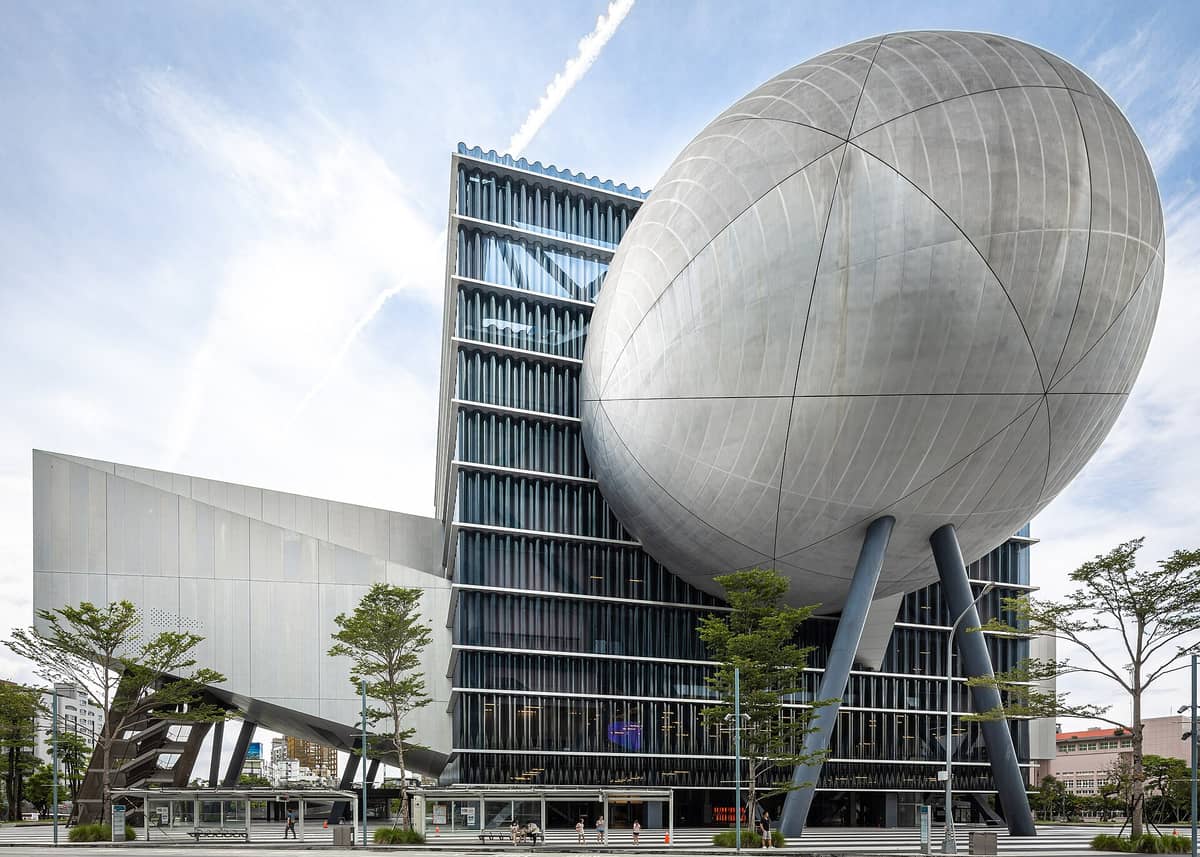
The building was designed by Dutch architect Rem Koolhaas and his firm OMA. Koolhaas, a Pritzker Architecture Prize laureate, approached the brief not as a conventional performing arts box but as a kind of industrial machine for culture: a large cube form with three separate theater volumes protruding from its faces, each at a different angle and scale. From the street, it reads as something between a science facility and a brutalist sculpture. Nothing about it is conventional, and that is entirely the point.
The complex houses three distinct performance spaces: the Grand Theater, the Globe Playhouse, and the Blue Box. Each is designed for different production scales and formats, from large-scale opera and dance to experimental and immersive works. Taken together, they give Taipei a genuinely flexible multi-theater facility that can serve both international touring productions and homegrown experimental work.
The Architecture: What Makes This Building Worth Seeing
Most performing arts buildings hide their machinery. TPAC does the opposite. The public loop route, available Wednesday through Sunday from 14:00 to 17:00 (last entry 16:15, free admission), takes visitors through circulation corridors and transitional spaces that deliberately expose backstage infrastructure: rigging systems, acoustic surfaces, loading routes, and the sheer scale of the fly towers above the stages. You are not watching theater; you are walking through the building's own internal logic.
💡 Local tip
The free public loop is one of the genuinely underused architectural experiences in Taipei. Arrive close to 14:00 on a weekday to walk it without crowds. Last entry is 16:15, so do not arrive late.
From the outside, the building is most dramatic when seen from ground level on Jiantan Road or from the footbridge connecting to the MRT station. The sphere of the Globe Playhouse protrudes through the cube's face in a way that looks structurally implausible from certain angles. In direct afternoon sunlight the polished surfaces reflect the surrounding streetscape in distorted patches. At dusk, when the building is lit from within, the effect is more monumental: the glowing volumes suspended in the Shilin skyline look genuinely unlike anything else in the city.
Visitors interested in Taipei's broader architectural range will find TPAC a useful counterpoint to the city's other major cultural buildings. Where the National Palace Museum in nearby Shilin uses classical Chinese palace forms, and where older institutions lean on postwar institutional architecture, TPAC is unambiguously contemporary and confrontational in its design language.
Opening Hours, Access, and How to Visit
The general venue and customer service areas are open daily from 12:00 to 21:00, with Mondays closed. The public loop self-guided visit runs Wednesday to Sunday, 14:00 to 17:00, with the last entry at 16:15 and free admission. For performances and daily guided tours, tickets are sold through the OPENTIX platform or at the venue's box office, with pricing set per event.
Getting here is straightforward. Take the MRT Tamsui–Xinyi Line (the Red Line) to Jiantan Station and exit via Exit 3. TPAC is about a two-minute walk from there. If you are already at Shilin Night Market, the building is visible from the market's main approach. For a broader look at how to navigate Taipei's MRT and bus network, the getting around Taipei guide covers the essentials, including EasyCard use and fare structures.
Accessibility is well-considered throughout the building. Accessible ramps are provided at the 1F entrance, the 2F footbridge, and the Chengde Road side entrance. Elevators connect to all main theater levels, including the Grand Theater, Globe Playhouse, and Blue Box. Accessible restrooms are distributed across multiple floors, a nursery room is available on 1F, and there are accessible parking spots at B1. Visitors with visual impairments can arrange guided assistance from Jiantan MRT Station to the building by contacting TPAC in advance by phone or email.
Attending a Performance: What to Expect
TPAC programs a wide range of work across the three stages. The Grand Theater handles large-format productions: opera, dance, and high-production theatrical works with substantial technical requirements. The Globe Playhouse, occupying the sphere that dominates the building's exterior, is designed for more flexible staging configurations. The Blue Box functions as a black-box experimental space suited to intimate and unconventional work.
Tickets are listed and sold through the OPENTIX platform, which covers many of Taiwan's performing arts venues. Prices vary significantly by production and seat location. TPAC programs both Taiwanese productions and international touring shows, so the calendar is genuinely varied. It is worth checking the schedule a few weeks in advance if you are planning a trip around a specific performance.
ℹ️ Good to know
TPAC's program mix leans toward contemporary and experimental work as much as classical forms. If you are expecting a conventional opera house experience, confirm the specific production before booking — the venue's programming philosophy is deliberately broad.
Performance nights bring a noticeably different atmosphere to the building and the surrounding block. Audience members in formal attire mix with the crowds spilling out of Shilin Night Market just meters away. It is an unusual juxtaposition: you can finish a contemporary dance performance and be eating oyster vermicelli within five minutes.
The Shilin Context: What's Around TPAC
Shilin is one of Taipei's larger northern districts, and the TPAC site sits at its most commercially active point. Shilin Night Market is essentially at your back door when you leave through the main entrance: one of Taipei's largest and most visited night markets, running from late afternoon into the early hours. If you are visiting on the afternoon public loop, it is easy to combine both in a single evening outing.
The National Palace Museum, which holds one of the world's most significant collections of Chinese art and artifacts, is also in Shilin District, roughly 15 to 20 minutes away by bus or taxi. It is a very different experience — classical collection, formal galleries — but pairing the two gives you a useful cross-section of how Taipei manages cultural heritage and contemporary ambition in the same district. Details on that collection are covered in the National Palace Museum guide.
For those interested in Taipei's broader range of museums and cultural institutions, the Taipei museums guide provides a useful overview of what the city offers across different neighborhoods and collections.
Practical Details and What to Know Before You Go
TPAC is closed on Mondays. If your Taipei schedule only permits a weekend visit, that is not a problem — the public loop runs Wednesday through Sunday. Plan to arrive between 14:00 and 16:00 for the self-guided access. The lobby café and public areas give you a reason to linger even outside loop hours.
Photography is generally permitted in public areas and on the loop route. The angular geometry of the building rewards wide-angle lenses, and the interplay of industrial materials with theatrical scale gives you unusual compositional opportunities that you will not find at most performing arts centers. Avoid using flash in any spaces that are adjacent to active rehearsal areas.
Taipei's summers are hot and humid, with temperatures regularly exceeding 33°C from June through September. TPAC is air-conditioned throughout, which makes an afternoon visit genuinely refreshing during peak summer months. There is no dress code for general access or the loop visit, though performances follow standard venue etiquette.
⚠️ What to skip
TPAC is not a conventional tourist attraction in the way that a night market or historic temple is. If you are visiting purely for visual spectacle without interest in architecture or performing arts, the experience may feel underwhelming. The building rewards curiosity, not passive sightseeing.
Travelers building a full Shilin day should consider combining TPAC with an evening at the night market and potentially a trip further north toward Beitou or Yangmingshan. The Taipei 3-day itinerary includes Shilin as a dedicated segment and can help structure the timing.
Insider Tips
- The public loop on a Wednesday or Thursday afternoon is notably quieter than weekends. You can move through the space at your own pace and spend more time at the sections that expose the theatrical rigging infrastructure above the stage volumes.
- The 2F footbridge connecting to Jiantan MRT Station offers one of the better elevated vantage points for photographing the building's exterior geometry. Most visitors walk straight through it without stopping.
- Check the OPENTIX calendar two to three weeks before your visit. TPAC occasionally programs free or reduced-price performances as part of outreach initiatives, particularly for experimental and local work in the Blue Box.
- If you are visiting Shilin Night Market in the evening after attending a performance or the loop, enter from the Jiantan side rather than the Zhongzheng Road entrance to avoid the densest crowds near the market's main indoor hall.
- TPAC's building acts as a landmark for orientation in the northern Shilin area. If you arrive at Jiantan MRT and feel disoriented, the building is visible from Exit 1 as well as Exit 3, and it anchors the surrounding street grid clearly.
Who Is Taipei Performing Arts Center For?
- Architecture enthusiasts and design students who want to see OMA's work outside of a glossy monograph
- Performing arts travelers looking for contemporary and experimental theater outside of East Asia's conventional touring circuit
- Budget travelers who want a high-quality cultural experience — the public loop is entirely free
- Visitors combining a cultural afternoon with a Shilin Night Market evening in a single outing
- Photographers looking for unconventional architectural subject matter in Taipei
Nearby Attractions
Other things to see while in Shilin District:
- National Palace Museum
The National Palace Museum in Shilin houses one of the largest and most significant collections of Chinese imperial art in the world. From jade carvings to ancient bronzes and delicate ceramics, a visit here offers a depth of history few museums anywhere can match.
- Qixing Mountain (Seven Star Mountain) Trail
The Qixing Mountain Trail (七星山步道) leads to the highest point in Taipei City at 1,120 metres, passing volcanic fumaroles, alpine meadows, and stone-paved ridges inside Yangmingshan National Park. The 4.5 km route is free, well-marked, and achievable in a half-day, making it one of the most rewarding hikes accessible by public bus from central Taipei.
- Shilin Night Market
Shilin Night Market is the largest and most visited night market in Taiwan, with over 500 stalls spread across several streets in Taipei's Shilin District. Free to enter and officially open every day from around 4 PM to midnight, it draws visitors with iconic street food, games, and an atmosphere that builds from early evening to full intensity after 8 PM.
- Shung Ye Museum of Formosan Aborigines
Located steps from the National Palace Museum in Shilin, the Shung Ye Museum of Formosan Aborigines is Taipei's most focused institution for understanding Taiwan's Indigenous peoples. Opened on June 9, 1994, it covers the traditions, material culture, and histories of Taiwan's 16 recognized Indigenous groups across four floors of carefully curated displays.