Taipei Grand Mosque: Taiwan's Largest Mosque in the Heart of Da'an
The Taipei Grand Mosque stands as Taiwan's largest and most significant Islamic place of worship, a quiet pocket of Middle Eastern-influenced architecture tucked into a tree-lined residential stretch of Da'an District. Free to visit and open daily, it offers a genuinely different perspective on Taipei's religious and cultural landscape.
Quick Facts
- Location
- No. 62, Section 2, Xinsheng South Road, Da'an District, Taipei
- Getting There
- Taipower Building Station or MRT Daan Forest Park Station (Tamsui-Xinyi Line), approx. 10–15-min walk
- Time Needed
- 30–60 minutes
- Cost
- Free admission
- Best for
- Architecture lovers, interfaith visitors, Muslim travelers seeking halal services
- Official website
- www.taipeimosque.org.tw/index.php?lang=eng
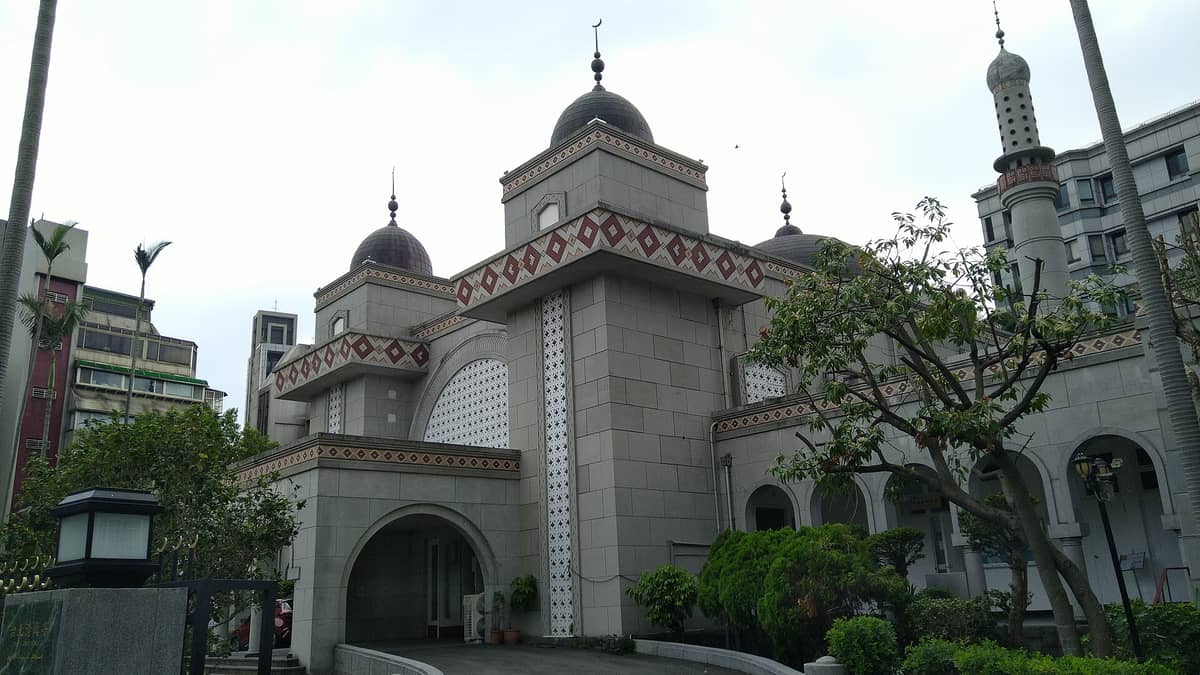
What Is the Taipei Grand Mosque?
The Taipei Grand Mosque, known in Chinese as 臺北清真寺, is Taiwan's largest mosque and the spiritual center of the island's Muslim community. It sits on a wide, tree-shaded plot along Xinsheng South Road in Da'an District, its pale green facade and white dome offering a striking visual contrast to the surrounding mid-rise apartment blocks and convenience stores. For many visitors, it is the last thing they expect to encounter in central Taipei, and that surprise is part of what makes it worth seeking out.
The mosque is an active place of worship, not a heritage site frozen in time for tourists. Prayers are held throughout the day, and Friday midday prayers draw a larger congregation. Visitors are welcome outside of prayer times, and the grounds are open and free of charge. The combination of architectural interest, cultural depth, and genuine religious activity makes this one of the more quietly compelling stops in the Da'an area.
⚠️ What to skip
Opening hours vary by source: some official listings give 09:00–20:00 daily with a Friday closure from 10:30–15:00 for Friday prayers, while others cite 08:00–16:00. Confirm current hours at taipeimosque.org.tw or recent government tourism pages before visiting.
A Brief History: Islam in Taiwan
Islam arrived in Taiwan primarily with the movement of Nationalist (Kuomintang) forces and associated civilian communities from mainland China following 1949. Many of these migrants were Chinese Muslims, known as Hui, who had practiced Islam in regions such as Yunnan, Gansu, and Xinjiang. The need for a permanent place of worship in the new capital led to the establishment of the Taipei Grand Mosque. The current building was completed in January 1960 and inaugurated on 13 April 1960.
Over the following decades, the Muslim population in Taiwan diversified. Indonesian and Malaysian workers, students, and professionals added to the community, as did migrants and visitors from across the Middle East and South Asia. Today the mosque serves a genuinely international congregation, and this multicultural character is quietly visible in the faces and languages you encounter on the grounds.
The Architecture: What to Look At
The Taipei Grand Mosque is designed in a broadly Arab-Islamic architectural style. The most prominent features are the central dome and the two flanking minarets, which rise above the surrounding neighborhood and are visible from Xinsheng South Road well before you reach the entrance. The facade is rendered in off-white and pale green, and the arched windows follow geometric proportions typical of classical mosque design.
Up close, the detailing rewards attention. The entrance archway carries Arabic calligraphy, and the interior prayer hall, visible from the doorway when the mosque is open to visitors, shows a clean, unadorned aesthetic: geometric tilework, directional alignment toward Mecca, and a mihrab niche in the qibla wall. Photography inside the prayer hall is generally not appropriate during active worship; use judgment and observe what others are doing.
The courtyard and the approach from the street are the most comfortable spaces for non-Muslim visitors to spend time. The grounds are quiet, shaded by mature trees, and feel noticeably removed from the street-level noise of Da'an's busier corridors a few blocks away.
Visiting as a Non-Muslim: What to Expect
Non-Muslim visitors are welcome, but this is a working mosque, not a tourist attraction in the conventional sense. Respectful behavior is the baseline expectation. Remove your shoes before entering the prayer hall. Dress modestly: shoulders and knees should be covered. Women may be asked to cover their hair when entering the main hall; carrying a scarf is practical preparation.
The atmosphere on a weekday morning is calm and largely unpeopled. You may encounter a few worshippers, mosque staff, or students from nearby National Taiwan University. Friday afternoon, by contrast, brings a significant congregation and the external approaches fill with people. If your interest is architectural, weekday mornings between 09:00 and 11:30 give the most unobstructed access and the best light on the facade from the east.
💡 Local tip
The best light for photographing the mosque's dome and minarets falls in the morning, when the sun is roughly behind you as you face the building from Xinsheng South Road. By mid-afternoon, the facade falls into shadow.
The Surrounding Area: Making a Day of It
The Taipei Grand Mosque sits in a section of Da'an that rewards unhurried walking. Daan Forest Park, one of Taipei's largest urban green spaces, is roughly a 10-minute walk from the mosque and makes a natural pairing, particularly on weekends when the park fills with locals. The Daan Forest Park is large enough to spend an hour in, and the contrast between the mosque's architectural formality and the park's open lawns gives the morning a satisfying range of textures.
The broader Da'an District is one of Taipei's most livable neighborhoods, known for its mix of universities, independent cafes, and food streets. Yongkang Street is a short walk away and offers some of the city's best soup dumplings, beef noodle soup, and bubble tea. If you are planning a wider circuit of Taipei's religious architecture, the Taipei temples guide covers the full range from Taoist and Buddhist sites to this mosque, giving useful context for how different traditions coexist in the city.
Travelers using the mosque visit as part of a Da'an or central Taipei itinerary can combine it with a walk past the Chiang Kai-shek Memorial Hall and the 228 Peace Memorial Park in Zhongzheng District, both accessible by MRT within a few stops.
Practical Notes: Getting There and Getting In
The most straightforward route is the MRT Tamsui-Xinyi Line to Daan Forest Park Station, followed by roughly a 15-minute walk north along Xinsheng South Road, or a shorter 10-minute walk from Taipower Building Station. The mosque is clearly visible from the street. There is no dedicated parking on-site, and the surrounding streets in Da'an are narrow; arriving by MRT or taxi is the practical choice.
Admission is free. There is no ticket booth and no queuing infrastructure. You simply walk into the grounds. The mosque has facilities including restrooms, and third-party accessibility listings suggest wheelchair access and accessible parking may be available, though this has not been confirmed by an official accessibility statement from the mosque itself. Verify directly if this is a requirement for your visit.
For Muslim travelers specifically, the Taipei Grand Mosque functions as a practical resource beyond worship. The surrounding area has halal restaurants and grocery options that have developed around the community over decades. Taipei's overall food scene is navigable for halal travelers, and the Taipei food guide covers dietary considerations including halal options across the city.
Who Might Not Enjoy This Visit
Visitors looking for interactive exhibits, audio guides, or the kind of curated tourist experience offered by Taipei's formal museums will find none of that here. The Taipei Grand Mosque is, at its core, a functioning religious site. The experience is observational and quiet. If you are not drawn to religious architecture or cultural context, a 30-minute visit may feel thin. Children under ten may not find much to hold their attention unless they are curious about the building itself.
During Friday prayer hours, access for non-Muslim visitors is effectively suspended. Arriving without checking the schedule can mean finding the grounds closed or crowded in ways that are not conducive to a relaxed visit.
Insider Tips
- Visit on a weekday morning between 09:00 and 11:30 for the calmest experience and the best natural light on the building's facade.
- Carry a scarf regardless of gender if you plan to enter the prayer hall. It shows respect and avoids any awkwardness at the entrance.
- The mosque is located close to several Indonesian and Malaysian restaurants that serve halal food, concentrated along the nearby streets. These are genuine community restaurants, not tourist-facing, and the food reflects that.
- Friday prayers draw a large, internationally mixed congregation. If you are interested in the community dimension of the mosque rather than the architecture, arriving just after 15:00 on a Friday lets you observe the tail end of activity as the congregation disperses.
- The trees on the grounds provide real shade, which matters in Taipei's summers. Pairing this stop with Daan Forest Park on a hot day gives you two consecutive shaded environments before returning to street-level heat.
Who Is Taipei Grand Mosque For?
- Muslim travelers seeking an active mosque and halal food resources in central Taipei
- Architecture enthusiasts interested in Islamic design within an East Asian urban context
- Travelers building a religion-and-culture day across Da'an and Zhongzheng districts
- Visitors who want a quiet, contemplative break from Taipei's denser commercial areas
- Anyone curious about the layers of mid-20th century migration history embedded in Taipei's cityscape
Nearby Attractions
Other things to see while in Da’an District:
- Da'an Forest Park
Spanning roughly 26 hectares in the heart of Taipei's Da'an District, Da'an Forest Park is one of the city's largest public green spaces. Free to enter and generally open day and night, it draws everyone from dawn joggers to evening picnickers, offering a rare patch of calm in a dense urban landscape.
- Tonghua (Linjiang) Night Market
Officially named Linjiang Street Tourist Night Market, Tonghua Night Market in Da'an District is where Taipei residents actually eat on weekday evenings. Free to enter, open nightly from 6PM to 12AM, and a short walk from Xinyi Anhe MRT Station, it offers a more relaxed alternative to the tourist-heavy Shilin Night Market.
- Yongkang Street
Yongkang Street in Da'an District is the address that put Taipei's food scene on the global map. Home to the original Din Tai Fung, a cluster of serious bubble tea shops, Japanese-era architecture, and a low-key residential calm that most tourist corridors lack, it rewards slow walking and repeat visits.