St. Augustine Historic District: Walking America's Oldest City
Founded by the Spanish in 1565, St. Augustine is widely recognized as the oldest continuously occupied European-founded city in the continental United States. Its cobblestone streets, 16th-century plaza, and coquina-stone fort make it one of Florida's most historically rich day trips. Walking the district costs nothing; individual attractions charge separately.
Quick Facts
- Location
- St. Augustine, FL — centered on Plaza de la Constitución and St. George Street, approx. 40 miles south of Jacksonville
- Getting There
- By car from Orlando: approx. 1.5–2 hrs via I-4 E and I-95 N. A free STAR Circulator Bus serves the downtown historic district, and separate trolley tours also operate in the area. Park at the Historic Downtown Parking Facility, beside the Visitor Information Center at 10 S. Castillo Dr.
- Time Needed
- Half day minimum; full day recommended to include the Castillo and multiple museums
- Cost
- Free to walk. Castillo de San Marcos: USD 15 for visitors age 16 and older; children 15 and under free with an adult (verify current rates before visiting)
- Best for
- History lovers, architecture enthusiasts, families, photographers, and anyone seeking a break from theme parks
- Official website
- www.citystaug.com
What the St. Augustine Historic District Actually Is
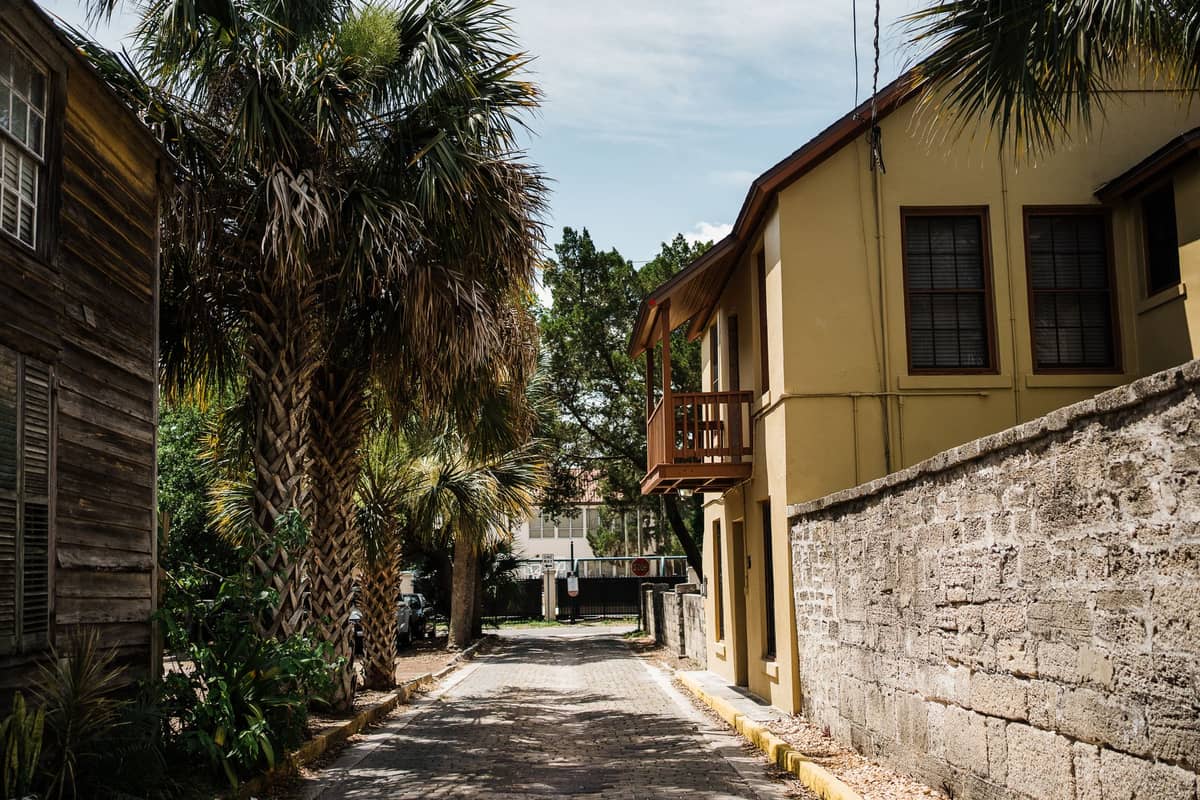
The St. Augustine Historic District is not a reconstructed colonial village or a themed entertainment zone. It is a living urban core where residents, restaurants, and businesses occupy buildings that trace their lineage to the Spanish colonial period. Many of the streets follow genuinely old alignments, and historic coquina stone walls in the core have been standing for centuries. That distinction matters, because it changes the texture of the experience entirely.
St. Augustine was founded by Spanish explorer Pedro Menéndez de Avilés in 1565, predating the English settlement at Jamestown by 42 years. It is widely recognized as the oldest continuously occupied European-founded city in the continental United States. The historic district preserves the spatial logic of the original colonial town, which was laid out under Spain's 1573 Laws of the Indies: a central plaza surrounded by the church, government buildings, and civic spaces, with a grid of streets radiating outward. That structure is still legible today.
The district was designated a National Historic Landmark on July 1, 1970. Its anchor is the Plaza de la Constitución, a rectangular public square that has functioned as the town center for over 450 years. Surrounding streets, particularly St. George, Aviles, and St. Francis, contain an unusually dense concentration of 18th- and 19th-century structures, many converted into shops, galleries, and museums.
💡 Local tip
Start at the St. Augustine Visitor Information Center (10 S. Castillo Dr., open daily 8:30 a.m. to 5:30 p.m.). It has the most convenient parking in the district, walking maps, and staff who can tell you which attractions have timed entry on busy weekends.
The Castillo de San Marcos: The Centrepiece Worth the Admission
No visit to the St. Augustine Historic District is complete without at least walking around the Castillo de San Marcos. This massive star-shaped fort, built from coquina, a local shell-stone, between 1672 and 1695, sits at the northern edge of the historic waterfront along the Matanzas River. Its silhouette against the water at sunrise is one of the more striking views in Florida.
Admission is USD 15 per visitor age 16 and older, with children 15 and under entering free when accompanied by a paying adult. The ticket is valid for seven consecutive days, so if you plan to return or linger, there is no need to rush through. The National Park Service manages the site; payment is typically accepted by card and cash. Ranger-led programs inside the fort explain the siege history and the ingenious properties of coquina, which absorbs cannonball impacts rather than shattering, effectively making the walls nearly indestructible with the weaponry of the era.
⚠️ What to skip
The Castillo's upper ramparts are exposed and offer no shade. In summer months, afternoon temperatures can be punishing. Visit the fort in the morning, before 10 a.m. if possible, and carry water.
Tickets & tours
Hand-picked options from our booking partner. Prices are indicative; availability and final rates are confirmed when you complete your booking.
St. Augustine guided day trip
From 78 €Instant confirmationFree cancellationSt. Augustine guided day trip including a hop-on hop-off trolleybus
From 103 €Instant confirmationFree cancellationSt. Augustine guided day trip including the Pirate and Treasure Museum
From 93 €Instant confirmationFree cancellationSt. Augustine guided day trip with admission to the Colonial Quarter
From 85 €Instant confirmationFree cancellation
Walking the District: What You See Street by Street
St. George Street is the district's main pedestrian artery, a narrow lane closed to vehicle traffic and lined with colonial-era facades. The street runs roughly north to south from the Old City Gates, a pair of coquina pillars dating to the early 1800s, down to the Plaza de la Constitución. On weekday mornings, before 10 a.m., the light is low and the crowds are thin enough to actually read the historical plaques and look at the architectural details. By midday on weekends, the street fills with tourists and the pace shifts from contemplative to festival-like.
Aviles Street, one block west of St. George, is a better choice for those who want less foot traffic. It runs past some of the oldest property lines in the district and contains several small galleries and the Oldest House (Gonzalez-Alvarez House), a museum managed by the St. Augustine Historical Society. The structure dates to the early 1700s, though its origins may predate that, and contains multiple layers of architectural history including Spanish, British, and American periods.
The Plaza de la Constitución, at the district's geographic center, is worth sitting in for twenty minutes. Its central monument and surrounding benches see a constant rotation of visitors and locals. The Cathedral Basilica of St. Augustine, on the plaza's northern edge, was originally built in 1793 and restored after an 1887 fire. Its bell tower is one of the most photographed corners of the city. Photography works best here in the late afternoon when the facade catches warm directional light from the west.
How the District Changes by Time of Day
Early morning, before 9 a.m., the historic district belongs to dog walkers, joggers, and a handful of visitors who have figured out what the crowds have not. The cobblestones are damp from overnight humidity, the air smells faintly of salt from the Matanzas River two blocks over, and you can stand in the plaza without anyone in your frame. This is the window for photography and for getting a genuine sense of the place's scale and quietness.
Midday brings the bulk of visitors: tour groups, trolleys, families with strollers, and the full complement of foot traffic that St. George Street accommodates. The district handles crowds reasonably well because of its street network, but the main pedestrian lane can feel congested between noon and 3 p.m. on weekends and during peak seasons.
Evening is a different city. Many of the daytime shops close by 6 or 7 p.m., but restaurants along the plaza and side streets stay active well into the night. The Spanish Colonial buildings glow under amber streetlights, and the atmosphere shifts from sightseeing to dining and ghost tour territory. St. Augustine has a well-established ghost tour industry, and several operators depart from the plaza after dark, which some visitors find a genuinely atmospheric way to hear the district's more macabre histories.
Getting There from Orlando: Day Trip Logistics
St. Augustine sits roughly 110 miles northeast of Orlando, a drive of approximately 1.5 to 2 hours depending on traffic via I-4 East and I-95 North. It is one of the most rewarding day trips from Orlando, especially for travelers who want a break from theme parks and want some genuine historical weight in their itinerary.
There is no direct public transit connection from Orlando to St. Augustine. A car is the practical necessity. Once in St. Augustine, park at the Historic Downtown Parking Facility at the Visitor Information Center on Castillo Drive. The facility is centrally located, reasonably priced, and walking distance from both the Castillo and St. George Street. A free STAR Circulator Bus runs through the downtown area if you need help covering distance within the district. Separate paid trolley and carriage tours provide narrated alternatives for those who prefer not to walk the full area.
ℹ️ Good to know
The brick and cobblestone surfaces on many historic streets can be uneven and difficult to navigate with standard wheelchairs or strollers. The STAR Circulator Bus is a very practical option for visitors with mobility considerations. Call ahead to individual museum sites for specific accessibility information.
If you are planning a broader Florida road trip, St. Augustine pairs naturally with a stop at Daytona Beach, which lies about 60 miles south along A1A. Alternatively, combine it with Kennedy Space Center for a day that covers both colonial history and space history, two of Florida's most distinctive draws.
Practical Notes: Weather, What to Bring, Who to Leave at Home
St. Augustine's climate mirrors Orlando's: humid subtropical, with hot and wet summers from June through September and milder, drier conditions from October through April. Summer visits are entirely feasible but require commitment: shade is limited on many of the open plazas and fort ramparts, afternoon thunderstorms are common, and the humidity is real. October through April is the more comfortable window, and winter weekdays offer the quietest conditions.
Wear comfortable, closed-toe shoes. The cobblestone and brick streets look charming in photographs but punish sandals and bare feet over a full day of walking. Bring sunscreen regardless of season. A refillable water bottle is worth having, as shade and seating are intermittent between major sites. For a broader sense of how to time a Florida trip, the best time to visit Orlando guide applies broadly to the region and can help calibrate expectations for weather across different months.
This attraction is not ideal for visitors who need constant sensory stimulation or structured entertainment. The historic district rewards people who are willing to read a plaque, look at a doorframe, or sit in a plaza and notice what is around them. It is genuinely quiet in the way that theme parks never are, and for some travelers, that is the best thing about it. For others, it might be slow.
Families with children do well here, particularly if the Castillo de San Marcos is on the itinerary. The fort's grounds give kids room to move, and the ranger programs hold attention better than most exhibit-only museums. For more ideas on keeping younger travelers engaged across the region, the Orlando with kids guide covers the wider Central Florida area.
Insider Tips
- The Castillo de San Marcos ticket is valid for seven consecutive days. Buy it on arrival and, if ranger cannon demonstrations are scheduled during your visit, you can return for one without paying again.
- Aviles Street, one block west of the main St. George Street corridor, has a fraction of the foot traffic and contains some of the district's oldest structures. Walk it first before the crowds arrive.
- The free STAR Circulator Bus connects the Visitor Information Center parking area with a loop route through the historic downtown. If you are visiting with someone who cannot walk long distances, plan your route around its stops.
- Evening ghost tours depart from the Plaza de la Constitución and typically run 90 minutes. Book in advance on busy weekends; they fill quickly from October through January when the weather is cooler.
- The Cathedral Basilica facade photographs best between 4 and 6 p.m. when the low western sun catches the tower directly. Midday light flattens the architectural detail.
Who Is St. Augustine Historic District For?
- History and architecture enthusiasts who want tangible colonial-era context rather than a reconstructed experience
- Families looking for an educational day trip from Orlando with a mix of outdoor space and museum content
- Photographers seeking pre-dawn or late-afternoon light on Spanish Colonial streetscapes
- Travelers on a Florida road trip who want a counterpoint to beach and theme park itineraries
- Couples looking for a slower-paced, walkable destination with good restaurants and evening atmosphere
Nearby Attractions
Combine your visit with:
- Blue Spring State Park
Blue Spring State Park in Orange City, Florida, is one of the state's most ecologically significant natural areas, drawing visitors year-round for manatee watching, swimming, tubing, and hiking. Located about 45 minutes from Orlando, it offers a genuine encounter with Florida's natural heritage that no theme park can replicate.
- Bok Tower Gardens
Bok Tower Gardens is a National Historic Landmark near Lake Wales, Florida, where a 205-foot Gothic and Art Deco carillon tower rises above one of the highest points on the Florida peninsula. Open since 1929, the sanctuary offers 250 acres of landscaped gardens, ancient oaks, and twice-daily bell concerts that carry across the surrounding pine scrub. It is one of the most genuinely peaceful places within day-trip distance of Orlando.
- Busch Gardens Tampa Bay
Busch Gardens Tampa Bay combines some of Florida's most intense roller coasters with one of North America's largest zoological collections. Located in north Tampa, it sits about 84 miles southwest of Orlando, making it a serious but rewarding day trip from the theme park capital of the world.
- Cocoa Beach
Cocoa Beach is Orlando's most accessible Atlantic beach, roughly an hour east on the Space Coast. It combines classic Florida surf culture with genuine rocket-launch proximity, free beach access, and a relaxed pace that stands apart from theme park crowds.