Kennedy Space Center Visitor Complex: A Complete Visitor Guide
Kennedy Space Center Visitor Complex is NASA's public gateway on Merritt Island, about an hour east of Orlando. From a Saturn V rocket the length of a football field to live launch viewing opportunities, this is one of the most substantive science and history attractions in the southeastern United States.
Quick Facts
- Location
- Space Commerce Way, Merritt Island, FL 32953 (approx. 1 hour east of Orlando)
- Getting There
- Car or organized tour only — no public transit serves the site directly. Parking is available on-site for an additional fee.
- Time Needed
- Full day (6–8 hours) to cover the major exhibits; half a day for highlights only
- Cost
- From $77 adults (12+), $67 children (3–11) plus tax; prices subject to change — confirm at kennedyspacecenter.com
- Best for
- Families, space enthusiasts, history buffs, anyone curious about human spaceflight
- Official website
- www.kennedyspacecenter.com
What Kennedy Space Center Visitor Complex Actually Is
Kennedy Space Center Visitor Complex is the publicly accessible face of an active NASA launch facility. This is not a replica or a science museum built around models — the hardware here is the real thing. The complex sits on Merritt Island on Florida's Atlantic coast, roughly an hour east of Orlando, and is one of the primary places where the general public can get close to a working spaceport.
Operated by Delaware North under a contract with NASA, the complex has grown significantly since its early days as a basic bus-tour stop. Today it covers multiple large indoor and outdoor exhibition areas, an IMAX theater, and the bus tour that takes visitors into restricted NASA property to reach the Apollo/Saturn V Center. The scale is genuinely impressive and, for visitors who care about the subject, the depth of content rewards a full day.
That said, if space history is not your focus, parts of the experience can feel slow or repetitive. Visitors primarily chasing thrill rides or fast-paced entertainment may find it more cerebral than expected. If you are looking for a broader overview of Orlando's major attractions, the Orlando theme parks guide covers the full landscape of options across the region.
💡 Local tip
Book tickets online in advance. On-site window prices are the same, but pre-purchasing lets you skip queues at the ticket counter and walk straight to the entry gates — especially useful during peak holiday periods.
The Apollo/Saturn V Center: The Centerpiece
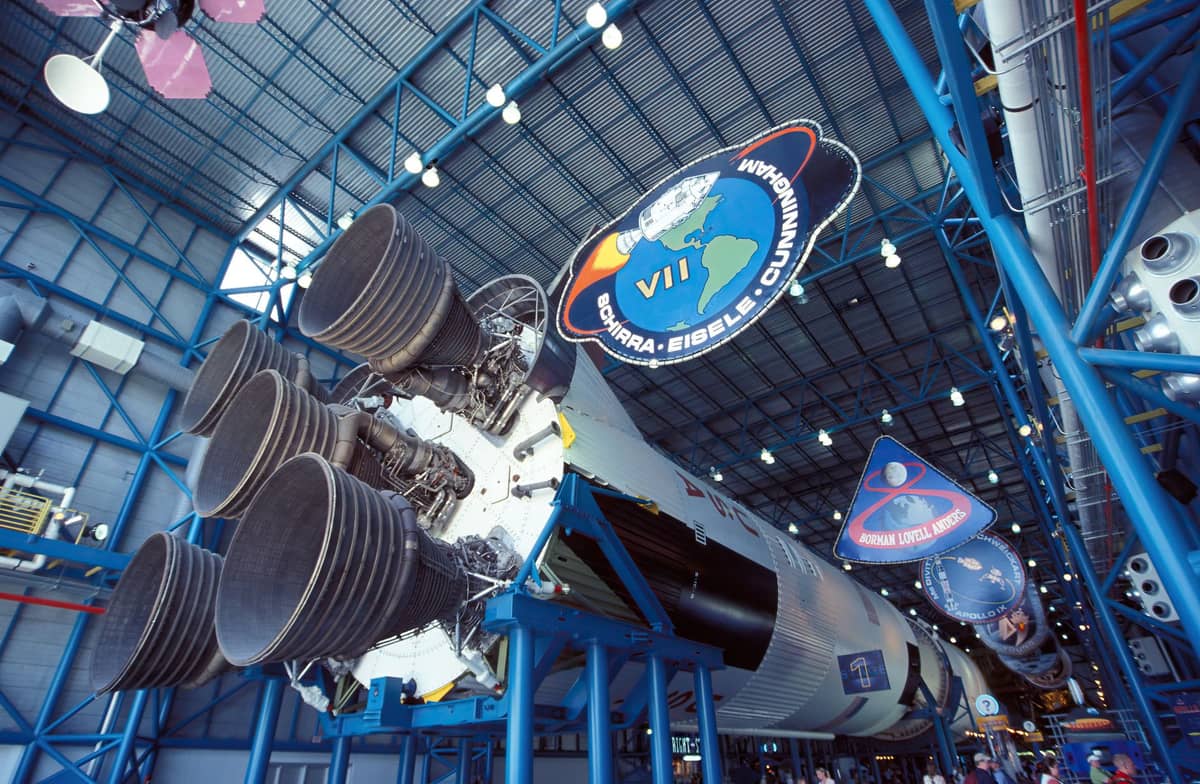
The Saturn V rocket housed inside the Apollo/Saturn V Center is, without exaggeration, one of the most impressive objects on public display anywhere in the world. At 363 feet (110 meters) long and suspended horizontally at roughly eye level, the scale of it is disorienting in the best possible way. Standing next to the F-1 engines at the base of the rocket — each engine bell alone is taller than most adults — reorients your understanding of what Apollo-era engineers built in the 1960s.
The building that contains it is enormous, but the rocket fills it. The lighting inside is warm and deliberate, picking out the details of each stage. The surrounding exhibits cover the Apollo program from Mercury through the lunar landings, with mission artifacts, spacesuits, and crew capsules that show real wear and heat scarring from reentry. This is a place to slow down and look carefully.
Access is by the included bus tour from the main complex, which runs throughout the day. The buses also pass launch pads and other active NASA facilities, though you view these from a distance. Allow at least 90 minutes at the Saturn V Center alone, more if you read the exhibit panels thoroughly.
ℹ️ Good to know
The last bus tour typically departs well before the complex closes. Check the daily schedule board near the bus tour entrance early in your visit — do not leave this for the end of the day.
Tickets & tours
Hand-picked options from our booking partner. Prices are indicative; availability and final rates are confirmed when you complete your booking.
Kennedy Space Center Admission + Chat with Astronaut
From 112 €Instant confirmationKennedy Space Center Adults at Kids Rates entry including add-on products
From 0 €Instant confirmationKennedy Space Center day trip with express transportation
From 149 €Instant confirmationFree cancellationChat with an Astronaut and Kennedy Space Center Tour from Orlando
From 200 €Free cancellation
The Main Complex: What Else to Expect
The main visitor complex at the entrance contains several distinct zones. The Heroes and Legends exhibit covers NASA's astronaut corps from the Mercury Seven forward, with immersive audio and display components. The Space Shuttle Atlantis display is a separate high point: the orbiter is tilted at 43 degrees in a posed position that mimics its orientation in space, with its payload bay doors open. Walk-around views from multiple levels let you inspect the tiles, the engines, and the crew compartment windows in detail.
There are also outdoor rocket gardens where you can walk among a collection of early American launch vehicles — Redstones, Atlases, Titans — standing upright against the Florida sky. Early morning, when light is soft and crowds are thin, the rocket garden is the most photogenic spot on the property. The contrast of 1950s-era metal against the blue Atlantic sky reads well in photographs and feels strikingly human in scale compared to the Saturn V.
An IMAX-format theater runs rotating films on space exploration topics. These are worth attending if you have children in your group or want a seated rest midday; the films are generally well-produced. Dining options are plentiful but unremarkable — standard theme park food court fare at theme park prices. Bring snacks if you are watching your budget.
How the Experience Changes by Time of Day
The complex opens daily at 9:00 a.m., and arriving at or just before opening makes a noticeable difference. The rocket garden and outdoor areas are coolest and least crowded in the first hour. By late morning, tour groups arrive in volume and the indoor exhibits, particularly the Shuttle Atlantis hall, fill up. Lines for the bus tour build quickly after 10:00 a.m.
Midday in summer is the hardest part of a visit. Florida heat from June through September is intense, and significant portions of the main complex require walking between buildings. The Apollo/Saturn V Center, being fully enclosed, becomes the best midday refuge. Afternoon often brings brief thunderstorms, which are a near-daily occurrence on Florida's Space Coast in summer. This rarely forces a full closure but can disrupt outdoor touring.
Late afternoon, as crowds thin before closing, is a good time to revisit any exhibits you rushed through. The atmosphere shifts noticeably in the final hour — less noise, more space to stand in front of the exhibits without other visitors in your sightline. Closing times vary by season, so check the official hours page before your visit.
⚠️ What to skip
Summer afternoon thunderstorms are common and can temporarily halt outdoor activities. If you are visiting June through September, plan to do outdoor areas in the morning and save indoor exhibits for the afternoon.
Getting There: The Logistics Are Real
Kennedy Space Center Visitor Complex is located on Space Commerce Way, Merritt Island, approximately 45–50 miles east of downtown Orlando — roughly a one-hour drive depending on traffic. There is no public transit connection to the site. LYNX bus service and SunRail do not extend to Merritt Island. Your practical options are driving your own vehicle, renting a car, booking an organized day-tour from Orlando, or arranging a private transfer.
If you are staying in the International Drive area or near the Walt Disney World corridor and do not have a rental car, an organized day-tour is the most practical option. Several operators run round-trip coaches from the Orlando hotel strip, typically including admission. These tours add structure but also add time — departures are usually by 8:30 a.m. for a reason.
Parking at the complex is available for a separate fee. The drive east on State Road 528 (the Beachline Expressway) is a toll road, so have cash or a SunPass transponder ready. The approach to Merritt Island itself, crossing over the Indian River Lagoon, is scenic and gives the visit a sense of destination.
Practical Notes: Weather, Accessibility, and What to Bring
Florida's humid subtropical climate means heat and sun are factors for most of the year. October through April offers the most comfortable visiting conditions, with lower humidity and generally fewer intense afternoon thunderstorms than peak summer. If you are planning a broader Florida trip, the best time to visit Orlando guide covers seasonal patterns in detail.
Comfortable walking shoes are non-negotiable. The distances between buildings are considerable, and the bus tour involves boarding and alighting at multiple stops. Bring sunscreen, a hat, and a refillable water bottle — there are water stations throughout the complex. Sunglasses are useful both outdoors and inside the Shuttle Atlantis exhibit, where lighting contrasts between illuminated displays and darker surrounding areas.
Accessibility is well-provided for: the complex features wide, flat paved paths, ramps, elevators, and accessible buses for the bus tour to the Apollo/Saturn V Center. Wheelchair and scooter rentals are available on a first-come basis. Guests requiring specific accommodations can contact the complex at 1-855-433-4210 before their visit. Reserved front-row viewing spaces are available for wheelchair users at presentation areas.
Photography is permitted throughout, including in the Shuttle Atlantis hall and the Saturn V Center. A wide-angle lens or phone camera with a wide setting helps with the rocket and shuttle interiors, where scale makes standard focal lengths difficult to use. Flash is not necessary in the well-lit exhibit spaces.
If a Launch Is Scheduled, Prioritize It
Kennedy Space Center is an active launch facility, and scheduled launches from nearby Cape Canaveral Space Force Station or from KSC's own launch complex 39 pads are visible from the visitor complex and from public viewing areas on the Space Coast. Launch schedules are published on NASA and Space Force websites but are subject to frequent scrubs and delays. If a launch coincides with your visit, it transforms the entire experience.
The visitor complex sells dedicated launch viewing packages that provide access to specific viewing sites closer to the pads than the general public can reach. These sell out well in advance and carry an additional cost above general admission. Even from the main complex grounds or from the public Banana Creek viewing area, a launch is audible and visible in a way that photographs cannot adequately convey — the sound arrives several seconds after ignition and is felt as much as heard.
💡 Local tip
Even if no launch is scheduled during your visit, check the Space Coast launch schedule a few weeks out. Launches from Cape Canaveral are sometimes visible from as far away as Orlando's downtown lakefront, so staying flexible about timing can pay off.
Insider Tips
- Take the bus tour as early in the day as possible — ideally on one of the first departures after opening. The Apollo/Saturn V Center is large and immersive, and arriving early gives you time to absorb it before the afternoon school groups and tour buses arrive.
- The Astronaut Encounter program, where a NASA astronaut speaks and takes questions, is included with admission and held at specific times during the day. Check the daily schedule board at the entrance and plan your day around it — it is genuinely not the same as watching a documentary.
- If you want the best photo of Space Shuttle Atlantis without other visitors in the frame, be in the Shuttle Atlantis exhibit within the first 30 minutes of opening. The lighting in the hall is designed for drama, and the early-morning quiet allows for compositions that are impossible by 11 a.m.
- The Rocket Garden is best experienced at opening or in the late afternoon golden hour. Most visitors walk through it quickly on their way to other exhibits, but it rewards slow, close inspection — the engineering details on each vehicle are visible and labeled.
- If you are visiting with children under 10, the Planet Play indoor area near the main complex provides a hands-on space-themed play area that serves as a useful energy release. Budget time for it before or after lunch so it does not fragment the flow of the exhibits.
Who Is Kennedy Space Center Visitor Complex For?
- Families with school-age children who have any interest in science, engineering, or exploration
- Space enthusiasts and amateur astronomers who want to see real flight hardware up close
- History travelers drawn to Cold War-era technology and the Space Race narrative
- Photographers looking for dramatic industrial subjects on an unusual scale
- Day-trippers from Orlando seeking something substantively different from theme parks
Nearby Attractions
Combine your visit with:
- Blue Spring State Park
Blue Spring State Park in Orange City, Florida, is one of the state's most ecologically significant natural areas, drawing visitors year-round for manatee watching, swimming, tubing, and hiking. Located about 45 minutes from Orlando, it offers a genuine encounter with Florida's natural heritage that no theme park can replicate.
- Bok Tower Gardens
Bok Tower Gardens is a National Historic Landmark near Lake Wales, Florida, where a 205-foot Gothic and Art Deco carillon tower rises above one of the highest points on the Florida peninsula. Open since 1929, the sanctuary offers 250 acres of landscaped gardens, ancient oaks, and twice-daily bell concerts that carry across the surrounding pine scrub. It is one of the most genuinely peaceful places within day-trip distance of Orlando.
- Busch Gardens Tampa Bay
Busch Gardens Tampa Bay combines some of Florida's most intense roller coasters with one of North America's largest zoological collections. Located in north Tampa, it sits about 84 miles southwest of Orlando, making it a serious but rewarding day trip from the theme park capital of the world.
- Cocoa Beach
Cocoa Beach is Orlando's most accessible Atlantic beach, roughly an hour east on the Space Coast. It combines classic Florida surf culture with genuine rocket-launch proximity, free beach access, and a relaxed pace that stands apart from theme park crowds.