Spinola Bay: Malta's Most Photogenic Fishing Harbour
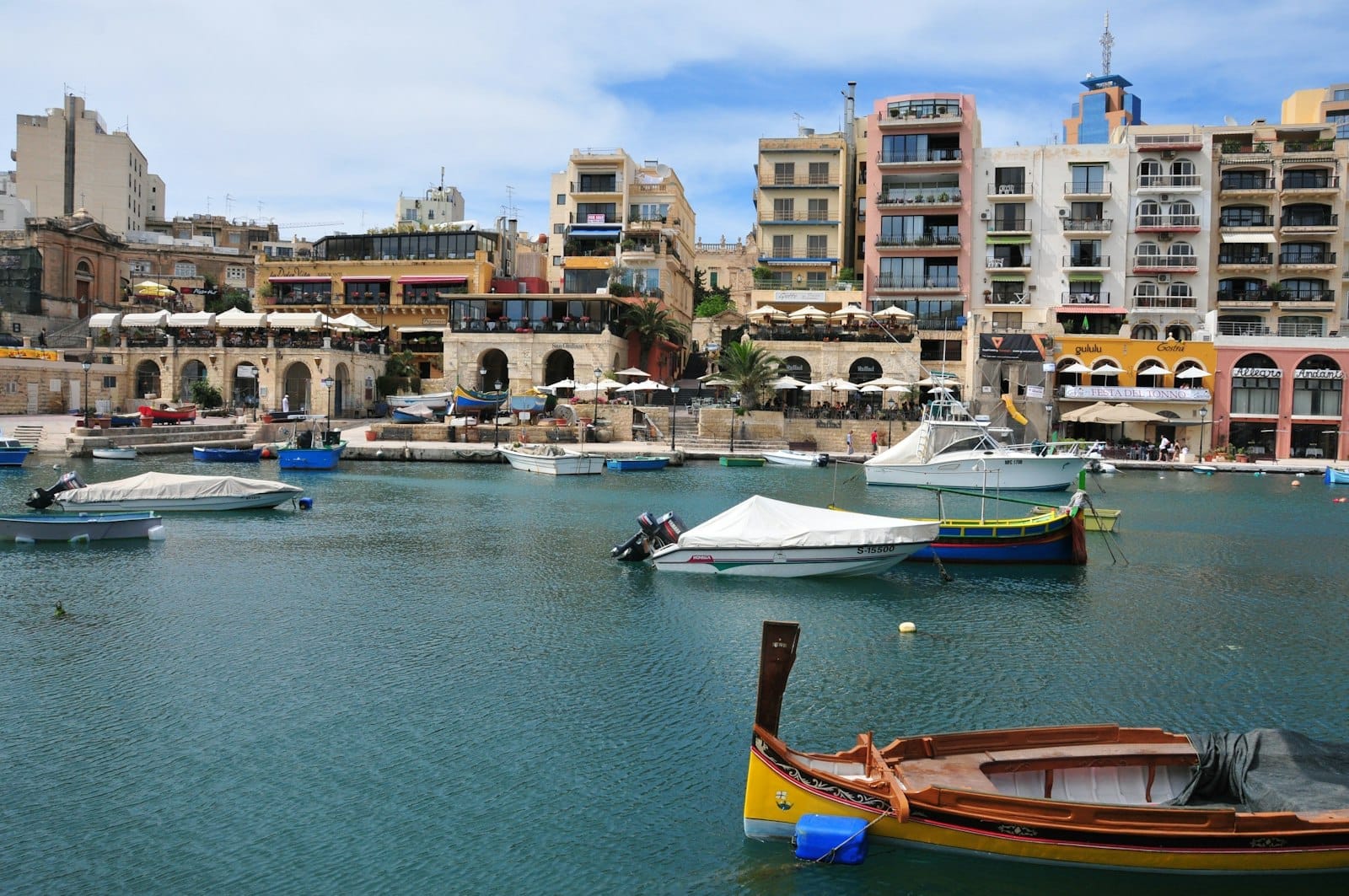
Spinola Bay sits at the heart of St. Julian's, where traditional painted luzzu fishing boats bob in still water just metres from busy restaurant terraces. It's free, accessible around the clock, and surprisingly easy to combine with the wider Sliema-St. Julian's promenade walk.
Quick Facts
- Location
- Spinola Bay, St. Julian's, Malta
- Getting There
- Buses 13, 14, or 16 from Valletta (approx. 25-30 min); stop along the bay
- Time Needed
- 30-60 minutes for the bay itself; 2-3 hours with a meal and promenade walk
- Cost
- Free public access, 24/7, no admission required
- Best for
- Waterfront photography, sunset dining, evening strolls, couples
What Spinola Bay Actually Is
Spinola Bay (Il-Bajja ta' Spinola in Maltese) is a small, sheltered inlet on the St. Julian's waterfront, framed on three sides by restaurants, apartment buildings, and the occasional limestone boathouse. It is not a swimming beach. The water is calm, the shoreline is rocky, and the bay's real draw is its composition: a cluster of traditional luzzu fishing boats, painted in bold primary colours with the Eye of Osiris on each bow, riding quietly on flat green water while the café terraces above fill with people.
For a country with hundreds of kilometres of coastline, Spinola stands out because it keeps its working-harbour character intact despite sitting in the middle of one of Malta's most commercial districts. That contrast is precisely what makes it worth your time.
ℹ️ Good to know
Spinola Bay is a public outdoor space, open and free 24 hours a day, 365 days a year. There are no gates, ticket booths, or entrance requirements of any kind.
The History Behind the Bay
The bay takes its name from Spinola Palace, a 17th-century mansion built by Fra Paolo Spinola, a Knight of the Order of St. John. The palace was enlarged in the 18th century and still stands above the bay today, though modern apartment blocks now obscure most of its facade from waterfront level. For centuries the bay served as a working fishing harbour for the surrounding communities of St. Julian's.
The luzzu boats you see today are the direct descendants of that fishing tradition. These brightly painted wooden vessels, believed by some historians to trace their design back to Phoenician craft, are one of Malta's most recognisable symbols. Understanding their presence at Spinola makes the scene feel less like decoration and more like continuity. For wider context on the Knights who shaped this coastline, the Knights of Malta history guide fills in the detail.
Tickets & tours
Hand-picked options from our booking partner. Prices are indicative; availability and final rates are confirmed when you complete your booking.
City Sightseeing hop-on hop-off bus tour of Gozo
From 20 €Instant confirmationFree cancellationThe Malta Experience Audio-Visual Show and La Sacra Infermeria Tour
From 20 €Instant confirmationFree cancellationLuggage Storage in Malta
From 6 €Instant confirmationFree cancellation6-day heritage and attractions pass in Malta
From 80 €Instant confirmationFree cancellation
How the Bay Changes Through the Day
Early morning, roughly 7-9am, is when Spinola Bay is most atmospheric and least crowded. The light is low and lateral, catching the painted hulls of the luzzu boats against the pale limestone buildings. Fishermen occasionally attend to their craft, and the restaurant staff are just setting out chairs. The smell is salt water and fresh coffee from the bakeries nearby. If you want photographs without other tourists in them, this is your window.
By late morning the tour groups and day visitors arrive, and the bay becomes a backdrop for the lunch crowd. Tables fill quickly on weekends from around noon. The light is high and flat through the middle hours, which is less interesting for photography but perfectly fine for sitting with a Kinnie or a glass of local wine while watching the boats.
Sunset is the peak hour. The western-facing bay catches the last light, turning the water copper-gold and silhouetting the luzzu masts. It is also the most crowded hour by a significant margin. Restaurant reservations for terrace tables overlooking the water are advisable from spring through October, particularly on weekends. If you want the golden-hour view without the wait, arrive 30 minutes before sunset, find a spot along the low harbour wall, and watch from there.
💡 Local tip
For the best photography, come between 7 and 9am in summer or 8 and 10am in winter. The light is warm and directional, crowds are thin, and you'll have the luzzu boats largely to yourself.
Walking the Waterfront: What to Expect
The promenade around Spinola Bay is flat and paved, taking about 10 minutes to walk end to end at a leisurely pace. It connects southward toward Balluta Bay, a quieter pocket of water with a small sandy patch that is calmer and less photographed. North of Spinola, the promenade continues into the broader Sliema waterfront walk, one of the longer and more rewarding coastal strolls in Malta.
The Sliema promenade runs several kilometres and makes a logical extension if you have a couple of hours. In the opposite direction, the St. Julian's restaurant strip leads toward Paceville, Malta's main nightlife district, which is a markedly different atmosphere after dark.
The bay itself has no easy water access for swimming. The shoreline drops directly off the harbour wall and the bottom is rocky. Families or swimmers should head to St. George's Bay, roughly a 15-minute walk north, which has a sandy beach and shallow entry. Rocky coves for more experienced swimmers exist along the coast but require navigation of the surrounding streets to find.
⚠️ What to skip
Do not attempt to swim directly from Spinola Bay. The harbour walls are steep, the bottom is rocky, and there are no lifeguards. St. George's Bay, a short walk away, is the nearest proper swimming spot.
Eating and Drinking Around the Bay
The restaurants circling Spinola Bay cover a range of budgets and cuisines, though seafood is the obvious focus. Several of Malta's better-regarded fish restaurants have established themselves here precisely because of the setting. Prices at waterfront tables reflect the view: expect to pay more than you would a few streets inland for similar food. The quality is not uniformly high, so treat the setting as a bonus rather than a guarantee of quality.
For a more casual option, the small cafés and kiosks near the bay sell pastizzi (flaky pastry filled with ricotta or mushy peas), sandwiches, and coffee. These are significantly cheaper than the sit-down restaurants and perfectly suited to a quick stop during a longer walk. If you want to eat well in the area, asking hotel staff or locals for their current recommendation is more reliable than walking into the first terrace with an English menu.
Practical Details for Visitors
Getting here from Valletta is straightforward. Buses 13, 14, and 16 run from Valletta's main bus terminus and take approximately 25-30 minutes, stopping along the St. Julian's waterfront close to Spinola Bay. The single-journey bus fare is €2. Ride-hailing apps Bolt and Uber both operate in Malta and are often faster, particularly in the evening when buses can be slow.
Parking in St. Julian's is limited and frustrating during peak hours. If you are driving, allow extra time and consider the paid parking areas slightly further from the waterfront. Walking from Sliema, where parking is sometimes easier to find, takes about 20-30 minutes along the promenade and is a pleasant option in good weather.
The promenade surface is smooth and flat, making it accessible for wheelchair users and pushchairs along the main path. Step-free access to some of the restaurants is less consistent, and it is worth checking with individual venues in advance. Malta's spring and autumn months (April to June, September to October) offer the most comfortable outdoor temperatures for a waterfront visit. For timing your broader trip, the best time to visit Malta guide breaks down the seasonal differences in detail.
Summer visits (July and August) mean intense heat through the middle hours. The bay is at its most photogenic and most crowded during these months. Winter evenings can be cool, and the restaurants thin out, but the bay itself retains its character year-round. A light jacket is useful from November through March.
Is Spinola Bay Worth Your Time?
For most visitors to Malta, yes, though it depends on your expectations. If you are looking for a beach, this is not it. If you are looking for a dramatic, large-scale attraction, the bay is modest in scale. What Spinola Bay offers is an authentic piece of Maltese coastal identity in an accessible, walkable setting, with good food and drink options nearby and strong photographic potential at the right hour.
Visitors who may find it less compelling: those with very limited time who need to prioritise Malta's world-class historical sites, or travellers who have already seen similar Mediterranean fishing-harbour scenes elsewhere. For those on a longer stay, Spinola Bay works well as part of a broader things to do in Malta itinerary, particularly when combined with the Sliema promenade walk and a visit to the nearby St. Julian's and Sliema district.
Insider Tips
- The low harbour wall on the south side of the bay gives an unobstructed view of the luzzu boats with the restaurant buildings as a backdrop. It is a better photography position than the restaurant terraces themselves, which look down rather than across.
- Several of the luzzu boats are privately owned by families who have fished from this bay for generations. If a fisherman is working on his boat and you want to photograph it up close, a polite request and a friendly greeting in Maltese (bongu, good morning) will usually be met warmly.
- Balluta Bay, a 10-minute walk south, has a small sandy patch and significantly fewer people than Spinola even on busy summer weekends. It also has a striking Art Deco apartment building on its waterfront worth seeing in its own right.
- If you are eating at the waterfront restaurants and want a terrace table with a clear view of the water, book specifically for sunset and arrive a few minutes early. Restaurants frequently seat walk-ins at less desirable interior tables even when terrace spots appear available.
- The bus stop for the return journey to Valletta is on the main road above the bay rather than at waterfront level. Allow a couple of extra minutes to walk up from the harbour.
Who Is Spinola Bay For?
- Couples looking for a scenic evening walk and waterfront dinner
- Photographers wanting traditional Maltese boat imagery at golden hour
- Travellers combining a leisurely half-day walk from Sliema to St. Julian's
- Visitors wanting a relaxed, free outdoor experience between more demanding historical sites
- Families with young children who need a flat, safe walking environment near cafés
Nearby Attractions
Other things to see while in Sliema & St. Julian's:
- Paceville
Paceville is the beating heart of Malta's nightlife scene, a compact district in St. Julian's where around 40 bars and clubs, a casino on a historic peninsula, a public beach, and a shopping complex coexist within a handful of streets. It's not about architecture or culture — it's about energy, and it delivers that from dusk until well past dawn.
- Sliema Promenade
Stretching roughly 3 to 5 kilometres along the northeastern coast of Malta, the Sliema Promenade connects Tigné Point to Balluta Bay with unbroken sea views, historic watchtowers, and one of the island's best vantage points toward Valletta. It is free, open around the clock, and accessible by bus or ferry.