Shibuya Crossing: Inside the World's Most Famous Intersection
Shibuya Scramble Crossing is a free, open-air spectacle where up to a few thousand people cross simultaneously from five directions every few minutes. Whether you join the flow or watch from above, it delivers one of Tokyo's most visceral urban moments.
Quick Facts
- Location
- 2-2-1 Dogenzaka, Shibuya-ku, Tokyo 150-0043 (Hachikō Exit, Shibuya Station)
- Getting There
- Shibuya Station (JR Yamanote Line, Tokyo Metro Ginza/Hanzomon/Fukutoshin Lines, Tokyu Toyoko/Den-en-toshi Lines, Keio Inokashira Line) — 1 min walk
- Time Needed
- 15–45 min at street level; 1–2 hrs if combining with elevated viewpoints or nearby streets
- Cost
- Free (public intersection). Paid viewpoints nearby are optional.
- Best for
- First-time visitors, photographers, urban culture enthusiasts, evening walkers
- Official website
- www.gotokyo.org/en/spot/1749/index.html
What Shibuya Crossing Actually Is
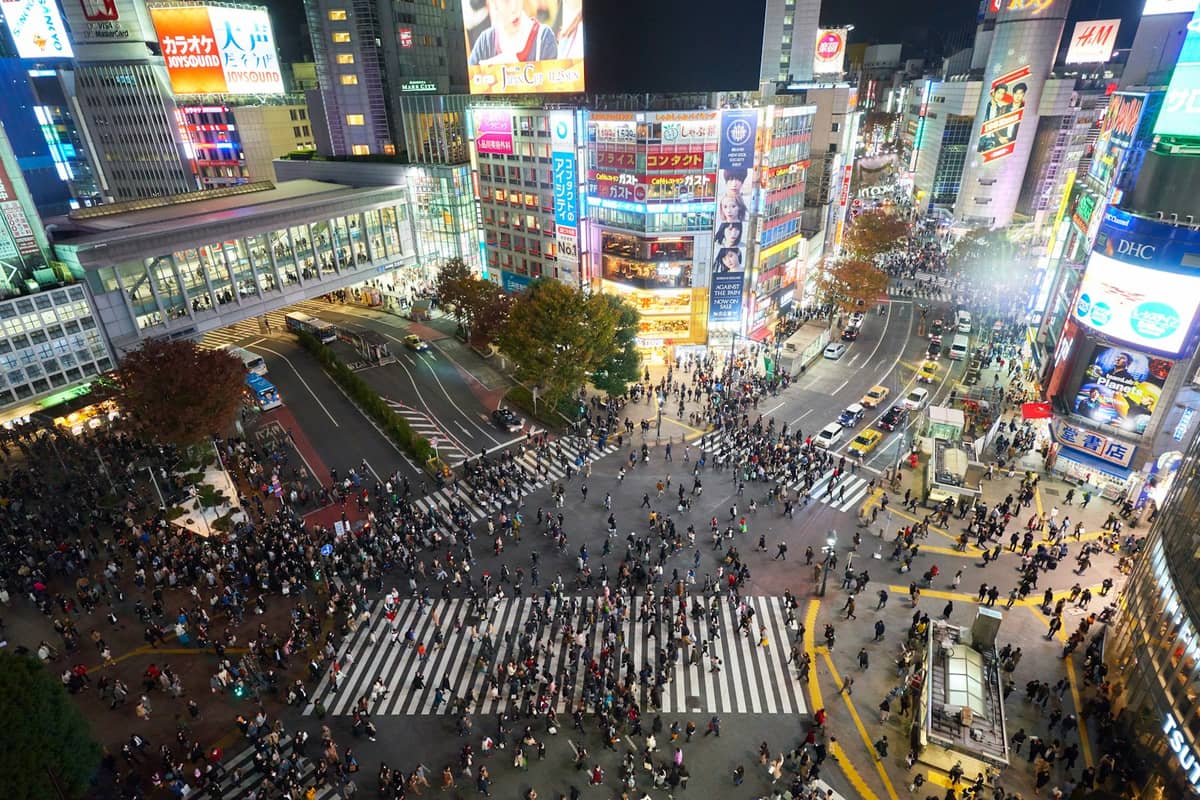
Shibuya Scramble Crossing, formally known in Japanese as 渋谷スクランブル交差点 (Shibuya sukuranburu kōsaten), is a scramble intersection directly in front of Shibuya Station's Hachikō Exit. In a scramble crossing, all vehicle traffic stops simultaneously, and pedestrians are permitted to cross in every direction at once, including diagonally. The result, especially during peak hours, is a controlled flood of bodies moving in all directions without apparent collision.
Estimates of pedestrian volume vary by source and time of day, but the crossing is consistently listed among the busiest in the world. During weekday evening rush hours and weekend afternoons, a single green-light cycle can send hundreds of people across from five approach points. The whole thing resets every few minutes. It is not a curated attraction. There is no entry gate, no ticket booth, no guided route. It is simply a street corner that happens to operate at a scale most cities cannot match.
ℹ️ Good to know
The crossing is open 24 hours as a public street. No tickets required. Just exit Shibuya Station at the Hachikō Exit and it is directly in front of you.
How the Experience Changes by Time of Day
The crossing looks and feels radically different depending on when you visit, and choosing the right time shapes the entire experience. Early morning, before 8 a.m., the intersection is surprisingly quiet. A few delivery workers, early commuters, and the occasional tourist with a camera occupy what will later become an ocean of people. The scale of the surrounding buildings, the giant video screens on the Tsutaya and Q-Front facades, the tangle of overhead wiring: all of it becomes easier to absorb when the crowds thin out.
Weekday mornings from around 8 to 9:30 a.m. produce the first real surge. Salarymen in dark suits, students, and retail workers converge from multiple train lines. The crowd is purposeful and fast-moving. Midday is moderate: busy by any normal city's standard, but not the spectacle first-time visitors usually imagine. The real density hits on weekday evenings from around 5 to 8 p.m., and on weekend afternoons from roughly noon onward.
Weekend evenings, particularly Friday and Saturday nights, are when Shibuya Crossing becomes theatrical. The neon output from surrounding screens is strongest after dark, the crowd mixes locals and tourists more visibly, and the sound level shifts from ambient urban noise to something more charged. Rain actually amplifies the visual drama: reflections of the screens ripple across the wet asphalt, and a sea of umbrellas creates an entirely different kind of spectacle.
💡 Local tip
For photography, overcast evenings are better than clear nights. The diffused light softens the harsh screen glare and evens out exposures across the crossing.
Tickets & tours
Hand-picked options from our booking partner. Prices are indicative; availability and final rates are confirmed when you complete your booking.
Bar-hopping night tour of Shibuya
From 61 €Instant confirmationFree cancellationShibuya Food Tour
From 163 €Instant confirmationFree cancellationShibuya Udagawacho Tokyo Dining Experience at an Izakaya Restaurant
From 35 €Instant confirmationFree cancellationBest Japanese regional food tour in Tokyo's Shibuya
From 129 €Instant confirmationFree cancellation
The View From Street Level vs. From Above
Crossing on foot is a different experience from watching. On the street, the scale disappears: you are simply one person navigating through a crowd, which moves more smoothly than it looks from above. The human stream is self-organizing. People fan out, adjust trajectory, and generally avoid contact. What feels chaotic from a rooftop is, at street level, a kind of practiced choreography.
The classic overhead view, the one reproduced in films and travel imagery, requires some elevation. One historically popular free vantage point was the second-floor window of the Starbucks inside the former Tsutaya building on the northeast corner of the crossing, though current tenants and layouts may change over time. Seating near the window is first-come, first-served, and competition for those spots is real, especially on weekends. Arrive, order, and move quickly if this is your priority.
For a paid but panoramic perspective, Shibuya Sky, the observation deck atop the Scramble Square tower, offers a direct aerial view of the crossing from around 230 meters. It requires advance booking and has a separate admission fee, but the view extends across the Shibuya basin and well beyond. It is a different experience from the Starbucks window, more composed and less spontaneous.
💡 Local tip
The walkway between Shibuya Station and the Shibuya Mark City complex also provides an elevated angle at no charge, though the view is slightly more oblique than Scramble Square.
Historical and Cultural Context
Shibuya's transformation into one of Tokyo's primary commercial hubs accelerated significantly in the postwar period, driven by the convergence of multiple rail lines at Shibuya Station and subsequent retail and entertainment development around the terminal. The scramble crossing configuration formalized what was already an extremely high-volume intersection, prioritizing pedestrian throughput by clearing all vehicular traffic simultaneously.
The crossing became internationally recognizable in part through film and media exposure. It appears in numerous movies, music videos, and advertising campaigns as shorthand for Tokyo's density and energy. That visibility created a feedback loop: the crossing became a destination precisely because it had been depicted so widely, drawing visitors who in turn became part of the image. Today it functions simultaneously as working infrastructure and as a self-aware landmark.
The Hachikō statue, located just to the left of the Hachikō Exit and a short walk from the crossing, adds a layer of local significance. The bronze dog, commemorating an Akita who waited at Shibuya Station for his deceased owner for nearly a decade, has been a meeting point for Tokyoites since the unveiling of the first statue in 1934. It is easy to combine both in a single visit. For more on the statue, see the Hachikō statue guide.
Getting There and Moving Through the Area
Shibuya Station is one of Tokyo's most complex rail hubs, served by the JR Yamanote Line, the Tokyo Metro Ginza, Hanzomon, and Fukutoshin Lines, the Tokyu Toyoko and Den-en-toshi Lines, and the Keio Inokashira Line. Navigating the station can disorient first-time visitors: different lines occupy different levels and exits. For the crossing, you want the Hachikō Exit (JR) or the connecting paths that emerge near the same plaza. Signage in English is present throughout the station.
Shibuya is also a gateway to several other neighborhoods worth exploring. Harajuku and Omotesando are a short walk or one train stop north, and Daikanyama and Nakameguro are accessible on foot south along the Yamanote tracks. Both directions offer a strong contrast to the sensory overload of the crossing itself.
⚠️ What to skip
Shibuya Station's renovation and expansion is ongoing. Exits and internal routing can shift. Check current station maps on JR East or Tokyo Metro apps before navigating if you have not been recently.
Photography Practicalities
The crossing is one of Tokyo's most-photographed sites, and shooting it well requires some patience and preparation. From street level, a wide-angle lens captures the surrounding signage and the crowd depth simultaneously. Shooting during the moment of maximum crossing density, the first 10 to 15 seconds of each green phase, gives the most dynamic images. A slightly elevated position, even standing on a low curb or step at the edge, provides cleaner sightlines over the crowd.
Tripods are impractical at street level during peak hours and are likely to obstruct pedestrian flow. For long-exposure night shots that blur the crowd into streams of motion, the elevated Starbucks window or Scramble Square observation deck are more controlled environments. Be aware that photographing individuals closely without consent is generally considered poor etiquette in Japan, even in a public space.
Is It Worth It? An Honest Assessment
Shibuya Crossing delivers exactly what it promises, but only if expectations are calibrated correctly. It is not a quiet, contemplative experience. It is loud, kinetic, and at peak times, physically demanding to move through. Travelers who prefer uncrowded spaces or find heavy foot traffic stressful are likely to find it more overwhelming than impressive. For that traveler, visiting early morning for the scale without the crowd, or viewing from above rather than crossing on foot, may be the more satisfying approach. For a broader look at how Shibuya fits into Tokyo's neighborhood fabric, the Shibuya neighborhood guide gives useful context on what else the area offers beyond the crossing itself.
For most first-time visitors to Tokyo, missing Shibuya Crossing would be an odd omission. It is free, it is central, it takes almost no time, and it captures something real about how this city moves. The risk is over-scheduling time around it. Twenty to thirty minutes at the right hour is enough to understand it fully. What keeps people longer is usually everything around it: the backstreets of Shibuya, the department stores, the restaurants, the surrounding chaos that the crossing is really just the most visible expression of.
Insider Tips
- The Starbucks in the Tsutaya building on the northeast corner fills up fast. If window seats are taken, the L-shaped counter on the same floor sometimes has partial views and is overlooked by most visitors.
- Friday evenings between 6 and 7:30 p.m. produce the single highest pedestrian counts of the week. If maximum crowd spectacle is the goal, this is the window. If you want to cross comfortably, choose Sunday late morning instead.
- Rain transforms the crossing visually: the wet asphalt reflects the surrounding screens, the umbrellas create a uniform canopy, and the overall image becomes more compositionally interesting. Don't avoid Shibuya Crossing on a rainy evening.
- The crossing from the inside is calmer than it looks from above. The crowd self-organizes remarkably well. Attempting to swim against the main flow is inadvisable, but walking at normal pace in the direction of your exit works without stress.
- If you want a less photographed angle, walk one block south along Dogenzaka and look back toward the crossing. The perspective from this direction, with the Shibuya Hikarie tower framing the right side, is underused by tourists and works well at dusk.
Who Is Shibuya Crossing For?
- First-time Tokyo visitors who want to experience the city's urban density at its most concentrated
- Photographers looking for both street-level crowd shots and elevated long-exposure opportunities
- Evening walkers combining the crossing with dinner in Shibuya's backstreet restaurants
- Travelers using Shibuya Station as a transit hub who have 20–30 minutes between connections
- Anyone who appreciates urban infrastructure and the choreography of high-volume public space
Nearby Attractions
Other things to see while in Shibuya:
- Hachiko Statue
Standing just outside Shibuya Station's Hachiko Exit, the Hachiko Memorial Statue is a small bronze figure with an outsized presence in Tokyo's cultural life. Free to visit at any hour, it marks the exact place where a dog named Hachiko waited for his owner for nearly a decade — and where millions of travelers now pause, photograph, and arrange to meet.
- Shibuya Sky
Perched atop Shibuya Scramble Square at roughly 229 meters, SHIBUYA SKY is one of Tokyo's few truly open-air observation decks. The rooftop strips away the glass barriers that define most city observatories, leaving you exposed to the wind and the full scale of the Tokyo skyline. Here is what to know before you go.