Hachiko Statue: Shibuya's Bronze Dog and the Story Behind Tokyo's Most Famous Meeting Spot
Standing just outside Shibuya Station's Hachiko Exit, the Hachiko Memorial Statue is a small bronze figure with an outsized presence in Tokyo's cultural life. Free to visit at any hour, it marks the exact place where a dog named Hachiko waited for his owner for nearly a decade — and where millions of travelers now pause, photograph, and arrange to meet.
Quick Facts
- Location
- Hachiko Square, 2-1 Dogenzaka, Shibuya City, Tokyo 150-0043
- Getting There
- Shibuya Station, Hachiko Exit (JR Yamanote Line, Tokyo Metro Ginza/Hanzomon Lines, Keio Inokashira Line) — under 1 minute on foot
- Time Needed
- 10–20 minutes for the statue itself; allow longer to explore Hachiko Square and Shibuya's surrounding streets
- Cost
- Free — no tickets, no reservations, no closing time
- Best for
- First-time Tokyo visitors, history seekers, travelers using Shibuya as a transit hub
What Is the Hachiko Statue?
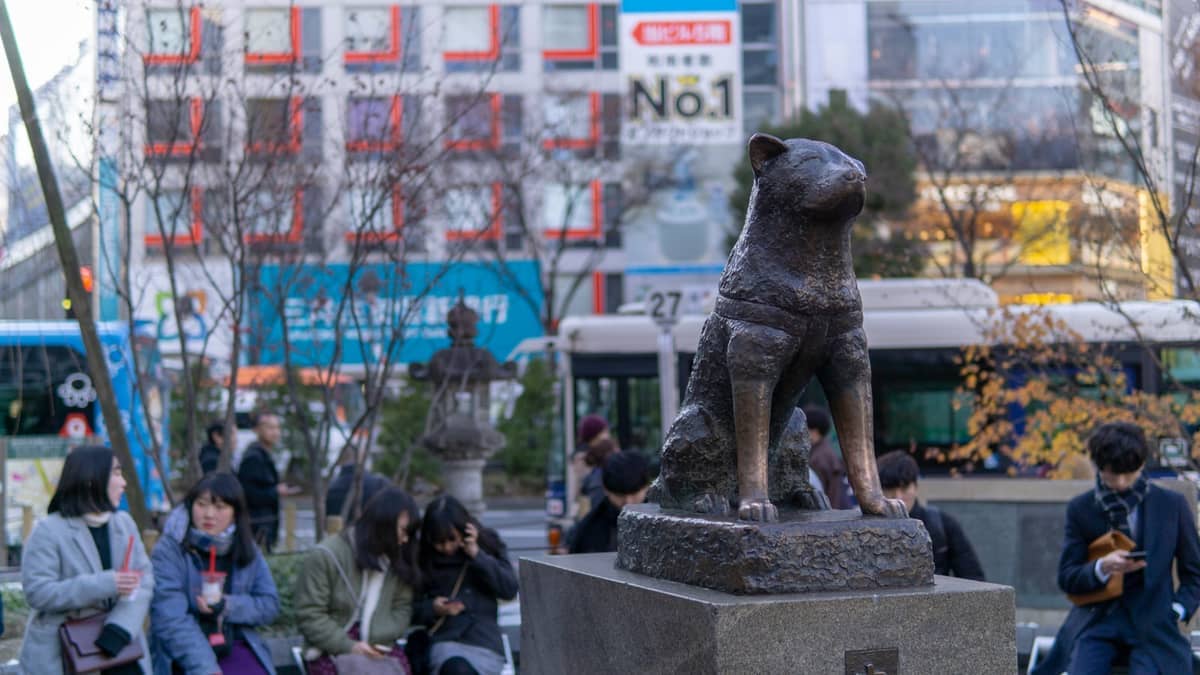
The Hachiko Statue, officially the Chuken Hachiko-zo (忠犬ハチ公像), is a bronze sculpture of an Akita dog positioned in the open plaza directly outside the Hachiko Exit of Shibuya Station. It is compact — not much taller than knee height on its pedestal — and that modesty is part of what makes it affecting. Amid the towers, screens, and constant movement of one of Tokyo's most commercial intersections, the statue is quiet and specific.
The statue commemorates a real dog named Hachiko, born in 1923, who became famous across Japan for waiting at Shibuya Station every day for nearly ten years after his owner, Professor Hidesaburo Ueno of Tokyo Imperial University, died suddenly in 1925. Hachiko continued appearing at the station until his own death in 1935. The story spread nationwide and came to represent devotion, patience, and faithfulness in the Japanese cultural imagination. A first statue was erected in Hachiko's lifetime, in 1934; the current statue is a postwar reconstruction, installed in 1948.
💡 Local tip
If you want a clear photo without crowds in frame, arrive before 8 AM on a weekday. The plaza is rarely empty, but morning foot traffic is mostly commuters who walk past without stopping — giving you a clean window.
The Experience: What to Expect When You Arrive
Step out of the Hachiko Exit and the statue is immediately visible to your left, perhaps five meters from the station door. The plaza around it is paved in flat stone, open to the sky, and flanked by a flower stall and a cluster of benches that are rarely empty. The bronze has developed a warm patina, slightly lighter on the nose and ears where thousands of hands have touched it over the years.
At midday and in the early evening, the square fills steadily. Tour groups arrive in waves, individuals hold their phones high for overhead shots, and pairs wait near the statue using it as the meeting point it has always been. The ambient noise is Shibuya in full voice: station announcements, the chime of a train departure, the layered sound of conversations in Japanese, English, Korean, and Mandarin. There is no ceremony here, no quiet reverence. It is a working urban monument embedded in the city's daily rhythm.
Late at night, the character of the square shifts considerably. After midnight, when the last trains have run and the station has quieted, the plaza empties to single figures. The statue is lit softly from below. The contrast with its daytime life is striking, and for those who have seen it in peak-hour chaos, the nighttime visit feels almost private.
Tickets & tours
Hand-picked options from our booking partner. Prices are indicative; availability and final rates are confirmed when you complete your booking.
Tsukiji Fish Market Walking Food Tour
From 40 €Instant confirmationFree cancellationMt.Fuji,Owakudani, Hakone Cruise & Ropeway, Oshino Hakkai 1-Day Trip
From 54 €Instant confirmationFree cancellationTour to Mt. Fuji Area, Oshino Hakkai and Kawaguchi Lake from Tokyo
From 57 €Instant confirmationFree cancellationNikko UNESCO Shrine and Nature View 1-Day Tour from Tokyo
From 78 €Instant confirmationFree cancellation
Historical Context: Why This Dog Became a National Symbol
Hachiko's story became widely known in Japan during his lifetime largely through newspaper coverage in the early 1930s. A journalist who encountered the dog waiting at Shibuya Station published the story in 1932, which prompted a public outpouring of affection. Railway staff fed Hachiko and treated him as a fixture of the station. His story was taught in elementary schools as an example of loyalty and perseverance, and both qualities carry deep significance in Japanese ethical tradition.
The first statue was unveiled in April 1934 while Hachiko was still alive, an almost unheard-of honor for an animal. It was melted down during World War II as part of metal collection drives. The current statue, created by sculptor Takeshi Ando, was re-erected in August 1948 at the same location, and has stood there since. The exit from Shibuya Station nearest the statue was renamed the Hachiko Exit (ハチ公口) in his memory, and the plaza itself is called Hachiko Square.
The story has crossed into international awareness through the 2009 American film Hachi: A Dog's Tale, which brought visitors to Shibuya from countries where the original Japanese story was unfamiliar. For many first-time Tokyo visitors, the statue is a point of emotional connection that precedes any experience of the city itself. The surrounding neighborhood is covered in our guide to Shibuya, which places the statue in the broader context of one of Tokyo's most layered districts.
Visiting in Practice: Timing, Crowds, and Photography
The statue is accessible 24 hours a day, every day of the year, with no entrance fee, ticketing, or reservations. Because Shibuya Station is one of the busiest rail hubs in Tokyo, the plaza sees human traffic at almost every hour, but the intensity varies significantly.
Weekday mornings between 7 and 9 AM are dominated by commuters who do not stop. Weekday afternoons from roughly noon to 6 PM see moderate tourist activity. Weekend afternoons and evenings, particularly Saturdays from around 3 PM onward, bring the heaviest crowds. School groups, tour parties, and tourists with shopping plans for the surrounding area all converge on the same stretch of pavement.
For photography, the statue is relatively small and the surrounding space is open, so your main challenge is isolating the subject. Wide-angle shots that include the station facade and crowd work well for conveying the atmosphere. Close-up portraits of the bronze itself are easier to get cleanly in early morning. The statue faces slightly toward the station entrance, so shooting from a low angle to the left of the statue (as you exit) tends to capture the face and the sense of patient attention that defines the figure.
ℹ️ Good to know
The plaza has flat, step-free access from the station exit and is described as wheelchair accessible. Tactile paving is present to support visitors with visual impairments.
How the Statue Fits Into a Shibuya Visit
Most visitors combine the Hachiko Statue with nearby sights in the same ten-minute walk. Shibuya Crossing, the broad pedestrian intersection famous for its coordinated diagonal crossing patterns, is less than two minutes on foot from the statue. The two together make a natural pairing: the crossing rewards elevated viewing from the surrounding buildings, while the statue rewards close attention at street level.
If you are spending a morning or afternoon in the area, the Meguro River is a 15-minute walk south and offers a very different atmosphere: quieter, residential, lined with cafes. For a rooftop view over Shibuya's landscape, Shibuya Sky is in the same station complex. The full picture of what the neighborhood offers is in our overview of things to do in Shibuya.
If your trip includes more of Tokyo's iconic public monuments and open spaces, the best temples and shrines in Tokyo guide and the broader things to do in Tokyo overview are useful for planning the rest of your itinerary.
An Honest Assessment: Is It Worth Stopping For?
The Hachiko Statue is genuinely worth a few minutes of your time, but it is not a spectacle. If you are expecting a large, dramatic monument, you will be surprised by how modest it is. The statue is roughly life-size, set on a low pedestal, and surrounded by an ordinary urban plaza. What it offers is story, not scale.
Travelers who arrive having read or watched something about Hachiko's story tend to find the stop unexpectedly moving. Travelers who arrive with no prior context sometimes struggle to understand why the spot merits attention. The statue rewards a small amount of preparation.
For visitors who are not interested in the story or in the social theater of a heavily photographed landmark, this stop can reasonably be skipped. The five minutes it takes to walk past can just as easily be redirected toward the surrounding streets or the crossing itself. That said, since it sits directly at the station exit and costs nothing, the barrier to stopping is almost zero.
⚠️ What to skip
Peak congestion around the statue occurs on weekend evenings and during Tokyo's major holidays, including Golden Week (late April to early May) and the New Year period. At these times, getting a clear photo can be genuinely difficult and the plaza gets physically crowded.
Insider Tips
- The statue's nose and ears have a noticeably lighter patina than the rest of the bronze because generations of visitors have touched them for luck. This detail is easy to miss in photographs but visible the moment you stand close.
- Hachiko Square is one of the most common informal meeting points in Tokyo — you will see people waiting, checking phones, and scanning faces constantly. If you are meeting someone and get separated, naming this as your backup meeting spot is immediately understood by any Tokyo local.
- The Hachiko Exit is the main western exit of Shibuya Station. If you are arriving on JR lines or from the Tokyo Metro Hanzomon Line and are not familiar with the station layout, follow signs toward the JR concourse and then look for Hachiko Exit — the station is large enough that it can take several minutes to navigate from the subway platforms.
- There is a smaller, secondary Hachiko statue inside Shibuya Station itself, near the ticket gates. It receives far less foot traffic than the outdoor one and is a better option if you want a close look at the figure without negotiating a crowd.
- Early spring mornings, when the cherry trees in nearby Yoyogi Park are blooming, bring a notable increase in photographers to the whole Shibuya area. If you are visiting during late March or early April, expect heavier-than-usual crowds around the statue even on weekday mornings.
Who Is Hachiko Statue For?
- First-time visitors to Tokyo wanting to connect with a well-known piece of the city's cultural fabric
- Travelers using Shibuya Station as a transit hub who have a few minutes between connections
- Photography enthusiasts interested in capturing Tokyo street life and crowd dynamics
- Families with children who are familiar with Hachiko's story from books or film
- Anyone building a self-guided walking tour of central Shibuya
Nearby Attractions
Other things to see while in Shibuya:
- Shibuya Crossing
Shibuya Scramble Crossing is a free, open-air spectacle where up to a few thousand people cross simultaneously from five directions every few minutes. Whether you join the flow or watch from above, it delivers one of Tokyo's most visceral urban moments.
- Shibuya Sky
Perched atop Shibuya Scramble Square at roughly 229 meters, SHIBUYA SKY is one of Tokyo's few truly open-air observation decks. The rooftop strips away the glass barriers that define most city observatories, leaving you exposed to the wind and the full scale of the Tokyo skyline. Here is what to know before you go.