Ses Salines Natural Park: Ibiza's Wild Southern Coast
Ses Salines Natural Park spans roughly 2,800 hectares of land and 13,000 hectares of protected marine space across southern Ibiza and northern Formentera. It combines ancient salt flats, dune-backed beaches, flamingo-populated wetlands, and the UNESCO-listed Posidonia oceanica seagrass meadows into one of the Balearic Islands' most ecologically significant landscapes. Entry is free.
Quick Facts
- Location
- Sant Francesc de s'Estany, southern Ibiza (municipality of Sant Josep de sa Talaia), Spain
- Getting There
- Bus Line 11 from Ibiza Town to Sa Canal; by car via road PM-802 south from Ibiza Town; bike-accessible via marked flat routes from Sant Jordi
- Time Needed
- 2–5 hours depending on trails walked; a full day if combining beach, salt flats, and birdwatching
- Cost
- Free entry to park, beaches, and trails; guided tours available at extra cost
- Best for
- Birdwatchers, nature walkers, beach swimmers, photography, travellers wanting a counterpoint to Ibiza's party scene
What Is Ses Salines Natural Park?
The Parque Natural de Ses Salines de Ibiza y Formentera is a protected natural area in the south of Ibiza that surprises many first-time visitors who expect the island to be entirely devoted to nightlife and beach bars. What they find instead is a quietly extraordinary landscape: rust-coloured salt pans shimmering in the heat, shallow lagoons edged with pink flamingos, pine-covered dunes dropping onto some of the island's cleanest beaches, and below the waterline, a carpet of Posidonia oceanica seagrass that UNESCO declared a World Heritage Site in 1999.
Salt extraction here dates to around 600 BC, when Phoenician settlers first began harvesting the mineral from the flat coastal wetlands. The salinas remained commercially active for millennia and are still in partial operation today. The area was formally designated a protected natural area in the mid-1990s, and in 2001 it became the Parque Natural de Ses Salines, a protected territory bridging the southern tip of Ibiza and the northern section of Formentera across the narrow Es Freus channel. That dual-island reach makes it one of the few protected areas in Europe that spans two separate islands.
ℹ️ Good to know
The park covers approximately 2,800 hectares of terrestrial habitat and 13,000 hectares of marine space. Entry is free. There are no ticket booths or timed entry requirements.
The Salt Flats: A Landscape Unlike Anywhere Else on the Island
Standing beside the salt pans on a clear morning in June, the colours are genuinely disorienting: the water shifts from pale grey to blush pink to deep rose depending on the salinity level and the angle of the light. That pink tint comes from halophilic microorganisms, tiny salt-tolerant algae and bacteria that thrive in the hyper-saline conditions. The effect is strongest in late summer, when salt concentration peaks and the biological pigments are most dense.
The salt pans sit on flat, windswept ground between the pine forests and the sea. Narrow paths and raised embankments allow walkers to move through the working salt production area without entering the active harvest zones. In late summer, when the salt is being harvested, you can watch the mechanical scrapers push bright white pyramids of coarse salt into growing piles along the embankment edges, a process that has barely changed in its fundamental logic since Phoenician times, even if the machinery is now industrial.
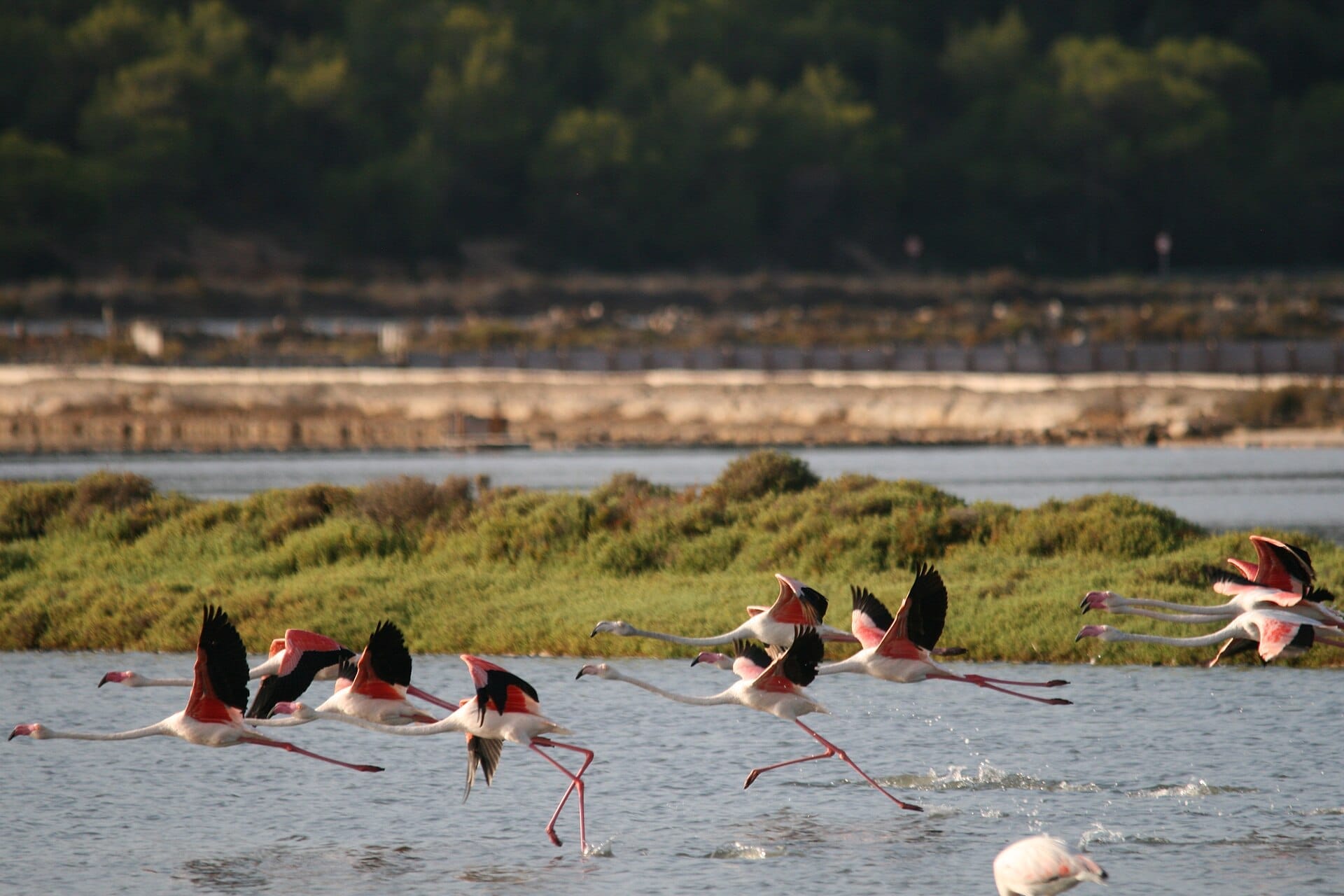
The best sustained birdwatching in Ibiza happens here. Greater flamingos are a consistent presence in the shallower lagoons, particularly in autumn and winter, alongside grey herons, little egrets, kentish plovers, and migrating waders passing through on Atlantic-Mediterranean flyways. For dedicated birders, Ses Salines ranks among the top sites in the Balearic Islands. You can find more walking context in the Ibiza hiking guide.
Tickets & tours
Hand-picked options from our booking partner. Prices are indicative; availability and final rates are confirmed when you complete your booking.
Sunset boat tour with tapas, open bar and water sports in Ibiza
From 70 €Instant confirmationFree cancellationEscape Tour self-guided, interactive city challenge in Ibiza
From 30 €Instant confirmationPrivate Sunset Cruise on a Maritime Classic in Ibiza
From 750 €Instant confirmationFree cancellationIbiza to Formentera boat trip with open bar and water sports
From 69 €Instant confirmationFree cancellation
Las Salinas Beach: The Social and Natural Midpoint
At the southern end of the salt flat complex, the terrain opens onto Las Salinas beach, a long, straight stretch of pale sand backed by low dunes and umbrella pines. The water is exceptionally clear, turquoise close to shore and deepening to blue-green further out, largely because the Posidonia meadows beneath filter sediment and maintain water clarity across much of the southern coast.
Las Salinas has a split personality that reflects the park itself. The northern end near the dunes is quieter, with a more natural beach character. The southern section, closer to the Sa Canal track, has beach bars and sun lounger concessions that attract a fashionable crowd on summer afternoons. By mid-morning in July and August, the beach fills rapidly. By midday the sun lounger rows are full and the music from the beach bars carries clearly along the shore. If you want the beach in something closer to natural stillness, arrive before 10:00 in summer or visit in September when the crowds thin considerably.
💡 Local tip
The stretch of beach closest to the dune path from the salt flats tends to be less crowded than the bar-facing sections. Walk a few hundred metres north from the main beach bar cluster for noticeably more space.
The Posidonia Meadows: Why the Sea Looks the Way It Does
The unusual clarity and colour of the water around southern Ibiza is not accidental. Beneath the surface, dense meadows of Posidonia oceanica cover much of the seabed across the park's marine zone. This flowering plant (not an alga, despite appearances) grows in dense underwater prairies that oxygenate the water, stabilise the seabed, and support an elaborate food chain of fish, sea urchins, cuttlefish, and molluscs. The meadows around Ibiza and Formentera are among the largest and oldest in the Mediterranean, with some colonies estimated to be thousands of years old.
UNESCO's 1999 designation of the Ibiza World Heritage Site specifically recognised these Posidonia meadows as an outstanding example of a marine ecosystem. For snorkellers, the clarity of the water above the seagrass is remarkable: visibility of 20 metres or more is possible on calm days. You can see the transition zone where sandy bottom gives way to the dark green meadow clearly from the surface, and small fish shelter in dense patches of the plant throughout the year.
Dead Posidonia leaves, known locally as 'alga', wash ashore as dark brown matted balls along beaches throughout the park. Some visitors mistake this for pollution. It is not. The leaf litter is a natural and ecologically important feature that protects dunes from erosion. Beaches that still have this seagrass wrack are, paradoxically, among the healthiest coastal environments in the Mediterranean.
How to Explore the Park: Routes, Timing, and Practical Logistics
The park has no single entrance gate. Most visitors approach via the Sa Canal road (PM-802) from Ibiza Town or Sant Jordi. From Ibiza Town by car, the salt flat area is roughly 10 kilometres south, following signs toward Las Salinas. Parking areas exist near the beach access points, though in peak summer these fill by 10:00 on weekends. Bus Line 11 from Ibiza Town runs to the Sa Canal area and is a practical alternative if you are not renting a car. The route from Sant Jordi by bicycle is flat and well-signed, passing directly through the salt flat perimeter, and takes around 30 to 40 minutes at a moderate pace.
On foot, the most straightforward circuit from the Sa Canal parking area loops around the main salt pans, follows the embankment track past the flamingo lagoons, and drops down to the beach. This takes around 90 minutes at a relaxed pace. Longer routes connect the park with Es Cavallet beach to the north, adding another 30 to 40 minutes of walking through pine forest. Both beaches are within the natural park boundary.
Bring water, sun protection, and footwear that can handle sand and compacted gravel tracks. The park has almost no shade between the salt flats and the beach. Afternoon temperatures in July and August regularly exceed 30°C in the open areas above the pans, and the light reflects intensely off the white salt and pale water. Early morning, before 9:00, is consistently the most comfortable time to walk the salt flat area and the best window for birdwatching before visitor numbers build.
⚠️ What to skip
Dogs are restricted in parts of the natural park, particularly near the salt pans and protected wetland areas. Check current regulations with the Balearic Government's environment portal before visiting with a dog.
Who Should Skip It, and Who Will Love It
Travellers who want a beach with full services, shade structures, and easy access to food and drink will find Las Salinas satisfactory on those terms, but may not feel the need to engage with the park's broader ecology. The bird hides and salt flat paths require genuine curiosity about landscape to feel rewarding. If you are in Ibiza primarily for nightlife and your days are already full, the park does not need to be on the itinerary.
That said, for anyone who wants to understand what Ibiza actually looks like outside the pool parties and the port bars, Ses Salines is one of the clearest demonstrations available. It sits physically close to Ibiza Airport and yet feels categorically separate from the resort atmosphere. It connects naturally with a quieter side of the island that many short-stay visitors never find.
Families with children do well here: the beach water is shallow at the southern end, the salt flats are visually fascinating for younger visitors, and spotting flamingos tends to require no particular birdwatching expertise. Photographers, particularly those interested in landscape and nature work, will find the late afternoon light over the salt pans consistently productive, with the low sun intensifying the pink and copper tones of the water.
Insider Tips
- The flamingos in the salt pans are most reliably present from late September through April. In the core summer months they are less numerous, as some of the shallower lagoons dry out. If flamingo-watching is your primary goal, plan a September or October visit.
- The salt flat track that runs parallel to the PM-802 road is almost entirely missed by casual visitors who drive straight to the beach. Park near the Sa Canal junction and walk the embankment north: you get the best elevated views over the pans and the most productive birdwatching angles.
- Es Cavallet beach, the next beach north within the park, has a notably quieter atmosphere than Las Salinas and is accessible on foot through pine woodland from the main salt flat area in around 30 to 40 minutes. It tends to attract a more local crowd.
- Guided birdwatching tours of the park are organised through operators working with the Sant Josep municipal tourism programme. These typically run in early morning and cover species identification across the salt pan and lagoon zones. Check the Sant Josep tourism office for current schedules.
- If you are combining the park with a day trip to Formentera, note that the northern section of the Ses Salines park extends onto Formentera around the Estany Pudent lagoon. The two sections are part of the same protected designation but require separate transport to visit.
Who Is Ses Salines Natural Park For?
- Nature and wildlife enthusiasts, particularly birdwatchers targeting flamingos and migratory waders
- Snorkellers and swimmers who prioritise water clarity over beach infrastructure
- Photographers working in landscape, nature, and documentary styles
- Cyclists and walkers looking for a structured half-day route from Ibiza Town or Sant Jordi
- Families with children who want a mix of beach time and a genuinely different landscape to explore
Nearby Attractions
Other things to see while in San José (Sant Josep de sa Talaia):
- Cala d'Hort
Cala d'Hort is a compact beach on Ibiza's southwest coast, in a formerly protected natural area and facing the sheer, mythologised rock of Es Vedrà. The scenery is unlike anywhere else on the island, but getting here takes effort, and the limited parking fills fast in summer.
- Cala Jondal
Cala Jondal is a sheltered south-coast bay in Sant Josep de sa Talaia, known for its remarkably clear turquoise water, white pebble shore, and high-end beach clubs. Access is free, but the scene here leans decidedly upscale. It rewards visitors who arrive early and leave before the midday sun turns the stones underfoot into a barefoot obstacle course.
- Cala Tarida
Cala Tarida is a large cove on Ibiza's western coast, stretching roughly 900 metres of fine white sand in the municipality of Sant Josep de sa Talaia. Calm, clear water and reliable afternoon light make it one of the most rewarding beaches on the island for a full day out.
- Cala Vadella
Cala Vadella is a 200-metre arc of fine white sand on Ibiza's southwest coast, tucked inside a deep natural inlet that keeps the water calm and the atmosphere unhurried. It currently holds a Blue Flag rating and is one of the few beaches on the island genuinely suited to families, swimmers, and anyone who prefers scenery over scene.