Es Cavallet Beach: Ibiza's Most Sophisticated Stretch of Sand
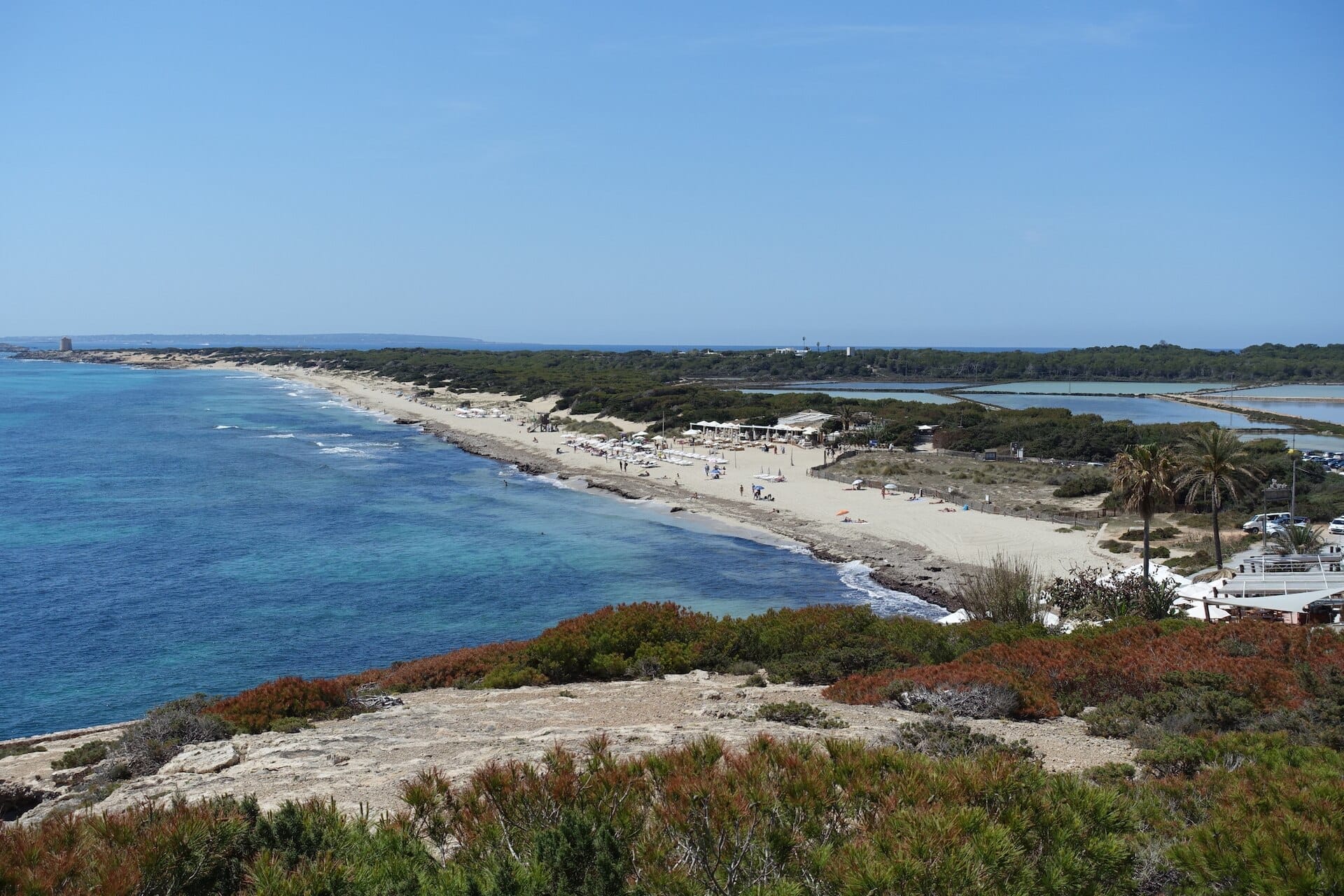
Es Cavallet Beach sits on Ibiza's southern coast inside the protected Ses Salines Natural Park, about 9 km from Ibiza Town. Around 1.1 km of soft white sand, a long history as one of Spain's first official nudist beaches, and a setting framed by dunes and salt flats make it a genuinely different experience from the island's more crowded resort shores.
Quick Facts
- Location
- Ses Salines Natural Park, Sant Josep de sa Talaia, south Ibiza, approx. 9 km from Ibiza Town
- Getting There
- By car: about 10 min from Ibiza Town via Ses Salines road. By bus: Line 11 to Las Salinas, then 20-min walk along the salt-flat road
- Time Needed
- Half day (3–5 hours minimum to settle, swim, and explore the surroundings)
- Cost
- Beach access is free. Paid parking near the north end. Sunbeds and umbrellas available for hire at beach bars
- Best for
- Nature lovers, nudists, LGBTQ+ travellers, beach connoisseurs avoiding crowded resort shores
- Official website
- www.illesbalears.travel/en/ibiza/beach-es-cavallet
What Es Cavallet Actually Is
Es Cavallet Beach (Catalan: Platja d'es Cavallet) is a 1.1-kilometre stretch of fine white sand on Ibiza's southern coast, fully contained within the Ses Salines Natural Park. That protected status is the single most important thing to understand about this place before you go. There are no hotels built to the waterline here, no jet-ski concessions, no neon-lit bar strips. The park's regulations have kept the development at a measured scale: a handful of beach bars with quality food, rows of sunbeds that don't dominate the full length of the sand, and a dune system still largely intact.
The park itself protects not just the land but the water. The seabed offshore contains Posidonia oceanica seagrass meadows that contribute to the UNESCO World Heritage recognition covering Ibiza's natural and cultural heritage. That seagrass is why the water here turns those specific shades of blue-green that photographers struggle to do justice. It also explains why the sea remains clear even on days when beaches closer to town look murky. For more on the broader protected ecosystem, the guide to Ses Salines Natural Park covers the salt flats, birdlife, and surrounding landscape in detail.
ℹ️ Good to know
The beach takes its name from 'es cavallet', a traditional working animal that once operated a wheel to fill the nearby salt ponds. The Ses Salines salt flats you pass through on the way in are still a working landscape, not just a scenic backdrop.
The Character of the Beach: Who Goes, and Why
Es Cavallet has two distinct characters depending on where you lay your towel, and knowing this before arrival saves confusion. The northern section of the beach is the most accessible (closest to the car park), tends to attract a general mix of visitors, and is where the main beach bar infrastructure is concentrated. Further south, the tone changes: Es Cavallet was one of the first official nudist beaches in Ibiza and a pioneer in Spain more broadly for permitting nudism openly. That southern end has also, for decades, been a well-known and welcoming space for LGBTQ+ travellers, particularly gay men.
This isn't a niche detail to bury at the bottom of a review: it shapes the atmosphere in ways that matter. The overall mood at Es Cavallet is relaxed, self-assured, and notably unpretentious compared to some of Ibiza's more conspicuously fashionable beaches. People come here to actually be on a beach, not to perform being on one. That said, the beach bars do attract a well-dressed crowd in the late afternoon, and the food at the main chiringuito-style restaurants is genuinely good rather than the usual overpriced afterthought.
Tickets & tours
Hand-picked options from our booking partner. Prices are indicative; availability and final rates are confirmed when you complete your booking.
Sunset boat tour with tapas, open bar and water sports in Ibiza
From 70 €Instant confirmationFree cancellationEscape Tour self-guided, interactive city challenge in Ibiza
From 30 €Instant confirmationPrivate Sunset Cruise on a Maritime Classic in Ibiza
From 750 €Instant confirmationFree cancellationIbiza to Formentera boat trip with open bar and water sports
From 69 €Instant confirmationFree cancellation
How the Beach Changes Through the Day
Morning arrivals before 10:00 find the beach almost entirely to themselves. The light is lower and cooler, the sand undisturbed, and the walk from the car park is genuinely pleasant rather than a sweaty ordeal. The dunes on the approach cast long shadows, and the only sounds are the salt-flat birds and the low wash of waves. If photography is part of your plan, this is the window.
By midday in July and August, the beach is busy but rarely feels as packed as Playa d'en Bossa or Cala Bassa. The sunbed rows fill up, the beach bars are doing solid business, and the sea is full. The sand here is fine enough that it heats quickly: bringing sandals to walk from towel to water is not overcautious. The beach runs roughly 30 to 40 metres deep, which gives enough room to find a quiet spot even when the sunbeds are all taken.
Late afternoon, from around 17:00 onward, is when Es Cavallet shifts into its most social mode. The light softens, the heat becomes bearable, and people migrate toward the beach bars for drinks and food. The sun sets behind the island at this point, so Es Cavallet doesn't deliver a direct sea sunset, but the sky to the west glows and the light on the water is warm and flat. This is the hour to linger rather than leave.
💡 Local tip
Arrive before 10:00 or after 17:00 in peak summer to avoid both the worst crowds and the most intense midday heat. Parking fills completely by late morning in July and August.
Getting There: What the Route Actually Looks Like
By car, the drive from Ibiza Town takes around 10 minutes via the road that crosses the Ses Salines salt flats. The road is flat, straight, and clearly signposted. The approach through the salt flats is one of the better parts of the journey: the pinkish-white crust of evaporating salt, the reed beds, and the wading birds (flamingos are regular visitors) make it feel like you're arriving somewhere genuinely unusual for a beach. Parking is near the northern end of the beach and is paid. Spaces are limited and in high season cars park along the verge for some distance back.
By bus, Line 11 from Ibiza Town runs to Las Salinas Beach. From the stop where the road branches toward Es Cavallet, the walk is approximately 20 minutes along an unpaved track through the salt flat landscape. It's flat and manageable, but in July heat with a full beach bag it's worth factoring in. Cyclists find the approach easy. If you're combining Es Cavallet with Las Salinas Beach next door, a single bus trip to Las Salinas serves both, and the two beaches connect at their southern ends along a dune path.
What to Bring, What to Expect at the Water
The water at Es Cavallet is shallow for some distance from the shore, which makes it suitable for children and less confident swimmers. The Posidonia seagrass offshore occasionally deposits dried leaves (known locally as 'balls of neptune grass') on the sand. These are a natural sign of a healthy marine ecosystem, not pollution, but first-time visitors sometimes misread them. The water entry is sandy-bottomed near the shore.
Facilities on the beach include sunbeds, umbrellas, showers, a volleyball net, and a security presence. The main beach bar serves food and drinks to a standard above the Ibiza average. Bring cash as backup; card machines on beaches in natural parks can be unreliable. Tap water on Ibiza is treated but many visitors prefer bottled water for taste reasons: bring your own rather than relying on buying from the beach bars throughout the day.
⚠️ What to skip
The beach sits inside a protected natural park. Dune vegetation is fragile: stick to marked paths and avoid climbing on or walking through the dune system. Fires are not permitted anywhere within the park.
Historical and Ecological Context
The name Es Cavallet refers to the small horse or donkey ('cavallet' means 'little horse' in Catalan) that was used to operate the wheels lifting brine into the salt pans of the adjacent Ses Salines flats. Salt production in this area has a long history, and the salt flats remain an active commercial operation today. The economic and cultural importance of Ibiza's salt is one reason the Ses Salines area received such strong protection: the landscape has been shaped by human use for more than two millennia, and the ecosystem that developed around it is now irreplaceable.
The Posidonia oceanica meadows offshore are among the most extensive in the Mediterranean. These seagrass meadows produce oxygen, act as nurseries for fish species, and trap carbon: their ecological role goes well beyond making the water look appealing. The UNESCO World Heritage designation covering Ibiza, granted in 1999, specifically included the marine Posidonia ecosystems. This gives Es Cavallet's surroundings a conservation status that few beaches in Spain can claim. Visitors interested in exploring more of the protected southern coastline can consult the Ibiza hiking guide for walking routes through the Ses Salines area.
Who Should Think Twice Before Going
Es Cavallet is not the right beach for every visitor. Travellers who want a beach with direct sunset views over open water should look elsewhere: the beach faces roughly southeast, and the sun sets behind the island. For classic Ibiza sunsets from the water, the beaches on the western coast deliver far better. Families with very young children may find the 20-minute walk from the bus stop impractical with prams or heavy gear, and the unpaved access track is not suitable for wheelchair users without significant assistance.
People who want a beach with a large resort complex, a wide variety of water sports, or immediate proximity to shopping and accommodation will find Es Cavallet too remote and low-key. The beach's strength is precisely its restraint, which won't suit everyone. Travellers looking for a livelier resort beach closer to town should consider Talamanca Beach or Playa d'en Bossa instead.
Insider Tips
- Walk the dune path south from the main beach access point rather than stopping at the first open stretch of sand. The beach improves as you go further from the car park, and the southern end is noticeably quieter even at peak times.
- The beach bar at the north end of Es Cavallet has a reputation for quality food by beach standards. Arriving for a late lunch (14:30 to 15:30) rather than peak midday means shorter waits and the same quality.
- If you're driving, the road through the Ses Salines salt flats has two or three pull-off points with clear views over the flamingo areas. These make a worthwhile 5-minute stop on the way in or out, particularly in morning light.
- The walk between Es Cavallet and Las Salinas Beach via the southern dune path takes about 15 to 20 minutes and is worth doing at least one way. The two beaches together give a much better sense of the Ses Salines coastline than either does alone.
- Nudism is established at the southern end of the beach but not enforced island-wide: the northern section operates as a conventional beach. Neither section is segregated by signage; the transition is gradual and unmarked.
Who Is Es Cavallet Beach For?
- Travellers who want a genuinely natural beach setting without heavy resort development
- LGBTQ+ visitors, particularly those looking for a welcoming and established beach environment
- Nudists and those curious about one of Spain's earliest official nudist beaches
- Nature and ecology-focused visitors interested in the Ses Salines Natural Park and Posidonia seagrass ecosystem
- Anyone wanting to combine a quality beach day with the landscape of the Ses Salines salt flats
Nearby Attractions
Other things to see while in San José (Sant Josep de sa Talaia):
- Cala d'Hort
Cala d'Hort is a compact beach on Ibiza's southwest coast, in a formerly protected natural area and facing the sheer, mythologised rock of Es Vedrà. The scenery is unlike anywhere else on the island, but getting here takes effort, and the limited parking fills fast in summer.
- Cala Jondal
Cala Jondal is a sheltered south-coast bay in Sant Josep de sa Talaia, known for its remarkably clear turquoise water, white pebble shore, and high-end beach clubs. Access is free, but the scene here leans decidedly upscale. It rewards visitors who arrive early and leave before the midday sun turns the stones underfoot into a barefoot obstacle course.
- Cala Tarida
Cala Tarida is a large cove on Ibiza's western coast, stretching roughly 900 metres of fine white sand in the municipality of Sant Josep de sa Talaia. Calm, clear water and reliable afternoon light make it one of the most rewarding beaches on the island for a full day out.
- Cala Vadella
Cala Vadella is a 200-metre arc of fine white sand on Ibiza's southwest coast, tucked inside a deep natural inlet that keeps the water calm and the atmosphere unhurried. It currently holds a Blue Flag rating and is one of the few beaches on the island genuinely suited to families, swimmers, and anyone who prefers scenery over scene.