Seoul Forest: The Urban Park That Actually Delivers
Spanning about 1.16 square kilometers along the Han River in Seongsu, Seoul Forest is one of the city's most rewarding green spaces. Free to enter and open around the clock, it combines ecological habitats, open meadows, and family-friendly facilities with one of the best casual atmospheres in Seoul.
Quick Facts
- Location
- 273 Ttukseom-ro, Seongdong-gu, Seoul
- Getting There
- Ttukseom Station (Line 2, Exit 8) or Seoul Forest Station (Suin-Bundang Line, Exit 4)
- Time Needed
- 1.5 to 3 hours
- Cost
- Free admission; some facilities may have separate fees
- Best for
- Families, cyclists, picnickers, photography, weekend escapes
- Official website
- seoulforest.or.kr/english
What Seoul Forest Actually Is
Seoul Forest opened on June 18, 2005, on land that previously served as a horse racing track and later a public golf course. The Seoul Metropolitan Government redeveloped the 1,156,498 square meter site into a multi-zone park. The comparison is not just marketing: the park is genuinely large enough to absorb crowds, and its zones feel distinct enough that different visitors can use the space simultaneously without getting in each other's way.
The park divides into five main zones: Culture & Arts Forest (the main entry meadow area), Ecological Forest, Experiential Learning Park, Wetlands Ecology Field, and Han River Waterside Park. The Ecological Forest contains a deer habitat that consistently surprises first-time visitors — spotting a small herd grazing behind low fencing in the middle of Seoul is genuinely disorienting in the best way. The Wetlands section is quieter and less visited, which makes it worth the short detour if you want to escape the weekend crowds.
💡 Local tip
The Insect Garden is only open May through October, 10:00–17:00. If insects are a draw for your visit, plan accordingly. It is closed entirely from November through April.
How It Feels at Different Times of Day
Early mornings, particularly on weekdays, belong to local residents. By 7:00 AM the Ecological Forest is open, and you will find joggers, dog walkers, and older adults doing slow stretching exercises on the open lawns. The air carries a noticeable green dampness in spring and summer — the combination of the Han River proximity, tree canopy, and morning dew gives the park a freshness that evaporates once temperatures climb past noon.
Weekend afternoons between roughly 1:00 PM and 4:00 PM are the most crowded windows. Families spread out picnic mats on the main lawn near the Culture & Arts Forest entrance, cyclists move through the paths at speed, and the deer habitat draws consistent queues of visitors with children. If you visit during this window, the park still handles the volume well, but the sense of calm is reduced.
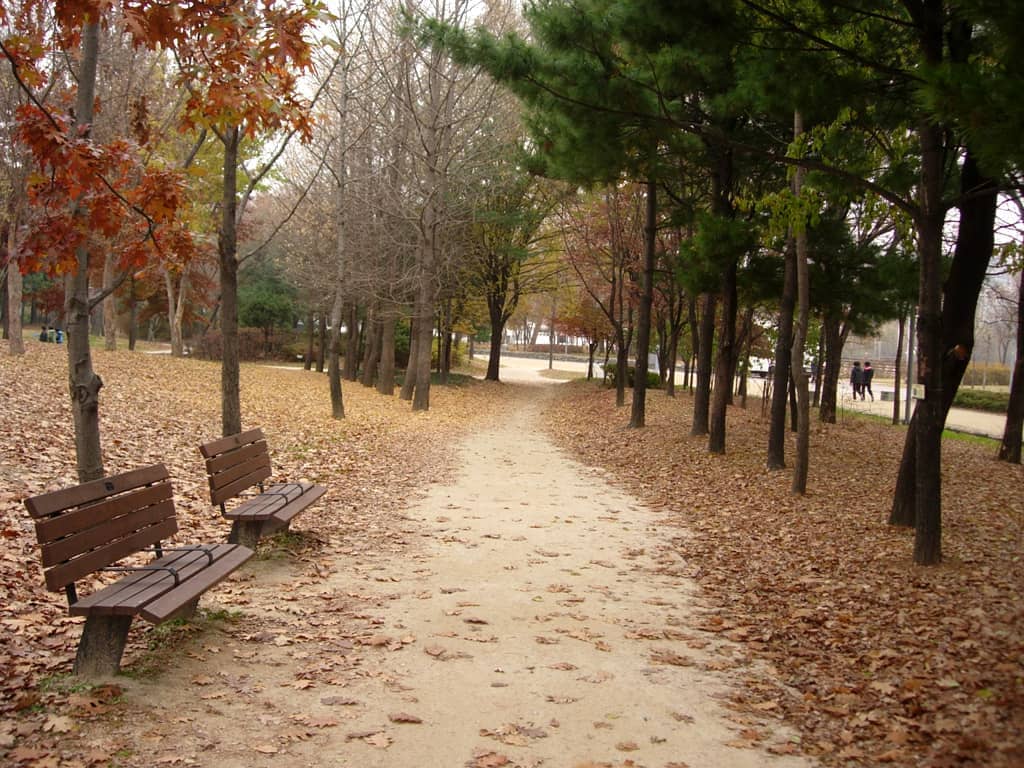
Late afternoon into early evening, especially in autumn, is when the light through the tree canopy is most photogenic. The ginkgo and maple trees lining the main paths turn gold and red from mid-October onward, and the low angle of the sun catches them well between 4:00 PM and sunset. This is also when the Seongsu cafes nearby begin to fill, making it a natural endpoint to a park visit if you continue into the neighborhood.
⚠️ What to skip
The park is open 24 hours, but facility hours vary significantly. The Visitor Center and ecological facilities have restricted operating hours, and you should not assume everything is accessible at all hours.
Tickets & tours
Hand-picked options from our booking partner. Prices are indicative; availability and final rates are confirmed when you complete your booking.
DMZ and Lake Majang Suspension Bridge Tour from Seoul
From 57 €Instant confirmationFree cancellationHalf Day DMZ Tour from Seoul, 3rd Tunnel, Observatory and More
From 47 €Instant confirmationFree cancellationSeoul zombie city exploration game and private tour
From 10 €Instant confirmationFree cancellationLuggage Storage in Seoul
From 7 €Instant confirmationFree cancellation
Getting There and Getting Around Inside
The most straightforward subway access is via Seongsu's two nearby stations: Ttukseom Station on Line 2 (Exit 8) drops you about a 10-minute walk from the main entrance, while Seoul Forest Station on the Suin-Bundang Line (Exits 3 or 4) is closer and places you near the southern side of the park. The Suin-Bundang Line option is often faster if you are coming from Gangnam-side neighborhoods.
Inside the park, paths are wide and generally flat, which makes it comfortable for strollers and wheelchairs. Free wheelchair and stroller rentals are available at the park for up to 2 hours, with ID required as a deposit. Cyclists can ride on designated paths.
If you are combining Seoul Forest with a broader itinerary, it connects naturally to a walk through Seongsu's converted-factory cafe district. The area's coffee shops and small restaurants are concentrated within a 10-15 minute walk from the park's eastern exits. Seoul Forest also sits close to the Han River, making it easy to link with a ride along Hangang Park if you have extra time.
What to See and Do: A Practical Walkthrough
The main entrance through the Culture & Arts Forest section sets the tone: wide gravel paths, mature trees, and open lawns that invite you to slow down. This is where most visitors spend the bulk of their time, and on a clear day in May or October, it is easy to see why. The scale is generous without feeling overwhelming.
The deer habitat in the Ecological Forest section is genuinely unusual for a city park. The animals are housed in a fenced enclosure but are visible at close range from viewing platforms. The deer are most active in the mornings and late afternoons — midday visits during summer often find them resting in shade and less visible. Children's reactions to the encounter range from complete fascination to mild terror, which seems about right.
The Wetlands Ecology Field in the northern section rewards visitors who make the effort to reach it. The reed beds and shallow water features support bird life that you would not expect to find this close to central Seoul. It is also significantly less crowded than the main lawn area, even on busy weekends. Bring modest footwear — the paths are paved, but you may want to explore the edges where the ground can be soft after rain.
Photography-wise, the park's footbridge over the ecological section offers elevated views of the canopy that are worth the detour. If you are building a broader photography itinerary, the light here pairs well with the golden-hour rooftop views covered in Seoul's best viewpoints guide.
Seasonal Considerations
Spring (April to May) is arguably the most attractive season. Cherry blossoms appear earlier in the city center, but Seoul Forest's flowering trees and green-up make late April especially pleasant. For context on timing, the Seoul in spring guide covers bloom windows and crowd patterns across the city.
Summer (June through August) brings heavy humidity and the jangma rainy season, typically June into July. The park is still usable in summer, but you will want to plan around the heat: early morning visits before 9:00 AM or evening visits after 6:00 PM are considerably more comfortable than midday. The Eco Forest footbridge extends its hours to 21:00 in June through August, which is worth noting.
Autumn (September through November) is the other peak window. The ginkgo trees along the main paths turn a deep yellow by mid-to-late October, and the maples add red and orange to the mix. This is also when the autumn foliage in Seoul draws the largest visitor numbers citywide, so weekend visits will be noticeably more crowded.
Winter is the most honest test of the park's appeal. The bare trees reduce visual interest significantly, and cold temperatures (often near or below 0°C) discourage casual lingering. That said, the park is free and the paths remain walkable, and the low-season quiet has its own quality. If you are visiting Seoul in winter primarily for urban exploration rather than nature, you might reasonably deprioritize Seoul Forest in favor of indoor alternatives.
Who This Park Is and Is Not For
Seoul Forest works well for families with children (the deer habitat and open lawns give kids space to move), for cyclists linking into the Han River path network, for photographers in spring and autumn, and for anyone who wants a genuine break from the density of central Seoul. The free admission makes it a low-stakes addition to any itinerary.
Visitors with limited time who are focused on Seoul's historical and cultural core may find that Seoul Forest competes awkwardly with more concentrated attractions. If your priority is palaces, markets, and neighborhoods with cultural depth, the park may not rank high on a short itinerary. The 3-day Seoul itinerary and things to do in Seoul pages can help you weigh how Seoul Forest fits against other options.
Travelers who are drawn specifically to dramatic city viewpoints, night markets, or museum-density will also find the park less immediately rewarding than other parts of the city. It is not overhyped exactly, but it is the kind of place that rewards visitors who go slowly and stay a while rather than those rushing through a checklist.
Insider Tips
- The Suin-Bundang Line's Seoul Forest Station (Exits 3/4) is closer to the park's southern entrance than the Line 2 Ttukseom Station. If you have a choice of route, it saves about 5 minutes of walking.
- Deer in the Ecological Forest are most active and visible in the early morning and late afternoon. A midday summer visit often means finding them resting in shaded corners at the back of the enclosure.
- The Wetlands Ecology Field in the park's northern section is consistently less crowded than the main lawn, even on busy autumn weekends. It is worth the 10-minute walk to reach it if you want space to yourself.
- Free wheelchair and stroller rentals are available at the park for up to 2 hours, but you need to present ID as a deposit. Plan accordingly if you are traveling with a stroller.
- The cluster of specialty coffee shops and small restaurants in Seongsu is a 10-15 minute walk from the park's eastern exits. Pairing a morning park visit with a Seongsu cafe stop makes for a well-rounded half-day.
Who Is Seoul Forest For?
- Families with young children who need open space and the deer habitat experience
- Cyclists connecting into the Han River path network
- Photographers visiting in mid-to-late October for autumn foliage
- Travelers based in or visiting Seongsu who want a genuine outdoor break
- Anyone looking for a free, low-pressure half-day option outside central Seoul