Queens Wharf, Auckland: Waterfront History, Events, and Harbour Views
Queens Wharf stretches 375 metres into the Waitematā Harbour at the heart of Auckland's CBD, directly opposite Britomart. A working wharf turned public venue, it hosts major events inside two heritage sheds while offering free, open-access harbour views and a front-row seat to the city's ferry traffic year-round.
Quick Facts
- Location
- 89 Quay Street, Auckland CBD — foot of Queen Street, beside the Downtown Ferry Terminal
- Getting There
- Britomart Transport Centre (2-minute walk); Downtown Ferry Terminal (adjacent)
- Time Needed
- 30–60 minutes for a casual walk; longer if attending an event
- Cost
- Free to access; ticket prices apply to individual events at Shed 10 and The Cloud
- Best for
- Waterfront walks, harbour views, event-goers, history interest
- Official website
- www.aucklandlive.co.nz/venue/queens-wharf
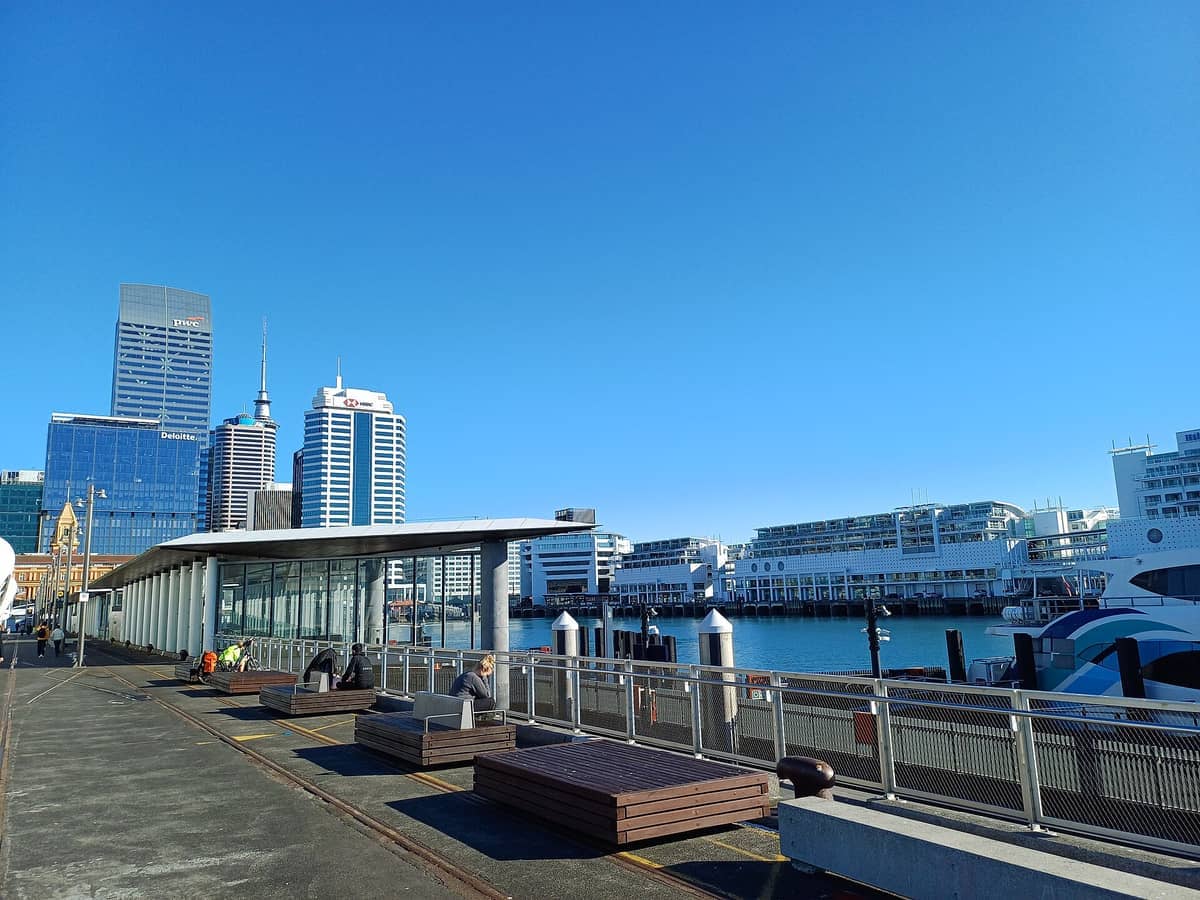
What Queens Wharf Actually Is
Queens Wharf is a concrete pier roughly 375 metres long and 86 metres wide, jutting into the Waitematā Harbour at the base of Queen Street. It is Auckland's most central waterfront structure: you can walk from Britomart in two minutes and arrive at the wharf's entrance with the downtown ferry terminal on your left and open harbour ahead. The wharf is publicly accessible — there are no gates or entry fees for the wharf itself — which makes it one of the more straightforward spots in the CBD to simply turn up at without planning ahead.
Two large heritage sheds dominate the structure. Shed 10 is a renovated wharf transit shed now used as an events and performance venue; The Cloud, a white tensile-fabric pavilion added at the seaward end, expands that capacity for larger gatherings. Between and beyond the sheds, open deck space runs along both sides of the wharf, giving unobstructed views of the harbour, the Waitematā, and on clear days the volcanic cone of Rangitoto Island.
ℹ️ Good to know
Queens Wharf has no fixed daily opening hours for the wharf area itself. The wharf is generally accessible during daylight hours and into the evening, but access to Shed 10 and The Cloud depends on scheduled events. Check Auckland Live's event calendar before visiting if your goal is to enter either venue.
A Brief History of the Wharf
The original Queen Street Wharf dates to 1852, making it one of Auckland's earliest formal harbour structures. The current concrete wharf was built in stages between 1907 and 1913 to handle the heavy shipping traffic of a rapidly growing colonial port city. For decades, this was where passenger liners docked and cargo moved through the heart of the city. Heritage New Zealand lists Queens Wharf on its register, recognising its significance to the evolution of Auckland's harbour and commercial history.
In the twentieth century, as container shipping migrated to purpose-built facilities further from the CBD, the wharf's transit sheds fell into a different kind of use: storage, light industry, and occasional public events. The transformation into a formal public venue accelerated in the lead-up to the 2011 Rugby World Cup, when Shed 10 was renovated and The Cloud was installed. The wharf became a free public space and festival hub, a function it has continued since.
For more on Auckland's relationship with its harbour and maritime past, the New Zealand Maritime Museum sits nearby in the Viaduct Harbour and goes into considerably more depth.
Tickets & tours
Live prices and dates from our booking partner. If you book, we may earn a commission at no extra cost to you.
Luggage Storage in Auckland
From 5 €Instant confirmationFree cancellationNew Zealand West Coast discovery tour
From 100 €Instant confirmationFree cancellation13,000ft skydiving experience in Auckland
From 195 €Instant confirmationFree cancellationDiscover Auckland City Tour
From 88 €Instant confirmationFree cancellation
What It Feels Like to Walk the Wharf
Step onto Queens Wharf from Quay Street and the city noise drops behind you almost immediately. The wind picks up as you clear the first shed, carrying the faint brine smell of the Waitematā and the low rumble of ferry engines from the terminal next door. On weekday mornings, the wharf is quiet: the occasional jogger, a few workers cutting through to the ferry, gulls perched on the railing. The light at that hour is particularly good for photos, with the CBD skyline reflected in the still harbour water.
By midday on a warm weekend, the character shifts. Families walk to the end of the wharf for the view; visitors sit on the timber deck sections watching the ferries come and go from the Devonport and Waiheke Island routes. The open deck at the seaward tip is the best vantage point: you are looking back at the Auckland CBD from the water, with the Sky Tower visible above the roofline and the Harbour Bridge to the west. It is a clean, open perspective that you cannot get from street level.
In the evening, especially during events or on summer weekends, the wharf has a different atmosphere entirely. Crowds flow in and out of Shed 10 or The Cloud, food vendors appear, and the harbour behind the city turns gold, then grey. The wharf is lit at night, but outside of event periods it is calm rather than lively.
💡 Local tip
For the clearest harbour views and the best photography light, visit on a weekday morning between 8 and 10am. The wharf is almost empty, the sky is often clear, and you get Rangitoto Island and the CBD skyline without anyone walking into frame.
The Venues: Shed 10 and The Cloud
Shed 10 is the more architecturally interesting of the two venues. The renovation kept the original corrugated iron and timber shed structure largely intact, preserving the industrial scale and proportions of a genuine early-twentieth-century transit building. Inside, the volume is large enough for concerts, exhibitions, and multi-day festivals. The acoustic quality depends heavily on what is being staged, but the raw shed aesthetic is a significant part of the appeal for event organisers and visitors alike.
The Cloud is a different proposition: a modern tensile fabric structure that can be dismantled or reconfigured, though it has become semi-permanent at the seaward end of the wharf. It lacks the heritage character of Shed 10 but offers substantial covered floor space for large-scale events. If you are not attending a specific event, neither building is accessible to the general public, and the interiors are not visible from outside.
Ticket prices and event schedules change throughout the year. Auckland Live manages the venue bookings; check their site for current listings. Events range from international touring concerts to public festivals, so the wharf's atmosphere can shift dramatically week to week.
Getting There and Getting Around
Queens Wharf is as well connected as anywhere in Auckland. Britomart Transport Centre, the main rail and bus hub for the central city, is a two-minute walk along Quay Street. The Downtown Ferry Terminal sits directly adjacent to the wharf's entrance, handling routes to Devonport, Waiheke Island, and other Hauraki Gulf destinations. Auckland Transport's AT HOP card or contactless payment works across bus, train, and ferry services.
There is no public car parking on the wharf itself. If you are driving, the nearest options are parking buildings on the CBD side of Quay Street. The most practical approach is to treat Queens Wharf as part of a waterfront walk connecting Viaduct Harbour to the west and Britomart to the east, rather than a standalone destination requiring its own transport plan.
Accessibility on the wharf itself is generally good: the main deck surfaces are flat and wide. However, Auckland Live advises visitors with specific access requirements to contact their accessibility team in advance of attending an event, particularly for Shed 10 and The Cloud, where event fit-outs can affect internal access. Drop-off points are provided for both venues.
Honest Assessment: Is It Worth Your Time?
As a free, open-access waterfront walk, Queens Wharf earns its place on any central Auckland itinerary without needing much justification. The harbour views from the seaward end are among the cleanest in the CBD, and the wharf's position at the foot of Queen Street makes it easy to visit without rerouting a day significantly.
As a standalone destination with nothing specific scheduled, it will not hold most visitors for more than 30 to 40 minutes. The sheds are closed between events, the wharf has no permanent café or retail presence to speak of, and there is no interpretive signage or exhibition to linger over. Travellers who arrive expecting a curated experience or a public market on a quiet Tuesday will find a large concrete pier with a good view.
The waterfront walking route extending west from the wharf through the Viaduct Harbour and into Wynyard Quarter adds considerably more variety, with permanent restaurants, public art, and the working harbour context that the wharf alone lacks.
⚠️ What to skip
If you are visiting specifically for an event at Shed 10 or The Cloud, verify access arrangements in advance. Event fit-outs occasionally restrict access to parts of the wharf. There is no permanent café on the wharf; bring water on hot days.
Insider Tips
- Walk to the very end of the wharf for the best unobstructed view of the Waitematā Harbour. From the seaward tip, you can see the Harbour Bridge to the northwest, Rangitoto Island to the northeast, and the full CBD skyline behind you — a combination you cannot get from any street-level position in the city centre.
- The wharf is an excellent spot to watch the Devonport and Waiheke ferry traffic at close range. Ferries depart from the adjacent terminal throughout the day; early morning and late afternoon see the heaviest traffic and give a tangible sense of how Auckland relates to the harbour.
- If Shed 10 is hosting an open event or festival, arrive in the first hour. Parking pressure on the waterfront and pedestrian crowding on the wharf builds quickly during popular events, and the shed's interior is most comfortable before capacity is reached.
- The wharf faces northeast, which means afternoon sun hits the western side of the deck directly. On summer afternoons, the timber deck sections on the eastern side of the wharf are in partial shade and noticeably cooler.
- Queens Wharf is near the harbour-side route of Auckland's Coast to Coast Walkway, whose downtown terminus is at Te Wero Bridge in Viaduct. If you are planning a longer walk across the city, this is a nearby place to start or finish on the harbour side.
Who Is Queens Wharf For?
- Travellers on a tight schedule who want a genuine harbour view without a boat trip or entry fee
- Event-goers attending concerts, exhibitions, or festivals at Shed 10 or The Cloud
- Visitors connecting to or from the Devonport or Waiheke Island ferries who have time between departures
- Architecture and history enthusiasts interested in Auckland's colonial-era port infrastructure
- Walkers treating the wharf as the waterfront anchor of a longer CBD walk through Viaduct Harbour and Wynyard Quarter
Nearby Attractions
Other things to see while in Auckland CBD:
- Albert Park
Albert Park is a free, 24-hour public park at the edge of Auckland's CBD, occupying land once held by colonial barracks. With formal Victorian gardens, mature trees, and a location flanked by the University of Auckland and the Auckland Art Gallery, it rewards a slow wander any time of day.
- Auckland Art Gallery Toi o Tāmaki
Auckland Art Gallery Toi o Tāmaki is New Zealand's largest art gallery, housing more than 18,000 works across historic French-château architecture and a striking contemporary addition. General collection entry is free, and the building itself is as worth examining as anything on the walls.
- Auckland Civic Theatre
The Civic is Auckland's most architecturally dramatic performance venue, a 2,379-seat Moorish fantasy built in 1929 at the corner of Queen and Wellesley Streets. Whether you're catching a touring musical, a film festival screening, or an Auckland Arts Festival production, the building itself is half the experience.
- Auckland Harbour Bridge
The Auckland Harbour Bridge is the city's most recognisable structure, stretching 1.2 km across the Waitematā Harbour since 1959. You can't walk across it, but you can climb over its arch or take a bungy jump from its underside. This guide covers the experience, the history, and how to make the most of your visit.
Planning a trip? Discover personalized activities with the Nomado app.