Puig de Missa: Santa Eulalia's Fortified Hilltop Church
Puig de Missa is the most historically significant landmark in Santa Eulalia des Riu, a whitewashed 16th-century fortified church perched 52 metres above the town. Free to visit, quietly commanding, and largely overlooked by day-trippers, it offers a rare window into Ibiza's pre-tourism identity.
Quick Facts
- Location
- Plaza de la Iglesia, 07819 Santa Eulària des Riu, Ibiza, Spain
- Getting There
- Short uphill walk from Santa Eulalia town centre; buses connect Ibiza Town to Santa Eulalia regularly
- Time Needed
- 45 minutes to 1.5 hours, including the walk up and time at the viewpoint
- Cost
- Free entry to the hill and church (special events may have separate charges)
- Best for
- History, architecture, panoramic views, photography, quiet exploration
What Is Puig de Missa?
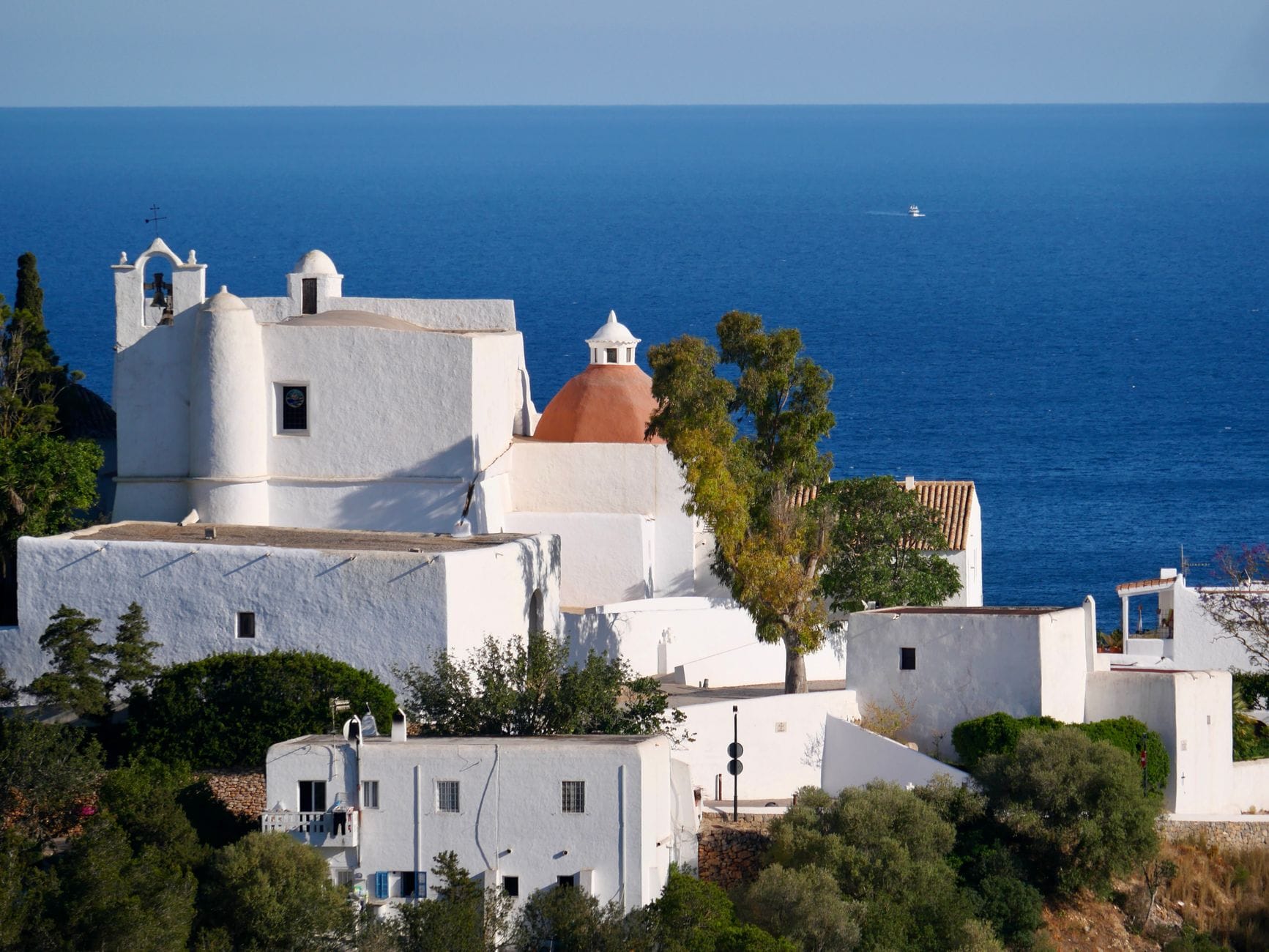
Puig de Missa is a fortified hilltop church complex in Santa Eulalia des Riu, on Ibiza's eastern coast. The full Catalan name, Església de Santa Eulària al Puig de Missa, translates roughly as the Church of Santa Eulalia on the Hill of the Mass. It sits at around 52 metres above sea level, high enough to command views across the rooftops of Santa Eulalia, the river plain, the surrounding pine-covered hills, and on a clear day, the sea stretching out into the Mediterranean.
The church is classified as a Bien de Interés Cultural, Spain's highest category of cultural heritage protection. What that designation actually means in person is a building that feels genuinely old rather than restored into smoothness: thick whitewashed walls, a crenellated defensive parapet, a squat bell tower, and the kind of proportional solidity that comes from a structure built for survival, not show.
For visitors who have spent time at Dalt Vila's fortified walls in Ibiza Town, Puig de Missa will feel like a quieter, more personal counterpart: smaller in scale, but no less genuine in its historical weight.
💡 Local tip
Opening hours are Tuesday to Sunday, 10:00–14:00. The church is closed on Mondays. Hours are subject to change, so confirm with the local tourist office or parish before visiting.
A Brief History: Pirates, Parishes, and Defensive Architecture
The current structure dates from the mid-16th century and was consecrated in 1568, replacing an earlier church on the same hill that had been destroyed in pirate attacks. The threat of coastal raids was not abstract in 16th-century Ibiza: the entire island had developed a culture of hilltop fortification, and Puig de Missa reflects that directly. The church was designed not just as a place of worship but as a refuge the local population could retreat to when raids threatened.
The thick perimeter walls, the position on elevated ground with sightlines across the coast, and the minimal windows at lower levels all serve a defensive logic. This is not decorative military architecture added later for aesthetic effect: it was the original purpose. The church became the parish of Santa Eulalia in 1785, by order of Ibiza's first bishop, giving it an administrative role that continued into the modern era.
This history of fortified religious sites runs throughout Ibiza. The same logic shaped Ibiza Cathedral and the broader citadel of Dalt Vila. Puig de Missa is a more intimate expression of that same island-wide instinct for defended high ground.
Tickets & tours
Hand-picked options from our booking partner. Prices are indicative; availability and final rates are confirmed when you complete your booking.
Sunset boat tour with tapas, open bar and water sports in Ibiza
From 70 €Instant confirmationFree cancellationEscape Tour self-guided, interactive city challenge in Ibiza
From 30 €Instant confirmationPrivate Sunset Cruise on a Maritime Classic in Ibiza
From 750 €Instant confirmationFree cancellationIbiza to Formentera boat trip with open bar and water sports
From 69 €Instant confirmationFree cancellation
The Walk Up and What to Expect on Arrival
Access is by foot from central Santa Eulalia, a walk of roughly five to ten minutes from the main seafront promenade or town square. The path climbs through narrow streets and stone steps, with the gradient noticeable but not demanding for most walkers. Comfortable shoes are more important here than at most Ibiza attractions: the cobbled surfaces and uneven stone steps can be slippery, especially after rain or in sandals with no grip.
As you ascend, the town quiets behind you. By the time you reach the church complex, the everyday noise of cafes, scooters, and beach crowds has largely faded. The approach opens onto a terrace with low walls and benches, where the view across Santa Eulalia and toward the coast becomes visible before you've even entered the church itself. In the morning, the light is clean and comes from the east, making the whitewashed walls glow against a blue sky. By midday the heat is concentrated on the south-facing terrace, so early visits are more comfortable in summer.
⚠️ What to skip
The steep cobbled approach is not suitable for wheelchairs or pushchairs without assistance. Visitors with reduced mobility should confirm access options directly with the local tourist office before making the journey uphill.
Inside the Church and Around the Complex
The church interior is restrained in the way that Ibicencan religious architecture generally is: whitewashed walls, a single nave, and minimal ornamentation compared to mainland Spanish baroque. The effect is austere and cool, a genuine relief in summer heat. The thick walls keep the interior several degrees cooler than outside, and the dimness after the brightness of the terrace requires a moment of adjustment.
The bell tower is a defining feature of the exterior silhouette and the most-photographed element of the building. From the terrace, the view takes in the town below, the flat plain of the Riu de Santa Eulalia (often described as the only river in the Balearic Islands), and the surrounding agricultural land that still breaks up the development on the eastern side of Ibiza. On a clear morning before summer haze sets in, the visibility is striking.
Around the church, a small cemetery has historically occupied part of the hilltop, as was common with Ibizan rural churches. The combination of the church, the views, and the remnants of this traditional settlement pattern gives Puig de Missa a quality that is genuinely different from the beach-focused or nightlife-oriented experiences that dominate most visitor itineraries on the island.
Photography and Timing
Puig de Missa is at its most photogenic in the first two hours after the church opens. The morning light falls directly on the south and west faces of the building, and the hill has few visitors before 11:00. By midday in July and August the terrace fills with day-visitors, the shadows shift unfavourably for the façade, and the heat becomes significant.
For wide shots that include the surrounding town and coastline, the terrace to the west of the church entrance offers the broadest framing. A moderate telephoto lens helps isolate the bell tower against the sky. The whitewash is highly reflective in direct sun, so early morning or the hour before closing, when the light is lower and softer, tends to produce better results than midday shooting.
If you are planning a broader photography-focused day on Ibiza's eastern side, combining Puig de Missa with the promenade in Santa Eulalia and a visit to Es Canar beach to the north makes for a coherent half-day itinerary.
How Puig de Missa Fits Into Santa Eulalia
Santa Eulalia des Riu is the third-largest town on Ibiza and has a noticeably different character from the party-oriented west of the island. It is more residential, more family-oriented, and calmer in tone. Puig de Missa is central to understanding that identity: this is the historical and spiritual heart of the municipality, predating the seafront promenade and tourist development by four centuries. Visitors who want to go beyond the beach and understand something of what Ibiza looked like before mass tourism should spend time here. For more on the town, the Santa Eulalia neighbourhood guide covers the full range of what the area offers.
The surrounding area around the church retains some of the architectural character of traditional Ibizan rural settlement: simple cubic forms, whitewash, and a density that comes from defensive concentration rather than planned urban layout. It is not a museum piece but a functioning parish that still holds services, which means the atmosphere is closer to a living building than a heritage site managed for tourism.
Santa Eulalia is also a reasonable base for exploring the northeast of the island, including the Punta Arabi hippy market and the beaches of the quieter northern coast. The town has good bus connections to Ibiza Town, making it easy to reach without a car.
Who Should Skip This Attraction
Puig de Missa is not the right stop for visitors whose priorities are beach time, nightlife, or high-stimulus experiences. The visit is quiet, the interior is simple, and the payoff is historical and visual rather than active or social. Those who find heritage sites without interactive elements or extensive museum content underwhelming are likely to feel that the uphill walk was not worth the return.
Visitors with significant mobility limitations should also assess carefully before making the trip. The cobbled ascent is steep in places and there is no lift or ramp access. The experience at the base of the hill, looking up, gives a reasonable sense of the structure but not the panoramic view from the terrace.
Insider Tips
- Arrive when the church opens at 10:00 on a weekday and you will likely have the terrace to yourself for the first 20 to 30 minutes. Weekend mornings bring more visitors.
- The best view of the church as a whole is not from the terrace but from the streets below on the eastern approach, where the bell tower and defensive wall compose cleanly against the sky.
- The church still holds regular religious services, particularly on Sundays and feast days (Sunday mass is typically at 11:00). The atmosphere during a service is very different from a standard visitor visit, and timing your arrival to avoid or coincide with one is worth checking locally.
- Wear shoes with grip. The cobbled path up from town becomes genuinely slippery after rain, and sandals with flat soles are a risk on the steeper sections.
- Combine the visit with a walk down through the old streets of Santa Eulalia town centre afterward. The contrast between the hilltop quiet and the seafront activity below takes about 15 minutes on foot and gives a good sense of the town's different layers.
Who Is Puig de Missa, Santa Eulalia For?
- Travellers interested in Ibiza's history and architecture beyond the nightlife and beaches
- Photographers looking for a viewpoint with genuine character rather than a staged overlook
- Families with older children who can manage the cobbled uphill walk
- Visitors based in Santa Eulalia who want a short morning excursion before the beach
- Anyone looking for a free, low-crowd experience that takes less than two hours
Nearby Attractions
Other things to see while in Santa Eulalia del Río:
- Cala Llonga
Cala Llonga is a sheltered horseshoe bay on Ibiza's eastern coast, about 7 km from Santa Eulalia. With about 200 metres of fine sand, calm and shallow water, and reliable amenities including disabled water access, it draws families and those who want a gentler pace than Ibiza's more famous beaches.
- Es Canar Beach
Es Canar Beach sits on the quieter eastern coast of Ibiza, within the municipality of Santa Eulària des Riu. A crescent of fine sand roughly 300 metres long, it draws families and couples looking for calm Mediterranean swimming, decent beach facilities, and easy access by bus, boat, or car. It is also home to the long-running Wednesday hippy market at Punta Arabí, one of the oldest in Ibiza.
- Hippy Market Punta Arabí (Es Canar)
Founded in 1973, Hippy Market Punta Arabí in Es Canar is Ibiza's oldest and largest open-air hippy market. Every Wednesday from April to October, hundreds of stalls fill the pine-shaded grounds of the Punta Arabí hotel complex with handmade jewellery, leather goods, clothing, artwork, and food. Entry is free.