Piscina das Marés: Swimming Inside a Work of Architecture
Designed by Álvaro Siza Vieira and inaugurated in 1966, Piscina das Marés in Leça da Palmeira is a rare example of a swimming complex classified as a National Monument. Built into the Atlantic shoreline at Matosinhos, the pools merge poured concrete and natural rock in a composition so understated it barely interrupts the horizon.
Quick Facts
- Location
- Avenida da Liberdade, Leça da Palmeira, 4450-716 Matosinhos, Portugal
- Getting There
- Bus lines connect central Porto and Matosinhos to Leça da Palmeira; check STCP/Matosinhos transport for current routes
- Time Needed
- 2–4 hours (half-day if combining with Matosinhos seafront)
- Cost
- Day ticket pricing for adults and young people aged 13+ is set by Matosinhos Sport and may change each season; check the official tariff before visiting. Bathing season only: June–September (exact dates vary).
- Best for
- Architecture lovers, swimmers, design photography, relaxed beach days
- Official website
- www.matosinhosport.pt/piscinas/piscina-das-mares
What Piscina das Marés Actually Is
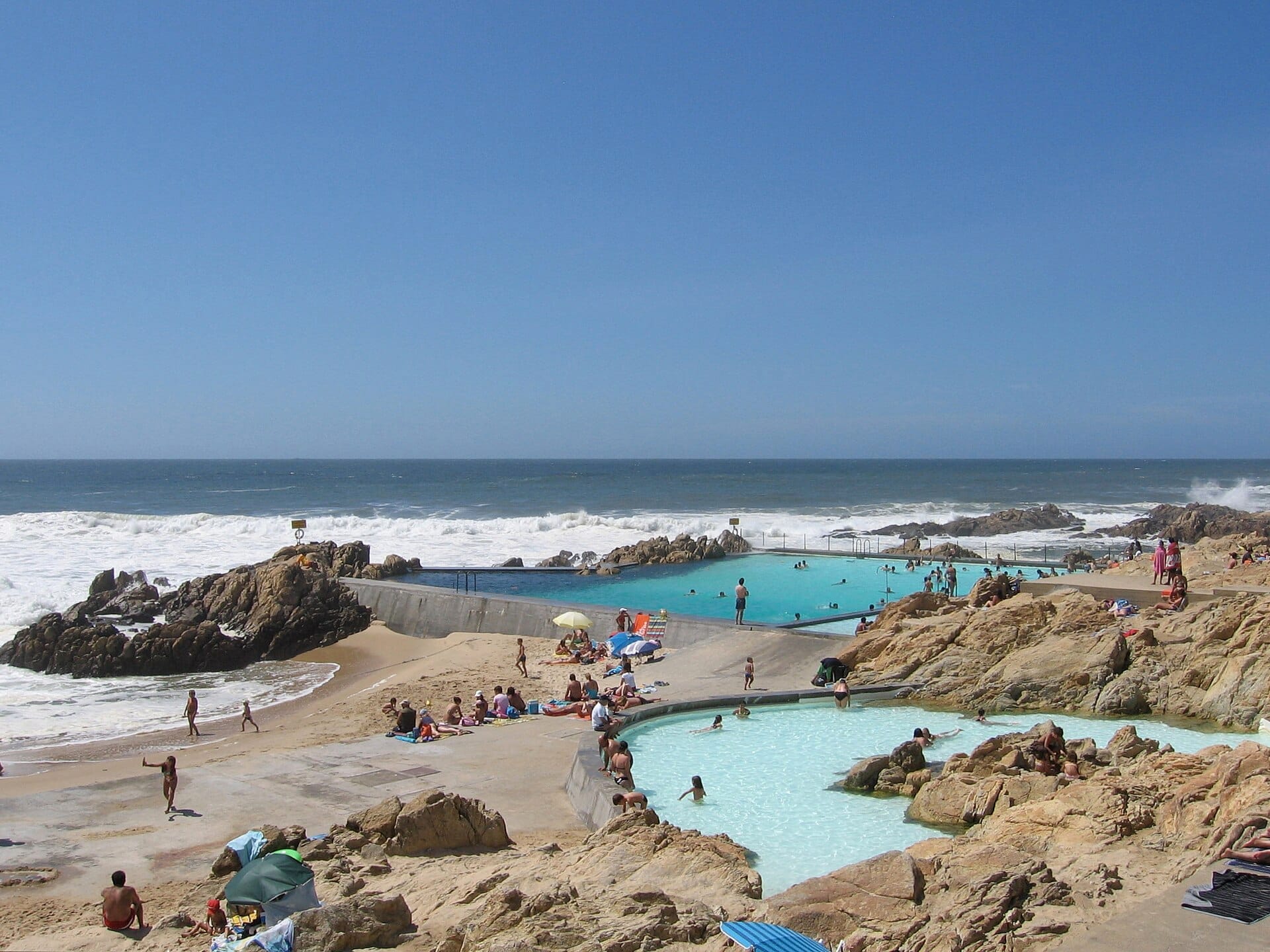
Piscina das Marés, commonly known in English as the Leça Swimming Pools or Leça Tidal Pools, is an outdoor seawater pool complex built directly into the rocky Atlantic coastline at Leça da Palmeira, in the municipality of Matosinhos, just north of Porto. The complex was designed by Portuguese architect Álvaro Siza Vieira, built in the 1960s, and inaugurated in 1966. In 2006, the Portuguese state designated it a National Monument, one of the very few 20th-century sports facilities in Portugal to receive that status.
The pools do not pretend to compete with the ocean. Siza's approach was to work with the existing rock formations rather than impose a structure on them. Low concrete walls follow the irregular contours of the shore, creating two pools of different depths that fill and drain with the tides. Changing rooms, showers, and a narrow reception pavilion are partially sunk below the dune line so that, viewed from the beach promenade, the complex almost disappears into the landscape. That restraint is the whole point.
ℹ️ Good to know
Piscina das Marés is only open to the public during the bathing season, which normally runs across June, July, August, and September, with opening and closing dates varying by year. Outside the season, the pool is closed to casual visitors; access is only possible through pre-arranged guided architectural or technical visits.
The Architecture: Why This Pool Is in Every Textbook
Álvaro Siza Vieira is one of the most studied architects of the 20th century, and Piscina das Marés is among the first works that established his international reputation. At the time of the commission, Siza was still a young architect in Porto, working under Fernando Távora. The pools represent what critics now call Siza's "critical regionalism": a rigorous modern language that refuses to ignore where it is. The concrete is deliberately raw, unfinished in texture, and aged in a way that makes it difficult to distinguish from the lichen-covered granite boulders surrounding it.
The walkway system that connects the entrance to the pool deck is worth studying on its own. A long, low ramp descends from street level through the dunes, narrowing and widening as it responds to rock outcrops. Handrails are minimal. The approach deliberately withholds the ocean view until you have almost reached the water. It is a piece of choreographed movement, and it explains why architecture students and critics continue to make pilgrimages here decades after completion.
For wider context on Siza's influence on Porto's built environment, the Serralves Museum in Boavista offers another major example of the architect's mature work, completed in 1999. The contrast between the two projects, separated by more than 30 years, is striking.
Tickets & tours
Hand-picked options from our booking partner. Prices are indicative; availability and final rates are confirmed when you complete your booking.
Serralves All-Access Pass
From 24 €Instant confirmationFree cancellationSantiago de Compostela Full-Day Tour
From 79 €Instant confirmationFree cancellationPeneda Geres park full-day tour from Porto
From 100 €Instant confirmationFree cancellationPorto historical center and the best viewpoints on a tuk-tuk
From 39 €Instant confirmationFree cancellation
How the Experience Changes Through the Day
Morning visits, roughly 09:00–11:00, are quieter and cooler. The light at that hour is low and lateral, which throws the texture of the concrete into sharp relief and makes the pool water appear a deeper blue-green. Photographers who care about the architecture more than the swimming tend to arrive early. The Atlantic wind can be cold this early even in August, so bring a layer you can shed.
By midday, particularly on weekends in July and August, the pools draw large crowds. Families with children occupy the shallower pool, which is more sheltered. The main pool fills with lap swimmers and groups of teenagers. The changing rooms can get congested, and finding space on the concrete terraces around the pools requires arriving before noon or accepting a spot on the rocks.
Late afternoon, from around 16:00 onward, offers a secondary window of calm as the midday crowd disperses before closing time. The westward-facing orientation means late sun falls directly across the water and the concrete surfaces, which is when the complex looks its most photogenic. On overcast days, the pools take on a different character entirely: the muted light flattens the contrast between rock, concrete, and sea, and the whole composition feels more monochromatic and severe.
💡 Local tip
If architectural photography is your priority, visit on a weekday morning in June or early September, when crowds are thin and the low sun angle emphasizes the concrete textures. Avoid Saturday and Sunday afternoons in July and August.
The Water: What It Feels Like to Actually Swim Here
The water in the pools is cold. This is the Atlantic Ocean off northern Portugal, not the Mediterranean, and even in August the sea temperature rarely exceeds 19–20°C. The pools are seawater pools that exchange with the tides, so the temperature reflects the ocean directly. Visitors who arrive expecting warm, calm water comparable to a conventional public pool will be caught off guard. The shock on entry is real, and it is part of the experience.
Once acclimatized, the sensation of swimming within Siza's concrete enclosure while the open Atlantic rolls just beyond the low walls is genuinely unusual. Waves occasionally spray over the outer edge of the main pool during higher swells, and you can hear the ocean constantly. The water is clear, and the pool floor is unfinished concrete rather than tiles. There are no lane ropes in the main pool and no lifeguard positioning that suggests a competitive swimming environment. It feels more like an organized rock pool than a sports facility.
Getting There from Porto
Leça da Palmeira sits north of Matosinhos town centre, roughly 12 km from central Porto. Public bus connections from Porto and from Matosinhos are available, though schedules and route numbers should be verified with STCP and Matosinhos municipal transport before travel, as they are subject to change. A taxi or ride-hailing service from central Porto is a straightforward option and usually covers the distance in around 20–25 minutes depending on traffic.
If you plan to combine this visit with lunch in Matosinhos, the Matosinhos seafront promenade and its concentration of grilled seafood restaurants are a 10–15 minute walk south of the pools. The neighbourhood is also close to Matosinhos beach, Porto's most accessible urban beach, which makes a logical extension of the day.
Parking is available near the complex on Avenida da Liberdade, but spaces fill early on summer weekends. Arriving by bus or taxi is more reliable between 10:00 and 14:00 on Saturdays and Sundays in July and August.
Practical Notes Before You Go
Day tickets during the bathing season typically cover roughly 09:00–19:00 and adult pricing is set by Matosinhos Sport for each year; check the current tariff for up-to-date prices, including any discounts with the Matosinhos Sport (MTS) card. Children's pricing and season ticket options are listed on the Matosinhos Sport website and are subject to annual revision. Bring your own towel, sunscreen, and footwear for the rocks. The concrete and natural rock surfaces around the pools become hot in direct sun and are uneven underfoot, so water shoes or sandals are useful.
The changing rooms and shower facilities are functional rather than luxurious. Lockers for valuables are available. There is no food service within the complex itself, so bring water and snacks or plan to eat before or after at the nearby seafront. The sun exposure on the open pool terraces is intense in summer; shade is minimal within the complex by design.
⚠️ What to skip
Outside the June–September bathing season, Piscina das Marés is closed to casual visitors. Entry during the off-season is only possible through pre-arranged guided architectural or technical visits, or approved commercial activities such as photography and filming. Do not travel specifically for the pools without confirming the season is open.
Accessibility within the complex is limited by the nature of the site. The approach ramps and terraces involve uneven stone and concrete surfaces. Visitors with mobility limitations should check directly with Matosinhos Sport before visiting, as facilities may not fully accommodate all needs.
Is It Worth Your Time?
For architecture lovers, this is not optional. Piscina das Marés is one of a small number of 20th-century buildings in Portugal that genuinely rewards careful attention. The experience of moving through Siza's spatial sequence, from street level down through the dunes to the water, is something photographs do not fully communicate. If you are in Porto and have any interest in modern architecture, making the short trip to Leça da Palmeira is the right decision.
For travelers who just want a beach day near Porto and are indifferent to architecture, the pools are a pleasant if slightly austere option. The cold water and functional facilities mean this is not a glamorous resort experience. People expecting warm water, café service, and sunloungers will be more comfortable at Matosinhos beach. But if you are comfortable with cold seawater and appreciate the idea of swimming inside a National Monument, the combination of novelty and quality is hard to match anywhere in the Porto area.
To plan your wider Porto itinerary around this visit, the Porto 3-day itinerary covers how to sequence the city's main attractions efficiently, and the Porto beaches guide gives a full overview of the Atlantic coastline options within reach of the city.
Insider Tips
- Arrive at opening time (09:00) on a weekday in June or early September for the best combination of empty pools and architectural light. The difference from a Saturday afternoon in July is enormous.
- The main pool exchanges water with the tides, so water clarity and temperature are noticeably better during a rising or high tide. Check local tide tables before you go.
- The external approach along the promenade from the south gives the best first view of how the complex sits in the landscape. Walk past it before entering so you understand the roofline relationship with the dunes.
- If you are visiting out of season and want to see the architecture, contact Matosinhos Sport directly by phone or email to arrange a guided architectural visit. These happen and are well worth organizing.
- Bring a wetsuit top or rash guard if you are sensitive to cold water. Even in August, the first 10 minutes in the main pool will feel very cold to most people accustomed to Mediterranean or pool swimming.
Who Is Piscina das Marés (Leça Swimming Pools) For?
- Architecture enthusiasts and students of 20th-century design
- Photographers looking for geometric concrete-and-sea compositions
- Swimmers who prefer cold seawater to heated pools
- Travelers combining a Porto trip with a coastal half-day
- Anyone curious about what a National Monument pool actually feels like
Nearby Attractions
Other things to see while in Matosinhos:
- Matosinhos Beach
Praia de Matosinhos is the closest major beach to Porto — a long, wide stretch of golden Atlantic sand backed by one of Portugal's most celebrated seafood dining strips. Free to access, open year-round, and a short metro ride from central Porto, it draws surfers, swimmers, Sunday lunchers, and evening walkers in equal measure.
- Matosinhos Seafront Promenade
The Matosinhos seafront promenade runs for roughly 4 kilometres along Praia de Matosinhos, Porto's largest and most accessible beach. Free to visit and open around the clock, it draws surfers at dawn, families at noon, and sunset walkers in the evening. This is where Porto residents actually go to breathe.
- SEA LIFE Porto
SEA LIFE Porto is a family aquarium on the Atlantic coastline in Matosinhos, featuring 31 tanks, Portugal's first underwater tunnel spanning over 500,000 litres of water, and a seaside park setting beside the historic Castelo do Queijo. It opened in 2009 and remains one of the few purpose-built aquarium attractions in northern Portugal.