National Memorial on Vítkov Hill: History, Views, and Bronze Giants in Žižkov
Perched above the Žižkov district, the National Memorial on Vítkov Hill is one of Prague's most architecturally imposing sites. It spans six centuries of Czech history, carries the scars of communist-era repurposing, and rewards visitors with panoramic city views — all for free.
Quick Facts
- Location
- U Památníku 1900, Praha 3 – Žižkov, Prague
- Getting There
- Florenc metro (lines B & C), then bus 133, 175, or 207 to U Památníku stop; or trams 7, 10, 11 to Biskupcova
- Time Needed
- 1.5 to 2.5 hours
- Cost
- Free entry (verify current policy at vhu.cz before visiting)
- Best for
- History enthusiasts, architecture lovers, city view seekers, travelers wanting a crowd-free alternative to castle viewpoints
What the National Memorial on Vítkov Hill Actually Is
The National Memorial on Vítkov Hill — Czech: Národní památník na Vítkově — is a monumental granite complex sitting on a narrow ridge above the Žižkov district in Prague 3. It was constructed between 1928 and 1938 as a tribute to the Czechoslovak legionaries who fought in World War I and to Jan Žižka, the Hussite military commander who won a decisive battle on this same hill in 1420. The building is severe and deliberate in its scale, clad in rough-cut stonework that catches grey light on overcast days and turns almost gold in afternoon sun.
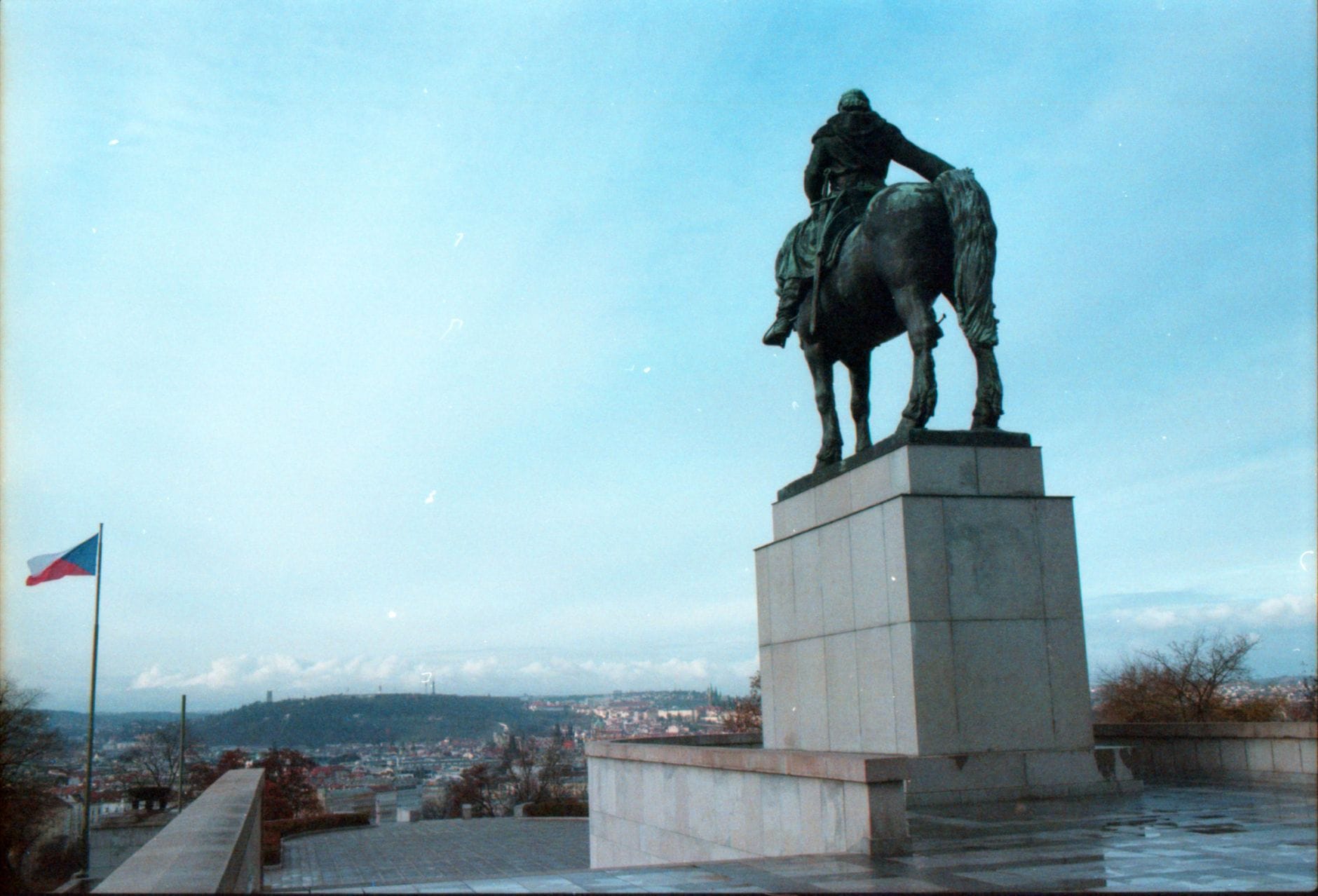
Dominating the forecourt is the equestrian statue of Jan Žižka, the third-largest bronze equestrian statue in the world. The figure sits nearly 9 metres tall on its plinth and faces east with an authority that stops most visitors mid-step. Up close, the surface of the bronze shows the texture of the casting work and decades of oxidation. The scale is genuinely difficult to process until you stand directly beneath it.
ℹ️ Good to know
Opening hours are Tuesday to Sunday, 10:00–18:00 (last entry 17:30), with Monday closures. Hours can vary on special dates. Always verify at vhu.cz before making the trip.
A Building With a Complicated Past
The memorial was conceived in a period of Czechoslovak national confidence after the founding of the First Republic in 1918, designed to anchor the country's self-image in both medieval military glory and the modern legionary sacrifice of World War I. Construction dragged through the Depression years and was not complete when World War II interrupted everything.
After the Communist takeover in 1948, the building was repurposed with unsentimental efficiency. Between 1954 and 1962, the interior housed the embalmed body of Klement Gottwald, Czechoslovakia's first communist president, in a mausoleum that was self-consciously modeled on Lenin's tomb in Moscow. Gottwald's preservation proved difficult, and his remains were eventually cremated and relocated. The building then served various state functions until the regime collapsed in 1989.
Management passed to the Historical Museum of the National Museum in 2000, triggering an extensive restoration. The memorial reopened to the public on 29 October 2009. Since June 2024 it has been administered by the Military History Institute Prague (VHU Praha) under the Ministry of Defence. The National Museum's former permanent exhibition "Crossroads of Czech and Czechoslovak Statehood" is closed. Public access currently includes spaces such as the Ceremonial Hall, Presidential Lounge, and the Tomb of the Unknown Soldier; check the official VHU site for current exhibitions and what is open on the day you visit.
If you want to understand how Czech identity was constructed, contested, and distorted across the 20th century, Vítkov remains a powerful place to start — even while new exhibitions are being prepared. Pair it with a visit to the Museum of Communism in New Town for a fuller picture of the communist period.
Tickets & tours
Hand-picked options from our booking partner. Prices are indicative; availability and final rates are confirmed when you complete your booking.
Tour of Terezin Concentration Camp Memorial from Prague
From 55 €Instant confirmationFree cancellationSelf guided tour with interactive city game of Prague
From 5 €Instant confirmationFree cancellationPrague by night city tour
From 27 €Instant confirmationFree cancellationPrague city tour with Vltava River cruise
From 38 €Instant confirmationFree cancellation
What the Visit Feels Like, Hour by Hour
The uphill approach from the U Památníku bus stop takes around five to eight minutes on foot through a quiet park. In the morning, especially on weekdays, you will likely have the forecourt nearly to yourself. The silence around the Žižka statue at this hour is close to complete — no street noise reaches the ridge, and the wind tends to come in low and steady from the west. It is a noticeably different register from the sensory density of the Old Town.
The interior of the memorial is cool in all seasons. In winter, the stone walls hold cold that your coat alone may not manage — bring a layer. In summer, the building provides real relief from heat. The main hall has a high vaulted ceiling, and voices carry in odd ways: a murmured conversation echoes further than expected, which keeps most visitors instinctively quiet.
Afternoon light enters through west-facing elements and the exterior terrace facing the city becomes noticeably warmer from around 14:00 onward. The view from the terrace takes in a wide sweep of Prague's eastern and central districts, with the spires of Žižkov's television tower visible to the south and the Old Town roofline further west. It is not the postcard view of the Charles Bridge, but it is a more honest view of the whole city.
💡 Local tip
For the best light on the Žižka statue, arrive between 14:00 and 16:00 when afternoon sun strikes the bronze from the southwest. Photographers using a wide-angle lens will want to step back to the far edge of the forecourt — the statue is large enough that a standard lens forces awkward vertical distortion at close range.
The Architecture: What to Look For
The building was designed by architect Jan Zázvorka in a stripped classical style that was common to state memorial architecture across Europe in the interwar years — think severe horizontals, monumental scale, and an absence of ornamental detail that reads as solemnity rather than austerity. The granite cladding is consistent across the exterior, sourced to give an impression of geological permanence.
Inside, the communist-era alterations are still partially legible: proportions were modified to accommodate the mausoleum function, and some interior finishes reflect the aesthetic preferences of 1950s state socialism rather than the original 1930s design. Rather than concealing this, the building itself still reads as an architectural palimpsest, showing where one regime literally built over another. Check vhu.cz for whatever interpretive displays are currently open.
Visitors with a strong interest in Czech interwar and modernist architecture will find this worth cross-referencing with the Prague architecture guide, which covers the full range of building movements visible across the city.
The View From the Hill
Vítkov Hill is one of the elevated ridges that define Prague's eastern inner districts, and the memorial terrace sits at a height that gives clear sightlines without the queuing and entry fees associated with the more famous viewpoints. On a clear day you can identify Prague Castle's silhouette to the northwest, the dome of the National Museum at the top of Wenceslas Square, and the Žižkov Television Tower's distinctive tubular form to the southeast.
For comparison, the city's other significant elevated viewpoints, including Petřín Lookout Tower and Letná Park, each offer different compass orientations. Vítkov gives the clearest eastward and central panorama of the three.
Getting There and Practical Notes
From Florenc metro station (lines B and C, the closest major interchange), buses 133, 175, and 207 stop at U Památníku. From there, a short uphill walk through the park brings you to the memorial forecourt. The route is clearly signposted. From Florenc metro station (lines B and C, the closest major interchange), buses 133, 175, and 207 stop at U Památníku. From there, a short uphill walk through the park brings you to the memorial forecourt. The route is clearly signposted. From nearby metro stations on Line A, you can also continue by local bus or tram.
Trams 7, 10, and 11 stop at Biskupcova, from which you approach the hill from a slightly different angle through the residential Žižkov streets. This approach gives a better sense of the neighborhood's texture: low-rise apartment blocks, local pubs, a few small groceries. Trams 7, 10, and 11 stop at Biskupcova, from which you approach the hill from a slightly different angle through the residential Žižkov streets. This approach gives a better sense of the neighborhood's texture: low-rise apartment blocks, local pubs, a few small groceries.
The memorial access is barrier-free, with step-free routes confirmed by the operator. The park surrounding the building is commonly used by local residents for walking, particularly in the mornings and early evenings.
⚠️ What to skip
The memorial is closed on Mondays. Some third-party listing sites show different days or hours — the authoritative source is vhu.cz. Check before visiting, particularly around Czech public holidays when schedules shift.
Who Should Reconsider This Visit
Travelers with very limited time in Prague and a primary interest in architecture or riverside scenery may find that the 30-plus minutes of transit and walking required tips the cost-benefit calculation against Vítkov. The monument is genuinely moving and historically dense, but it rewards visitors who come prepared — if you have not read even a paragraph about the Hussite period or Czechoslovak 20th-century history, the site's historical layers will land less clearly. It is also a physically removed location: a dedicated trip, not a casual detour from the Old Town.
Families with young children will find the forecourt and park grounds appealing, but the interior spaces are oriented more toward adult visitors than young children. If you are traveling with children and want to manage their attention carefully, consider pairing it with a broader Prague with kids itinerary that builds in the right pacing.
Insider Tips
- The park surrounding the memorial is a local walking route. Arriving from the Ohrada bus stop (buses 133, 136, 207) and walking along Pražačka Street through the park is quieter and more pleasant than the direct approach from U Památníku — and gives you a better sense of the hill's actual scale.
- The Tomb of the Unknown Soldier is inside the memorial and is a specific, clearly marked space within the complex. It is easy to miss if you move quickly through the main hall — slow down in that section.
- Photography of the Žižka statue is most effective from the far western end of the forecourt, where you can get the statue against an open sky rather than the building behind it. Early morning gives a cleaner background with fewer visitors in frame.
- The memorial often feels less crowded than Prague's best-known sights, so even on summer weekends the interior exhibition rooms are usually easy to move through at your own pace.
- The surrounding Žižkov neighborhood has a concentration of older Prague pub culture. After visiting, the streets downhill toward Seifertova and Fibichova offer straightforward local restaurants and pubs — noticeably different in price and atmosphere from the tourist-facing establishments near Old Town Square.
Who Is National Memorial on Vítkov Hill For?
- History travelers who want to understand Czechoslovakia's 20th century beyond surface-level summaries
- Architecture enthusiasts interested in interwar memorial design and its communist-era modifications
- Photographers looking for city panoramas without queues or entry fees
- Repeat visitors to Prague who have covered the main sites and want something with more depth
- Visitors based in Žižkov or Vinohrady for whom this is a short walk from their accommodation
Nearby Attractions
Other things to see while in Žižkov:
- Žižkov Television Tower
Standing 216 metres above the Žižkov district, the Žižkov Television Tower is Prague's most polarising structure: a brutalist communist-era transmitter encrusted with crawling bronze babies and topped by an enclosed observation deck. This guide tells you what the view is actually like, when to go, and whether it's worth the admission.