Nashville Murals & Street Art: A Neighborhood-by-Neighborhood Guide
Nashville's public murals are scattered across a dozen neighborhoods, from the iconic wings in the Gulch to politically charged walls in North Nashville. Viewing is free, self-guided, and best done on foot. This guide covers where to go, when to go, and what you'll actually find when you get there.
Quick Facts
- Location
- Citywide: The Gulch, 12South, East Nashville, Downtown, North Nashville, The Nations, and more
- Getting There
- Ride-share or car recommended for multi-neighborhood routes; WeGo bus routes serve major districts
- Time Needed
- 1–2 hours for a single neighborhood; 3–5 hours for a citywide self-guided route
- Cost
- Free to view independently; guided mural tours available from select operators at varying fees
- Best for
- Photography, neighborhood exploration, understanding Nashville's cultural identity beyond Broadway
- Official website
- www.visitmusiccity.com/nashville-trip-ideas/nashville-murals
What Nashville's Street Art Scene Actually Is
Nashville Murals is not a single location or attraction with a ticket booth. It's a loose, city-wide collection of outdoor public art on building exteriors, parking garage walls, alley fences, and commercial facades spread across more than a dozen neighborhoods. The collection has no central curator and no admission fee. What it does have is scale: the mural scene expanded dramatically through the 2010s as the city grew, and walls that were blank concrete a decade ago now carry large-format work ranging from sentimental music tributes to pointed commentary on race, history, and gentrification.
Because murals sit on public sidewalks and streets, they're viewable at any hour. Practically speaking, the best light for photography falls between early morning and late afternoon, depending on which direction the wall faces. Some murals are in neighborhoods that feel comfortable after dark; others are better visited in daylight. Each neighborhood has its own tone, its own reasons for the art, and its own walking conditions.
💡 Local tip
Many murals sit on private property (business walls, parking lots) and technically belong to the businesses that commissioned them. A few sites have limited-hour access. If a gate is closed, respect it and return during business hours.
The Gulch: Where the Wings Made Nashville Famous for Murals
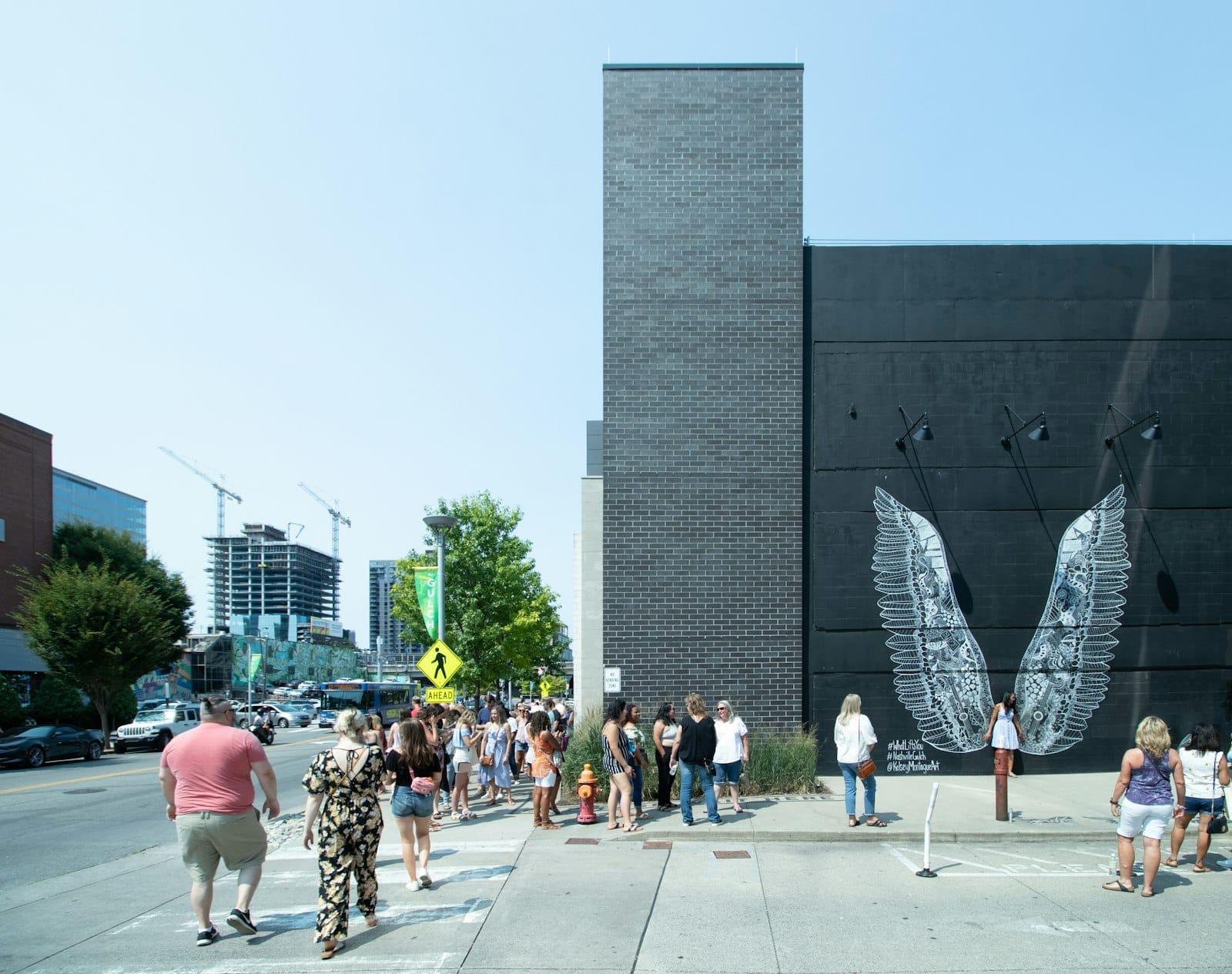
The most photographed mural in Nashville is the 'What Lifts You' wings piece on the exterior of a building at 302 11th Avenue South (often listed as 230–302 11th Avenue South) in The Gulch. Created by local artist Kelsey Montague, the large-scale butterfly wings are designed so that a person standing in front of them becomes the body of the creature. On any given weekend morning, there's a queue of people waiting to take their turn. By midday, the line can stretch noticeably. If you want a photo without strangers in the background, arrive before 8:30 a.m. on a weekday.
The Gulch itself is a former industrial district south of downtown that was redeveloped into a mixed-use neighborhood in the 2000s. Beyond the wings mural, the area has several other painted walls within a few blocks. The Gulch wings mural has become so associated with Nashville's Instagram identity that it now functions almost as a city landmark. Worth seeing for that cultural context alone, though serious street art enthusiasts tend to find more interesting work elsewhere.
Tickets & tours
Live prices and dates from our booking partner. If you book, we may earn a commission at no extra cost to you.
Old Town trolley tour of Nashville
From 54 €Instant confirmationFree cancellationDowntown walking tour of Nashville
From 21 €Instant confirmationFree cancellationNashville Downtown Underground Donut Tour
From 46 €Instant confirmationFree cancellationNashville City Center audio-guided walking tour
From 9 €Instant confirmation
12South and East Nashville: Neighborhood Scale, Genuine Character
The 12South corridor along 12th Avenue South has murals integrated into storefronts and small businesses. The scale here is more human: these aren't giant-format productions but medium-sized works that sit comfortably on the side of a boutique or coffee shop. Walking the stretch takes about 30 minutes and pairs naturally with stopping into the shops. Late morning on a weekday is ideal, when foot traffic is light and the light falls favorably from the east.
East Nashville carries some of the most artistically diverse work in the city. The Five Points intersection and the streets radiating from it have a higher concentration of independently commissioned murals, several of which engage directly with the neighborhood's evolving identity. East Nashville has been reshaping rapidly, and some murals reflect that tension between older character and new development. Pairing a mural walk here with a visit to Five Points in East Nashville gives context to what you're seeing on the walls.
North Nashville: Art Rooted in African American History
North Nashville's mural landscape is distinct from the rest of the city. Here, the art is often explicitly historical and community-rooted, reflecting the neighborhood's African American heritage and the long-term presence of historically Black colleges and universities including Fisk University and Tennessee State University. Murals in this area have addressed civil rights history, neighborhood identity, and social justice in ways that are more substantive than the decorative or promotional work found in commercial districts.
The Frist Art Museum has documented the North Nashville mural tradition through its programming, acknowledging that this scene predates and operates independently from the tourism-driven mural culture elsewhere in the city. If you visit only the Gulch and 12South, you're seeing a curated, commercially adjacent version of Nashville street art. North Nashville is where the form carries more weight.
ℹ️ Good to know
North Nashville murals are best explored as part of a deliberate visit rather than a quick detour. Research specific locations in advance using community arts organizations or the Nashville Public Art database at nashvillepublicart.com.
Downtown and Broadway: Music History on the Walls
Downtown Nashville has several murals oriented toward the city's country music identity. The Legends Corner mural at 428 Broadway depicts iconic country figures and sits on one of the most-trafficked blocks in the city. Viewing it requires navigating the Broadway strip, which is a very different experience from the quieter neighborhood walks elsewhere. On weekend evenings, this stretch is loud, packed, and disorienting for anyone trying to focus on public art.
The more rewarding approach downtown is to connect mural-spotting with the broader music history district. Hatch Show Print and the surrounding SoBro blocks have graphic art traditions that inform the visual character of the neighborhood. If you're doing a structured walking route, the Nashville walking tour guide covers several of these connections in sequence.
Practical Notes: Timing, Photography, and Getting Around
Most Nashville murals face east or west, meaning the quality of natural light changes significantly over the course of a day. East-facing walls photograph best in morning light; west-facing walls are better in the afternoon. The wings mural in the Gulch faces east and catches excellent light on clear mornings. Midday sun creates harsh shadows and flat colors on most wall surfaces, which is worth knowing if photography is part of your reason for going.
Weather matters. Nashville's summers are hot and humid, with highs regularly reaching the upper 80s Fahrenheit. Walking multiple neighborhoods in July or August means planning for heat, bringing water, and wearing light clothing. The most comfortable months for a multi-neighborhood mural walk are April, May, September, and October, when temperatures are mild and precipitation is manageable.
Getting between neighborhoods requires a car or ride-share. The Gulch, 12South, downtown, East Nashville, and North Nashville are spread across the city, and WeGo bus routes connect some but not all of them efficiently. For a focused single-neighborhood visit, parking or drop-off on foot works well. For a multi-stop route covering four or more areas, a car or a series of ride-share trips makes more sense than trying to walk everything.
⚠️ What to skip
Some mural sites listed on popular travel blogs have been painted over or replaced. Nashville's street art scene is not static. Verify specific mural locations using current sources like Visit Music City or nashvillepublicart.com before planning a route around a particular piece.
Is This Worth Your Time? An Honest Assessment
If your goal is to understand Nashville beyond Broadway, the mural circuit is one of the better ways to do it. Moving through neighborhoods like East Nashville and North Nashville on foot puts you in contact with the actual city rather than its entertainment district. The art quality varies widely: some pieces are thoughtful and well-executed; others are commercial commissions with little artistic ambition. That range is part of what makes the scene authentic.
The experience is genuinely free, genuinely outdoors, and genuinely self-paced. It works well as a complement to Nashville's indoor cultural offerings rather than a replacement for them. Pairing a mural walk with visits to the National Museum of African American Music or the Country Music Hall of Fame gives the visual art more context. The murals tell part of Nashville's story; those institutions fill in the rest.
Travelers who expect a cohesive, curated outdoor gallery will be disappointed. The murals are scattered, uneven in quality, and surrounded by parking lots and commercial traffic. That's not a flaw, it's just what a city-wide public art scene looks like. Approaching it with flexibility and a willingness to wander produces a better experience than following a rigid list.
Insider Tips
- The wings mural in the Gulch photographs cleanest before 9 a.m. on weekdays. Arrive early to get the wall to yourself and avoid the queue that builds by mid-morning on weekends.
- Several murals have disappeared or changed since popular travel blogs published their lists. Use the Visit Music City mural page or nashvillepublicart.com to confirm a piece still exists before driving across town for it.
- North Nashville's mural tradition is distinct from the Instagram-driven work in the Gulch. If you want street art with genuine historical grounding, prioritize that area over the commercial districts.
- Wide-angle and standard lenses work better than telephoto for most wall murals. Getting close enough to fill the frame without distortion usually means standing 15–25 feet back and shooting at eye level.
- The Nations neighborhood, west of downtown, has a smaller but growing mural presence and gets far less foot traffic than the Gulch or 12South. It's a good option for seeing the scene without the crowds.
Who Is Nashville Murals & Street Art For?
- Photographers looking for outdoor locations with varied subjects and backdrops
- Travelers who want to explore Nashville's neighborhoods beyond the Broadway entertainment strip
- Those on a tight budget seeking free, substantive things to do across a half or full day
- Anyone interested in the intersection of urban development, community identity, and public art
- Families with older children who can handle walking multiple blocks between sites
Nearby Attractions
Combine your visit with:
- Arrington Vineyards
Arrington Vineyards is a working winery set on 95 acres of rolling Tennessee countryside about 25 miles south of Nashville. With 16 acres of estate vines, five tasting rooms, and a calendar full of live music events, it offers a genuinely relaxed alternative to the city's usual attractions.
- Carnton
Built in 1826 and thrust into Civil War history on a single November night in 1864, Carnton in Franklin, Tennessee stands as one of the most significant and sobering historic sites near Nashville. The mansion served as the principal Confederate field hospital after the Battle of Franklin, and four Confederate generals killed in action were laid on its back porch. Today it operates as a museum alongside the McGavock Confederate Cemetery, one of the largest privately owned Confederate cemeteries in the United States.
- Downtown Franklin Historic District
About 21 miles south of Nashville, the Downtown Franklin Historic District packs genuine 19th-century architecture, Civil War history, and an independently owned Main Street into a walkable few blocks. Entry is free, the streets are open all day, and it rewards slower travelers who actually stop to look up.
- GEODIS Park
Opened in May 2022, GEODIS Park is one of the largest soccer-specific stadiums in the United States, seating over 30,000 fans. Home to Nashville SC and a growing concert calendar, it brings serious sports infrastructure to a city better known for music.
Planning a trip? Discover personalized activities with the Nomado app.