Moda Waterfront: Kadıköy's Coastal Promenade and the Soul of Asian Istanbul
Moda Waterfront (Moda Sahili) is a free public promenade on Istanbul's Asian shore, winding past the restored 1917 Moda Pier, rocky coves, and tea gardens overlooking the Sea of Marmara. Unlike the historic peninsula's monument-heavy tourism, this is where local Istanbulites actually spend their mornings and evenings.
Quick Facts
- Location
- Moda neighborhood, Kadıköy district, Asian side of Istanbul
- Getting There
- Ferry to Kadıköy from Eminönü or Karaköy, then 10-min walk south; or nostalgic Kadıköy–Moda tram to Moda stop
- Time Needed
- 1–3 hours for the full promenade; all day if you settle at a café
- Cost
- Free (public promenade); food and drinks extra
- Best for
- Morning joggers, sunset seekers, mga solo traveler, families, café-hoppers
What Is Moda Waterfront?
Moda Waterfront, known locally as Moda Sahili, is the seaside promenade and coastal park that traces the western and southern edges of the Moda peninsula in Kadıköy. This small promontory on Istanbul's Asian shore juts into the Sea of Marmara, giving it water views on three sides. The promenade itself is a public walkway, free and open around the clock, connecting the Moda Pier in the north to the rocky coves and green parks that curl around the tip of the peninsula.
This is not a manicured tourist attraction with ticket booths and audio guides. It is a neighborhood waterfront that Kadıköy residents have claimed as their own outdoor living room. On any given morning, you will find elderly men doing tai chi beside the sea wall, teenagers cycling in pairs, and mothers pushing strollers past fishermen perched on the rocks. The rhythm here is local, and that is precisely what makes it worth crossing the Bosphorus for.
If you are planning a full day on the Asian side, Moda pairs naturally with the energy of Kadıköy Market and the broader pleasures of the Kadıköy neighborhood, one of Istanbul's most self-contained and walkable districts.
💡 Local tip
The Kadıköy–Moda nostalgic tram runs a 2.6 km circuit from Kadıköy Square along Bahariye and Moda Streets — a slow, charming ride that drops you close to the waterfront without the navigation.
The Moda Pier: A Landmark Worth Pausing At
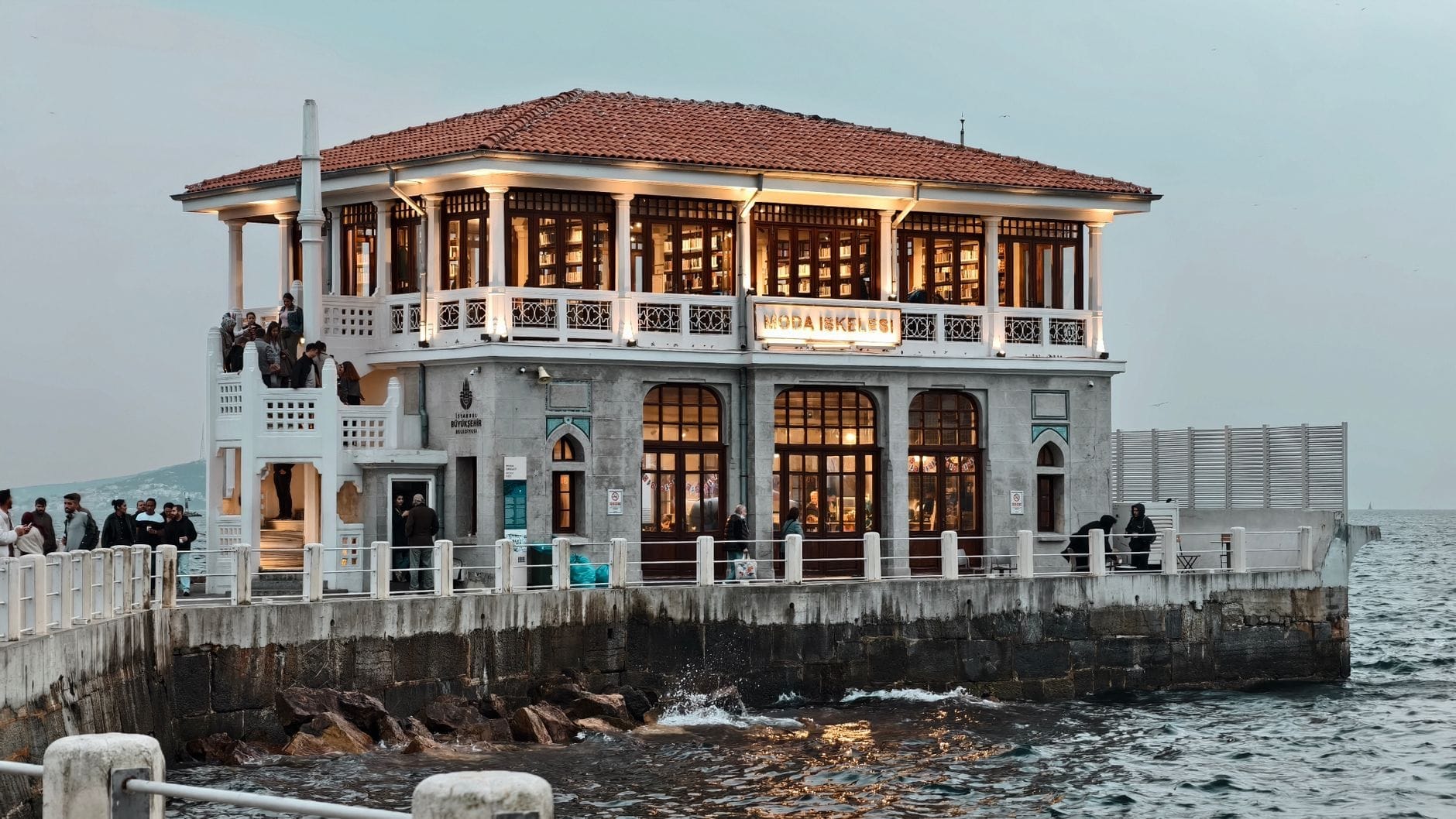
The anchor of the waterfront is the Moda Pier (Moda İskelesi), a slender wooden structure that extends over the water at the northern end of the promenade. Built originally in 1917, the pier has been restored and repurposed: today it houses a book café and a small public library, making it one of the more unusual reading spots in Istanbul. The creak of the wooden planks underfoot, the salt smell rising off the Marmara, and the sight of tankers moving slowly in the distance make for a sensory combination that is hard to replicate anywhere else in the city.
The pier is busiest in the late afternoon, when Kadıköy residents stop in after work. If you want a seat at the café with a proper view of the water, arrive before 5 p.m. or on a weekday morning. On weekend afternoons in spring and summer, the pier and its surrounding benches fill up quickly, and the atmosphere turns convivial and slightly chaotic in a good way.
ℹ️ Good to know
The Moda Pier café functions as both a working café and a library. You are welcome to browse books while you wait for your tea, though most of the collection is in Turkish.
Tickets & tours
Hand-picked options from our booking partner. Prices are indicative; availability and final rates are confirmed when you complete your booking.
Bosphorus sunset cruise on luxury yacht with guide
From 55 €Free cancellationIstanbul and Bosphorus cruise on private boat - half day afternoon tour
From 40 €Instant confirmationFree cancellationWhirling Dervishes live show and exhibition
From 29 €Instant confirmationBasilica Cistern fast-track entry ticket and optional audio guide
From 34 €Instant confirmation
Walking the Promenade: What You Actually See
The paved coastal path runs south from the pier, past a series of rocky outcroppings, small parks, and informal seating areas. The terrain is broadly flat along the main path, but a few sections near the water involve steps down to lower rocky ledges where locals fish and swim in summer. Step-free access runs the full length of the main paved walkway, so the route is manageable with a stroller or for anyone with limited mobility, though the lower rocky areas are not accessible.
As you walk south, the city noise gradually fades. The visual field opens up: to the west, on clear days, you can make out the minarets of the historic peninsula across the Marmara. On very clear days in winter or early spring, the snow-capped peaks of Uludağ in Bursa appear on the horizon, roughly 90–100 km south. These views are not guaranteed — Istanbul's haze and humidity often reduce visibility — but when the air is sharp and clean after rain, they are genuinely striking.
The path eventually curves around the tip of the peninsula and connects back toward central Moda through a quieter residential stretch. Completing the full loop takes roughly 45 minutes at a relaxed pace, longer if you stop at the tea gardens and kiosks positioned along the route. Most visitors anchor somewhere mid-route and simply sit, which is a perfectly valid strategy.
How Time of Day Changes the Experience
Mornings, especially between 7 and 9 a.m., are the most peaceful time to visit. The light on the water is soft, joggers and dog walkers outnumber everyone else, and the tea kiosks are just opening. This is also when the Marmara is at its most photogenic, with low-angle light catching the surface and the fishing boats sitting still before the ferries begin to churn up the water.
Midday in summer can feel exposed. The promenade offers limited shade, and the southern sun reflects hard off the sea. Bring sunscreen and water if you plan to walk the full route between 11 a.m. and 3 p.m. in July or August. In autumn and spring, this same midday window is ideal: temperatures between 15 and 22°C, clear skies, and thinner crowds.
Sunsets here are not the most dramatic in Istanbul — the sun sets over the European side, so you are watching it sink behind the city silhouette across the water rather than directly into the sea. That said, the golden hour light on the Moda Pier and the way it reflects on the Marmara makes for a photogenic hour, particularly in autumn when the light turns amber and the air is cool enough to stay outdoors comfortably.
After dark, the waterfront remains safe and used, with couples and small groups gathering around the benches and tea kiosks that stay open late. The mood is subdued rather than rowdy. If you want actual nightlife, Kadıköy's bar streets are a 15-minute walk north.
For context on what Kadıköy offers beyond the waterfront, the Istanbul Asian side guide covers the district's food scene, transport links, and how it compares to the European side.
Historical and Cultural Context
Moda as a neighborhood took shape in the late 19th century, when wealthy non-Muslim families, primarily Armenian, Greek, and Levantine, built wooden summer houses along the lanes leading to the waterfront. The area had a distinctly cosmopolitan character in the late Ottoman period, which left an architectural legacy visible today in the form of surviving wooden mansions and ornate apartment buildings set back from the sea path.
Today, Moda's population is largely secular and middle-class, and the neighborhood has a reputation across Istanbul as a place with a particular kind of progressive, bookish identity. The waterfront reflects this: you are more likely to see a poetry magazine tucked under someone's arm than a selfie stick. That character is not forced or performative — it is simply the neighborhood being itself.
Moda sits within the broader context of Kadıköy's Asian-shore identity, which is explored in detail in the Istanbul Asian side guide if you want to understand how the Asian and European sides of the city developed differently over time.
Practical Notes: Getting There, Photography, and Who Should Skip It
The most enjoyable way to arrive is by ferry from Eminönü or Karaköy on the European side. The crossing takes roughly 20 minutes and costs a single Istanbulkart fare. From Kadıköy ferry terminal, walk south along the coast for about 10 minutes, or pick up the nostalgic tram at Kadıköy Square. The tram is slow by design — it loops at about walking pace — but the ride itself through the residential streets is part of the experience.
For photography, a wide-angle lens works well for capturing the full sweep of the promenade and the pier. The pier's wooden railings and the fishing boats moored nearby are the most compositionally interesting subjects. Avoid shooting directly into the sun from the pier in the afternoon — you lose the pier detail entirely. Early morning and the hour before sunset give the best light for both the pier and the Marmara.
Who should consider skipping Moda Waterfront: if your Istanbul itinerary is tight and focused on historic monuments, this walk will feel like a digression. There is no architecture of world significance here, no museum, no UNESCO site. Its value is entirely atmospheric and human-scale. Travelers who find pleasure only in landmark tourism will likely feel underwhelmed. But if you want to see how a city of 16 million actually relaxes on a Tuesday evening, this is as authentic a window as Istanbul offers.
If you are looking for more elevated viewpoints across the city, the Istanbul viewpoints guide covers the city's best panoramic spots including options on both the Asian and European shores.
⚠️ What to skip
The promenade has limited shade. In July and August midday heat, the walk can be uncomfortable without sun protection. Early mornings or evenings are strongly preferable in peak summer.
Insider Tips
- Walk to the very tip of the Moda peninsula rather than stopping at the pier. The rounded southern end of the promenade has the widest sea views and is usually quieter than the pier area, with informal stone seating directly above the water.
- The tea kiosks along the path sell çay in small tulip glasses for a fraction of what café-bar spots in central Kadıköy charge. Bring cash in small denominations — many kiosk operators do not use card readers.
- In winter, the promenade after a rain squall is unusually beautiful: the air clears completely and the Princes' Islands appear in sharp silhouette to the southeast. The Büyükada landmass, roughly 18–20 km away, is visible on most clear days year-round from the southern tip of the walk.
- The nostalgic tram back toward Kadıköy Square runs on a timed schedule with gaps of 20–30 minutes between runs. Check the posted timetable at the Moda tram stop to avoid a long wait, especially on weekday mornings.
- Local residents bring their own seating — small folding stools and even chairs — on weekend evenings. If you see an unusually well-equipped group settled on the rocks with a thermos and backgammon board, that is a reliable indicator you have found one of the better informal spots along the coast.
Who Is Moda Waterfront For?
- Solo travelers who want a low-key afternoon that feels local rather than tourist-facing
- Couples looking for a quiet sunset walk without crowds or commercial pressure
- Families with young children: the flat paved path and open green spaces work well, and the rocky areas provide natural curiosity for older kids
- Photographers interested in everyday Istanbul life and Marmara light rather than monument photography
- Anyone combining a Kadıköy market morning with an afternoon that doesn't require more indoor time
Nearby Attractions
Other things to see while in Kadıköy:
- Haydarpaşa Train Station
Haydarpaşa Railway Station is a 1908 German neo-baroque masterpiece standing at the point where the Bosphorus meets the Sea of Marmara. Currently undergoing extensive restoration with reopening expected in late 2026 or early 2027, it remains one of the most architecturally striking buildings in Istanbul, as well as a pilgrimage site for anyone interested in the city's Ottoman and early-Republic history.
- Istanbul Toy Museum
Housed in a historic multi-storey wooden mansion in Göztepe, the Istanbul Toy Museum displays around 4,000 toys. Founded by poet Sunay Akın and opened on 23 April 2005, it offers a thoughtful, uncrowded alternative to the city's major museums.
- Kadıköy Market District
Kadıköy Çarşısı is a sprawling, walkable market district on Istanbul's Asian shore, packed with fishmongers, spice vendors, greengrocers, patisseries, and meyhanes. Free to explore, reached by ferry in minutes from the European side, and far less crowded than the Grand Bazaar.