Los Cahorros de Monachil: Granada's Gorge Walk with Hanging Bridges
Los Cahorros de Monachil is a free hiking route through a narrow limestone gorge carved by the Río Monachil, located just outside Granada in the Sierra Nevada foothills. The trail crosses suspension bridges, squeezes through rock passages, and passes cold, clear pools — all within an approximately 7–8 km round trip from the village of Monachil.
Quick Facts
- Location
- Monachil, Granada, Andalusia, Spain
- Getting There
- Bus 183 (Mon–Sat mornings) or 181 (Sat afternoon, Sun & holidays) from Paseo de los Basilios (junto a Puente Blanco), Granada
- Time Needed
- 3–4 hours for the full round trip
- Cost
- Free access; no entry fee
- Best for
- Hikers, nature lovers, families with older children, photographers
- Official website
- monachilsierranevadaturismo.es/los-cahorros-de-monachil
What Los Cahorros Actually Is
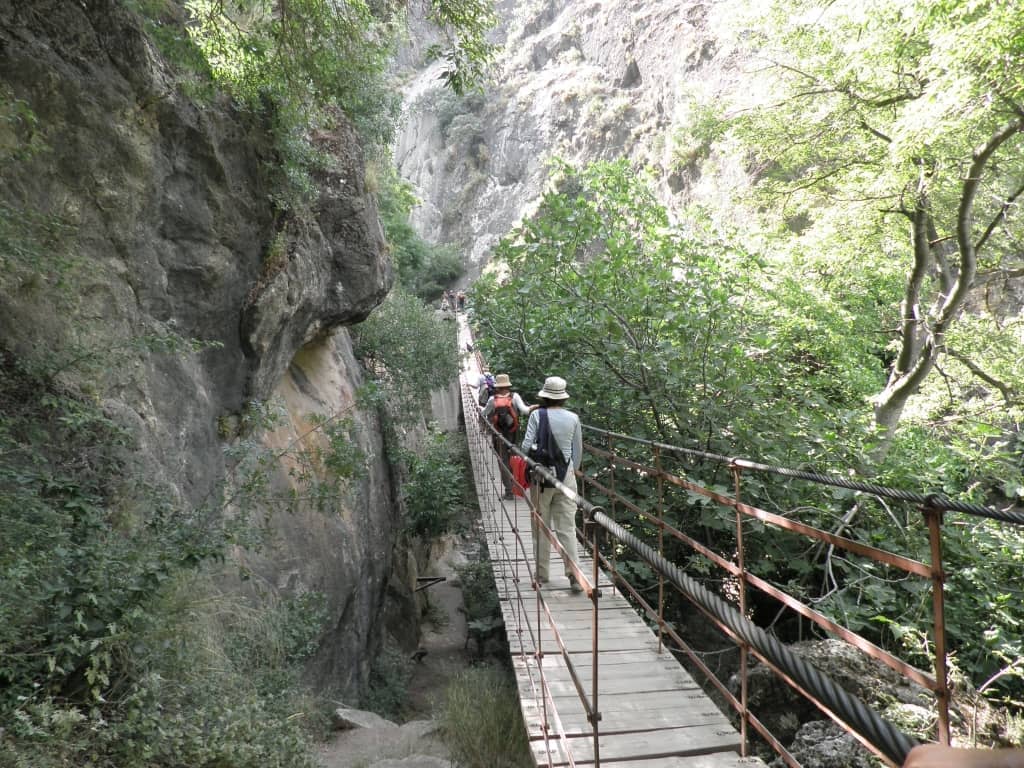
Los Cahorros de Monachil is a gorge trail — officially designated as the Sendero del Río Monachil (SL-A 294), inaugurated in 2017 — that follows the course of the Río Monachil through a limestone canyon in the Sierra Nevada foothills. The route is roughly 7–8 km return with about 250–300 metres of elevation gain, making it a moderate day hike rather than a demanding mountain ascent. What sets it apart is the terrain itself: the canyon narrows so sharply in places that the path clings to the rock face via iron staples and wooden walkways, and two suspension bridges carry you across the void above the river.
The rock here is pale limestone shot through with darker strata, and the gorge walls rise steeply enough that midday sunlight only reaches the river floor for a short window. Earlier in the morning, the canyon is all cool shadow and the sound of rushing water. Later, when the sun clears the rim, the pale stone glows and the pools flash silver. These two versions of the same walk look and feel quite different, which is worth knowing before you choose your start time.
💡 Local tip
Start before 9:30 am on weekends to walk the gorge in relative quiet. By mid-morning on Saturdays and Sundays in spring, the trailhead fills quickly and the narrowest passages can create bottlenecks of walkers going in opposite directions.
Getting There: Village, Bus, and First Steps
Monachil is a small municipality about 10 km from Granada city centre, and the bus connection is straightforward. Bus 183 runs Monday to Saturday (excluding holidays) from Paseo de los Basilios, near Puente Blanco. On Saturday afternoons, Sundays, and public holidays, bus 181 covers the same corridor. Check current schedules with the operator before you go, as frequencies and departure times change seasonally. For broader context on getting around the Granada area, the getting around Granada guide covers your options in detail.
From the bus stop in Monachil village, the walk to the trailhead takes about 15 minutes on a clear path that descends toward the river. You will see the gorge entrance announced by a sharp change in the landscape: the open hillside suddenly drops away and the canyon appears, the air noticeably cooler and damper than it was above. There is limited parking near the trailhead for those arriving by car, and on busy weekends it fills early. Driving in and walking down from the village is often easier than competing for the closest spots.
Tickets & tours
Live prices and dates from our booking partner. If you book, we may earn a commission at no extra cost to you.
Alhambra guided tour with Carlos V Palace, Generalife and Alcazaba
From 35 €Granada CF Nuevo Estadio de Los Carmenes Interactive Guided Tour
From 18 €Instant confirmationFree cancellationAlcazar of Cordoba skip-the-line tickets and guided tour
From 19 €Instant confirmationFree cancellationAlcazar of the Christian Monarchs guided tour in Cordoba
From 19 €Instant confirmationFree cancellation
The Trail: Sequence and Terrain
The route follows the river upstream along the south bank, then crosses to return on the north side. The first section is relatively open, with poplar and willow trees lining the water and the path wide enough to walk comfortably. The river sound — a low, consistent rush that fills the canyon — is present from the moment you enter the gorge and doesn't leave you until you climb back out.
As you move deeper, the canyon walls close in and the path transitions to fixed iron steps and narrow ledges cut into the limestone. These sections require you to pay attention to foot placement, especially if the rock is damp. The suspended bridges — hanging over the gorge on cables — are the visual centrepiece of the route. They move underfoot, not dramatically, but enough that walkers with vertigo should be aware.
The upper section of the trail widens again before reaching the turnaround point. Some walkers continue further up toward the Sierra Nevada proper, but the core Los Cahorros experience is contained within the gorge itself. The return leg on the opposite bank offers different angles on the canyon and tends to be quieter, since most people simply retrace their steps.
⚠️ What to skip
The trail is not suitable for wheelchairs or pushchairs. Sections with iron staples, narrow ledges, and suspension bridges require confident walking on uneven terrain. Children need to be supervised carefully at the bridge crossings and along the cliff-edge ledges.
When to Go and What the Seasons Change
Spring (April and May) is the most rewarding time to visit Los Cahorros. The river is running high from Sierra Nevada snowmelt, the gorge walls are streaked with moisture, and the vegetation along the banks is dense and green. Temperatures in Granada during April average around 20–21°C in the daytime, which translates to genuinely pleasant conditions inside the canyon. This is also the busiest period, so weekday visits are worth considering. For a full picture of when Granada rewards visitors most, the best time to visit Granada guide is a useful reference.
Summer (July and August) is the trickiest season. Granada city regularly exceeds 35°C in July, but the gorge floor stays noticeably cooler, making Los Cahorros a genuine escape from urban heat. The river drops considerably, exposing more rock and reducing the pools, but the swimming spots are at their most accessible. Go early — by 7:30 or 8:00 am — and you will have the canyon nearly to yourself in a different kind of quiet, just birdsong and the reduced river.
Autumn brings the most photogenic light. September and October still offer warm afternoons (around 24–30°C in September), the crowds thin after the summer peak, and the deciduous trees along the river begin to turn. Winter visits are possible but require caution: the fixed iron steps and ledge sections become genuinely slippery when wet or frosted, and the sun barely enters the deepest part of the gorge between November and February. Check weather conditions carefully before a winter visit.
⚠️ What to skip
After heavy rain, the river level can rise rapidly. If rainfall has been significant in the preceding 48 hours, verify conditions locally before entering the gorge. The canyon has limited escape routes in its narrowest sections.
What to Bring and How to Prepare
Footwear is the most important decision. Hiking boots or trail shoes with grip are strongly recommended; standard trainers are manageable in dry conditions but become unreliable on wet limestone. The iron staple sections, while not technically demanding, are steep enough that soft-soled shoes make them uncomfortable. Sandals are a poor choice regardless of weather.
Carry at least 1.5 litres of water per person. There are no facilities on the trail itself — no cafes, no water points, no toilets beyond the start area. The village of Monachil has a couple of bars where you can eat and drink before or after, and they serve as the natural bookends to the walk. Sun protection matters more than the canyon shade might suggest, because the open sections at either end of the route receive full exposure.
For photography, the suspension bridges photograph best from slightly below, from the bank or a stable rock. Wide-angle lenses suit the gorge walls; telephoto is less useful here. The colour palette inside the gorge is cool and green-grey for most of the year, with brief warm windows when direct sunlight strikes the upper walls. Early morning in summer produces the most dramatic light contrast.
Context: Sierra Nevada Foothills and the Wider Area
Los Cahorros sits at the western edge of the Sierra Nevada, in a zone that transitions from the populated Granada metropolitan area to the protected natural park. The Río Monachil is one of several rivers that descend from the high sierra toward the Vega de Granada, cutting gorges through the limestone as they go. The route connects to a broader network of trails in the sierra, and walkers wanting longer or more demanding options can extend the day by continuing upriver toward higher elevations. For those interested in more ambitious hiking, the hiking near Granada guide maps out the wider network.
The Los Cahorros route sits within proximity of Sierra Nevada ski resort to the east, though the two experiences occupy completely different altitude bands. The gorge itself is around 800–1,050 metres; the ski area operates above 2,000 metres. This means it's theoretically possible to walk Los Cahorros in the morning and drive up to see snow in the afternoon, though both deserve more than a rushed half-day.
Who This Walk Suits and Who Should Think Twice
Los Cahorros rewards walkers who are comfortable on uneven terrain and don't need constant reassurance from wide, well-maintained paths. The route is not technically difficult, but it asks for basic fitness, sensible footwear, and willingness to navigate narrow ledges. It is a genuine outdoor experience, not a manicured park walk.
Families with children aged eight or older who are confident walkers will find this manageable and exciting. Younger children, or children who are nervous on exposed sections, may struggle with the bridge crossings and ledge paths. Visitors with a significant fear of heights should be honest with themselves before committing to the route: the exposure is real, even if the actual danger is low when conditions are dry and unhurried.
Those who want a half-day out of Granada that combines exercise with striking scenery will find Los Cahorros difficult to improve on. It pairs well with the village of Monachil itself, which has an old quarter worth a brief exploration before or after the walk. For a broader day-trip framework from Granada, the day trips from Granada guide includes several options at a similar distance from the city.
Insider Tips
- Weekday mornings in spring give you the gorge almost entirely to yourself. The route is technically identical to a weekend visit but the experience is fundamentally quieter — you can stop at the bridges without a queue forming behind you.
- The pools below the first suspension bridge are the best swimming spots in summer. Bring a towel and water shoes if you plan to wade; the river bed is slippery and the water is cold even in August.
- Monachil village has at least one bar that opens early enough to get coffee and a tostada before the walk. Eating in the village rather than carrying a full pack simplifies the logistics considerably.
- If you are sensitive to route-finding, download an offline trail map before you leave Granada — mobile signal inside the gorge is unreliable. The route is well-marked but having a backup is sensible.
- The return leg on the opposite bank is quieter and offers angles on the gorge that most visitors miss, since the majority retrace their steps. Take the loop if conditions allow.
Who Is Los Cahorros de Monachil For?
- Hikers and trail walkers looking for a scenic route accessible without a car
- Visitors wanting a genuine nature escape within easy reach of Granada city
- Families with older children and teenagers who are comfortable on varied terrain
- Photographers after limestone gorge and water scenery in a compact setting
- Summer visitors seeking shade and cooler temperatures away from the city heat
Nearby Attractions
Other things to see while in Sierra Nevada:
- Hoya de la Mora
Hoya de la Mora is a high-altitude parking and staging area in the Sierra Nevada, sitting at roughly 2,500 metres above sea level above the ski resort of Pradollano. Free to access as a viewpoint when the access road is open, it serves as a dramatic viewpoint, a trailhead for summit hikes, and a place where the scale of Andalusia's mountain landscape becomes suddenly, almost shockingly clear.
- Sierra Nevada Ski Resort (Pradollano)
The Estación de Esquí y Montaña Sierra Nevada is one of the most accessible ski resorts in Europe, perched above Granada in the Sierra Nevada mountains. Whether you're here in winter for the slopes or in summer for high-altitude trails and gondola rides, this guide covers everything you need to plan a smart visit.
Planning a trip? Discover personalized activities with the Nomado app.