Lisbon Oceanarium (Oceanário de Lisboa): What to Expect Before You Go
The Oceanário de Lisboa is one of Europe's most impressive aquariums, built for Expo '98 on the Tagus waterfront in Parque das Nações. With more than 8,000 animals across 500 species and a central tank holding roughly 5 million litres of seawater, it rewards visitors who go in knowing what to look for.
Quick Facts
- Location
- Esplanada Dom Carlos I, Parque das Nações, Lisbon
- Getting There
- Oriente Metro Station (Red Line), 10-min walk
- Time Needed
- 2 to 3 hours
- Cost
- Check official site for current pricing
- Best for
- Families, marine life enthusiasts, rainy-day visits
- Official website
- www.oceanario.pt
What Is the Lisbon Oceanarium?
The Oceanário de Lisboa opened in 1998 as the centrepiece attraction of Expo '98, an international exposition themed around the ocean. Designed by American architect Peter Chermayeff, the building appears to float on the Tagus estuary: a cylindrical steel-and-glass structure surrounded by water on three sides, connected to the riverfront promenade by two footbridges. It was an architectural statement as much as a scientific institution, and that ambition carries through to the interior.
Today it ranks among the best aquariums in Europe by any reasonable measure. The numbers are striking: more than 8,000 animals and plants representing over 500 species, distributed across multiple tanks, with a total water volume exceeding 5,000 cubic metres. The centrepiece is the Global Ocean tank, which holds approximately 5 million litres of seawater and reaches a depth of around 7 metres. It is not just large — it is designed to be watched from two separate levels, which changes the experience completely depending on where you stand.
💡 Local tip
Book tickets online in advance. The Oceanarium is one of Lisbon's most visited paid attractions, and weekend queues at the door can be long. Booking ahead also locks in the current price, which can fluctuate.
The Central Tank: The Heart of the Experience
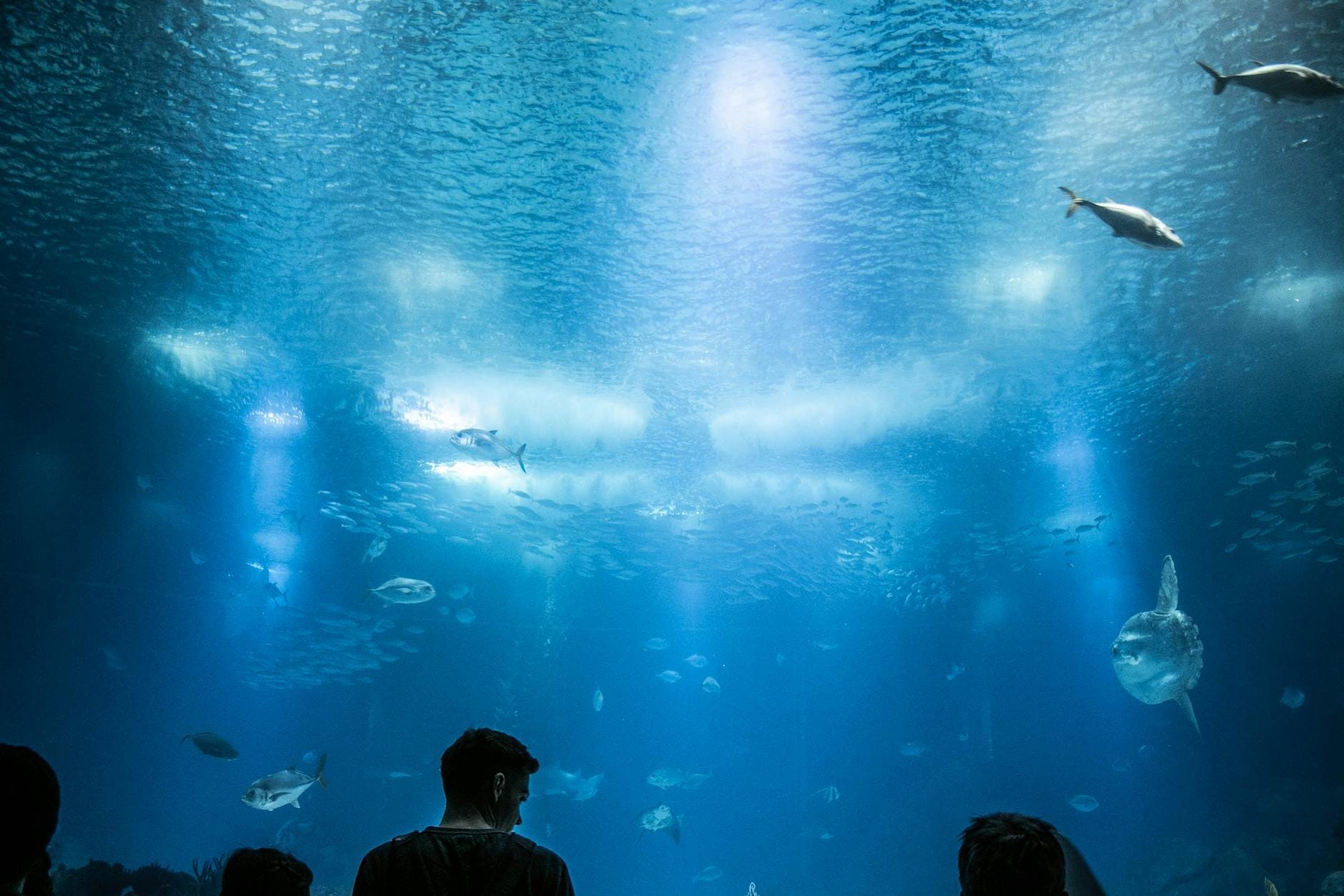
The Global Ocean tank is the gravitational centre of the building, both physically and emotionally. On the upper level, you look across its surface through a wide curved window, watching sharks, rays, barracuda, and large schools of fish navigate the water column at eye level. The light here shifts with the time of day: morning visits tend to offer a cooler, dimmer atmosphere, while afternoon light pushes through more warmly, catching the scales of moving fish in ways that feel almost choreographed.
Downstairs on the lower level, the same tank reveals an entirely different scene. You are now looking up through the water column, watching silhouettes of rays glide overhead against the filtered light. The sense of scale registers differently here. A sand tiger shark that seemed manageable from above suddenly commands much more attention when it passes at close range, nose to the glass. The lower gallery is often quieter than the upper level, partly because visitors move through it faster and partly because the lighting is more subdued.
Both floors also feature the four habitat zones surrounding the central tank: Antarctic, Arctic, Temperate North Atlantic, and Tropical. Each zone has its own separate tank representing a distinct ocean ecosystem, with species matched accordingly. The penguin enclosure in the Antarctic zone is a consistent crowd magnet, particularly for younger visitors, while the sea otters in the Pacific zone draw long pauses from adults.
Tickets & tours
Live prices and dates from our booking partner. If you book, we may earn a commission at no extra cost to you.
Navigating the Building: Upper to Lower and Back Again
The flow through the Oceanarium is broadly circular, moving around the central tank on each floor before connecting via a central spiral ramp. The layout is intuitive enough that you rarely feel lost, though the building can feel compressed during peak hours when school groups move through in organised lines. If you arrive at opening time (10:00), you will typically have the first 30 to 45 minutes in relative calm before the midday wave.
Photography works best on the lower level, where the light entering through the main tank creates long, dramatic exposure opportunities. A phone camera in portrait mode handles the conditions reasonably well, but dedicated camera users should plan for slow shutter speeds and bring some patience. Flash photography does not help and often produces glare — most serious photographers switch it off entirely.
ℹ️ Good to know
The building has two main viewing floors plus a mezzanine area with temporary exhibitions. Opening hours are 10:00–20:00 daily (though some sources indicate 10:00–19:00), though these may vary seasonally. Always verify on the official website before visiting.
Accessibility within the building is designed around the ramp structure rather than stairs, which makes the principal route manageable for pushchairs and most wheelchair users. For specific accessibility needs, contacting the Oceanarium directly before your visit is advisable, as the official site contains the most current information.
The Surrounding District: Parque das Nações
The Oceanarium sits within Parque das Nações, Lisbon's most deliberately modern neighbourhood. Built on former industrial land along the Tagus for Expo '98, the district has aged well: wide riverfront promenades, contemporary architecture, a functioning cable car, and the Oriente transport hub all combine to make this feel like a different city from the historic centre. It is calmer, more spacious, and largely tourist-free compared to areas like Alfama or Baixa-Chiado.
If you have time before or after the Oceanarium, the waterfront walk between the Oceanarium and the Vasco da Gama Tower is worth taking. The Vasco da Gama Tower now houses a hotel with a public sky bar, and the views back across the Tagus from the promenade are among the most photogenic in this part of the city. The whole area rewards a half-day rather than a rushed hour.
Getting There from Central Lisbon
Parque das Nações is straightforward to reach by public transport. The Red Line of the Lisbon Metro connects Oriente station to the city centre in around 15 minutes. From Oriente, the Oceanarium is approximately a 10-minute walk along the waterfront. For advice on navigating Lisbon's metro and bus network, the getting around Lisbon guide covers the full system including ticket types and pricing.
Oriente is also served by intercity trains, long-distance buses, and regional rail, making it easy to combine a visit here with a day arriving from or departing to other destinations. Taxis and ride-hailing apps (Uber and Bolt both operate in Lisbon) are available if you prefer a direct route from your accommodation.
⚠️ What to skip
Avoid driving to the Oceanarium on weekends or school holiday periods. Parking in Parque das Nações fills up quickly, and the metro is genuinely faster from most central neighbourhoods.
How It Fits into a Lisbon Visit
The Oceanarium pairs naturally with a half-day in Parque das Nações, but it also works as a standalone itinerary anchor. If you are building a longer Lisbon schedule, combining this with Jerónimos Monastery or the National Tile Museum on the same day is possible, though ambitious — both require proper attention and each involves real travel time.
For visitors with children, the Oceanarium is one of the strongest choices in the city. It handles rainy days well (entirely indoors), maintains comfortable indoor temperatures year-round, and has food and retail options on site. For ideas on structuring a family trip to Lisbon, the Lisbon with kids guide covers neighbourhood logistics alongside family-friendly attractions.
Solo travellers and couples who have little interest in marine biology might find two hours here is enough. The experience is genuinely impressive but linear: you walk the circuit, watch the tanks, and exit. There is no hidden layer of discovery for those who have already visited comparable European aquariums. That is not a criticism — it is a calibration. Manage expectations and you will leave satisfied.
Insider Tips
- The lower floor of the central tank is almost always less crowded than the upper gallery, even at peak times. Spend more time there — the viewing angles are more dramatic and the photographs are better.
- Arrive at 10:00 when the doors open. The first 30–45 minutes are noticeably quieter, and you can walk the entire circuit at your own pace before school groups arrive.
- The temporary exhibition space on the mezzanine level changes periodically and is often overlooked by visitors rushing toward the main tanks. Check the official site before your visit to see what is running.
- The outdoor promenade around the building offers close-up views of the structure's waterfront design. Walking the perimeter before entering takes less than 10 minutes and gives useful context for appreciating the architecture from outside.
- If you are visiting Parque das Nações anyway, the Oceanarium and the waterfront walk together make a logical half-day. Combine both rather than treating the aquarium as a quick stop — the neighbourhood rewards slower exploration.
Who Is Lisbon Oceanarium For?
- Families with children of any age, particularly those who need a reliable rainy-day option
- Marine biology enthusiasts and anyone interested in ocean conservation
- Visitors who want to see a different side of Lisbon beyond the historic neighbourhoods
- Travellers building a half-day in Parque das Nações around the waterfront area
- First-time visitors to Lisbon who want a well-organised, internationally recognised attraction
Nearby Attractions
Other things to see while in Parque das Nações:
- Vasco da Gama Tower
Standing 145 metres tall on the Tagus riverbank in Parque das Nações, the Vasco da Gama Tower is Lisbon's tallest tower and its most architecturally striking modern landmark. Built for Expo '98, it doubles as a daytime viewpoint and a rooftop bar after dark, offering genuinely different experiences depending on when you visit.
Planning a trip? Discover personalized activities with the Nomado app.