Krabi Walking Street (Maharaj Walking Street): The Local Market Worth Your Friday Night
Krabi Walking Street, officially located on Soi Maharaj 8 in Krabi Town, runs Friday through Sunday evenings and draws a mix of locals and travelers with grilled skewers, handmade goods, and live Thai music. Entry is free, the food is cheap, and the atmosphere is a welcome contrast to the resort-area crowds along the coast.
Quick Facts
- Location
- Soi Maharaj 8, Mueang Krabi District, Krabi Town, Krabi 81000
- Getting There
- 14 km from Krabi International Airport (KBV); approx. 35 min by songthaew or car. Grab available in Krabi Town.
- Time Needed
- 1–2 hours
- Cost
- Free entry. Food and goods priced in Thai baht (THB); expect to spend ฿100–300 on a full street food meal.
- Best for
- Street food lovers, budget travelers, those based in Krabi Town on a Friday, Saturday, or Sunday evening
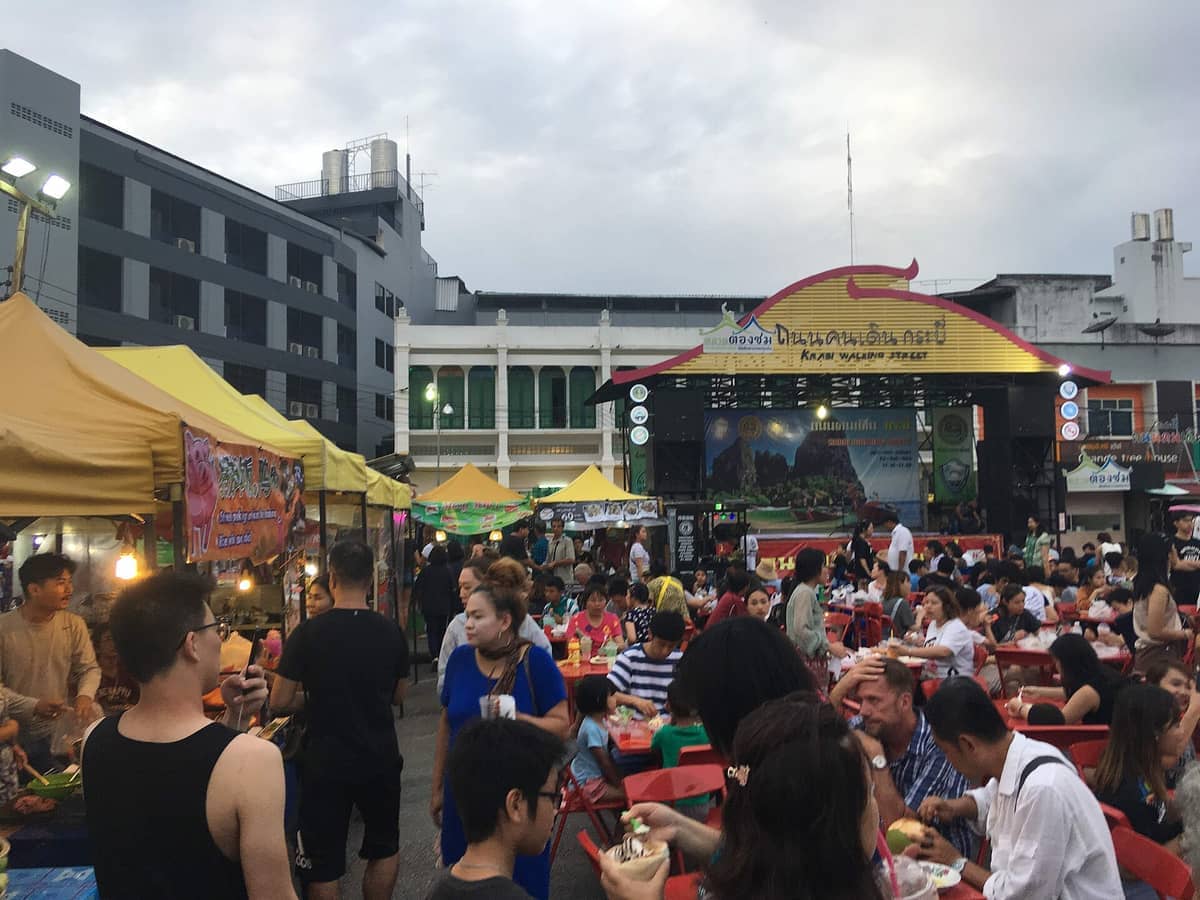
What Krabi Walking Street Actually Is
Krabi Walking Street, also called Maharaj Walking Street, is a weekly evening market held on Soi Maharaj 8 in the center of Krabi Town. It runs on Friday, Saturday, and Sunday evenings from 17:00 to 22:00, with no admission charge. The street is closed to vehicle traffic during market hours, and vendors set up stalls along both sides selling grilled meats, pad thai, mango sticky rice, fresh-pressed juices, clothing, accessories, and locally made crafts.
Unlike the beach markets along the Ao Nang strip, this one is primarily aimed at and attended by local residents. That distinction matters in practical terms: prices tend to be lower, the food is less filtered for tourist palates, and the atmosphere has a genuine community feel rather than a performance of one. That said, travelers staying in Krabi Town have adopted it as a regular stop, and on weekend nights it draws a noticeable mix of both.
ℹ️ Good to know
Hours: Friday, Saturday, and Sunday only, 17:00–22:00. If you arrive before 17:00, the street is still a regular road. Plan accordingly.
The Experience: What You'll See, Smell, and Hear
Arrive at 17:00 and you'll catch the market mid-setup: vendors laying out merchandise, smoke beginning to rise from charcoal grills, and the first clusters of families claiming spots on low plastic stools. The smell of grilled pork skewers and garlic hits before you're even on the main stretch. By 18:00, when the heat of the day has eased to something more bearable, the street reaches full capacity and the noise level rises accordingly: Thai pop from a small speaker system, vendor calls, and the hiss of oil in woks.
Food stalls cluster toward the center of the market and tend to move fastest. Look for grilled corn rubbed with coconut milk and salt, crispy fried insects if you're curious, green papaya salad (som tum) with a proper fish-sauce punch, and several dessert stalls selling kanom krok, the small coconut-rice pancakes cooked in a dimpled iron pan. Sit where a Thai family is sitting and you're almost certainly at the right stall.
The crafts and clothing section occupies the outer edges of the street. Quality varies, as it does at every market of this type, but there are genuinely locally made items among the mass-produced souvenirs. Batik fabric, hand-painted woodwork, and woven bags appear regularly. Prices are fixed at most stalls, though light haggling is not uncommon on larger purchases.
Tickets & tours
Live prices and dates from our booking partner. If you book, we may earn a commission at no extra cost to you.
Daily Cooking Class at Thai Cookery School in Krabi
From 42 €Instant confirmationFree cancellation7 islands speedboat excursion from Krabi
From 41 €Instant confirmationFree cancellationSpeedboat Tour to Hong Island Archipelago from Krabi
From 34 €Instant confirmationFree cancellationPhi Phi archipelago and Krabi 4 Islands full‑day speedboat tour
From 0 €Instant confirmationFree cancellation
How the Market Changes Through the Evening
The 17:00–18:00 window is the quietest, and arguably the most comfortable. Temperatures are still warm but the crowds are thinner, making it easier to move between stalls without being funneled by foot traffic. This is the best time to photograph the market without dozens of other visitors in every frame.
From 18:30 onward, the market reaches its social peak. Groups of Thai teenagers cluster near the music stages or near dessert stalls. Families occupy the seated eating areas. By 20:00, if there is any live music or cultural performance scheduled, it is usually underway. The market doesn't wind down sharply at 22:00; vendors begin packing around 21:30, so if you want full stall selection, aim to finish browsing by 21:00.
💡 Local tip
The sweet spot for visiting is 17:30–19:30. You get the full stall lineup, manageable crowds, and cooler air as sunset approaches. Arriving after 20:00 means some food stalls will already be running low.
Getting There from Krabi Town and Beyond
Soi Maharaj 8 is in central Krabi Town, walkable from most guesthouses and hotels in the town center. If you are staying in Krabi Town, you likely won't need transport at all. From Krabi International Airport, the town is approximately 14 km, roughly 35 minutes by car or songthaew. Grab operates in Krabi Town and is the most straightforward option from the airport or from outlying accommodation.
Travelers based in Ao Nang can take a songthaew or hire a car for the roughly 20-minute drive into town. There is no dedicated shuttle, so confirm transport back before you arrive, particularly if you plan to stay until close to 22:00. Tuk-tuks and taxis are available in Krabi Town for the return journey.
⚠️ What to skip
Parking near the market on weekends is limited and the surrounding streets fill up quickly after 18:00. If you're driving, allow extra time to park and consider leaving the car further away.
Cultural and Local Context
Krabi Town is the provincial administrative center of Krabi Province, a working city with government offices, hospitals, schools, and long-established residential neighborhoods alongside its role as a transit hub for travelers heading to the coast and islands. The walking street was established through a collaboration between local authorities and business groups, who renovated the Maharaj area to support small traders and give residents a regular community gathering point.
This context shapes how the market feels. It is not a set-piece tourist attraction in the way that a beach club or island tour is. It's a local commerce and social event that happens to be accessible to visitors. That makes it a useful counterpoint if you are spending time in Krabi Town between excursions, and also makes it genuinely informative if you want to understand how local life in the provincial capital operates beyond the tourism industry.
If you're interested in pairing the market with other town-center experiences, the Krabi Town Night Market near the riverside is another option, though the two have different characters and different days of operation. The walking street skews younger and more street-food-focused; the riverside night market has a more mixed merchandise emphasis.
Practical Notes: What to Bring, What to Wear
Dress casually. There are no dress code requirements at a street market. Light, breathable clothing is practical given the heat and the proximity to cooking smoke. Closed-toe shoes or sandals with grip are preferable to flip-flops if the ground is wet, which it sometimes is near food preparation areas.
Bring small bills in Thai baht. Most stalls operate cash-only. ATMs are available in Krabi Town, but not directly at the market entrance. Budget travelers will find this market genuinely affordable: a full meal of skewers, a papaya salad, and a sweet drink can come to well under ฿200.
The street lighting at night is functional but not bright, so if you're taking photos, a phone with decent low-light performance will serve you better than expecting crisp results from standard settings. The most photogenic moments are early in the evening when the grill smoke catches the remaining daylight.
ℹ️ Good to know
Accessibility: The market occupies a flat, paved street closed to traffic during hours of operation. Verified wheelchair-accessibility details are not available from official sources; the flat surface is generally navigable, but stall placement can narrow the walkway during peak hours.
Who Should Skip This
If you are based entirely in Ao Nang or on the Railay Peninsula and have only a few days, the travel time to Krabi Town for a market visit may not be the best use of your evening, particularly given that boat transfers back to Railay stop running at night. The market also only operates three days a week, so if your itinerary doesn't include a Friday, Saturday, or Sunday, it's simply not an option.
Travelers who find crowded, narrow street environments uncomfortable will want to plan their visit for early in the evening. By 19:00 on a Saturday, the street can feel congested. The market does not have a particularly international food range, so if you're looking for variety beyond Thai street food, it won't fully deliver.
Insider Tips
- Arrive at 17:15, before the main crowd, to walk the full length of the market and identify your target food stalls before lines form. Then loop back to eat.
- The stalls closest to the market entrance tend to have the highest foot traffic and occasionally adjust prices upward. Walk toward the middle and far end for more consistent local pricing.
- If you see a stall with a long queue of Thai customers and no English signage, join it. The absence of a tourist-facing menu is usually a reliable signal of quality and price.
- Combine the market with a late-afternoon visit to Khao Khanab Nam, the twin limestone hills visible from the Krabi Town riverfront, which are at their best in the hour before sunset.
- If it has rained earlier in the day, the ground near some food stalls can be slippery. The market does not close for light rain, but heavy downpours reduce vendor numbers significantly.
Who Is Krabi Walking Street (Maharaj Walking Street) For?
- Budget travelers wanting a full Thai street food meal for under ฿200
- Visitors staying in Krabi Town with a free Friday, Saturday, or Sunday evening
- Travelers seeking genuine local atmosphere rather than a resort-facing market
- Families looking for an easy, free, low-pressure evening activity
- Food-focused travelers who want to eat beyond pad thai and green curry
Nearby Attractions
Other things to see while in Krabi Town:
- Ao Tha Lane & Mangrove Forest
Ao Tha Lane, also listed officially as Tha Lane Bay, is a tidal bay in Khao Thong Subdistrict where dense mangrove forest meets sheer karst cliffs. The only meaningful way to explore it is by kayak, paddling through narrow channels where the canopy closes overhead and the water turns dark green. It is quieter and less commercialized than most of Krabi's headline attractions.
- Huai To Waterfall
Huai To Waterfall (Nam Tok Huai To) is a multi-tiered cascade tucked inside Khao Phanom Bencha National Park, roughly 20 km north of Krabi Town. A short forest walk leads through dense tropical vegetation to a series of pools fed by cool mountain water, making it one of the most accessible natural retreats on the Krabi mainland.
- Khao Khanab Nam Caves
Two sheer limestone towers rising roughly 100 metres above the Krabi River, Khao Khanab Nam is the geological signature of Krabi Town. A short long-tail boat ride from Chao Fah Pier leads into cave chambers that served as a Japanese military camp in World War II and contain fossilised remains estimated to be millions of years old.
- Khao Phanom Bencha National Park
Khao Phanom Bencha National Park is Krabi's inland rainforest reserve, protecting steep limestone peaks, a dramatic five-tier waterfall, and dense jungle habitat roughly 20 km north of Krabi Town. It rewards early risers with cool air, birdsong, and cascading water, but trails beyond the lower falls require preparation and a degree of fitness.
Planning a trip? Discover personalized activities with the Nomado app.