Koh Lanta Lighthouse: What to Expect at Laem Tanod's Iconic Lookout
Perched at the southern tip of Ko Lanta Yai, the Patchachot Vachirapa Lighthouse sits inside Mu Ko Lanta National Park and rewards the short, steep climb with sweeping views over the Andaman Sea. It is one of Koh Lanta's most photogenic spots and a satisfying half-day trip for those exploring the island's quieter southern end.
Quick Facts
- Location
- Laem Tanod, southern tip of Ko Lanta Yai, Ko Lanta District, Krabi Province
- Getting There
- By road to the island's southern tip; no public transit — motorbike, scooter rental or songthaew recommended
- Time Needed
- 1.5 to 2.5 hours including the walk and time at the viewpoint
- Cost
- ฿200 foreign adults, ฿100 foreign children (3–14); ฿40 Thai adults, ฿20 Thai children; vehicle fee extra (฿30 car, ฿20 motorcycle). Check current fees before visiting.
- Best for
- Sunset seekers, photographers, nature lovers, and anyone driving the southern loop of Koh Lanta
- Official website
- www.dnp.go.th
What the Koh Lanta Lighthouse Actually Is
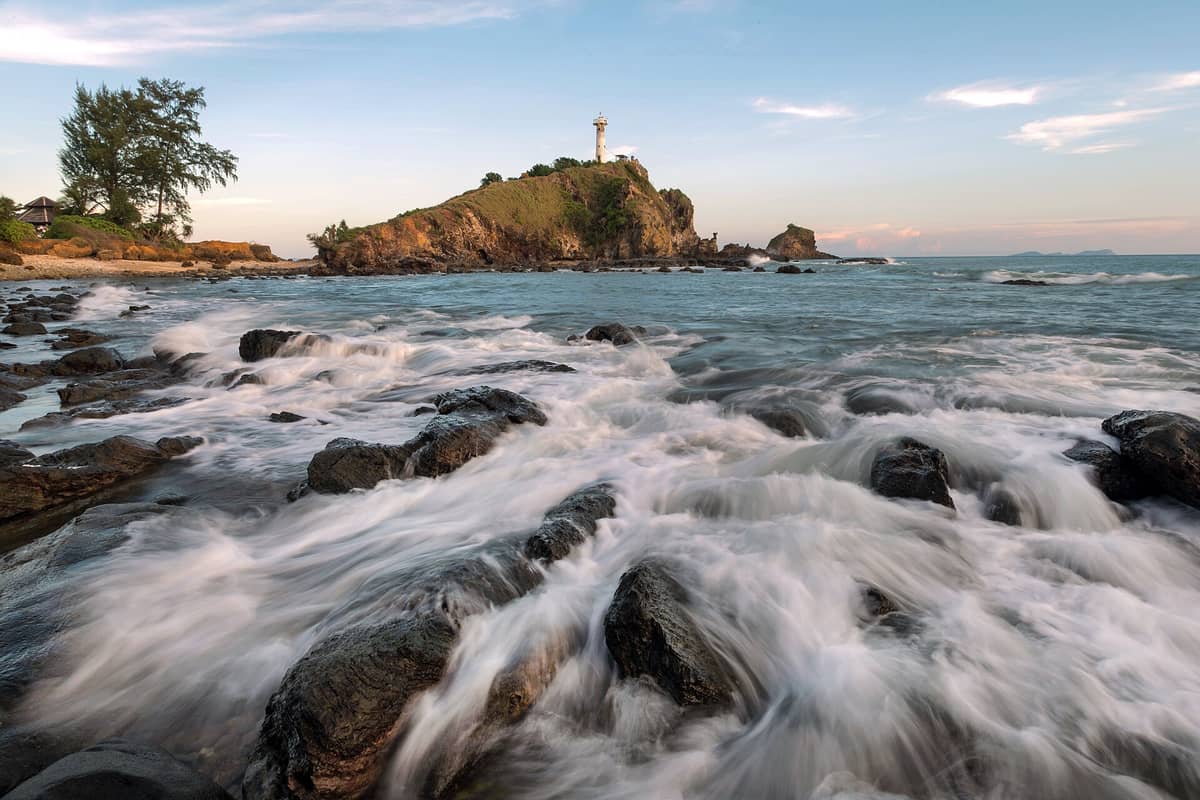
The Koh Lanta Lighthouse, officially known as the Patchachot Vachirapa Lighthouse, sits at Laem Tanod on the southernmost point of Ko Lanta Yai. It stands roughly 11 metres tall and operates as a working navigational light over the Andaman Sea. The tower itself is closed to visitors, so you will not be climbing inside. What you come for is the setting: the lighthouse perches at the edge of a forested headland with the sea stretching away in three directions, and the surrounding land falls within the protected boundaries of Mu Ko Lanta National Park.
The park encompasses both marine and terrestrial zones, and the drive to Laem Tanod takes you through the quieter, less-developed southern stretch of the island. If you have spent time at the more popular beaches further north, the change in atmosphere is noticeable — fewer vendors, fewer crowds, and more forest. For context on the wider island, see our guide to Koh Lanta and what it offers across its different zones.
ℹ️ Good to know
The tower itself is not open for climbing. Do not visit expecting an elevated deck or interior access. The value here is the headland viewpoint and the walk through national park forest, not the lighthouse as a structure.
Getting to the Southern Tip
There is no scheduled public transport to Laem Tanod. The practical options are renting a motorbike or scooter, hiring a driver for the day, or arranging a songthaew (shared pickup truck taxi) from one of the main beach areas. The road south runs through Ban Saladan and continues past Klong Dao, Klong Nin, and the other beaches before the terrain becomes more hilly and forested as you approach the park. The final section of road involves some inclines.
If you are on a motorbike, allow around 45 minutes from the northern ferry pier depending on traffic and road conditions. The road quality is generally manageable for a standard automatic scooter, but less experienced riders should be aware that some bends in the southern section require confidence. Once you pay the national park entrance fee at the gate, parking is available near the trailhead.
⚠️ What to skip
Koh Lanta has no metered taxis. Always agree on a price before departing if using a private driver or tuktuk. Fuel up before heading south — petrol stations thin out past the central beach zone.
Tickets & tours
Live prices and dates from our booking partner. If you book, we may earn a commission at no extra cost to you.
Full-day Koh Rok and Koh Haa from Koh Lanta
From 47 €Instant confirmationFree cancellationKoh Kradan and Four Islands Boat Tour from Koh Lanta Yai
From 52 €Instant confirmationFree cancellationMuay Thai introductory group class for beginners in Koh Lanta
From 14 €Instant confirmationFree cancellationMuay Thai introductory private class for beginners in Koh Lanta
From 45 €Instant confirmationFree cancellation
The Walk to the Lighthouse: What to Expect Underfoot
From the park entrance area, a short path leads through forest to the lighthouse. It is described as steep in sections, and the footing is uneven enough that flip-flops are a genuinely poor choice. Closed shoes with grip make the ascent more comfortable. The walk itself takes around 10 to 20 minutes depending on your pace — it is not a long trail, but the gradient will get your heart rate up, especially in the midday heat.
The forest along the path provides shade, and you are likely to hear a dense layer of insect sound throughout. At certain times of year, the undergrowth is very green and the humidity is palpable. Closer to the top, the trees thin out and the light changes. The first view of open water tends to appear before you clear the treeline fully, which adds a sense of arrival to the final steps.
The lighthouse itself stands on an exposed rocky headland. The ground around it is dry and rocky, with coarse grass in places. On a clear day, you can see across the open Andaman Sea to the southwest, and the coastline of Ko Lanta curves away to the north. The sense of standing at the edge of something is genuine here — this really is the southernmost accessible point of the island.
💡 Local tip
Bring water. The walk is short but the heat and humidity can be draining, and there are no stalls or refreshment points between the park gate and the viewpoint.
Time of Day and Light Conditions
The lighthouse faces broadly westward over the sea, which makes it one of the more logical sunset spots on Koh Lanta. Arriving around 90 minutes before sunset gives you time to complete the walk comfortably, settle in at the viewpoint, and watch the light shift before the sun drops. The colours at this hour can be striking: the white tower against a warm sky, the water catching orange and pink below. This is also when you are most likely to find other visitors there, though the numbers rarely feel overwhelming compared to the main beach areas.
Midday visits work fine if your priority is the view rather than the light. The sea is bright and the visibility is often good, but the heat is at its most intense and the hard overhead sun flattens the colours for photography. Morning visits are quieter still and the air is cooler, though the light falls less dramatically on the seaward face. If photography matters to you, late afternoon is the clear choice.
During the rainy season, which generally runs from May through October in Krabi Province, the road to the south can be slick and the headland is frequently overcast. A sunset visit in June or July often means a cloud-obscured horizon. For a broader picture of how weather affects Koh Lanta across the year, read our guide to the best time to visit Krabi.
Photography and the View
The lighthouse is undeniably photogenic and it is well-suited to wide shots that include both the tower and the sea behind it. A standard smartphone camera handles the composition well in good light. For close-up architectural shots, the white-painted tower against a blue or sunset sky is the main subject. There is no single 'signature angle' that every visitor replicates — the headland is open enough that you can move around the structure and find different framings.
If you want a clear shot without other visitors in it, the best window is early morning or the first 30 minutes after the park opens. Later in the afternoon, particularly around sunset, small groups tend to gather and you will need patience to get an unobstructed frame. A wide-angle lens or a phone with a wide mode captures the full sweep of sea and headland effectively.
Practical Details: Fees, Hours, and Accessibility
Access to the lighthouse falls under the Mu Ko Lanta National Park entrance fee. The published park entrance fee is ฿200 for foreign adults, with reduced rates for foreign children aged 3 to 14 at ฿100. Thai nationals pay ฿40 for adults and ฿20 for children. Vehicle fees are charged separately: ฿30 for cars and ฿20 for motorcycles. National park fees in Thailand can be updated, so confirm at the gate or via the Department of National Parks before your visit.
Published park opening hours range from 08:30 to 16:30 in some sources and 08:30 to 17:30 in others — this discrepancy is worth noting. If a late-afternoon sunset visit is your plan, contact the park or check with your accommodation before assuming a 17:30 closing time applies on the day you visit. Arriving before 16:00 gives you a reasonable buffer. Note that some offshore islands within the national park close seasonally between mid-May and mid-October, but this seasonal closure has not been confirmed to apply to the lighthouse at Laem Tanod.
Accessibility at this site is limited. The steep, uneven path to the lighthouse is not suitable for wheelchairs or visitors with significant mobility restrictions. There is no alternative route or accessible viewing platform documented. The Mu Ko Lanta National Park covers a large area and has other entry points, but the lighthouse specifically requires the uphill trail.
Who Should Skip This Attraction
Visitors who come expecting to enter the lighthouse tower will be disappointed — the structure is operational and not open to the public. If your interest is in lighthouse history or maritime heritage rather than the landscape, there is limited interpretive content at the site. Similarly, travellers with limited mobility or those travelling with very young children may find the steep, rough-surfaced trail more trouble than the view justifies.
Anyone visiting Koh Lanta on a one-day schedule focused on beaches may find the time investment in reaching the southern tip less practical than spending those hours at Klong Nin Beach or Klong Dao Beach. The lighthouse works best as part of a full southern loop rather than a standalone trip.
Insider Tips
- Combine the lighthouse with a visit to the nearby Sea Gypsy village at the island's southern end — the two sites pair naturally and fill a half-day without backtracking.
- If you are renting a scooter, check the fuel gauge before heading south. The last reliable petrol station is in the central beach zone, and running low on the return uphill section is a common nuisance for visitors.
- The park gate staff generally speak basic English. Have small THB bills ready for the entrance fee — change is not always available for large notes.
- Cloudy afternoons occasionally produce more dramatic light at sunset than perfectly clear skies; a partial cloud cover can create layered colour effects over the water that blue-sky days lack.
- The path through the national park forest is worth taking slowly rather than rushing straight to the top. The birdsong in the canopy is dense in the early morning, and the forest itself is part of the experience.
Who Is Koh Lanta Lighthouse For?
- Photographers chasing sunset light over the Andaman Sea
- Travellers doing a full southern loop of Ko Lanta Yai by motorbike
- Nature-oriented visitors who want a short forest walk without a full-day hike
- Couples looking for a quieter, less commercialised viewpoint on the island
- Anyone with a particular interest in working lighthouses and coastal landscapes
Nearby Attractions
Other things to see while in Koh Lanta:
- Kantiang Bay
Kantiang Bay sits near the southern tip of Koh Lanta Yai, backed by forested hills and flanked by limestone headlands. The beach is free, uncrowded compared to Koh Lanta's northern stretches, and rewards visitors who make the effort to get there with a genuinely peaceful atmosphere and clear water.
- Khlong Chak Waterfall
Khlong Chak Waterfall sits deep inside Mu Ko Lanta National Park on Ko Lanta Yai, reached by a trail that weaves through dense jungle and crosses a stream multiple times. It rewards patient hikers with a shaded, 8-metre cascade and a natural pool, well away from the island's beach crowds.
- Klong Dao Beach
Stretching nearly 3 kilometres along Koh Lanta Yai's west coast, Klong Dao Beach is one of the island’s longest and most well-developed beaches. Wide, calm, and easy to reach from Saladan Pier, it offers something that rarer shores often don't: comfort without sacrifice.
- Klong Nin Beach
Klong Nin Beach runs for roughly 2.4 km along the west coast of Koh Lanta Yai, offering calm waters, affordable beachside restaurants, and dramatically low crowds compared to Thailand's more famous shores. It rewards travelers who prioritize atmosphere over facilities.
Planning a trip? Discover personalized activities with the Nomado app.