Freetown Christiania: Copenhagen's Self-Governing Commune Explained
Freetown Christiania is a car-free, self-governing community of roughly 900 residents occupying about 7.7 hectares of former military land in Christianshavn. Founded in 1971, it operates outside standard Danish norms — with its own rules, its own architecture, and an atmosphere unlike anything else in the city. Entry is free and open to visitors.
Quick Facts
- Location
- Prinsessegade / Bådsmandsstræde, Christianshavn, Copenhagen
- Getting There
- Metro: Christianshavn St (M1/M2), then 10-min walk
- Time Needed
- 2–4 hours for a thorough visit
- Cost
- Free to enter; individual venues charge separately
- Best for
- Curious travelers, alternative culture, photography, live music
- Official website
- www.christiania.org
What Freetown Christiania Actually Is
Freetown Christiania, known in Danish as Fristaden Christiania, is a self-declared autonomous district covering roughly 7.7 hectares of former military barracks and earthwork ramparts in the Christianshavn borough of Copenhagen. Around 900 to 1,000 people live here permanently, governed by consensus rather than conventional Danish law. They pay a communal user fee rather than standard property taxes, cars are banned from the interior, and major decisions are made at community meetings open to all residents.
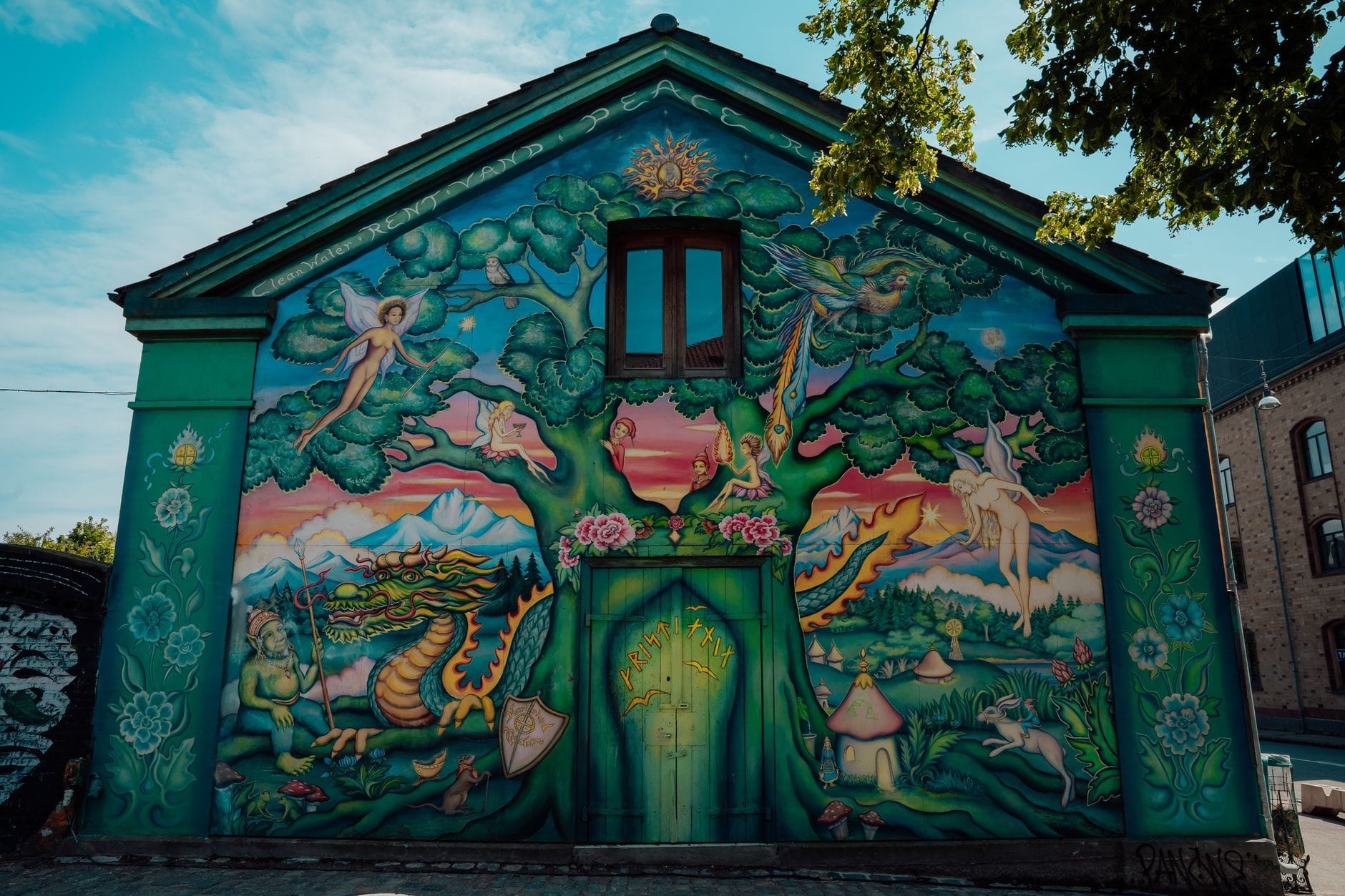
What that means on the ground: you will walk through a neighborhood that looks assembled over decades by many different hands, because it has been. Brightly painted wooden houses sit against brick military warehouses. Murals cover every available surface. Gardens tumble over borders without fences. It is one of the few places in Scandinavia where the built environment looks genuinely improvised rather than designed.
ℹ️ Good to know
Christiania is not a museum or theme park. Roughly 900 people live and work here. Treat it accordingly: keep noise down in residential lanes, respect private courtyards, and follow posted signs about photography.
A Short History Worth Knowing Before You Arrive
The site was a Danish military installation that fell into disuse in the late 1960s. In 1971, a local journalist named Jacob Ludvigsen published a call to action declaring the abandoned land open to the public, and on 26 September 1971 the community was formally proclaimed. Squatters, artists, and social experimenters moved in, constructing homes and communal spaces on ramparts originally built in the 17th century.
The following decades brought repeated political confrontations with the Danish state over the community's legal status, drug policy, and land rights. In 2011, a legal framework was established that allowed residents, through the Christiania Foundation, to collectively purchase a portion of the land from the state, stabilizing the community's existence for the first time. The arrangement remains unusual by any European standard: a legally recognized community with an explicitly self-governing structure, operating inside the capital city of a welfare state.
Understanding that background makes the place more readable. The architecture you see is literally decades of autonomous decision-making expressed in timber and paint. For more on how Christianshavn fits into Copenhagen's broader urban landscape, see the Christianshavn neighborhood guide.
Tickets & tours
Hand-picked options from our booking partner. Prices are indicative; availability and final rates are confirmed when you complete your booking.
Hippie Freetown Christiania exploration game in Copenhagen
From 10 €Instant confirmationFree cancellation1-hour boat harbour tour in Copenhagen
From 26 €Instant confirmationFree cancellationSmall group 3-hour walking tour in Copenhagen
From 45 €Instant confirmationFree cancellationCopenhagen to Malmo one-day tour
From 56 €Instant confirmationFree cancellation
What the Visit Actually Feels Like
The main entrance on Bådsmandsstræde is marked by a painted sign declaring, in several languages, that you are now leaving the EU. It is slightly tongue-in-cheek, but it does signal a shift in atmosphere. The first area most visitors traditionally reached was the main strip, informally called Pusher Street, which for many years was associated with open cannabis trading, though in recent years many stalls have been removed and the street has been repeatedly closed to that trade. The situation on Pusher Street is complicated: the trade is technically illegal under Danish law, the community has repeatedly debated its presence, and the visible market has expanded and contracted over the years depending on enforcement and community decisions. Photography is not permitted on Pusher Street, and signs make this explicit.
Move past that initial stretch and Christiania opens into something genuinely different. There are lakes fed by the moat system from the original ramparts. There are community gardens, a children's playground designed with salvaged materials, several cafes and restaurants, a concert venue, a skateboarding area, and lanes of residential housing that wind through the greens. Dogs wander freely. Children cycle on cargo bikes. On a weekday morning it is quiet enough to hear birds over the canal.
By mid-afternoon in summer the visitor numbers increase substantially. Weekends between May and August bring the largest crowds. The atmosphere shifts from neighborhood calm toward something closer to an open-air event, with music drifting from cafe terraces and groups gathering on the grass near the water. If you want to experience it as a place rather than a spectacle, the window between 09:00 and 12:00 on weekday mornings is significantly quieter.
💡 Local tip
The ramparts on the eastern edge of the commune offer elevated views over the moats and the rooftops of Christianshavn. Most visitors stay on the main strip and miss this entirely. It takes about 10 minutes of walking and is worth the detour.
Food, Drink, and Music on Site
Christiania has a genuine food and drink culture that predates the current Copenhagen restaurant scene by decades. Cafe Nemoland is a long-established outdoor venue with a large terrace operating in warmer months. Spiseloppen, housed in a former military warehouse, has operated as a sit-down restaurant for many years and offers a more formal dining experience than the surroundings might suggest. Prices at most venues are in line with mid-range Copenhagen rather than tourist-premium levels.
The Grey Hall (Den Grå Hal) and Loppen are the two main music venues. Both have hosted internationally known acts alongside local Danish artists across several decades. Loppen in particular has a reputation as one of Copenhagen's better mid-size live music spaces, with a capacity that keeps the sound and atmosphere intimate. Check listings before you visit because the calendar varies considerably.
For broader context on Copenhagen's music and nightlife scene, the Copenhagen nightlife guide covers venues across the city including some that have roots in the Christiania scene.
Photography: What Is and Is Not Permitted
Photography rules in Christiania are specific and enforced by residents rather than security staff. The prohibition on photography applies primarily to Pusher Street and surrounding commercial areas. Throughout the rest of the commune, photography is generally acceptable but discretion matters: photographing individuals without permission in a residential setting will be met with a direct request to stop, and that is a reasonable expectation in any neighborhood.
The most photogenic areas are the lake edges in the interior, the painted facades along the main footpaths, and the rampart walks on the perimeter. Morning light from the east hits the canal-facing facades well. The children's area near the entrance has a density of color and texture that photographs well in overcast conditions when glare is reduced.
⚠️ What to skip
Do not photograph on Pusher Street. Signs are posted, residents enforce this actively, and ignoring it is disrespectful to the community regardless of legal technicalities. Phones have been confiscated for this.
Getting There and Getting Around Inside
The most practical transit option from central Copenhagen is the Metro to Christianshavn Station on the M1 and M2 lines, followed by a walk of roughly 10 minutes south along Torvegade and then into Christianshavn's canal district. Several bus lines also stop in the Christianshavn area. Cycling is the most natural approach from neighboring districts and aligns well with how the community itself operates.
Cars are not permitted inside the commune. There is no parking lot within Christiania. Once inside, movement is entirely on foot or bicycle along unpaved or loosely surfaced paths. The interior is not flat: the rampart sections involve inclines and uneven ground. Wheelchair and pushchair accessibility is limited and varies by route; the main central paths are manageable but many of the residential and lake-edge areas are not consistently accessible.
Christiania sits within cycling distance of the Church of Our Saviour, whose spiral external staircase is one of Christianshavn's other main draws. Combining the two makes for a coherent half-day in the district.
An Honest Assessment: Is It Worth Your Time?
Freetown Christiania is genuinely interesting as a social experiment and as an urban environment unlike anything else in northern Europe. The architecture, the self-governance model, the longevity of the community — these are all worth engaging with seriously. The commune has lasted over 50 years in a city that has repeatedly tried to resolve or renegotiate its existence. That is a remarkable fact.
It is also, in parts, overhyped as a counterculture experience. The main strip near the entrance is commercialized in ways that are easy to find underwhelming, and the crowds in peak summer reduce some of the spontaneity that makes the place interesting in quieter months. Travelers expecting a preserved piece of 1970s utopianism will find it more complicated than that. Travelers who approach it as a living neighborhood with a particular history will find it more rewarding.
Visitors who are strongly opposed to cannabis or uncomfortable around open drug markets should know that this is part of the environment on and near Pusher Street. Families with children visit regularly and the community is not inherently unsafe, but those sensitivities are worth weighing in advance.
If you are putting together a broader Copenhagen itinerary, the 2-day Copenhagen itinerary includes Christiania alongside the other Christianshavn highlights in a logical sequence.
Insider Tips
- Visit on a weekday before noon to experience Christiania as a neighborhood rather than a tourist attraction. The difference in atmosphere is significant.
- The rampart walk around the eastern edge of the commune is almost always uncrowded and gives a sense of the original military geography beneath the painted surfaces. Most visitors miss it entirely.
- Cafe Nemoland's outdoor terrace is a reliable spot for a drink in warmer months, with a relaxed pace and resident regulars rather than a tourist-only crowd.
- Check the Loppen and Grey Hall listings before your visit. Catching a live show here is a genuinely different experience from the usual Copenhagen venue circuit, and tickets are typically reasonably priced.
- The 'You are now leaving the EU' sign at the main entrance is where most visitor photographs are taken. If you want a cleaner shot, arrive before 09:30 on any day.
Who Is Freetown Christiania For?
- Travelers interested in alternative urban communities and social history
- Photography and street art enthusiasts willing to respect the local photography rules
- Live music lovers looking for smaller, atmospheric venues outside the mainstream circuit
- Visitors who want to understand Copenhagen beyond its design-magazine surface
- Cyclists: Christiania is naturally suited to an approach by bike from Christianshavn or the city centre
Nearby Attractions
Other things to see while in Christianshavn:
- Church of Our Saviour
Vor Frelsers Kirke in Christianshavn is one of Copenhagen's most recognizable landmarks, its black-and-gold helical spire rising high above the canal district (the whole tower reaches about 90 metres). The church interior is free to enter, while the tower climb rewards visitors with some of the finest rooftop views in the city.
- Copenhagen Opera House
The Copenhagen Opera House is one of the most architecturally striking buildings in Denmark, a 41,000-square-meter landmark sitting directly on the Holmen waterfront. Whether you come for a performance, a guided tour, or simply to take in the exterior from across the harbor, it rewards a closer look.