Fort Point National Historic Site: The Civil War Fort Beneath the Golden Gate Bridge
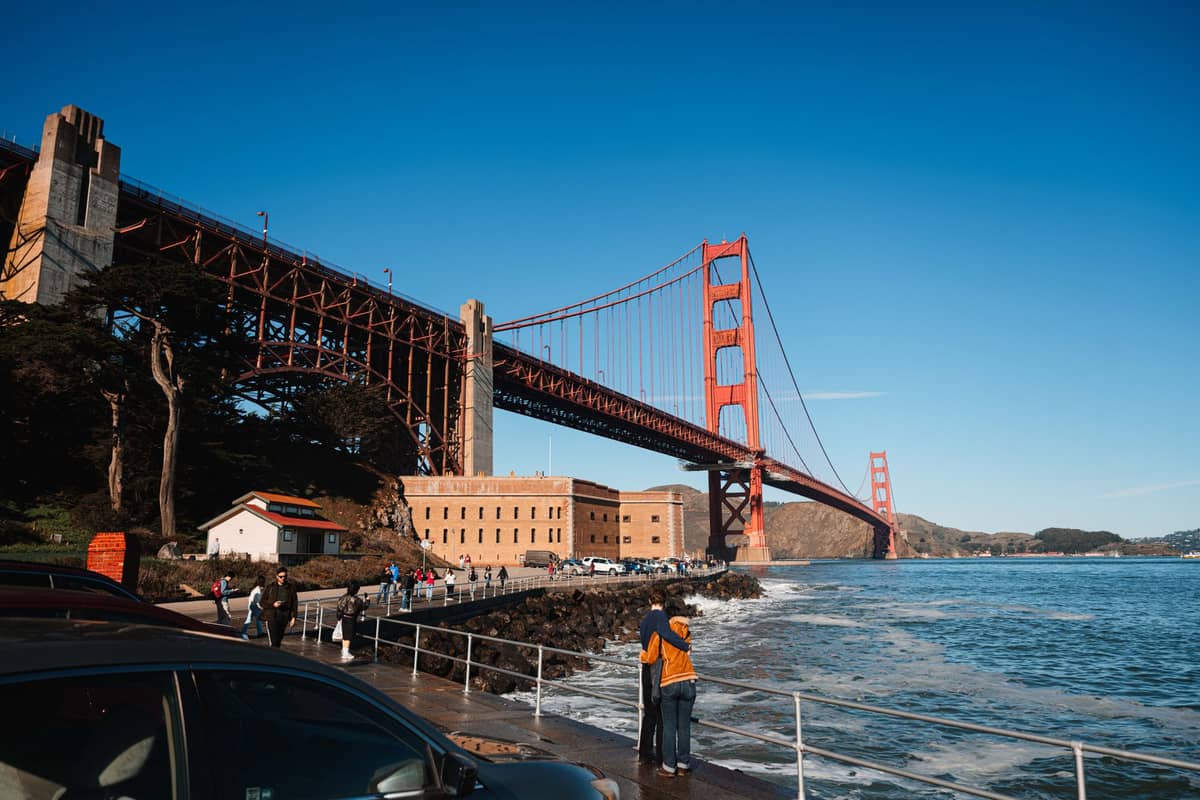
Fort Point National Historic Site sits directly beneath the south anchorage of the Golden Gate Bridge at the southern entrance to San Francisco Bay, a rare surviving example of American Civil War-era masonry fortification. Managed by the National Park Service, it offers free admission, dramatic coastal views, and four floors of military history.
Quick Facts
- Location
- 201 Marine Drive, Presidio, San Francisco, CA 94129
- Getting There
- Presidio GO Shuttle + walk; Muni route 28 to the Golden Gate Bridge area connects with Presidio shuttles into the park
- Time Needed
- 1.5 to 2.5 hours
- Cost
- Free (some guided tours/special events may require paid tickets)
- Best for
- History enthusiasts, architecture lovers, bridge photography
- Official website
- www.nps.gov/fopo/index.htm
What Fort Point Actually Is
Fort Point National Historic Site is a four-story brick and granite seacoast fortification built by the U.S. Army Corps of Engineers in the 1850s, positioned on the southern side of the Golden Gate at the entrance to San Francisco Bay. It stands directly beneath the south anchorage of the Golden Gate Bridge, which was deliberately arched overhead during construction in the 1930s to preserve the fort below. That visual relationship, a 19th-century military structure framed by a 20th-century engineering icon, is unlike anything else in the National Park System.
The site occupies ground with an even longer history. A Spanish colonial fortification called the Castillo de San Joaquin (Saint Joachim's Castle) occupied this same promontory before the American-era fort was constructed. California Historical Landmark No. 82 commemorates that earlier structure under its Spanish name. The current fort was established as a National Historic Site on October 16, 1970, when President Richard Nixon signed the authorizing legislation.
ℹ️ Good to know
The fort building is open Thursday through Monday, 10:00 a.m. to 5:00 p.m. (roof access closes at 4:30 p.m.). It is closed Tuesdays, Wednesdays, Thanksgiving, December 25, and January 1. The exterior grounds are accessible seven days a week. Confirm current hours at nps.gov/fopo before visiting, as they are subject to change.
The Experience: What You See and Feel
Approaching Fort Point on foot along Marine Drive, the scale of the structure takes time to register. The walls are built from red brick imported from the East Coast, laid in thick arched tiers that absorb the constant wind off the water. The air here carries salt, kelp, and diesel exhaust from passing cargo ships, and the sound of waves breaking against the seawall competes with the low groan of bridge traffic overhead. On clear mornings, the angle of light on the brick turns the whole facade a deep amber before the marine layer rolls back in.
Inside, the fort is arranged around a central parade ground open to the sky. Three tiers of arched casemates surround it, each designed to house heavy artillery. Those cannon embrasures now frame views of the bay, the Marin Headlands, and, looking straight up through an open roof tier, the underside of the Golden Gate Bridge's south tower. That upward view is one of the most photographed angles in San Francisco and requires nothing more than pointing your camera skyward from the courtyard.
Rangers and interpretive displays cover the fort's role in coastal defense from the Civil War through World War II, when it was garrisoned again and equipped with anti-submarine nets stretched across the bay entrance. The building never fired its guns in combat, but it was never meant to be tested quietly either: its brick construction was already becoming obsolete in the face of rifled artillery by the time it was completed.
Tickets & tours
Hand-picked options from our booking partner. Prices are indicative; availability and final rates are confirmed when you complete your booking.
Point Reyes National Seashore self-guided driving audio tour
From 13 €Instant confirmationFree cancellationSelf-Guided Driving Tour of Point Reyes National Seashore
From 17 €Instant confirmationSonoma and Napa Valley wine tour from San Francisco
From 127 €Instant confirmationFree cancellationGo City | San Francisco Explorer Pass
From 76 €Instant confirmationFree cancellation
Time of Day and Seasonal Considerations
The exterior grounds around the fort reward early arrivals. Before 9 a.m., the area is largely empty, the light is low and directional, and the Golden Gate Bridge is often visible above the fog line even when the city behind you disappears. Photographers who want a clean shot of the bridge from directly beneath it, without other visitors in frame, should aim for weekday mornings.
The interior opens at 10 a.m. and sees its heaviest foot traffic between 11 a.m. and 2 p.m. on open days, especially Friday through Monday, when tour groups from Fisherman's Wharf and the main bridge viewing area spill down to the fort. If you arrive at opening on a Thursday or Friday, you may have entire casemate corridors to yourself, which changes the experience considerably. The brick vaults amplify sound, and in a quiet moment you can hear wind channeling through the cannon ports with a low, resonant hum.
September and October are climatically the most reliable months to visit. San Francisco's summer fog is thickest in June and July, and while the fort itself is worth seeing in any weather, the panoramic views from the roof and exterior seawall are dramatically better on a clear day. Wind is constant here regardless of season; it is noticeably stronger than elsewhere in the Presidio. Bring a layer that you would not bring to most other San Francisco attractions.
⚠️ What to skip
Wind at Fort Point is reliable and often strong. Even on warm days in late summer, temperatures at the water's edge near the fort can feel 10 to 15 degrees cooler than inland San Francisco. A windproof jacket is not optional if you plan to spend time on the roof or the seawall.
History and Architectural Significance
Fort Point is the only completed casemated Third System masonry fort on the Pacific coast of the United States. Third System refers to a generation of coastal fortifications built after the War of 1812, characterized by thick brick walls, tiered casemates for artillery, and a design philosophy that treated defensive geometry as primary. The Army Corps of Engineers designed Fort Point to mount as many as 126 guns across its three casemate tiers and open barbette tier on the roof.
Construction began in 1853 and was largely complete by 1861, at the outbreak of the Civil War. The timing mattered: Confederate privateers and the possibility of a Pacific coast attack were genuine strategic concerns, and San Francisco's gold-fueled economy made it a priority target in federal military thinking. The fort was never attacked, and the rapid development of rifled artillery during the Civil War made its masonry walls dangerously vulnerable almost as soon as it was finished.
The decision to preserve Fort Point during the construction of the Golden Gate Bridge was made by chief engineer Joseph Strauss, who redesigned the bridge's south approach with a special arch to span the fort rather than demolish it. That arch is visible from the courtyard. Without that decision, the site would not exist. The architectural relationship between the two structures is part of what the National Park Service interprets here, and it gives Fort Point a context that purely military history sites rarely have.
Getting There and Practical Logistics
Fort Point is at the end of Marine Drive within the Presidio, and reaching it without a car requires some planning. The Presidio GO Shuttle connects to Muni route 28 at the Golden Gate Bridge parking area and stops within the park; from there, the walk to Marine Drive and the fort takes around 15 to 20 minutes depending on your starting point within the Presidio. Check the Presidio Trust website for current shuttle routes and schedules, as these change seasonally.
By car, from US-101 at the south end of the Golden Gate Bridge, follow the signed exit for the Presidio, then turn onto Lincoln Boulevard, left on Long Avenue, and continue onto Marine Drive. Parking near the fort is limited to a small lot; it fills quickly on weekends. If you are combining this visit with the Golden Gate Bridge or Crissy Field, consider parking once and walking between sites.
As a mid-19th-century military structure, Fort Point has significant accessibility limitations. Staircases connect the casemate tiers, passageways are narrow, and floor surfaces are uneven brick and stone. The exterior grounds and lower courtyard level are more accessible. Visitors requiring detailed accessibility information should contact the NPS directly before planning their trip.
Photography at Fort Point
Three distinct compositions draw photographers here: the upward view of the Golden Gate Bridge from the courtyard (best with a wide-angle lens on a clear morning), the view from the seawall looking north toward the Marin Headlands with the bridge in the background, and the interior casemate corridors, where arched brick repeats into shadow and the cannon ports frame rectangles of bay light. The interior corridors are dim, so a camera that handles low light reasonably well matters more here than it does at most outdoor San Francisco sites.
The seawall exterior at Fort Point is one of the few places in San Francisco where you can stand at water level directly beneath the bridge, making it a very different compositional perspective from the standard overlooks. If you want the broader context of the best viewpoints in San Francisco, the roof of Fort Point on a clear day belongs on that list alongside Hawk Hill and Twin Peaks.
Who Should Reconsider This Visit
Fort Point is free and historically significant, but it is not the right stop for every traveler. If your San Francisco itinerary is limited to one or two days and you are prioritizing variety over depth, the fort covers relatively specialized ground. The interior exhibits are text-heavy and require some existing interest in American military history or architecture to hold attention. Children under 10 may find the experience less engaging unless they have a specific enthusiasm for cannons and brick fortifications.
Visitors with mobility limitations should be aware that the most compelling parts of the site, the upper casemate tiers and the roof, are only accessible via stairs. The exterior seawall view and the lower courtyard are accessible without climbing, but the full experience of the four-story interior is not.
Insider Tips
- The upward view of the Golden Gate Bridge from the fort's central courtyard is best before 10 a.m. when fog occasionally sits at bridge deck level but the fort itself is clear, creating an eerie partial-bridge effect that disappears as the day warms.
- Rangers at Fort Point are notably knowledgeable and often conduct informal demonstrations involving period artillery equipment and Civil War-era military dress. These are unscheduled and free; ask at the entrance when you arrive.
- The seawall path on the west side of the fort, at water level, offers a close-up view of the bridge's south tower base that most visitors never find. Walk past the main entrance and follow the path toward the water.
- If you are visiting on a weekend and the parking lot is full, drive back up to the main Crissy Field parking area on Mason Street and walk the waterfront path southwest toward the fort. The 15-minute walk along the shoreline is worth doing regardless.
- The fort's brick interior stays significantly colder than the outside temperature. Even on a warm September afternoon, the deep casemate corridors feel like a wine cellar. A light layer in your bag prevents a short, uncomfortable visit.
Who Is Fort Point National Historic Site For?
- Architecture and military history enthusiasts who want to understand the physical logic of 19th-century coastal defense
- Photographers looking for the under-bridge angle of the Golden Gate that standard overlook viewpoints cannot provide
- Travelers on a tight budget who want a substantive, free National Park Service site in San Francisco
- Visitors combining a Presidio walk with Crissy Field and the Golden Gate Bridge into a single half-day itinerary
- Anyone curious about the engineering decisions behind the Golden Gate Bridge's unusual south approach arch
Nearby Attractions
Other things to see while in The Presidio:
- Baker Beach
Baker Beach is a free, mile-long ocean beach within the Presidio and Golden Gate National Recreation Area, offering some of the closest ground-level views of the Golden Gate Bridge in the city. Cold water, strong currents, and reliable afternoon winds define the experience — this is a beach for walking and watching, not swimming.
- Crissy Field
Crissy Field is a restored tidal marsh and beachfront promenade on the northern shore of the Presidio, offering unobstructed views of the Golden Gate Bridge and San Francisco Bay. Free to enter and open around the clock, it rewards early risers and late-afternoon walkers in equal measure.
- Golden Gate Bridge
The Golden Gate Bridge spans the strait between San Francisco and Marin County in one of the most recognizable silhouettes in the world. Free to cross on foot or by bike, it rewards visitors who plan around the fog, arrive early, and know where to stand.
- Walt Disney Family Museum
Housed in a converted 1897 military barracks inside the Presidio, the Walt Disney Family Museum traces Walt Disney's life from his Midwest childhood to the creation of a global entertainment empire. This is not a theme park experience. It is a closely curated biographical museum with real depth, designed for people who want to understand the man behind the myth.