Es Vedrà: Ibiza's Most Iconic Rock and the Legends Around It
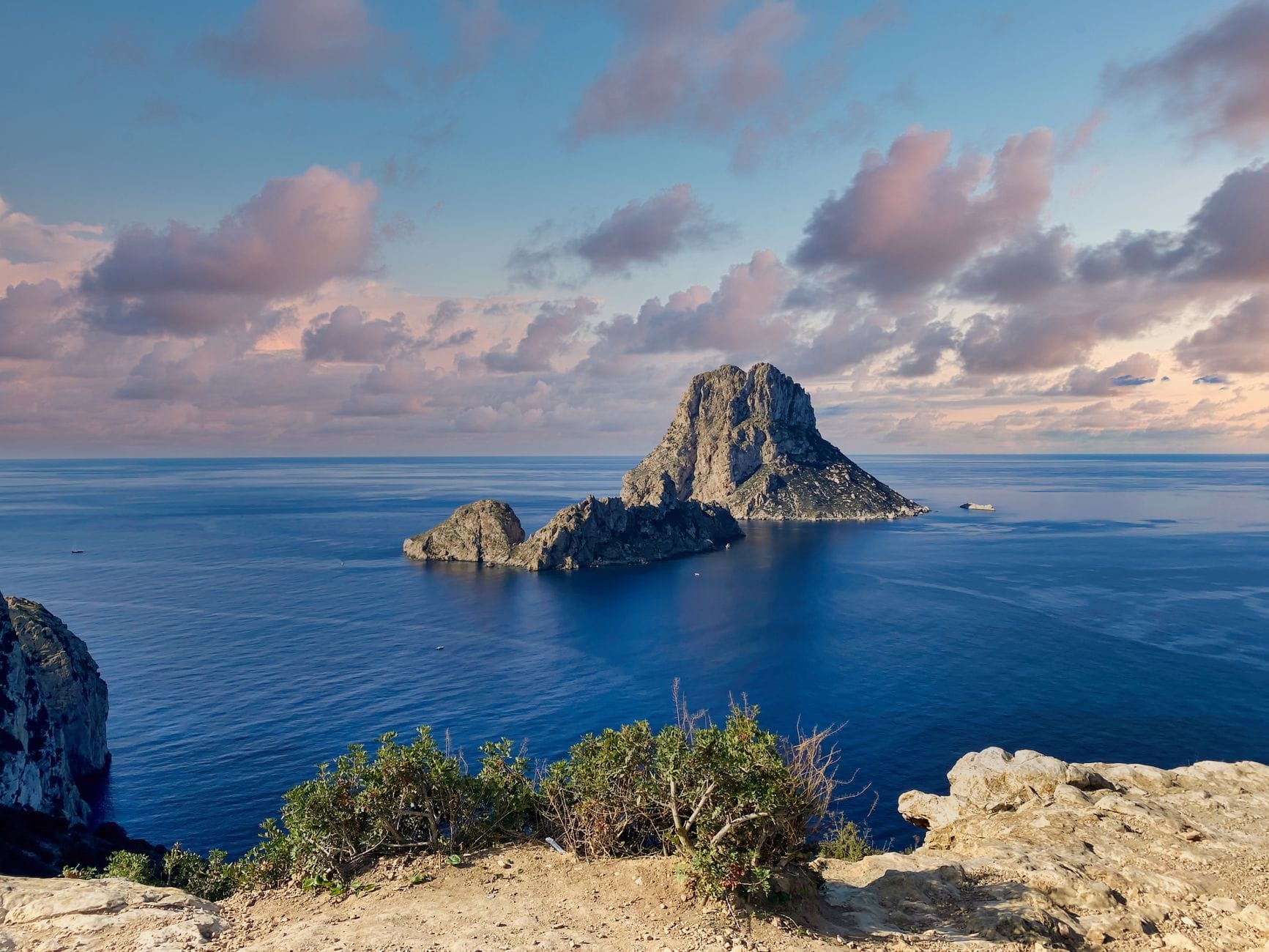
Es Vedrà is a 413-metre limestone islet rising from the sea off Ibiza's southwest coast, strictly protected and impossible to visit on foot. You see it from the shore at Cala d'Hort, from clifftop viewpoints, or from a boat — and it earns its reputation every time the light changes.
Quick Facts
- Location
- Off the southwest coast of Ibiza, approx. 2.5 km from Cala d'Hort, Sant Josep de sa Talaia
- Getting There
- Drive to Cala d'Hort (no direct public bus to the beach); boat excursions depart from Sant Antoni de Portmany
- Time Needed
- 1–2 hours at Cala d'Hort viewpoint; 3–4 hours for a boat excursion
- Cost
- Free from public viewpoints; boat excursions at variable prices (check operators directly)
- Best for
- Sunset photography, nature lovers, boat trips, mythology enthusiasts
What Es Vedrà Actually Is
Es Vedrà is a limestone islet that rises 413 metres straight out of the Mediterranean, roughly 2.5 kilometres off Ibiza's southwest coast. It is uninhabited, strictly protected, and completely inaccessible to visitors on foot. No ferry runs to it. No path leads down to it. You cannot land on it under any circumstances. What you can do is stand on the shore at Cala d'Hort, or lean over the rail of a boat circling its base, and watch it occupy the horizon in a way that very few geological formations manage.
The islet sits within the Natural Reserves of Es Vedrà, Es Vedranell and the Western Islets, a designation established in 2002 that covers nine islets in this corner of Ibiza's coastline. Navigation and disembarkation are tightly regulated, and disembarkation on the islet is not allowed. These rules are enforced. The restrictions exist because the islet supports rare seabird populations and fragile endemic flora that would not survive open access.
ℹ️ Good to know
Es Vedrà is free to view from Cala d'Hort beach and coastal viewpoints. There is no ticket, no gate, no opening time. The beach car park may charge a seasonal fee. The islet itself is off-limits to all visitors.
How It Looks at Different Hours of the Day
In the morning, Es Vedrà catches the eastern light from behind and sits in its own shadow. The rock looks dark and slightly forbidding from Cala d'Hort at this hour, its vertical cliffs sheering straight into water that is unusually clear and still. The beach itself is quiet before 10am, and the combination of cool air, turquoise shallows, and the silhouette ahead of you is genuinely arresting. A few fishing boats are usually anchored in the bay. You can hear the water against the rocks below the restaurant terrace.
By midday the character changes. The sun hits the southwest-facing cliffs directly and the rock turns a pale, warm grey-gold. The beach fills. Loungers appear, music starts from the beach bars, and the contemplative quality of the morning is replaced by something more social. Es Vedrà does not disappear in the midday scene but it becomes one element among many rather than the dominant focus.
The late afternoon and sunset period is when the formation is at its most photogenic and most crowded. From about 6pm onwards, the rock catches the low western light at a full angle. The cliff faces glow amber, then orange, then a deep copper as the sun drops. The sea around the base turns colours that are genuinely difficult to describe accurately. Cala d'Hort fills with people specifically for this moment, which is worth knowing before you arrive expecting solitude.
Ibiza's southwest coast produces some of the island's most reliable sunset conditions. If you want a broader understanding of where Es Vedrà fits into the island's sunset circuit, the Ibiza sunsets guide covers the full range of viewpoints across the island, from Cala Comte to the cliffs above Sant Antoni.
Tickets & tours
Hand-picked options from our booking partner. Prices are indicative; availability and final rates are confirmed when you complete your booking.
Guided boat tour from Ibiza to Es Vedra
From 83 €Instant confirmationFree cancellationSunset boat tour with tapas, open bar and water sports in Ibiza
From 70 €Instant confirmationFree cancellationEscape Tour self-guided, interactive city challenge in Ibiza
From 30 €Instant confirmationPrivate Sunset Cruise on a Maritime Classic in Ibiza
From 750 €Instant confirmationFree cancellation
The History and the Mythology
The only person on record as having actually lived on Es Vedrà was a Carmelite friar named Francis Palau y Quer, who spent a short period there in 1855 after being exiled from Catalonia. His account of his time on the islet describes visions and spiritual experiences. Whether that story seeded the later mythology or merely became absorbed into it is impossible to say, but Es Vedrà has accumulated legends at a rate that bears no obvious relationship to its size.
The stories in circulation range from the plausible to the frankly extraordinary. Es Vedrà has been described as the tip of the lost city of Atlantis. It has been identified as the island of the Sirens referenced in Homer's Odyssey. It has been connected to unusual compass behaviour and alleged UFO sightings. Locally, the area around it is sometimes called the Ibiza Triangle. None of these claims are supported by scientific evidence, but the mythology has become part of the cultural identity of the place, and dismissing it entirely misses something about why people respond to Es Vedrà the way they do. The rock simply looks like it should have a legend attached to it.
Getting There: Your Two Main Options
From Land: Cala d'Hort and Clifftop Viewpoints
The most straightforward way to see Es Vedrà is to drive to Cala d'Hort, a small beach on the southwest coast in the municipality of Sant Josep de sa Talaia. The beach sits directly opposite the islet and gives you an unobstructed view across open water. There are restaurants on the beach with terrace seating that faces the rock. If you time your visit for late afternoon, you can eat and watch the sunset simultaneously, which is a very good way to spend a few hours.
There is no reliable direct public bus service to Cala d'Hort, so a hire car or taxi is the practical choice for most visitors. The road down from the main Sant Josep road is narrow and winding but paved. Parking at the beach fills quickly in summer afternoons. Arriving before 5pm on a peak summer day gives you a reasonable chance of finding a space without stress.
The area also has elevated viewpoints that look down onto Es Vedrà from above. Torre des Savinar is the most cited of these, offering a dramatic aerial perspective on both the islet and the coastline. The path to it involves steep, uneven terrain and has been subject to access restrictions at various points. Check local sources before planning a route there, as the situation can change.
⚠️ What to skip
Torre des Savinar access has been reported as restricted or closed at times. Do not assume the viewpoint path is open. Verify locally before making it the centrepiece of your plans.
From the Sea: Boat Excursions
Seeing Es Vedrà from water level is a fundamentally different experience to seeing it from the beach. The islet is significantly more imposing from a boat. At 413 metres, it is tall enough that you crane your neck to see the summit from close range. The vertical limestone faces have textures and colour variations that are invisible from the shore. Seabirds nest in the cliff crevices. The water at the base is extraordinarily clear.
Boat excursions depart from Sant Antoni de Portmany and from other marinas around the island. Several operators offer dedicated Es Vedrà tours, often combined with swimming stops at nearby coves. Prices and schedules vary by season and operator and need to be confirmed directly with the companies. Remember that landing on the islet is prohibited regardless of the circumstances.
If you are basing yourself in the southwest for the day, Cala d'Hort is worth combining with a visit to nearby Cala Vadella or Cala Tarida, both of which are within easy driving distance.
What to Bring and How to Prepare
If you are visiting purely to see the view from Cala d'Hort, you need very little: sunscreen, water, and a camera. If you plan to combine the visit with a swim, the beach has clear, shallow water suitable for swimming, though it is pebbly rather than sandy in parts. Shade on the beach itself is limited, so a hat is useful in midsummer.
Photography works well from either the beach or slightly elevated positions above it. A standard smartphone camera handles the view adequately in the late afternoon when the light is warm. For sunrise photographers or those shooting in the harsh midday light, the conditions are less cooperative. A polarising filter helps with the sea colour in any condition. The islet is distant enough that optical zoom or a longer lens makes a meaningful difference if rock detail is what you are after.
Driving through the Sant Josep area puts you near several other points of interest. The Mirador des Vedrà provides another elevated angle on the islet and is worth a brief stop if you are approaching from the inland road.
What to Expect: Is It Worth the Trip?
Es Vedrà is not a place you do in the conventional tourist sense. There is no interior to walk through, no information panels to read, no structured experience to complete. You look at a rock. Depending on what you bring to that activity, this is either a profound half-hour or a mildly baffling one. Visitors who arrive expecting an active excursion or a beach with facilities should know that the beach at Cala d'Hort is scenic but small, and the rock is the reason to be there, not the amenities.
That said, very few natural formations on the island create the same visual impact. The combination of scale, isolation, and light conditions on the southwest coast means that Es Vedrà consistently delivers something that photographs in travel writing have difficulty conveying. It looks more interesting in person than in pictures, which is a rarer quality than it might seem.
If you are putting together a week on the island and want to understand how Es Vedrà fits into a broader itinerary, the one-week Ibiza itinerary gives practical structure for combining this area with the rest of the island.
Insider Tips
- Arrive at Cala d'Hort by 5pm in summer to secure parking. After 6pm, cars line the approach road for several hundred metres.
- The restaurant terraces at Cala d'Hort face Es Vedrà directly. Booking a table for the final hour before sunset is more comfortable than standing on the beach, and the food is good. Reservations are strongly recommended in July and August.
- Cloudy afternoons often produce the most dramatic light on the rock. An overcast sky that breaks just before sunset can create extraordinary colour on the cliff faces. Do not write off a visit because the morning weather looks uncertain.
- The water at Cala d'Hort is some of the clearest on the island. If you bring snorkelling equipment, the underwater visibility near the shore is exceptional, though the rock itself is too far for casual snorkelling.
- For the elevated perspective without committing to the Torre des Savinar path, driving the road between Cala d'Hort and the main Sant Josep road offers multiple informal pull-off points with open views toward Es Vedrà. These spots are significantly less crowded than the beach itself.
Who Is Es Vedrà For?
- Photographers and visual travellers who want the southwest light at golden hour
- Nature-focused visitors interested in protected Mediterranean ecosystems
- Couples or small groups looking for a scenic sunset location away from the main crowd at Cala Comte or Sant Antoni
- Boat trip enthusiasts who want to see Ibiza's coastline from the water
- Travellers interested in local folklore, mythology, and the stranger side of Ibiza's cultural identity
Nearby Attractions
Other things to see while in San José (Sant Josep de sa Talaia):
- Cala d'Hort
Cala d'Hort is a compact beach on Ibiza's southwest coast, in a formerly protected natural area and facing the sheer, mythologised rock of Es Vedrà. The scenery is unlike anywhere else on the island, but getting here takes effort, and the limited parking fills fast in summer.
- Cala Jondal
Cala Jondal is a sheltered south-coast bay in Sant Josep de sa Talaia, known for its remarkably clear turquoise water, white pebble shore, and high-end beach clubs. Access is free, but the scene here leans decidedly upscale. It rewards visitors who arrive early and leave before the midday sun turns the stones underfoot into a barefoot obstacle course.
- Cala Tarida
Cala Tarida is a large cove on Ibiza's western coast, stretching roughly 900 metres of fine white sand in the municipality of Sant Josep de sa Talaia. Calm, clear water and reliable afternoon light make it one of the most rewarding beaches on the island for a full day out.
- Cala Vadella
Cala Vadella is a 200-metre arc of fine white sand on Ibiza's southwest coast, tucked inside a deep natural inlet that keeps the water calm and the atmosphere unhurried. It currently holds a Blue Flag rating and is one of the few beaches on the island genuinely suited to families, swimmers, and anyone who prefers scenery over scene.