Buena Vista Park: San Francisco's Oldest Park and Its Best-Kept Panorama
Established in 1867, Buena Vista Park is San Francisco's oldest official park, rising 589 feet above Haight-Ashbury with forested trails and panoramic views of the city skyline, the Bay, and beyond. Free to enter and open daily, it rewards visitors who are willing to climb for their views.
Quick Facts
- Location
- Buena Vista Ave & Haight St, Haight-Ashbury, San Francisco, CA 94117
- Getting There
- Muni 6 Parnassus or 7 Haight-Noriega (Haight & Baker stop); 37 Corbett (Upper Terrace & Buena Vista West)
- Time Needed
- 45 minutes to 1.5 hours depending on trail exploration
- Cost
- Free — no admission fee
- Best for
- Views, solo hikers, dog walkers, photography, neighborhood immersion
- Official website
- sfrecpark.org/facilities/facility/details/Buena-Vista-Park-155
What Is Buena Vista Park?
Buena Vista Park is San Francisco's oldest official park, established in 1867 under the name Hill Park by the city's Committee on Outside Lands. It was renamed Buena Vista Park in 1894, a nod to what 'buena vista' means in Spanish: good view. That name earns its keep. The park covers approximately 37 acres on a steep hill rising to about 589 feet above sea level, positioned between Haight Street at its base and the residential streets of Buena Vista Heights above.
Unlike many urban parks that flatten and manicure their terrain, Buena Vista has kept much of its wild character. The hill is densely forested with eucalyptus, Monterey cypress, and pine, and the trails are mostly packed dirt and stone staircases rather than paved paths. This is not a park you stroll through passively. You climb it, and the views at the top are what you came for.
ℹ️ Good to know
Buena Vista Park is open daily from 6:00 a.m. to 10:00 p.m., year-round. There is no entrance fee. Dogs are welcome on leash on the main paths.
The Views: What You Actually See From the Summit
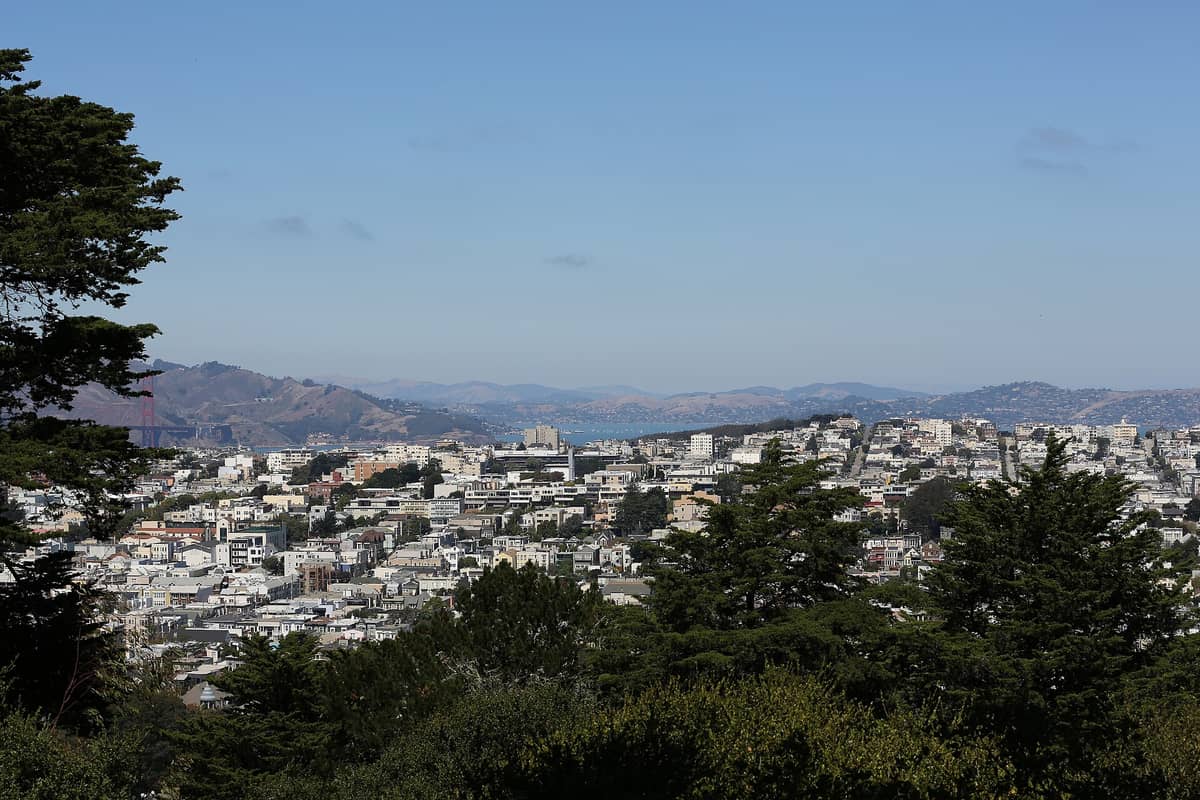
From the upper trails and the park's summit clearing, the view opens up across a wide sweep of the city. To the north and east, you can see downtown San Francisco's skyline, the Bay, and on clear days, the hills of the East Bay and Marin County beyond. The Golden Gate Bridge is visible from certain vantage points along the upper ridgeline, though tree cover limits the angle depending on where exactly you stand.
The views change considerably based on the time of day and season. San Francisco's marine fog rolls in most reliably through the Golden Gate corridor during summer mornings (June through August), and Buena Vista sits directly in its path. Early summer mornings can wrap the summit in thick fog that obscures everything beyond the nearest trees. By contrast, September and October bring the city's clearest, warmest days, when the panorama from the top becomes especially striking: sharp city geometry, blue Bay water, and distant ridgelines all visible at once.
For a more reliably clear experience on any given day, aim to arrive in the afternoon, after the marine layer has burned off. If panoramic views are your primary reason for visiting San Francisco, it is worth reading up on the best viewpoints across the city to compare Buena Vista with Twin Peaks, the Marin Headlands, and other alternatives.
Tickets & tours
Hand-picked options from our booking partner. Prices are indicative; availability and final rates are confirmed when you complete your booking.
Sonoma and Napa Valley wine tour from San Francisco
From 127 €Instant confirmationFree cancellationGo City | San Francisco Explorer Pass
From 76 €Instant confirmationFree cancellationMuir Woods and Sausalito guided tour with transportation
From 82 €Instant confirmationFree cancellationSan Francisco CityPASS
From 77 €Instant confirmationFree cancellation
Walking the Park: Trails and Terrain
The most common approach is from the Haight Street entrance at the corner of Haight and Baker. A set of stone steps leads up from the sidewalk into the tree canopy almost immediately. The air shifts within a few paces: cooler, shadowed, carrying the sharp scent of eucalyptus. The path is uneven and can be slippery after rain, so shoes with grip are worth wearing.
Several intersecting trails wind through the hill. Most are informal and unmarked, which means first-time visitors often take wrong turns on the way to the summit. The general principle is to keep moving uphill. The trails converge near the top at a clearing where benches face the city view. The total climb from Haight Street to the summit takes roughly 10 to 15 minutes at a moderate pace.
If you want the gentler approach, Muni route 37 Corbett stops near the Upper Terrace and Buena Vista West intersection on the southeastern side, which provides access via the service road. This route involves significantly less climbing and is the more practical option for visitors with limited mobility, though it is still hilly. The park does not have a fully accessible paved loop, and the main stairway entrances from Haight Street are not wheelchair-accessible.
💡 Local tip
Wear rubber-soled shoes. The dirt paths through Buena Vista Park can turn slick with dew or after rainfall, especially on the steeper staircases near the Haight Street entrance.
History and Neighborhood Context
Being the city's oldest official park gives Buena Vista a footnote in San Francisco urban history, but its surroundings give it more personality than that title alone would suggest. The park sits at the eastern edge of Haight-Ashbury, the neighborhood that became the center of the 1960s counterculture movement. The streets immediately below the park, particularly along Haight Street, still carry traces of that era in the mix of vintage shops, independent cafes, and painted Victorian storefronts.
Spending time in the park pairs naturally with exploring the broader Haight-Ashbury neighborhood below it. The stretch of Haight Street between Masonic and Stanyan offers a concentrated look at the area's character, and the park entrance is only a few minutes' walk from the commercial strip.
From the park's hillside, the residential blocks of Buena Vista Heights to the west are visible: steep streets lined with Edwardian and Victorian homes that survived the 1906 earthquake and fire largely intact. The hill's position outside the main paths of the post-earthquake fire helped preserve both the park and the surrounding architecture.
How the Park Changes Through the Day
The park's population shifts noticeably by hour. Early mornings, from opening until around 9 a.m., belong mostly to dog walkers and solo runners. The trails are quiet, the light filters low through the cypress canopy, and the city below has not yet filled with noise. This is when the park feels most like its own self: an island of forest above the grid.
Midday sees a mix of nearby residents on lunch walks, tourists navigating up from Haight Street, and small groups sitting at the summit benches. Weekends amplify this, particularly in spring and fall when the weather cooperates. By late afternoon, the light on the downtown skyline turns warm and the views become photogenic, though the park can feel busier.
After dark, the park closes at 10:00 p.m. and is not lit. It is not recommended to enter after closing, both for safety reasons and because navigation on the unlit trails becomes genuinely difficult. The park has a reputation among longtime San Francisco residents as a spot that sees occasional criminal activity at night, so there is no reason to test its nighttime atmosphere.
⚠️ What to skip
Avoid entering Buena Vista Park after dark. The trails are unlit, the terrain is uneven, and the park closes at 10:00 p.m. Evening visits should end well before dusk if you are unfamiliar with the layout.
Photography and Practical Notes
For photography, the summit clearing faces northeast and is best in the afternoon when the sun is behind you relative to the city skyline. The forest trails themselves photograph well in the soft, diffused light of overcast days, which San Francisco provides frequently. The eucalyptus trunks have interesting texture and the canopy creates layered depth that works well for wide-angle compositions.
There are no food vendors, restrooms, or water fountains in the park, so bring water, especially if you plan to spend more than 30 minutes exploring the trails. The nearest cafes and shops are on Haight Street, a short walk from the main entrance.
Getting to Buena Vista Park by Muni is straightforward. The 6 Parnassus and 7 Haight-Noriega lines stop at Haight and Baker, placing you directly at the main entrance stairway. For broader guidance on using San Francisco's transit system, the guide to getting around San Francisco covers Muni routes, BART connections, and the practical realities of moving between neighborhoods.
Who This Park Is and Is Not For
Buena Vista Park works well for visitors who want a genuine urban nature experience without driving to Marin or riding out to Lands End. The climb is real but short. The views are worthwhile. The surrounding neighborhood provides easy pre- or post-visit options for coffee or a meal.
Visitors primarily after a flat, leisurely stroll should look elsewhere. Golden Gate Park is roughly 15 minutes west on foot and offers hundreds of acres of mostly flat terrain, plus the Conservatory of Flowers, the Japanese Tea Garden, and dedicated cycling paths. Buena Vista is small, steep, and unpolished in comparison. That is also what makes it interesting, but the distinction matters when you are deciding how to spend limited time.
Visitors with young children in strollers, or anyone with significant mobility limitations, will find the primary entrances from Haight Street largely inaccessible. The 37 Corbett approach via Upper Terrace is gentler but still involves walking on an unpaved service road with a noticeable incline.
Insider Tips
- The service road entrance off Upper Terrace and Buena Vista West (served by Muni 37 Corbett) drops you much closer to the summit than the Haight Street stairways. If you want the views without the full stair climb, start here.
- September and October are statistically the clearest and warmest months in San Francisco. A visit to the summit during these months, in the afternoon after any morning fog has cleared, gives you the best possible version of the panorama.
- The park has multiple unmarked trail junctions that confuse first-time visitors. When in doubt, keep going uphill. All main paths converge near the summit clearing.
- There are no restrooms inside the park. Use facilities at a cafe on Haight Street before you climb. The nearest public options are on the commercial strip a few minutes from the park entrance.
- The forested canopy makes Buena Vista noticeably cooler than the streets below, even on warm days. Bring a light layer, particularly in summer when marine air keeps temperatures lower than expected.
Who Is Buena Vista Park For?
- Solo walkers and runners looking for a short but genuine uphill trail within the city
- Dog owners in the Haight-Ashbury area wanting varied terrain beyond flat sidewalks
- Photographers interested in city panoramas and forest canopy compositions
- Travelers combining a neighborhood walk through Haight-Ashbury with an elevated perspective
- Budget-conscious visitors who want a free, uncrowded alternative to commercial viewpoints
Nearby Attractions
Other things to see while in Haight-Ashbury:
- Alamo Square Park
Alamo Square Park is a 12.7-acre hilltop public park in San Francisco's Alamo Square / Western Addition area, best known for its east-facing viewpoint overlooking a row of ornate Victorian houses with the downtown skyline rising behind them. Free to enter and open almost around the clock, it rewards visitors who arrive early or late, when the crowds thin and the light turns the city gold.
- Painted Ladies (Postcard Row)
The Painted Ladies at 710–722 Steiner Street are a row of 1890s Victorian houses framed by the San Francisco skyline, best seen from Alamo Square Park. Entry is free, the view is genuine, and the experience varies enormously by time of day and season.