Bondi to Coogee Coastal Walk: The Walk Every Sydney Visitor Should Do
The Bondi to Coogee Coastal Walk is a free 6-kilometre clifftop route connecting two of Sydney's most famous beaches. It takes in ocean pools, sandstone headlands, cemetery views, and a string of smaller beaches that most visitors never reach. Allow 2 to 3 hours at a relaxed pace.
Quick Facts
- Location
- Southern end of Bondi Beach to Coogee Beach, Eastern Suburbs, Sydney NSW
- Getting There
- Bus to Bondi Beach (from Bondi Junction) or Bus to Coogee Beach (from Circular Quay/City). Check Transport for NSW trip planner for current routes.
- Time Needed
- 2–3 hours one way (approx. 6 km)
- Cost
- Free
- Best for
- Scenic walks, ocean pools, coastal photography, solo travellers, couples
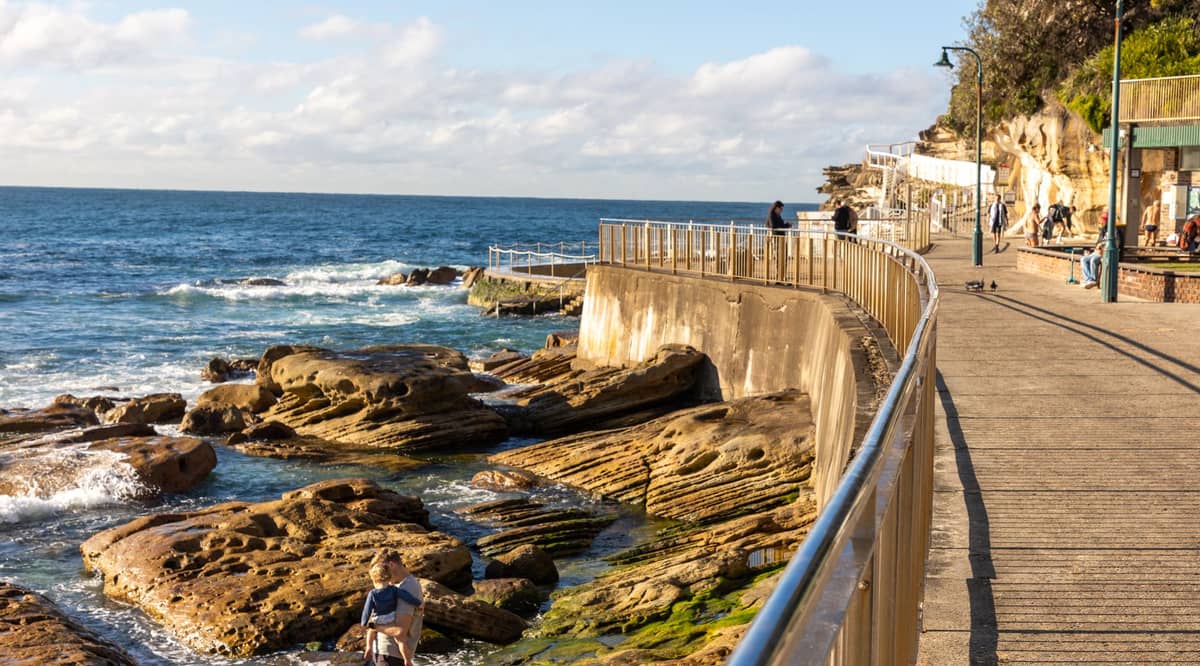
What the Walk Actually Is
The Bondi to Coogee Coastal Walk is a continuous footpath that follows Sydney's Eastern Suburbs coastline for approximately 6 kilometres, starting at the southern end of Bondi Beach and finishing at Coogee Beach. The route is entirely free, open year-round with no set operating hours, and passes through a sequence of smaller beaches, ocean rock pools, coastal parks, and clifftop lookouts that most visitors simply never find.
Unlike many city walks, this one delivers genuine variation. Within the same route you pass a 1930s ocean pool carved into a rock shelf, an historic cemetery perched above the sea, surfers at one beach, families at another, and long stretches where the path narrows to a single track with nothing between you and the Pacific. It earns its reputation not through spectacle alone but through sustained quality across its full length.
💡 Local tip
Walk south from Bondi to Coogee if you want the sun mostly at your back in the morning. Walking north (Coogee to Bondi) in the afternoon puts the light in a better position for photography and tends to be cooler. Either direction works; neither is significantly harder.
The Route, Stop by Stop
The walk begins at the southern end of Bondi Beach, past the famous Bondi Icebergs Swimming Club, whose pool hangs over the rocks at the edge of the beach. This is where you leave the sand behind and the clifftop path begins. The smell shifts immediately: salt spray replaces sunscreen, the noise of the beach fades, and the sandstone underfoot gives you a rougher, more elemental surface to walk on.
From Icebergs, the path moves through Mackenzies Bay and then drops down to Tamarama Beach, a small, steep-sided cove that locals rate highly for bodysurfing. Tamarama is sometimes called 'Glamarama' due to the particularly fashion-conscious crowd that gravitates here, but it has a genuine rip hazard and is worth watching rather than swimming unless you're a confident open-water swimmer. The Bondi Icebergs Pool is worth an early stop if you have time for a swim before setting out.
Bronte Beach follows: wider, calmer, and sheltered by a grassed reserve with Norfolk Island pines that provide rare coastal shade. Bronte has a kiosk, toilets, and a rock pool of its own, making it the natural midpoint for a rest or snack. Beyond Bronte, the path climbs past Waverley Cemetery, one of the most dramatically situated burial grounds in Australia. Established in 1877, it occupies a clifftop headland and contains the graves of several well-known Australians. The contrast between the white headstones and the deep blue water below is visually arresting, and the cemetery is open to respectful visitors.
After the cemetery the path descends to Clovelly Beach, a narrow sea inlet rather than a traditional surf beach. Clovelly's concrete promenade runs alongside a long, calm channel that is popular with snorkellers and families with young children. It feels quiet and almost suburban by comparison with Bondi, which is part of its appeal. The final stretch from Clovelly rises again before dropping into Gordons Bay, a small harbour used by a local dive club, and then follows the coast into Coogee Beach, where the route officially ends at the grassed foreshore park.
The eastern beaches area has more to explore if you want to extend the day. Bronte Beach and Coogee Beach are both worth lingering at rather than treating as mere waypoints.
Tickets & tours
Live prices and dates from our booking partner. If you book, we may earn a commission at no extra cost to you.
The Rocks historic walking tour
From 20 €Instant confirmationFree cancellationBeginner surf lesson at Bondi Beach
From 79 €Instant confirmationFree cancellationMarrickville Brewery walking tour
From 64 €Instant confirmationFree cancellationSydney whale-watching cruise with breakfast or lunch
From 62 €Instant confirmationFree cancellation
How the Experience Changes by Time of Day
Early morning, roughly 6am to 8am, is the most rewarding time on the walk. The path is shared mainly with joggers and swimmers heading to the ocean pools. Light is low and golden, the water catches it at steep angles, and the headlands glow amber. Bondi Beach in the background is nearly empty at this hour, a contrast with its midday state that is hard to overstate.
By mid-morning, particularly on weekends between October and April, the path fills quickly. School groups, tourist groups, and joggers with prams all use the same narrow sections simultaneously. The benches at key lookouts get claimed early. This is not an unpleasant experience, but it is a different one: more social, louder, and slower.
Midday in summer brings direct sun with no tree cover for much of the route. Exposed sandstone sections radiate heat, and the path near Tamarama and above Waverley Cemetery can feel significantly hotter than the air temperature. A hat, sunscreen, and water matter more than they would on almost any other urban walk in Sydney. Midday in winter is in many ways ideal: the temperature sits in the high teens, the light is clear, crowds thin out considerably, and the sea takes on a deeper blue.
⚠️ What to skip
There is no shade for long stretches of this walk. In summer, starting after 3pm or before 8am makes a genuine difference to your comfort. Carry at least 500ml of water per person; refill points are available at Bronte and Coogee but not reliably between.
Practical Walkthrough: Getting There and Getting Back
Public transport is the correct approach for this walk. Parking near both Bondi and Coogee is genuinely difficult on weekends and during summer, and driving to one end leaves you with a return problem. From the city, buses run to Bondi Beach via Bondi Junction; from Bondi Junction, multiple bus routes reach Bondi Beach in around 10 minutes. From Coogee, buses connect back to the city centre and to Bondi Junction. Check the Transport for NSW trip planner before you go, as routes and stop arrangements can change.
If you are combining this walk with time in the broader Bondi and Eastern Beaches area, allow a full day. The walk itself takes 2 to 3 hours at a relaxed pace, but the beaches en route are worth slowing down for.
The walk is entirely one-way as described here, though you can turn around at any point. Most walkers choose to finish at Coogee and take the bus back rather than retracing their steps. The route is well-signposted and follows a single path for most of its length; you are unlikely to take a wrong turn. Footwear should have a grip: the sandstone sections near the ocean pools can be slippery when wet or spray-covered, and there are steep stair sections at several points.
ℹ️ Good to know
Accessibility note: this walk is not suitable for wheelchairs or prams. The route includes significant stair sections, steep gradients, and uneven surfaces. Anyone with limited mobility should check individual beach access separately; several beaches along the route have accessible areas that can be reached independently.
Photography: What to Shoot and Where
The walk offers more photographic range than almost any other free attraction in Sydney. For architecture and pool photography, the Bondi Icebergs complex is best at sunrise when the pool is mirror-smooth and the light comes from the north. For clifftop sea shots, the section above Tamarama gives you a clear view south along the sandstone headlands with no infrastructure in frame. Waverley Cemetery offers an unusual combination of headstones and open ocean that photographs well in overcast light, which softens the contrast between the white stone and dark sea.
Clovelly is underrated for photography. The concrete channel at low tide, surrounded by rock, attracts snorkellers and locals reading on towels, and the compressed, enclosed space gives images a different feel from the wide panoramas elsewhere on the route. A wide-angle lens or a phone camera in portrait mode handles the narrow geometry well. For the most dramatic ocean swell photography, the exposed headlands south of Tamarama and north of Clovelly perform best after storms, when sets run large and the spray is visible from the path.
For context on what makes Sydney's coastal walks distinctive, the Sydney coastal walks guide covers the broader network and helps compare this route with others like the Manly Scenic Walkway.
Who This Walk Suits and Who Should Reconsider
The Bondi to Coogee Coastal Walk suits a wide range of visitors reasonably well, but it is not universally appropriate. Fit adults and older teenagers will find the distance and terrain manageable without special preparation. Those who enjoy open-water swimming will find three swimmable beaches along the route and two ocean pools. Anyone interested in Sydney's coastal ecology or colonial history will find the cemetery section and the rock shelf ecosystems genuinely interesting.
Visitors who dislike crowds should avoid summer weekends between 9am and 2pm, when the path between Bondi and Tamarama specifically becomes congested. Families with young children or prams should note that the stairs and uneven surfaces make this route unsuitable for prams and require constant supervision near cliff edges. People with a strong preference for shade and flat terrain will find this walk uncomfortable rather than enjoyable in summer. It is also not a wilderness experience: the route passes through residential and commercial areas and is audibly urban for portions of its length.
If you are planning a broader Sydney itinerary and want to see how this walk fits in, the 3 days in Sydney guide and the free things to do in Sydney guide both place it in useful context.
Insider Tips
- Waverley Cemetery is open to respectful visitors during daylight hours. Walk through rather than around it: the views from the eastern edge of the cemetery headland, looking south toward Clovelly, are among the best on the entire route and almost no one stops here.
- Gordons Bay, in the final section before Coogee, has an underwater nature trail marked with a chain on the seabed. It is used regularly by local divers and snorkellers. If the water is clear and you have gear, this is a legitimate detour.
- Clovelly Beach's channel is one of the few spots on the Eastern Suburbs coast where children can snorkel in genuinely calm water. The fish population is healthy and unafraid of swimmers; bring a cheap mask and fins if travelling with kids.
- If you finish at Coogee and want to eat, walk one block inland from the beach rather than using the strip immediately on the foreshore. The quality improves noticeably within 200 metres.
- The Bondi Icebergs pool charges an entry fee and has a sauna. If your legs are tired after the walk in reverse (Coogee to Bondi), finishing with a cold pool swim and sauna session is a legitimate way to end the day.
Who Is Bondi to Coogee Coastal Walk For?
- Solo travellers or couples who want a half-day of coastal scenery without paying for it
- Photographers looking for ocean, clifftop, and urban beach combinations in one outing
- Swimmers who want to combine a walk with dips at multiple beaches and ocean pools
- Visitors with limited time who want to see the Eastern Suburbs coast efficiently
- Anyone building a Sydney itinerary who needs a reliable, free, high-quality activity
Nearby Attractions
Other things to see while in Bondi & the Eastern Beaches:
- Bondi Beach
Bondi Beach is a 1-kilometre arc of white sand in Sydney's eastern suburbs, free to enter and open year-round. It draws everyone from serious surfers to Sunday café-goers, and its promenade connects to one of the city's great coastal walks. Here is what to know before you go.
- Bondi Icebergs Pool
Perched at the southern tip of Bondi Beach, the Bondi Icebergs Pool is a 50-metre saltwater lap pool carved into the sandstone headland. The Bondi Icebergs Winter Swimming Club was established in 1929, it offers one of the most photographed swim experiences in Australia, with waves crashing over the pool walls and the full sweep of Bondi Beach stretching to the north.
- Bronte Beach
Tucked between Bondi and Coogee, Bronte Beach offers a more relaxed pace than its famous neighbours. With a free ocean pool, a grassy reserve backed by sandstone cliffs, and direct access to the coastal walk, it rewards visitors who venture a little further south.
- Camp Cove
Camp Cove is a small, sheltered harbour beach at Watsons Bay, just inside the Sydney Heads. Protected from ocean swell, it offers calm swimming water, a historic foreshore, and easy ferry access from Circular Quay. It rewards visitors who arrive early on weekday mornings and those who appreciate a quieter, less commercial alternative to the eastern ocean beaches.
Planning a trip? Discover personalized activities with the Nomado app.