Ancient City (Muang Boran): Thailand's Open-Air Museum Worth the Journey
Ancient City, known in Thai as Muang Boran, spreads across roughly 200 acres of landscaped grounds on the outskirts of Bangkok and contains over 100 reconstructed and scaled monuments representing every region of Thailand. It rewards patient visitors who want architectural history without temple fatigue.
Quick Facts
- Location
- 296/1 Sukhumvit Road, Samut Prakan (approx. 33 km southeast of central Bangkok)
- Getting There
- BTS to Kheha station (end of Sukhumvit line), then songthaew or taxi to the entrance
- Time Needed
- 3 to 5 hours minimum; full day recommended
- Cost
- 700 THB adults / 350 THB children (bicycle and golf cart rentals extra)
- Best for
- History enthusiasts, architecture lovers, families, photographers
- Official website
- www.muangboranmuseum.com
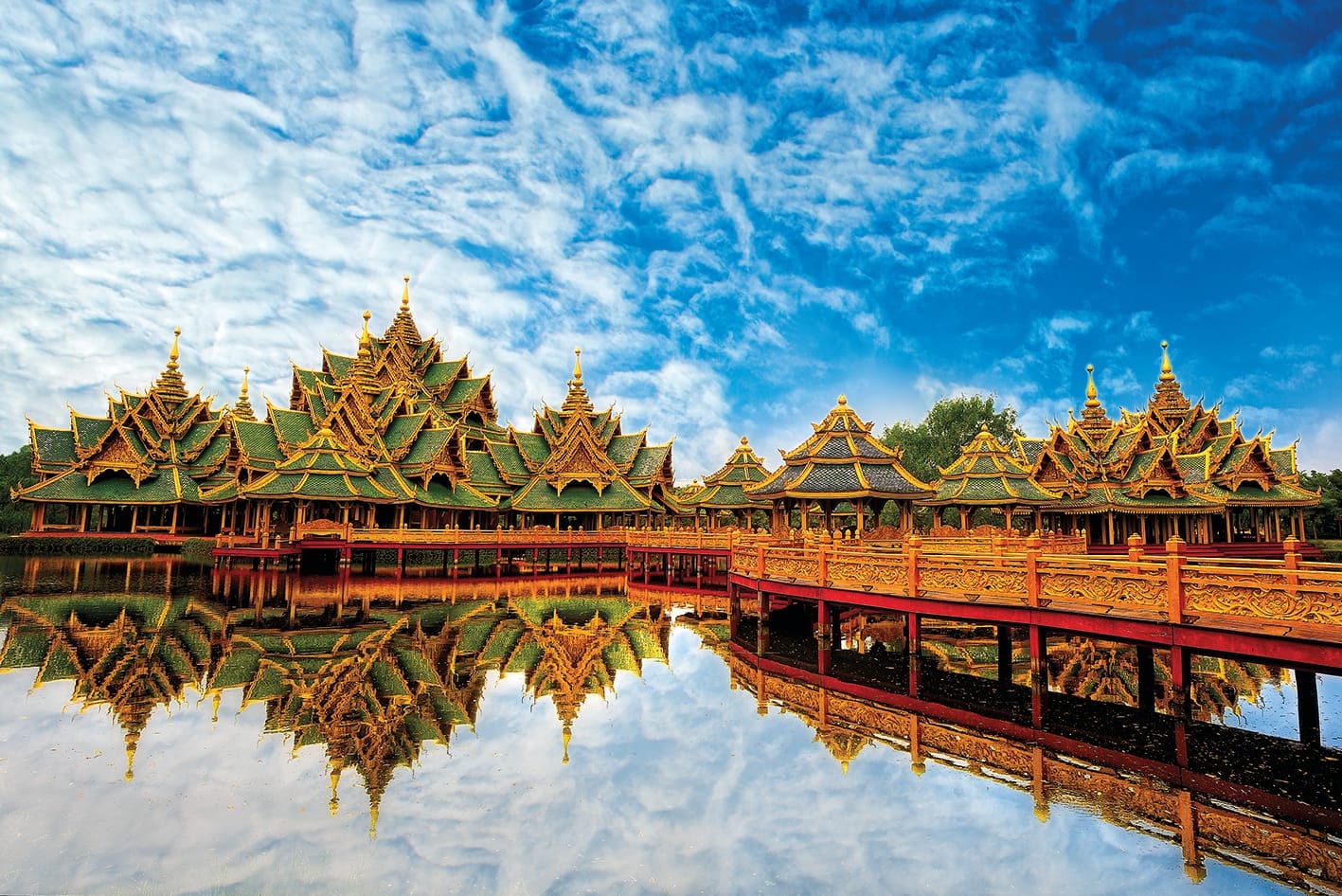
What Ancient City Actually Is
Ancient City, or Muang Boran in Thai, is not a theme park in any cheap sense of the word. It is a privately funded open-air museum conceived in the 1960s by businessman Lek Viriyaphant, the same visionary behind the Erawan Museum nearby. The grounds are shaped roughly like the outline of Thailand itself, and the monuments inside are arranged geographically to mirror where each structure originally stood or stands in the country. That design choice alone tells you something about the ambition of the project.
Over 100 monuments fill the site, ranging from full-scale reconstructions of temples that no longer exist to scaled-down replicas of landmarks that are too remote for most travelers to reach. Several structures here are the only surviving representations of buildings destroyed by war or neglect. This is not decoration. For anyone interested in Thai architectural history, Muang Boran holds genuine scholarly and cultural weight.
ℹ️ Good to know
The site covers roughly 200 acres. Walking the entire grounds is possible but exhausting. Rent a bicycle at the entrance for 50-100 THB or hire a golf cart with a driver for a narrated circuit. Most visitors underestimate the distances between structures.
Arriving and First Impressions
Getting here is the main friction point. Ancient City sits in Samut Prakan province, about 33 kilometers southeast of central Bangkok. The most convenient route is the BTS Skytrain to Kheha station, the southern terminus of the Sukhumvit line. From there, shared songthaew minibuses run directly to the Muang Boran entrance and cost around 10-20 THB per person. Taxis from central Bangkok are comfortable but can cost 400-600 THB each way depending on traffic, and the expressway toll adds a small surcharge.
Arriving before 10:00 is a real advantage. The grounds are quietest on weekday mornings, and the low morning light cuts across the spires and pond reflections in ways that photographers find extremely useful. By midday, tour groups from Bangkok arrive and the main circuits get noticeably more crowded. On weekends, Thai families with young children make up a large share of the visitors, creating a lively but slower-paced atmosphere near the pavilion areas.
💡 Local tip
Wear comfortable shoes with grip. Many paths between monuments are brick, gravel, or slightly uneven stone. Sandals work fine on main routes but become uncomfortable on longer loops between the outer monuments.
Tickets & tours
Hand-picked options from our booking partner. Prices are indicative; availability and final rates are confirmed when you complete your booking.
Ancient city of Ayutthaya guided tour from Bangkok
From 69 €Instant confirmationFree cancellationTemples of Bangkok and Grand Palace half-day guided tour
From 18 €Instant confirmationFree cancellationDamnoen Saduak floating market and Maeklong railway guided tour
From 36 €Instant confirmationFree cancellationBangkok tuk-tuk night tour with Chinatown street food meal
From 28 €Instant confirmationFree cancellation
The Monuments: What to Prioritize
With over 100 structures spread across the property, having a loose priority list helps. The Prasat Hin Phimai reconstruction in the northeastern zone is one of the most detailed pieces on the site, representing the great Khmer sanctuary in Nakhon Ratchasima province. The original is extraordinary, but few Bangkok visitors make the four-hour journey. The Muang Boran version conveys the scale and carved sandstone detail well enough to give genuine architectural context.
Near the center of the grounds, a replica of the Sanphet Prasat Palace from the old capital of Ayutthaya occupies a prominent position. The original was razed by Burmese forces in 1767 and never rebuilt. What stands here is reconstructed from historical records and visual evidence, making it one of the few places where visitors can understand what the Ayutthaya royal court actually looked like at its height. Walking around it in the late afternoon, when the light goes gold and the crowds thin slightly, is one of the more quietly affecting experiences the site offers.
The floating market pavilion and the traditional Thai house cluster in the central zone show domestic architecture rather than religious monuments, and they provide useful contrast. Children tend to gravitate toward the accessible wooden structures here, and there are resident peacocks and deer in parts of the grounds that make the space feel genuinely alive rather than purely academic.
If you have already visited the Grand Palace and Wat Pho in the old city, Ancient City offers meaningful architectural counterpoint: it shows how temple and palace design evolved across different regions and eras of Thai history, not just the Rattanakosin-period style concentrated in Bangkok's historic core.
How the Experience Changes Through the Day
Morning visits reward anyone with a camera or a preference for solitude. The ponds and canals that run through the property catch the light cleanly before 9:00, and the air is cooler and noticeably more pleasant for walking. Most of the large monuments face east or sit near water features, so the early light works compositionally for photography without requiring any special positioning.
Midday heat between 11:00 and 14:00 is the hardest stretch. Temperatures regularly reach 33-36°C from March through May, and the open grounds offer limited natural shade between monuments. This is the time to take the covered golf cart option, stop at the restaurant near the central zone, or linger inside the few air-conditioned indoor exhibits on the property. Pushing through the outer circuit on foot in peak heat is genuinely draining.
Late afternoon, roughly 15:00 onward, is the second-best window. Tour groups have largely departed, the light softens, and the gardens take on a more reflective quality. The site closes at 19:00, so there is still comfortable time to complete a circuit. Sunset from near the Ayutthaya palace replica, looking west across the water, is worth timing deliberately.
⚠️ What to skip
Bring water and sunscreen regardless of season. The grounds are almost entirely outdoors, shade is uneven, and Bangkok's humidity is persistent even in the cooler months of November through February.
Cultural and Historical Context
Lek Viriyaphant founded Ancient City in 1963, initially as a private collection of Thai art and architecture displayed in a garden setting. The project grew steadily over the following decades into a full interpretive landscape. The driving idea was preservation through replication: if structures in remote provinces were deteriorating or had already been lost, reconstructing them in a single accessible location would keep the architectural knowledge alive and visible.
That philosophical premise has real merit. Several monuments at Muang Boran represent building traditions from Lanna (northern Thailand), Isan (the northeast), and the deep south that rarely appear in Bangkok's main temple circuit. For travelers who will not visit Chiang Rai, Sukhothai, or the Cambodian border regions, this site provides legitimate architectural exposure to traditions that differ sharply from the central Thai style most tourists encounter.
The same founder also created the Erawan Museum a short distance away in Samut Prakan, and the two sites are often paired together. The Erawan Museum focuses on Thai cosmological art and is architecturally striking for its giant three-headed elephant structure. Visiting both in a single day is feasible but long.
Practical Walkthrough and Logistics
The entrance gate provides maps in English and Thai. The grounds are divided into geographic zones loosely corresponding to Thai regions: central plains, north, northeast, south. A complete circuit by bicycle takes approximately two to three hours at a relaxed pace. Golf cart tours run on a fixed route and take around 90 minutes. On foot, expect four to five hours for a thorough visit including time inside individual structures.
Food options inside the site are limited but functional. There is a restaurant near the central zone that serves standard Thai dishes at fair prices, and a few smaller drink and snack stations are positioned along the main routes. Bringing your own water bottle and light snacks is sensible, particularly for families with children or anyone planning a long morning session.
Accessibility is partial. The main paved paths between major monuments are manageable for wheelchairs and strollers, but several outer structures involve steps, uneven terrain, or narrow walkways. The golf cart option covers the majority of highlights and is the most practical choice for visitors with mobility considerations.
Ancient City makes most sense as a standalone day trip or as part of a Samut Prakan excursion. It pairs well with the Erawan Museum on a full-day itinerary. Those building a broader Bangkok temple itinerary might also consider Loha Prasat and Wat Saket for central Bangkok's own architectural highlights, covered separately in the best temples in Bangkok guide.
Who Should Skip This
Ancient City is not for visitors with tight schedules, low mobility, or a strong preference for the original over the replica. The journey from central Bangkok takes 45 minutes to over an hour depending on traffic, and the return adds equal time. If your Bangkok itinerary runs only two or three days, this site competes with genuinely original landmarks in the old city that demand priority.
Visitors who find outdoor walking in heat unpleasant, or who are not specifically drawn to architectural history, may find the scale more exhausting than rewarding. The monuments are reproductions, and while many are beautifully executed, the experience requires an active interest in what they represent. Without that, the distance and heat can make the day feel long.
Insider Tips
- Rent a bicycle rather than defaulting to the golf cart if you want to stop independently at lesser-visited outer monuments. The cart follows a fixed route and skips several structures in the northern and southern zones.
- The Sanphet Prasat Palace replica is most photogenic in the 60-90 minutes before closing when tour groups have left and the western light is warm. Time your loop to end near the central zone at around 16:30.
- Muang Boran pairs well with the Erawan Museum, which is only a few kilometers away. Book a taxi from the Ancient City exit rather than trying to find a songthaew between the two sites.
- The peacocks on the grounds are free-roaming and tend to congregate near the central pavilion and floating market zone in the mid-morning. They are not shy.
- Weekday visits are noticeably quieter than weekends. If you are traveling without children and want an unhurried circuit, Tuesday through Thursday mornings offer the least competition for photographs and space around the major monuments.
Who Is Ancient City (Muang Boran) For?
- Architecture and history enthusiasts who want to survey Thai building traditions across all regions in a single visit
- Photographers looking for golden-hour pond reflections and temple spire compositions without urban crowds
- Families with older children who can engage with the context and handle a half-day of outdoor walking
- Travelers who have already covered Bangkok's main temple circuit and want architectural depth beyond the Rattanakosin period
- Anyone planning a longer Thailand trip who wants to preview northern or northeastern architectural styles before visiting those regions
Nearby Attractions
Combine your visit with:
- The Erawan Museum
The Erawan Museum is a towering copper elephant standing over a dome-shaped building filled with antique relics and Buddhist artifacts. Located south of central Bangkok, it rewards visitors who seek something beyond the usual temple circuit.