Erawan Museum: Bangkok's Three-Headed Elephant Shrine Explained
The Erawan Museum is a towering copper elephant standing over a dome-shaped building filled with antique relics and Buddhist artifacts. Located south of central Bangkok, it rewards visitors who seek something beyond the usual temple circuit.
Quick Facts
- Location
- Samut Prakan, south of Bangkok (approx. 30 km from Siam)
- Getting There
- BTS Skytrain to Pu Chao, then taxi or motorcycle taxi south (or walk ~15 min)
- Time Needed
- 1.5 to 2.5 hours
- Cost
- 500 THB adults / 250 THB children
- Best for
- Art lovers, culture seekers, photography, families curious about Thai cosmology
- Official website
- www.erawanmuseum.com
What the Erawan Museum Actually Is
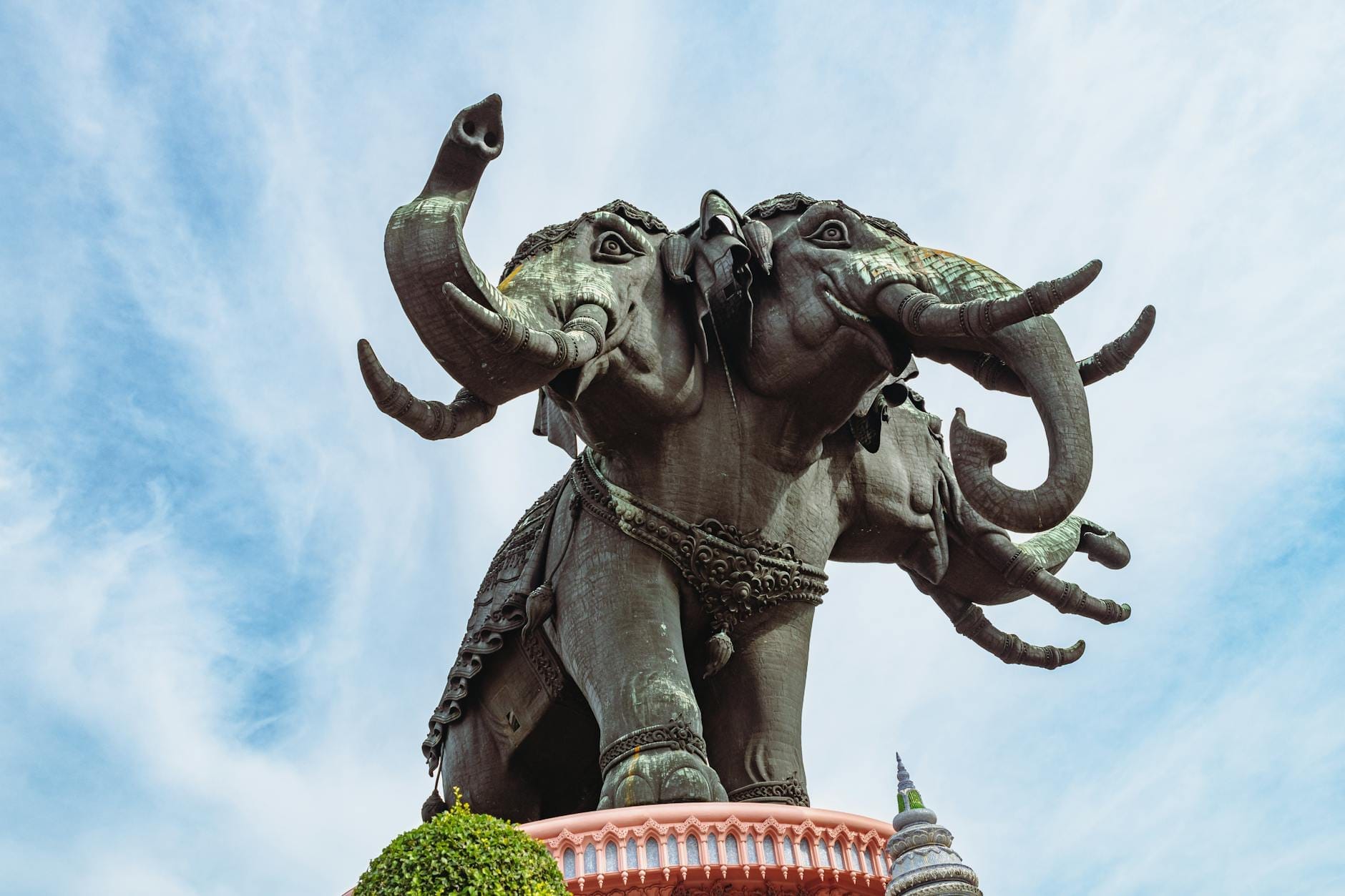
The Erawan Museum is not a temple in the conventional sense, though it functions with the spiritual weight of one. At its center stands a massive three-headed elephant cast in copper, rising roughly 29 meters from a landscaped garden outside Samut Prakan. The elephant, known in Hindu-Buddhist mythology as Erawan (the cosmic mount of the god Indra), carries a dome on its back. That dome is the museum. Beneath the elephant's legs, visitors descend into a lower level styled as the Underworld, then rise through the Earth and up into the Celestial dome, passing through three conceptual realms of Thai cosmology.
The complex was created by Lek Viriyaphant, the same collector and visionary behind the Ancient City (Muang Boran) project. Viriyaphant spent decades accumulating antique artifacts, sacred objects, ceramics, and religious art from across Southeast Asia, and the Erawan Museum was built as a permanent home for a significant portion of that collection. The result is equal parts private collection, monument, and philosophical statement about Thai identity and Buddhist cosmography.
ℹ️ Good to know
The museum is roughly 30 km south of central Bangkok. Factor in 45 to 60 minutes of travel time from the city center, even if you take the BTS Skytrain to Pu Chao and a taxi from there. Budget your day accordingly.
The Grounds and the Elephant: First Impressions
You see the elephant before you see anything else. It is visible from the road as you approach, its three copper heads facing outward at different angles, the surface weathered to a dark greenish brown that reads almost black against a bright sky. The scale only becomes clear once you're standing underneath it. The legs alone are the height of a two-story building, and the intricate surface detailing, scales, trunk textures, decorative armor, becomes legible only up close.
The garden surrounding the structure is manicured and relatively calm compared to Bangkok's central attractions. There are topiary animals, fountains, and ornamental plants arranged in a loose formal style. On weekday mornings, you may have the gardens almost to yourself. On weekend afternoons, school groups and Thai families fill the paths, and the atmosphere shifts accordingly. Photographers get the cleanest shots of the full elephant in morning light, when shadows fall away from the front-facing heads.
💡 Local tip
Arrive before 10 AM on a weekday if exterior photography is a priority. The copper catches warm morning light well, and tour groups typically arrive mid-morning onward.
Tickets & tours
Hand-picked options from our booking partner. Prices are indicative; availability and final rates are confirmed when you complete your booking.
Erawan National Park guided tour from Bangkok
From 159 €Instant confirmationFree cancellationPrivate tour in a luxury van, Erawan Fall, Floating and Railway Markets
From 884 €Instant confirmationFree cancellationErawan Waterfall, Floating and Railway Market private tour
From 389 €Instant confirmationFree cancellationTemples of Bangkok and Grand Palace half-day guided tour
From 18 €Instant confirmationFree cancellation
Inside the Dome: Three Levels, Three Realms
Entrance to the interior begins at the basement level, conceptually the Underworld. The space is cool and dimly lit, with a hushed atmosphere that encourages slow movement. Display cases hold antique Buddhist and Hindu artifacts: figurines, ritual objects, ceramics from different periods and regional traditions. The curation is dense rather than spare, and there is no English explanation sophisticated enough to contextualize every piece, so visitors without background knowledge may find the lower level interesting but opaque.
The middle level, representing Earth, is a circular hall with walls covered in Thai mural paintings and lacquered panels. Natural light begins to filter in here, and the scale of the interior dome becomes apparent. This is where most visitors slow down and look upward.
The upper level, inside the elephant's body, opens into the most spectacular space in the complex: a stained-glass dome painted with celestial imagery. The effect on a sunny day is striking. Light refracts through panels of colored glass, casting shifting color across the floor and walls. The dome was crafted by Belgian artisans and contains detailed illustrations of Buddhist and Hindu deities. Spend time here. It is the visual centerpiece of the entire museum, and it is genuinely unlike anything else in the Bangkok region.
Visitors interested in a broader context for this kind of religious art collection might also explore the Bangkok National Museum in the Rattanakosin area, which covers Thai artistic history in more academic depth. For another example of Lek Viriyaphant's grand vision, Ancient City Muang Boran is located in the same Samut Prakan area and can be combined into a single day trip.
Cultural and Historical Context
Erawan is the Thai rendering of Airavata, the white elephant of Hindu cosmology, described in ancient texts as a multi-headed celestial beast born from the churning of the cosmic ocean. In Thai tradition, the elephant is deeply embedded in royal iconography: white elephants were historically gifted to kings as symbols of power, and the three-headed form appears in royal crests and religious art across the country. Viriyaphant's choice of this symbol for his collection's home was deliberate, linking a private act of cultural preservation to a much older national mythology.
The museum opened to the public in 2003, though construction began in 1994 and Viriyaphant had been collecting for decades before that. He died in 2000, and the complex has been managed by the Muang Boran Foundation since. The collection itself spans Thai, Khmer, Chinese, and regional Southeast Asian traditions, reflecting a pan-regional vision of Buddhist and Hindu cultural exchange rather than a strictly Thai nationalist perspective.
If you are building a broader understanding of Bangkok's temple and religious landscape, a guide to the best temples in Bangkok provides useful context for how the Erawan Museum fits into the wider devotional geography of the city.
Practical Walkthrough: Getting There and Moving Through
The easiest public transit route from central Bangkok is the BTS Skytrain to Pu Chao station, followed by a quick taxi or motorcycle taxi heading south toward Samut Prakan or a 15mn walk. Rideshare apps (Grab is widely used) can take you directly from Pu Chao or from central Bangkok. Allow for traffic, especially if traveling after noon or returning late afternoon.
Dress modestly. This is a religious site in addition to a museum, and visitors in shorts or sleeveless shirts may be asked to cover up. A light sarong or overshirt in your bag is practical. The interior is air-conditioned, but the exterior garden is exposed. Bring water if you plan to spend time outside, particularly between April and October when heat is significant.
The museum is open daily; confirm current hours directly through the official website or by calling ahead, as they have varied seasonally. The ticket price for adults has been approximately 500 THB, with reduced rates for children and Thai nationals. Photography is generally permitted inside, though tripods and flash may be restricted in certain areas.
Honest Assessment: Who This Suits and Who Might Leave Unmoved
The Erawan Museum rewards visitors who are genuinely curious about Thai cosmology, Southeast Asian religious art, or the vision of a single extraordinary collector. The stained-glass dome alone justifies the trip for anyone interested in architectural spectacle. The gardens and exterior sculpture are photogenic and relatively peaceful compared to Bangkok's central temples.
However, visitors expecting the kind of dense interpretive signage found in Western museums will be frustrated. English labeling is inconsistent, and the curatorial logic of the collection is not always self-evident. If you have limited time in Bangkok and haven't yet seen core attractions like Wat Pho or Wat Arun, prioritize those first. The Erawan Museum requires a dedicated half-day including travel, which is a real cost against a short itinerary.
Travelers planning their time in Bangkok efficiently should also check the complete Bangkok itinerary guide to see how the Erawan Museum fits against other major attractions. Those who are temple-focused might pair it with a visit to Wat Pho on a separate day, given the travel distance involved.
Insider Tips
- Combine your visit with Ancient City (Muang Boran), which is also in Samut Prakan. Both attractions in one day is entirely manageable and makes the long journey from Bangkok worthwhile.
- The stained-glass dome on the upper level is at its most dramatic between 10 AM and 1 PM on sunny days, when direct light passes through the colored glass at the right angle. Overcast days mute the effect considerably.
- Buy water before entering the grounds. There is a small shop on site, but options are limited and priced for tourists. The walk around the exterior in midday heat is more demanding than it looks on maps.
- If you use Grab, set your pickup point carefully when leaving. The museum's main gate is on a busy road and motorcycle taxis sometimes wait outside, but metered cabs are rare. Having the Grab app ready saves a long wait.
- English-speaking guided tours are occasionally available through third-party operators and significantly improve the experience for visitors unfamiliar with Thai religious iconography. Check in advance rather than expecting on-site guides.
Who Is The Erawan Museum For?
- Art and antique collectors drawn to Southeast Asian religious objects
- Photographers looking for large-scale architectural subjects outside the central tourist circuit
- Families with older children curious about mythology and cultural history
- Travelers combining a day trip to Samut Prakan with Ancient City
- Anyone interested in how private patronage has shaped Thai cultural preservation
Nearby Attractions
Combine your visit with:
- Ancient City (Muang Boran)
Ancient City, known in Thai as Muang Boran, spreads across roughly 200 acres of landscaped grounds on the outskirts of Bangkok and contains over 100 reconstructed and scaled monuments representing every region of Thailand. It rewards patient visitors who want architectural history without temple fatigue.