Aegina Island: The Day Trip from Athens That Earns Its Journey
Aegina is the closest of the Saronic Islands to Athens, reachable by ferry or hydrofoil from Piraeus in under an hour. Once a rival city-state to Athens and briefly the capital of modern Greece, it offers a rare combination of serious ancient history, a working port town, and enough beaches to justify a full day away from the city.
Quick Facts
- Location
- Saronic Gulf, Region of Attica, Greece — approx. 27 km from Piraeus
- Getting There
- Ferry from Piraeus: ~1 hour (conventional) or ~40 min (hydrofoil). Reach Piraeus via Metro Line 1 from central Athens.
- Time Needed
- Full day (6–8 hours) to cover Aegina town, Temple of Aphaia, and a beach stop
- Cost
- No island entry fee. Ferry fares roughly €8–15 per person each way depending on vessel type (verify with operator). Site tickets extra.
- Best for
- History enthusiasts, families, anyone needing a break from Athens without a long journey
- Official website
- www.visitgreece.gr/islands/saronic-islands/aegina
Why Aegina Works as a Day Trip
Most islands off the coast of Greece require a flight or an overnight ferry. Aegina, sitting roughly 27 kilometers southwest of Athens in the Saronic Gulf, is different. The hydrofoil from Piraeus docks at Aegina town in about 40 minutes, which means you can have breakfast in Athens, spend a full day on the island, and be back in your hotel before dark without any of the logistical weight of a longer island trip.
That accessibility does come with a tradeoff: Aegina is well known to Athenians, and on summer weekends the morning ferries fill with day-trippers and weekenders. The island copes with this traffic better than you might expect, largely because it has genuine substance beyond a single beach or photo opportunity. There is a well-preserved ancient temple, a historic waterfront town, a scatter of Byzantine churches, and a pistachio trade that has shaped the island's economy for generations.
💡 Local tip
Travel on a weekday if your schedule allows. Weekend ferries from Piraeus fill fast in July and August, and the waterfront gets crowded by midday. A Tuesday or Wednesday visit gives you a noticeably quieter experience at both the harbor and the Temple of Aphaia.
If you are building a wider Athens itinerary, Aegina pairs naturally with time spent in Piraeus before or after the crossing. The port area around Mikrolimano harbor has its own character and is worth an hour before you board.
A Place With More History Than It Gets Credit For
Aegina tends to be described as a pleasant day trip, which is accurate but undersells what the island actually was. In classical antiquity, Aegina was a significant maritime power and commercial hub, credited by ancient authors with minting the first coins in Greece: tortoise-marked silver coins whose weight standard was adopted across much of the Greek world until the Roman period. The island was, for a stretch, Athens' most serious rival in the Aegean.
The rivalry ended badly for Aegina. After the Persian Wars, Athens expelled the island's population in 431 BCE, effectively breaking its power. The archaeological record, however, survived better than the political legacy. The island has been continuously inhabited since at least the Bronze Age, around 3000 BCE, and layers of that occupation are visible throughout: Neolithic traces, classical temples, Byzantine chapels, and a neoclassical waterfront built when the island briefly served as the capital of the newly independent Greek state.
That last chapter is easy to overlook. From 11 January 1827 to 3 October 1829, Aegina town functioned as the first capital of modern Greece under Governor Ioannis Kapodistrias. Several public buildings from that period still stand in the town, and the first coin of the modern Greek state was minted here. For a small island, that is a considerable amount of national history concentrated in one place.
Tickets & tours
Hand-picked options from our booking partner. Prices are indicative; availability and final rates are confirmed when you complete your booking.
3-Island day cruise experience Agistri, Moni, and Aegina
From 119 €Instant confirmationFree cancellationHydra, Poros and Aegina day cruise from Athens
From 148 €Instant confirmationFree cancellationAegina Island Day Tour from Athens by Bus and Boat
From 59 €Instant confirmationFree cancellationGuided tour of the Acropolis, Parthenon and Museum in Athens
From 50 €Instant confirmationFree cancellation
The Temple of Aphaia: The Island's Defining Sight
The Temple of Aphaia, located on a pine-forested hill about 12 kilometers from Aegina town, is the archaeological centerpiece of the island and one of the better-preserved Doric temples in Greece. Built around 500 BCE and dedicated to the local goddess Aphaia, it predates the Parthenon and shares enough visual DNA with it that the two temples, along with the Temple of Hephaestus in Athens, are sometimes grouped as the Holy Triangle of Doric architecture. Standing inside the precinct, with the Saronic Gulf visible below through the trees, makes the connection to the sea-faring power this island once was feel concrete rather than academic.
The temple's sculptural program is largely in Munich now, at the Glyptothek, taken there in the early 19th century. What remains on site are the limestone columns and a small but well-curated site museum. If you want to understand how the pediment sculptures originally looked, the Acropolis Museum in Athens provides useful comparative context for Archaic-period Greek sculpture before or after your trip.
Getting to the temple without a car means taking a local bus from Aegina town toward Agia Marina and getting off at the temple turnoff, a journey of roughly 20 to 30 minutes. Buses run with reasonable frequency during the tourist season, though service thins in the off-season. A taxi is a faster and more predictable option, and the round-trip cost from town is modest enough that splitting it among two or three people makes economic sense.
Morning light hits the columns from the east and makes photography straightforward. By early afternoon in summer, the exposed hilltop becomes genuinely hot, so bring water and a hat. The site has limited shade outside the tree line surrounding the precinct. Opening hours and ticket prices for the temple and its museum are set by the Greek Ministry of Culture and change seasonally; verify current information before you travel.
Aegina Town: The Waterfront and What's Behind It
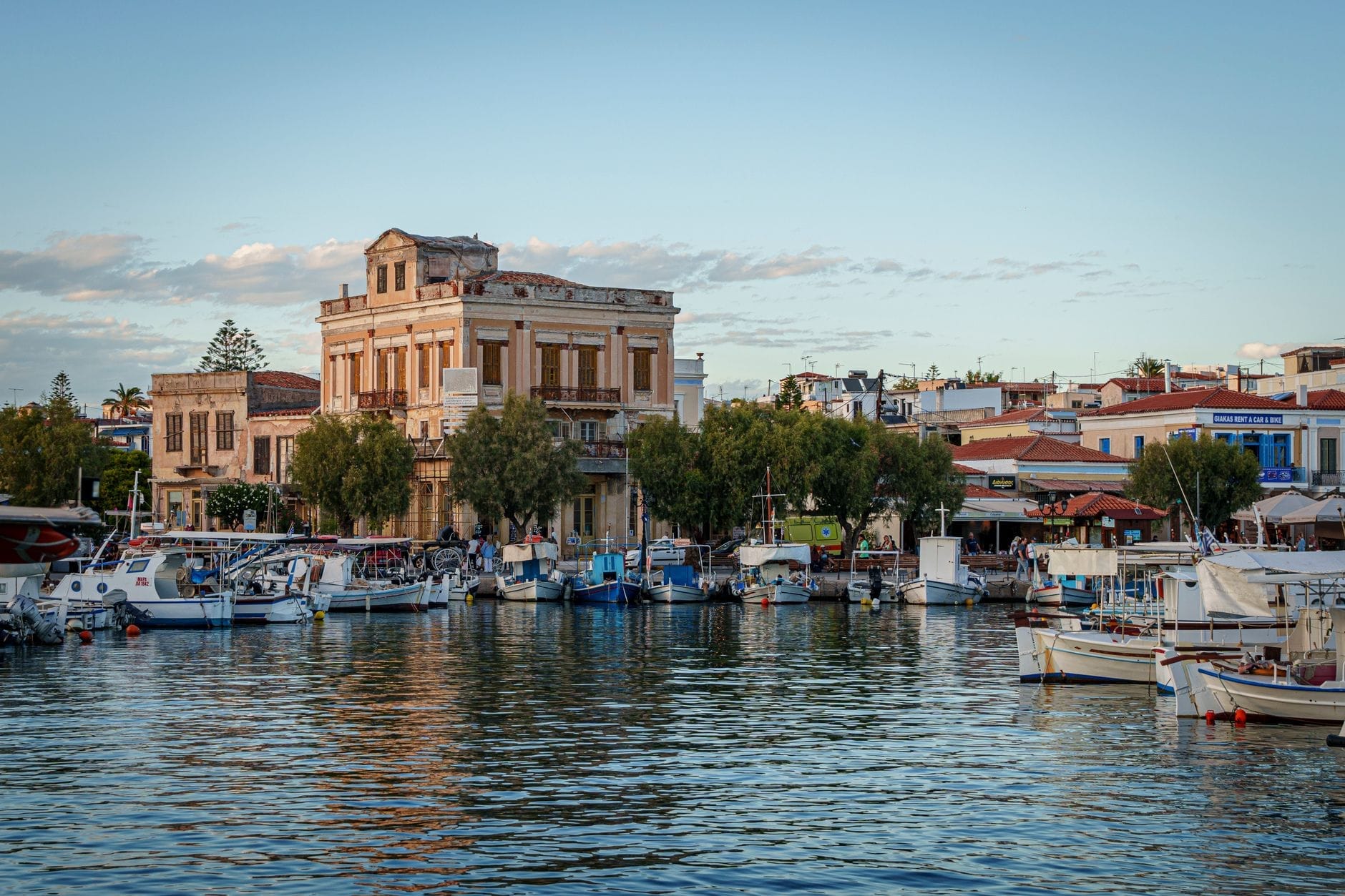
The ferry deposits you at the main harbor of Aegina town, a working port with fishing boats moored alongside the passenger terminals and a long promenade lined with cafes, tavernas, and stalls selling the island's signature pistachios. The first impression is of modest, unpretentious Greek island life rather than anything designed for tourism, which is part of its appeal.
Walk away from the water and the town opens into a grid of streets with neoclassical facades, a covered market building, small churches, and the occasional archaeological sign pointing to finds beneath the pavement. The single column standing near the harbor is all that remains of the ancient Temple of Apollo, once part of a larger sanctuary that faced the sea. It stands in a fenced enclosure a short walk from the ferry dock and is worth five minutes even if you are not an archaeology enthusiast.
The pistachio presence is impossible to miss. Vendors sell them roasted, salted, sugared, and ground into paste throughout the harbor area. Aegina pistachios have Protected Designation of Origin status in the EU, distinguishing them from imported nuts sold under the same name elsewhere in Greek markets. If you buy any, compare a few vendors before committing to a large bag, as quality and freshness vary.
ℹ️ Good to know
The harbor fills with day-trippers between roughly 10:30am and 2pm. If you take an early hydrofoil (departures from Piraeus begin before 7am), you will have the town largely to yourself for the first couple of hours. The afternoon light on the waterfront from around 4pm onward is also excellent for photography.
Beaches, Villages, and Moving Around the Island
Aegina's coastline is varied. Agia Marina, on the eastern side of the island, is the most developed beach resort, with sun beds, water sports rentals, and several hotels. It is convenient if you visit the Temple of Aphaia, since the bus route connects the two, but it gets busy. Marathonas, a smaller beach closer to Aegina town, is quieter and easier to reach on foot or by bicycle. The western coast around Perdika, a fishing village about 9 kilometers south of the main town, has a laid-back character and clear water, and the village itself has good fish tavernas that attract Athenian regulars.
Renting a bicycle or moped from one of the shops near the harbor is the most flexible way to explore the island at your own pace. The terrain is mostly manageable, though the road to the Temple of Aphaia involves a real climb. Horse-drawn carriages operate near the harbor and are a legitimate, if slower, way to see the immediate area around town, particularly for travelers with young children.
Practical Information: Getting There and Planning Your Day
All ferry and hydrofoil services depart from the Great Harbor (Megalo Limani) in Piraeus. The easiest way to reach Piraeus from central Athens is Metro Line 1, which runs from Kifissia through Monastiraki and Omonia to Piraeus station at the southern terminus. The journey from Monastiraki takes roughly 20 minutes. From the metro station, the ferry terminals are a short walk. Operators including Hellenic Seaways and others run regular services throughout the day; schedules and exact fares must be checked directly with the operators or at the ticket offices in Piraeus, as they change seasonally.
For those planning a broader Attica coast day, note that the Temple of Poseidon at Cape Sounion is another popular half-day excursion from Athens that provides a different kind of ancient coastal experience, reached by bus from Pedion Areos rather than by ferry.
What to pack: sunscreen and a hat matter more than you expect, especially if you plan to visit the Temple of Aphaia. The hilltop is exposed, and the summer sun on whitewashed and limestone surfaces is intense. Comfortable walking shoes are sufficient; there is no serious hiking involved unless you choose to explore off the main paths. Bring cash, as smaller tavernas and market stalls may not accept cards.
For timing within the broader Athens trip context, consult the day trips from Athens guide for how Aegina compares to other half-day and full-day options from the city.
⚠️ What to skip
In July and August, return ferries from Aegina in the late afternoon can be heavily booked. Buy your return ticket when you arrive on the island, or book both legs in advance online, to avoid being stranded for an extra sailing.
Who Should Reconsider This Trip
Aegina is a genuinely good day trip, but it is not the right choice for every visitor. Travelers with only one or two days in Athens should prioritize the Acropolis, the Ancient Agora, and the Acropolis Museum before considering any island excursion. The ferry journey, even at 40 minutes each way, eats into a short Athens itinerary, and there are enough ancient sites and neighborhoods in the city itself to fill two or three days without leaving the mainland.
Those who came to Greece specifically for beach culture may find Aegina's beaches modest compared to the Cyclades or the Athenian Riviera. The Athenian Riviera offers good swimming within easy reach of the city and requires no ferry at all, making it a better choice if the goal is purely a beach afternoon.
Visitors with limited mobility should check ferry accessibility with the specific operator before booking. The island's terrain is generally flat in town and on the main roads, but the Temple of Aphaia site involves uneven ground and some steps that are not easily managed with a wheelchair.
Insider Tips
- Take the first or second morning hydrofoil from Piraeus and head straight to the Temple of Aphaia before 10am. The site is at its quietest, the light is clean, and the pine trees around the precinct smell particularly sharp in the morning cool.
- Perdika village, at the island's southern tip, is where many Athenians who know Aegina well go to eat. The fish tavernas there are more relaxed and generally better value than the restaurants on the main Aegina town waterfront facing the ferry dock.
- If you want to try Aegina pistachios at their best, look for vendors selling from large open sacks of freshly roasted nuts rather than pre-packaged bags. The difference in flavor is considerable.
- The single standing column of the Temple of Apollo near the harbor is easy to miss because it is not well signposted from the main waterfront promenade. Walk one block inland from the harbor and look for the low iron fence enclosing it.
- Book the return ferry leg as soon as you arrive on the island, especially on weekends in summer. Afternoon return sailings sell out, and the next available boat can be two or three hours later than you planned.
Who Is Aegina For?
- Athens visitors with three or more days who want an easy island experience without an overnight stay
- History enthusiasts interested in Archaic Greek architecture and the story of the early modern Greek state
- Families looking for a structured day out combining a boat ride, ancient site, and beach
- Travelers who want to experience a working Greek island town rather than a resort environment
- Anyone willing to wake up early to beat the day-tripper crowds and get the most out of the island
Nearby Attractions
Other things to see while in Piraeus:
- Hydra
Hydra is a car-free island in the Saronic Gulf, roughly 1.5 hours by ferry from Piraeus. With no motor vehicles, stone-paved waterfront lanes, and 18th-century sea captains' mansions, it offers a genuinely different pace from the mainland. This guide covers what to expect, when to go, and how to make the most of a day trip or overnight stay.