Hydra Island: Athens' Car-Free Escape in the Saronic Gulf
Hydra is a car-free island in the Saronic Gulf, roughly 1.5 hours by ferry from Piraeus. With no motor vehicles, stone-paved waterfront lanes, and 18th-century sea captains' mansions, it offers a genuinely different pace from the mainland. This guide covers what to expect, when to go, and how to make the most of a day trip or overnight stay.
Quick Facts
- Location
- Saronic Gulf, Attica region, Greece — accessible from Piraeus port
- Getting There
- High-speed ferry from Piraeus; journey time typically 1 hour 10 minutes to around 2 hours depending on operator and stops
- Time Needed
- Minimum half-day; full day recommended; overnight possible
- Cost
- No admission fee to enter the island; ferry tickets and individual site fees apply separately
- Best for
- Slow travel, architecture enthusiasts, day-trippers from Athens, couples, photographers
- Official website
- www.visitgreece.gr/islands/saronic-islands/hydra
What Makes Hydra Different from Every Other Greek Island
Hydra, or Ύδρα in Greek, is one of the Saronic Gulf islands off the eastern tip of the Argolis peninsula, covering an area of about 50 square kilometres with a maximum length of about 20 kilometres. It is a municipality in the Attica region and sits close enough to the mainland to function as a day trip from Athens, yet feels genuinely removed from city life the moment you step off the ferry.
The defining fact about Hydra is not its architecture or history, though both are remarkable. It is the absence of motor vehicles. No cars, no scooters, no motorbikes. Transport on the island is by foot, by donkey, or by water taxi along the coast. This is not a gimmick or a seasonal restriction — it is a permanent legal condition that has shaped how the island feels and how it has aged. The cobblestones are intact because no tyres have worn them. The air has no exhaust. The loudest sounds are usually the clink of rigging and the occasional bell from a donkey's harness.
ℹ️ Good to know
There is no general admission fee to enter Hydra. You pay for your ferry ticket and, if you choose, for specific museums or sites. The island itself is open to anyone who steps off the boat.
Hydra is often paired with other Saronic islands — particularly Aegina and Poros — on organised boat tours departing from Piraeus. If you are planning your time from Athens, the day trips from Athens guide covers how to structure these routes and what to prioritise depending on your interests.
Arriving at the Port: First Impressions
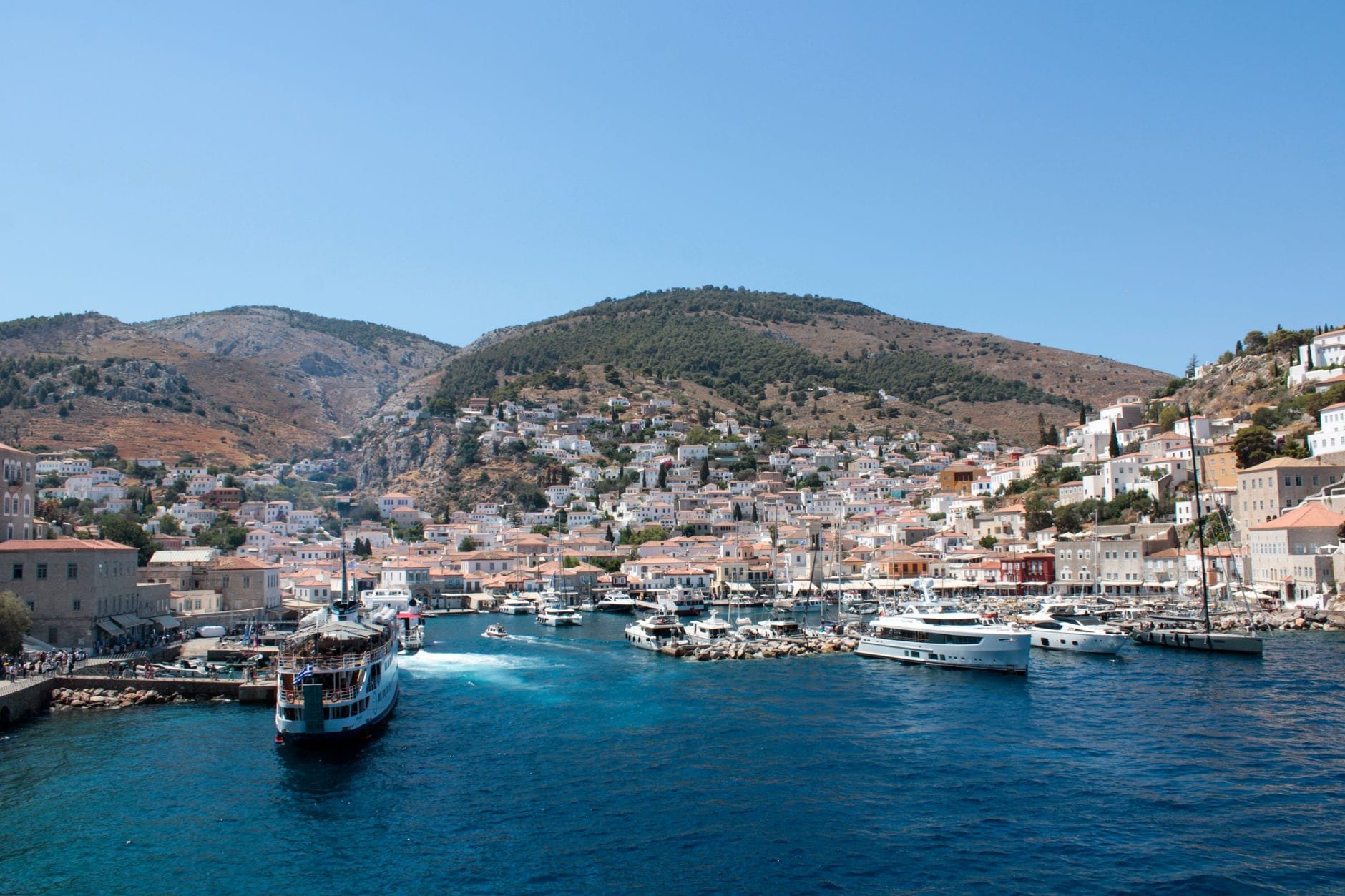
The ferry approaches Hydra from the open water and the town appears suddenly: a horseshoe harbour framed by grey-stone mansions stacked up the hillside, their windows and doorways trimmed in white. There are no cranes, no industrial structures, no advertising hoardings visible from the water. The waterfront is lined with café tables, caïques, and the occasional water taxi idling at the dock. It looks composed, almost theatrical, which is precisely why artists and writers have been drawn here since the 1950s and 1960s.
The main port, simply called the Port of Hydra, is where nearly all activity concentrates. The quayside fills with people in the late morning as the first wave of day-trippers arrives, and the cafés along the waterfront are loud with conversation and the scraping of chairs on stone. By early afternoon, if you have arrived on a busy summer day, the port area is dense with visitors. This is the moment to move.
💡 Local tip
The waterfront cafés are the most expensive dining option on the island and the most crowded. Walk a single street back from the harbour and prices drop noticeably, crowds thin, and the food is often better.
Tickets & tours
Hand-picked options from our booking partner. Prices are indicative; availability and final rates are confirmed when you complete your booking.
Hydra, Poros and Aegina day cruise from Athens
From 148 €Instant confirmationFree cancellationGuided tour of the Acropolis, Parthenon and Museum in Athens
From 50 €Instant confirmationFree cancellationAthens: Temple of Olympian Zeus E-ticket with audio tour on your phone
From 10 €Instant confirmationAthens full-day tour with Acropolis and Cape Sounion
From 92 €Instant confirmationFree cancellation
The Architecture: Stone Mansions and the Ghost of Naval Power
Hydra's wealth did not come from tourism. It came from the sea. During the 18th and early 19th centuries, Hydra produced some of Greece's most influential shipping families, whose fortunes built the grand archontika — the stone mansion houses — that still define the town's skyline. These were not decorative structures. They were statements of economic and political power, built with Venetian and Genoese architectural influences and positioned on the hillside for visibility from the sea.
The island's role in the Greek War of Independence (which began in 1821) amplified this significance further. Hydra contributed ships, money, and commanders to the revolutionary cause, and some of the mansions associated with the era's naval captains are now museums open to visitors. The Lazaros Kountouriotis Historical Mansion is among the most significant, offering an interior view of how these families lived and what they collected.
Walking through the upper lanes of the town, away from the port, the scale of the buildings becomes more apparent. The stone is local, grey-brown and rough-textured, and the walls are thick enough that the interior courtyards, glimpsed through open gates, feel several degrees cooler than the street outside. Many of the mansions remain private residences. There is no formal walking route or audio guide for the architecture — you navigate by instinct and curiosity, which suits the island's pace.
Moving Around: Donkeys, Water Taxis, and Your Own Feet
Walking is the primary way to experience Hydra. The town's lanes are stone-paved and in good condition, but they are steep in places. If you move beyond the immediate port area toward the upper neighbourhoods or the monasteries on the hillside above town, you will be climbing for stretches. Comfortable shoes with grip are not optional — sandals work for the flat waterfront, but the upper paths require more support.
Donkeys are the working transport of the island, used to carry luggage, building materials, and supplies to properties unreachable by any other means. They are not tourist novelties. You will encounter them on narrow lanes, usually led by their owners, and the standard etiquette is to press yourself to the wall and let them pass. They have right of way.
Water taxis operate from the port and can take you around the coastline to beaches and coves that are not accessible on foot. This is the practical way to reach swimming spots like Vlychos or Kamini if you are not prepared for a long hike. Negotiate the fare before boarding.
💡 Local tip
If you want to swim without walking 45 minutes, take a water taxi to one of the coastal coves. The beaches closest to the port are the most crowded; the further you go, the quieter it gets.
When to Go: How the Island Changes by Hour and Season
Hydra is accessible year-round, but it behaves very differently depending on when you arrive. Spring (April to early June) and autumn (September to October) offer the most balanced conditions: temperatures in the range of 18–25°C, ferry services running reliably, and far fewer day-trippers competing for waterfront space. These months align with what the best time to visit Athens guide identifies as the most comfortable periods for travel in the Attica region generally.
In July and August, the island is at its most crowded. The ferry from Piraeus can arrive with hundreds of passengers at once, the waterfront is packed by noon, and the quieter corners of town become harder to find. The heat is also significant — the stone lanes radiate warmth, there is limited shade away from café awnings, and the uphill walks become demanding. If you visit in summer, take the earliest available ferry and aim to be on island before 10:00.
Late afternoon is genuinely worth experiencing if you can arrange your return trip accordingly. By 16:00 or 17:00, many day-trippers have departed or are gathering at the port for the return journey. The light at that hour is low and warm, falling at an angle across the stone facades and the harbour water. The cafés still have seats available, the lanes are walkable without jostling, and the island shows something closer to what it looks like for the people who live here year-round.
⚠️ What to skip
In peak summer, ferries on the return journey to Piraeus can sell out or become very crowded in the early evening. Book your return ticket in advance or confirm availability before you leave Piraeus.
Getting There from Athens and Piraeus
All ferries to Hydra depart from the port of Piraeus. To reach Piraeus from central Athens, the most straightforward public transport option is Metro Line 1 (the green line, formerly ISAP), which runs directly from central stations including Monastiraki and Omonia to Piraeus terminal station. Journey time from central Athens is approximately 25–30 minutes, depending on waiting and transfer times. The guide to getting around Athens covers the metro network and ticketing in detail.
From Piraeus, high-speed hydrofoil and catamaran services operate to Hydra, with journey times typically between about 1 hour 10 minutes and just over 2 hours depending on operator and intermediate stops. Schedules and fares vary by season and operator — verify current timetables with Hellenic Seaways or other licensed operators before travel, as services are time-sensitive and subject to change.
Some organised tour operators run combined day-trip boats from central Athens and from the port itself, often including stops at multiple Saronic islands. These are convenient if you want logistics handled, but they compress your time on each island and route you through the most tourist-heavy arrival windows. Independent ferry travel gives you more flexibility.
Practical Details: What to Bring and What to Expect
Pack light. You will be walking on stone surfaces for most of your visit, and there are no vehicles to assist with heavy luggage unless you have pre-arranged donkey transport to your accommodation. If you are staying overnight, contact your accommodation in advance about luggage handling — most guesthouses have systems in place.
Sunscreen and water are essential, particularly in the warmer months. The island has shops and pharmacies, but they are small and stock can be limited. The waterfront restaurants and cafés accept cards, but smaller shops and water taxi operators may prefer cash. There are ATMs on the island, but not in large numbers.
Photography is unrestricted in public spaces. The light in the late afternoon and early morning is significantly better than at midday, when the Mediterranean sun flattens shadows and creates harsh contrasts on the pale stone. The view back toward the harbour from the upper town lanes gives the most comprehensive perspective on the architectural layout of the settlement.
ℹ️ Good to know
Hydra is not wheelchair accessible in the conventional sense. The stone lanes are uneven, many paths are stepped, and there are no ramps. Visitors with significant mobility limitations will find the port area and immediate waterfront manageable, but movement beyond that zone is difficult.
If you are building a broader Athens itinerary that includes island time, it helps to think about Hydra alongside what the mainland city offers. The contrast between a morning at the Ancient Agora and an afternoon on the car-free lanes of Hydra is genuinely striking, and the ferry from Piraeus makes it achievable in a single day.
Insider Tips
- Take the first or second ferry of the day from Piraeus to arrive before the main crowd. The harbour at 09:00 is a different place from the harbour at 12:00 — quieter, cooler, and the bakers and coffee shops are still fresh.
- The monasteries above the town are a 20–30 minute uphill walk from the port but most visitors never make the climb. The views over the harbour from that elevation are worth the effort and the lanes up are largely empty.
- If you are staying overnight, the island changes character completely after 19:00. The day-trippers are gone, the restaurants fill with a mix of residents and guests, and the waterfront has a genuinely unhurried quality that the midday crowds make impossible to access.
- Water taxi fares are not fixed — ask what the rate is before you board and confirm whether it is per person or for the boat. For groups of three or more going to the same spot, it is often cheaper than it sounds.
- Several of the upper-town lanes dead-end or loop back unexpectedly. This is not a problem — it is part of how the place works. Resist the urge to navigate by map and you will stumble into courtyards and stairwells that no route planner would send you through.
Who Is Hydra For?
- Day-trippers from Athens wanting a genuine change of pace without a long journey
- Architecture and history enthusiasts interested in 18th and 19th-century Greek naval heritage
- Photographers looking for unhurried stone-and-sea compositions away from heavily touristed sites
- Couples and slow travellers willing to stay overnight and experience the island after the day crowds leave
- Anyone who finds Athens overwhelming in summer and needs a half-day reset
Nearby Attractions
Other things to see while in Piraeus:
- Aegina
Aegina is the closest of the Saronic Islands to Athens, reachable by ferry or hydrofoil from Piraeus in under an hour. Once a rival city-state to Athens and briefly the capital of modern Greece, it offers a rare combination of serious ancient history, a working port town, and enough beaches to justify a full day away from the city.