Acuario Michin Guadalajara: What to Expect Before You Go
Acuario Michin Guadalajara is the city's main aquarium, home to nearly 10,000 live organisms across multiple themed exhibits. Located near Parque Alcalde in central Guadalajara (Mezquitán / Zona Centro), it opened in 2017 after a construction investment of close to 300 million Mexican pesos and draws a wide range of visitors, from families with young children to marine-life enthusiasts.
Quick Facts
- Location
- Av. Mariano de la Bárcena #990, Zona Centro, Guadalajara, Jalisco, México. Near Parque Alcalde.
- Getting There
- Metro Line 1, Mezquitán station. Buses 27, 27A, 50, 50A, 110, 110A, 231, 275F, 275B, and 633 also serve the area.
- Time Needed
- 2 to 3 hours for a comfortable visit; add 30–45 minutes if participating in Retos Marinos or Total Access add-ons.
- Cost
- Ticket prices vary; add-on supplements include a MXN 95 Total Access upgrade and MXN 30 Retos Marinos add-on. Confirm current base ticket price at the official website or ticket counter.
- Best for
- Families with children, first-time visitors to Guadalajara, rainy-day activities.
- Official website
- gdl-en.acuariomichin.com
What Acuario Michin Actually Is
Acuario Michin Guadalajara opened in March 2017 after construction that began in 2015, representing an investment of nearly 300 million Mexican pesos. It is one of the largest aquariums in western Mexico and sits on Avenida Mariano de la Bárcena, just east of Parque Alcalde, in a purpose-built structure that blends curved glass and steel in a way that signals the scale inside before you even buy a ticket.
The aquarium houses nearly 10,000 live organisms across its exhibits. That number covers a wide spectrum: sharks and rays gliding through the central oceanarium, freshwater species from Mexican rivers, jellyfish pulsing in dedicated cylindrical tanks, and interactive touch pools where children can handle sea stars and small rays under staff supervision. The programming is designed to run year-round. The aquarium itself closes at 19:00, seven days a week.
ℹ️ Good to know
Ticket prices are not displayed as a fixed table on the official site. Check current rates at gdl-en.acuariomichin.com or confirm at the ticket counter on arrival. Add-on options include a Total Access upgrade (MXN 95 supplement) and Retos Marinos challenge experiences (MXN 30 supplement).
The Experience: Moving Through the Exhibits
The visit flows in a roughly linear sequence, beginning with shallower freshwater and regional habitats before progressing toward the deep-ocean sections. The transition between biomes is handled with gradual lighting changes, so you move from bright, well-lit river tanks to the darker, more atmospheric blue of the open-ocean galleries without an abrupt shift. This pacing works well for younger visitors who need time to absorb each environment.
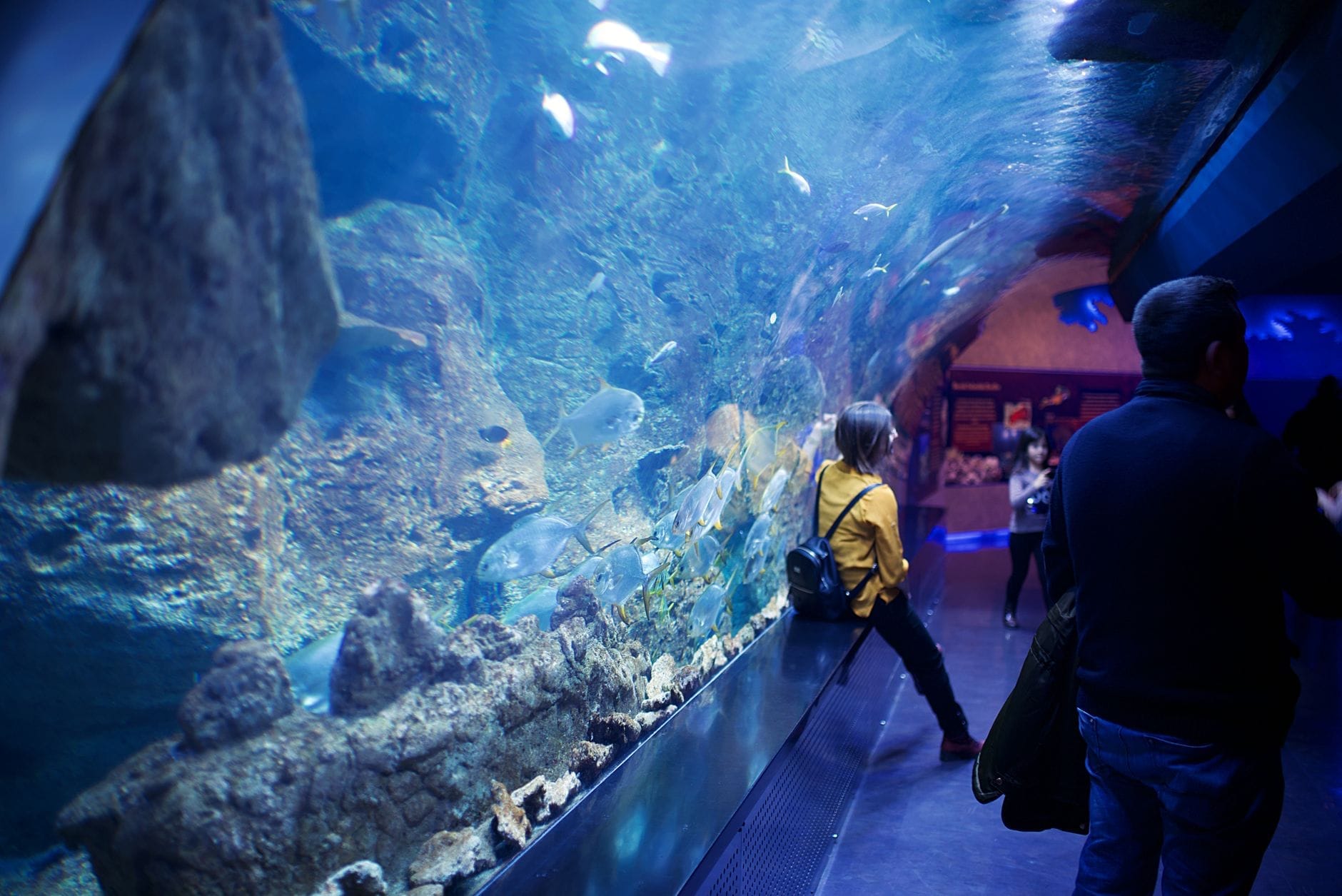
The central highlight is the large oceanarium: a floor-to-ceiling tunnel where sharks, rays, and large schooling fish pass directly overhead and on both sides. Visitors often slow to a near-stop here. The glass distortion is minimal, and the tank is deep enough that the lighting above creates visible depth rather than a flat wall of water. Spending five or ten minutes here without moving is common, and the design accommodates this, with the walkway wide enough that lingering doesn't create a bottleneck.
The jellyfish section is a quieter, more meditative space. The cylindrical tanks are backlit in shifting colors, and the ambient sound shifts from the general crowd noise of the main corridors to something noticeably calmer. This area tends to hold older visitors and photographers longer than almost any other section. Bring a phone or camera with a good low-light mode because the exposure windows are tricky: bright backlighting against the dark surround requires some adjustment.
Tickets & tours
Hand-picked options from our booking partner. Prices are indicative; availability and final rates are confirmed when you complete your booking.
Lake Chapala and Ajijic guided tour from Guadalajara
From 68 €Instant confirmationFree cancellationGuadalajara and Tlaquepaque guided tour
From 73 €Instant confirmationFree cancellation
Time of Day and Crowd Patterns
Weekday mornings are often the least crowded windows. By early afternoon on Saturdays and Sundays, especially during school holidays, the main corridors can fill noticeably. The touch pools and interactive areas see the heaviest concentration of people during weekend afternoons, when children's activity peaks and staff supervision becomes stretched.
Arriving at opening on a Tuesday or Wednesday gives the best combination of calm atmosphere and full staffing. Late afternoon on weekdays (around 16:00 to 17:30) is also workable, but account for the closing time if you arrive close to that time. Families with very young children tend to arrive earlier in the day, so if the touch pools or interactive exhibits are a priority, a 14:00 to 15:00 arrival on a weekday can find those areas at lower capacity.
💡 Local tip
The rainy season runs from June through September in Guadalajara. Acuario Michin is one of the best indoor options on heavy rain days, which means it draws significantly larger crowds during those months, especially on weekends. If your visit falls in that period, weekday mornings are strongly preferable.
Getting There from Different Parts of Guadalajara
Metro Line 1 is the most straightforward option. Mezquitán station is the closest metro stop, placing the aquarium within a short walk. Line 1 connects central Guadalajara to northern and southern areas, meaning visitors staying near the historic core can reach the aquarium without a transfer. The metro system, operated by SITEUR (Sistema de Tren Eléctrico Urbano), is reliable during standard hours and significantly faster than surface-level buses during peak traffic.
Bus routes 27, 27A, 50, 50A, 110, 110A, 231, 275F, 275B, and 633 also serve the area. For those staying in neighborhoods farther west, such as Colonia Americana or near Glorieta Minerva, ride-hailing apps including Uber and DiDi are a practical option. Journey times from the historic center by ride-hail are typically under 15 minutes outside of peak traffic hours. For a broader look at getting around the city, the guide to getting around Guadalajara covers transit options in detail.
Accessibility, Facilities, and Practical Notes
The aquarium is designed to be accessible for visitors with mobility limitations. Wheelchairs are available free of charge, subject to availability, and can be requested at the parcel area near the main entrance. An elevator connects the different levels, meaning the full exhibit route does not require stair use. Service dogs are permitted; personal pets are not.
The facility includes a food service area, a gift shop, and a parcel storage area at the entrance. Large bags and backpacks are typically checked in at the parcel area before entering the exhibits. Strollers are permitted inside the aquarium.
Photography is permitted throughout the general exhibit areas. Flash photography near the jellyfish and shark tunnel sections should be avoided: aside from disturbing other visitors trying to photograph through low-light glass, flash tends to reflect off the tank surface and produces worse results than a slow shutter or night mode on a smartphone. A small tripod or stabilizer attachment is useful in the darker sections if you have one and the space to use it.
How It Fits Into a Wider Guadalajara Itinerary
Acuario Michin sits in the Mezquitán / Zona Centro area of central Guadalajara, just east of Parque Alcalde. It is close enough to the historic center to combine with a visit to the city's downtown landmarks on the same day, though the two-to-three-hour aquarium experience plus travel makes a full afternoon commitment realistic.
The Guadalajara Zoo is located in the same general northern corridor, making the two attractions a logical pairing for families with children who have the stamina for a full day. The zoo is significantly larger in scale and requires more time, so sequencing matters: Acuario Michin in the morning, zoo in the afternoon, works better than the reverse for most children's energy levels.
For visitors planning more broadly, Guadalajara offers a range of indoor cultural venues that can anchor a day's itinerary. The Trompo Mágico interactive museum is another family-focused indoor option and is worth considering alongside Acuario Michin when building a kid-centered day. Those putting together a longer trip can consult the guide to Guadalajara with kids for a more complete picture.
Who Should Manage Expectations
Acuario Michin is a well-executed urban aquarium, but it is not on the scale of facilities like the Monterey Bay Aquarium or larger international equivalents. Visitors with prior experience at major world-class aquariums may find the exhibit range competent but not exceptional. The species diversity is strong within its size category, but the overall footprint is compact.
Adults traveling without children and looking for a deeply immersive marine-science experience may find the aquarium satisfying for an hour but not a full afternoon. The interactive add-ons (Retos Marinos) are geared toward younger visitors. Serious underwater photographers will also find the tank sizes limiting compared to purpose-built dive or photography-oriented aquariums.
None of this diminishes what the aquarium is good at: it is a genuinely well-designed family attraction with strong accessibility, consistent staffing, and a central enough location that it integrates well into most Guadalajara itineraries. As a rainy-day option or a half-day activity for families, it delivers reliably.
Insider Tips
- The ticket counter closes at 18:00 but the aquarium stays open until 19:00. Arriving at 17:30 gives you entry time but may feel rushed for the full circuit. Budget at least 90 minutes after entry for a comfortable visit.
- The jellyfish section is the best spot for photography but is also the most sensitive to crowd noise. Visiting it early in your walk-through (before the afternoon rush fills the space) makes for a much calmer experience and better shots.
- The Total Access supplement (MXN 95) unlocks additional areas. Ask at the ticket counter exactly what it includes on the day you visit, as the specific access it grants can vary.
- Mezquitán metro station on Line 1 is a convenient way to reach the aquarium from downtown. If you are using a ride-hailing app, specify 'Acuario Michin' rather than the street address to avoid drop-off confusion near the Parque Alcalde perimeter.
- Weekday mornings after 11:00 and before 13:00 offer the most uncrowded experience. If you are visiting during school holiday periods (July, August, December), arrive as close to opening as possible regardless of the day of the week.
Who Is Acuario Michin Guadalajara For?
- Families with children aged 4 to 14 who respond well to interactive exhibits and hands-on touch pools
- Visitors seeking a reliable indoor activity during Guadalajara's June to September rainy season
- First-time visitors to Guadalajara looking for a half-day, fully accessible indoor attraction
- Travelers combining the aquarium with a visit to the nearby Guadalajara Zoo for a full family-oriented day
- Visitors with mobility limitations who need a fully accessible, elevator-equipped attraction with wheelchair availability
Nearby Attractions
Other things to see while in Huentitán & Barranca de Oblatos:
- Barranca de Huentitán (Barranca de Oblatos)
Barranca de Huentitán (officially Barranca de Oblatos) is a protected 1,136-hectare canyon on Guadalajara's northeastern edge, carved by the Río Grande de Santiago to a depth of roughly 500–600 meters at its deepest points. Access is free, the hiking is demanding, and the scale of the landscape is unlike anything else within the city limits.
- Parque Mirador Independencia
Perched at the northern terminus of Calzada Independencia Norte, Parque Mirador Independencia sits at the dramatic rim of the Barranca de Huentitán. The park offers open-air viewpoints, shaded walking paths, and a genuine sense of escape from the city grid, all for free.
- Zoológico Guadalajara
Opened in March 1988 and spread across 50 developed hectares above the Barranca de Huentitán, Zoológico Guadalajara is one of Latin America's larger urban zoos. With 392 species, a roughly 70-meter elevation drop through the grounds, and a 280-hectare ecological reserve next door, it rewards more than a quick afternoon visit.