Victor Harbor & Granite Island: The Coastal Day Trip Worth Every Kilometre
Perched on the Fleurieu Peninsula about 85 kilometres south of Adelaide, Victor Harbor pairs a relaxed seaside town with Granite Island Recreation Park, an ancient granite outcrop reached by a 650-metre causeway and one of Australia's last horse-drawn trams. It is the kind of place that rewards a full day rather than a rushed afternoon.
Quick Facts
- Location
- Victor Harbor, Fleurieu Peninsula, SA — approx. 85 km south of Adelaide CBD
- Getting There
- Drive via South Road and the Victor Harbor Road (about 1 hr 15 min); no direct train service — coach options run from Adelaide, verify current schedules before travel
- Time Needed
- Half day minimum; full day recommended to include the island walk, town, and penguin viewing at dusk
- Cost
- Park entry free. Park entry free. Check the official horse-drawn tram website for current fares before visiting.
- Best for
- Families, nature lovers, wildlife watchers, couples on a beach drive
- Official website
- www.parks.sa.gov.au/parks/granite-island-recreation-park
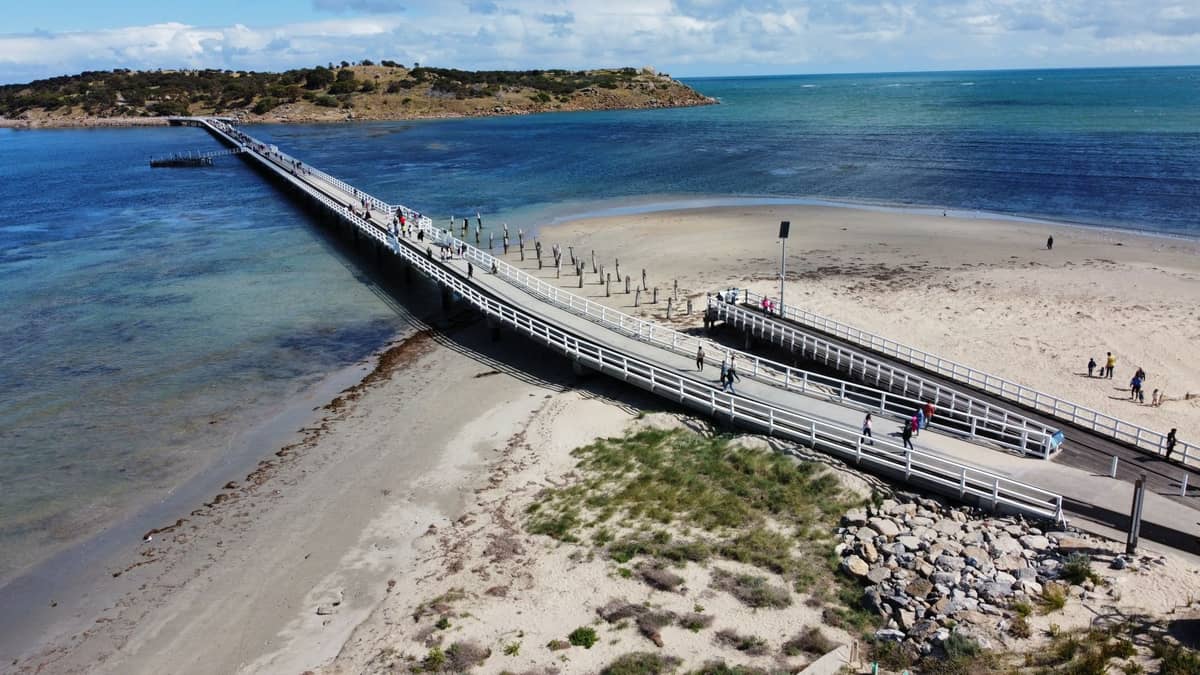
What Granite Island Actually Is
Granite Island Recreation Park — known to the Ngarrindjeri people as Nulcoowarra — is a rugged dome of ancient granite rising from Encounter Bay, connected to the mainland by a 630-metre timber and concrete causeway. The surrounding town of Victor Harbor is the Fleurieu Peninsula's main coastal centre: a strip of esplanade cafes, heritage buildings, and surf shops that slows down considerably once you leave the main street. Together, they form one of South Australia's most consistently popular day trips from Adelaide, and for once the reputation is largely deserved.
What makes the combination work is variety. You can spend an hour simply walking the causeway in the sea breeze, or invest a full day: the horse-drawn tram crossing, the island circuit walk, a rockpool scramble, lunch in town, and a return at dusk for little penguin sightings. The geology alone is striking — the rounded pink and grey granite boulders were formed around 500 million years ago, and the island's surface is scored with lichen, tidal pools, and wind-carved hollows.
ℹ️ Good to know
The horse-drawn tram departs from 1 Esplanade, Victor Harbor. Departure times vary; check horsedrawntram.com.au for current operating times before you go.
The Horse-Drawn Tram: Icon or Tourist Trap?
The short answer: it is genuinely worth it, at least one way. The Victor Harbor horse-drawn tram is one of two remaining in the world that operate a daily service. The causeway was built between 1862 and 1875, and the tramway commenced operation in 1894. The current operation is well maintained and unhurried, with Clydesdale horses walking a steady pace across the wooden causeway while the bay opens up on both sides.
If you are travelling with children, take the tram both ways: the experience is the point, and the novelty holds for the full crossing. If you are travelling as a couple or solo, consider taking it to the island and walking back along the causeway on your return — the views back toward the Victor Harbor foreshore and the inland hills are best appreciated at walking pace. Check the official horse-drawn tram website for current return and one-way fares.
💡 Local tip
Photography tip: The best tram shots are from the causeway itself, looking back toward the mainland with the hills behind. Position yourself about 100 metres from the tram platform before departure for a clear line of sight with the water in frame.
Tickets & tours
Live prices and dates from our booking partner. If you book, we may earn a commission at no extra cost to you.
Ultimate Adelaide and Hahndorf full-day tour
From 94 €Instant confirmationFree cancellationHalf-day Lofty Descents tour by bike
From 89 €Instant confirmationFree cancellationAdelaide kayak tour with expert instructors
From 51 €Instant confirmationFree cancellationTrue Crime Tour in Adelaide
From 21 €Instant confirmationFree cancellation
Walking the Island: What You Will Actually See
Once on the island, a marked walking trail loops around the perimeter — roughly 2.9 kilometres on uneven granite and gravel. The southern side of the island faces the open Southern Ocean and takes the full force of the swell; the noise of waves against rock is constant and the sea spray carries far enough to wet your face on a windy day. On calm mornings the water turns a shallow jade green over the submerged rocks, which is when snorkelling can be worth attempting for those who bring gear.
The rockpools on the eastern and northern shelves hold sea urchins, small crabs, and anemones at low tide. Check tide times before you arrive if exploring the lower platforms is a priority, since much of the accessible biology disappears under water at high tide. Wear shoes with some grip: the granite surface gets slippery even without waves.
The island's higher ground gives unobstructed 360-degree sightlines. On clear days, Kangaroo Island is visible across the mouth of Encounter Bay to the south. Inland, the rolling folds of the Fleurieu Peninsula hills frame the view north. This is one of the more quietly impressive coastal viewpoints in South Australia, without the crowds that tend to gather at more publicised lookouts closer to Adelaide.
For a broader look at South Australia's coastal and wildlife attractions, the Adelaide wildlife guide covers Granite Island alongside other accessible nature experiences within day-trip range of the city.
Little Penguins: When and How to See Them
Granite Island hosts one of the few little penguin colonies accessible on a day trip from Adelaide, though it is honest to say the colony has declined significantly in recent decades. Numbers are considerably smaller than they were in 2001, when 1,600 penguins were recorded, compared with 20 adults in the October 2021 census. and sightings are not guaranteed. That said, the experience of watching penguins come ashore at dusk — they return from feeding at sea and waddle up the rocky slope to their burrows — is quietly affecting when it does happen.
Penguins typically come ashore around sunset. Check current guided penguin walk availability with the Victor Harbor visitor centre before your visit, as tour offerings and restrictions on access near burrow sites have changed over the years to protect the colony. If you plan your day around penguin viewing, factor in staying for dinner in town before the drive back to Adelaide.
⚠️ What to skip
Do not use flash photography near the penguins. Keep to marked paths and do not approach burrows. Guided tours are the recommended way to see penguins responsibly — rangers can indicate where activity is likely on any given evening.
Victor Harbor Town: What Else to Do
The town itself is pleasant without being remarkable. The Esplanade is where most visitors spend time: a foreshore walk runs along Encounter Bay, with benches facing the water and the island visible throughout. The main street, Ocean Street, has a concentration of cafes, fish and chip shops, and gift stores that skews toward weekend holiday-makers. The quality of food varies considerably, so it pays to choose carefully rather than defaulting to the busiest place.
The South Australian Whale Centre on Railway Terrace is worth an hour for anyone interested in marine mammal ecology, with exhibits on the Southern Right Whales that gather in Encounter Bay between May and October each year. During peak whale season, the viewing platform at the causeway entrance can draw significant crowds on weekends — arrive early or visit on a weekday.
Victor Harbor makes a natural anchor point for a broader Fleurieu Peninsula loop. The day trips from Adelaide guide covers how to combine it with McLaren Vale's wine region or the beaches further south.
Practical Logistics: Getting There and When to Go
Travellers with very limited time in Adelaide — one or two days — may find the roughly 170-kilometre round trip disproportionate unless wildlife and coastal scenery are specific priorities. There is no direct train to Victor Harbor — the historic Cockle Train operates seasonally between Victor Harbor and Goolwa (a separate experience worth noting for railway enthusiasts), but is not a practical transit option from Adelaide. Verify current coach services from Adelaide before relying on public transport.
The best months to visit are September through November and March through May. In summer, Victor Harbor can become extremely crowded on weekends and school holidays, and the causeway in direct afternoon sun offers no shade whatsoever. Winter visits are quieter and the light has a particular quality over Encounter Bay in the early afternoon, but the horse-tram schedule may be reduced and southerly winds can make the island walk genuinely cold. The whale-watching window from May to October is a strong incentive to time a winter or spring visit.
Wear layered clothing regardless of the season: the causeway and island are fully exposed, and conditions can change. Sunscreen, sunglasses, and a hat are non-negotiable in summer. Carry water for the island walk. The accessible toilet on the island and accessible parking near the causeway entrance make the site manageable for wheelchair users; note that the tram can accommodate a manual wheelchair, though the island path is uneven granite and has natural surface limitations.
⚠️ What to skip
The causeway can close during severe weather when swell and wind make it unsafe. If you are visiting in winter or during a storm system, check conditions in advance. The horse-drawn tram also does not operate in severe weather.
Who Should Reconsider This Trip
Travellers with very limited time in Adelaide — one or two days — may find the Travellers with very limited time in Adelaide — one or two days — may find the roughly 170-kilometre round trip disproportionate unless wildlife and coastal scenery are specific priorities. disproportionate unless wildlife and coastal scenery are specific priorities. The island itself takes less than an hour to circuit, and the town can feel low-key to visitors expecting the energy of a resort. Anyone with mobility limitations beyond what the accessible tram and toilet can support should research the island path conditions before committing to the journey.
If you are short on time, closer options such as Glenelg Beach offer coastal scenery and a tram ride from the city centre in a fraction of the travel time. For a comparable sense of South Australian wild coastline without the distance, Hallett Cove Conservation Park is also worth considering.
Insider Tips
- Take the tram to the island, then walk back along the causeway on your return. The walking pace reveals the bay's colour and the hills behind Victor Harbor in a way the tram crossing does not.
- Whale season runs roughly May to October. If your visit falls in this window, bring binoculars and check with the South Australian Whale Centre for recent sighting reports — Southern Right Whales are sometimes visible from the causeway itself.
- The island circuit is quietest before 11:00 am on weekends. Arrive at tram opening to reach the island before coach tour groups, then circle anti-clockwise to cover the open southern face while it is still cool.
- Accommodation in Victor Harbor means you can stay for penguin viewing at dusk and avoid the peak-hour drive back to Adelaide on a weekend evening. Even a single night changes the experience significantly.
- The Cockle Train between Victor Harbor and Goolwa is a separate heritage railway experience that runs seasonally. If rail history is an interest, check the schedule at the time of your visit — it adds a distinctive layer to the Fleurieu Peninsula itinerary.
Who Is Victor Harbor & Granite Island For?
- Families with young children who will connect with the horse-drawn tram and rockpools
- Nature and wildlife travellers targeting little penguins or Southern Right Whales
- Couples looking for a full-day coastal drive with a clear focal point
- Visitors with a specific interest in South Australian heritage transport
- Anyone combining a Fleurieu Peninsula loop with McLaren Vale or Kangaroo Island
Nearby Attractions
Combine your visit with:
- Brighton Beach & Jetty
Brighton Jetty stretches over the calm Gulf St Vincent waters south of Adelaide, offering free access, easy train connections, and reliably good sunsets. Whether you're after a morning swim, a fish from the pier, or a slow walk above the water, Brighton delivers without the tourist crowds that gather at Glenelg.
- Hallett Cove Conservation Park
Hallett Cove Conservation Park preserves one of Australia's most accessible records of ancient glaciation, with striated rock pavements, dramatic coastal cliffs, and walking trails just 22 kilometres south of Adelaide. Entry is free, and two train stations put the park within reach without a car.
- Henley Beach
Henley Beach sits about 11 kilometres west of the Adelaide CBD, offering a long sandy shoreline, a beloved timber jetty, and a strip of cafes and restaurants that fill up on weekend mornings. It draws a local crowd rather than a tourist one, which is precisely what makes it worth the trip.
- Living Kaurna Cultural Centre
Situated at Warriparinga in Bedford Park, the Living Kaurna Cultural Centre offers access to the history, stories, and living culture of the Kaurna people, the original custodians of the Adelaide Plains. It is a place that rewards slow, attentive visitors far more than those simply ticking boxes.
Planning a trip? Discover personalized activities with the Nomado app.