Edge NYC at Hudson Yards: What to Know Before You Go
Edge NYC, located on the 100th floor of 30 Hudson Yards, is the highest outdoor observation deck in the Western Hemisphere. This guide covers what the experience actually feels like, the best time to visit, how to get there, and whether the ticket price is worth it for your trip.
Quick Facts
- Location
- 30 Hudson Yards, Manhattan, NY (enter via 4th floor of The Shops & Restaurants at Hudson Yards)
- Getting There
- Subway: 7 train to Hudson Yards (34 St–Hudson Yards station)
- Time Needed
- 1 to 1.5 hours
- Cost
- Paid admission; check edgenyc.com for current ticket prices
- Best for
- City views, architecture enthusiasts, special occasions, first-time visitors
- Official website
- www.edgenyc.com
What Edge NYC Actually Is
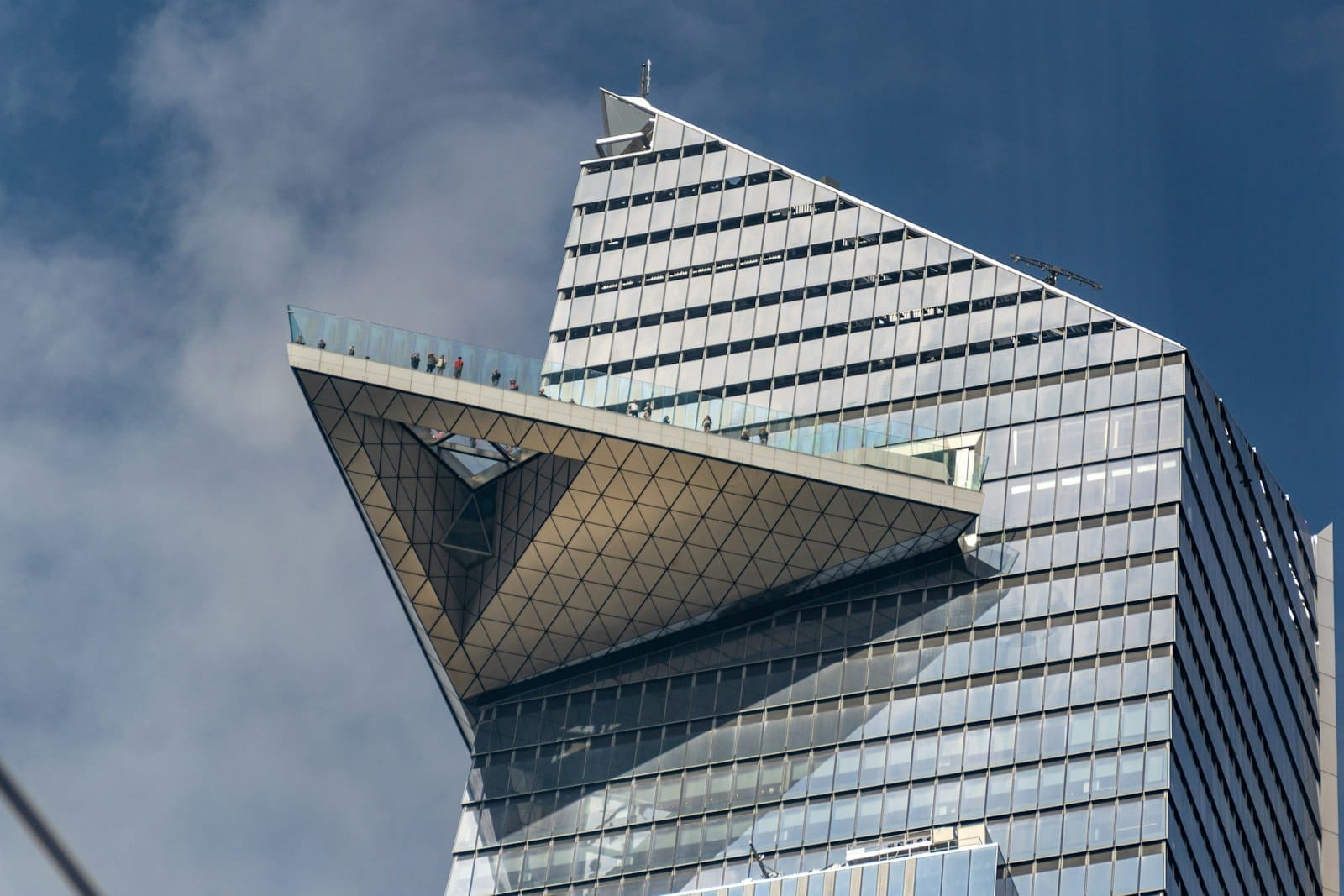
Edge NYC, officially known as Edge at 30 Hudson Yards, is the highest outdoor observation deck in the Western Hemisphere. It sits on the 100th floor of 30 Hudson Yards, 1,131 feet above Tenth Avenue on Manhattan's Far West Side. The deck cantilevers outward from the building's facade, meaning that when you step outside, there is nothing beneath your feet but glass and a long, uninterrupted drop to the streets below.
This is not a conventional rooftop terrace. The triangular outdoor platform extends beyond the building's footprint, giving the impression of standing in open air above the city. The floor is made of stepped glass panels, and the steel-framed enclosure angles outward rather than standing straight up. It is a deliberate architectural provocation, with interiors by Rockwell Group to force a physical awareness of height that most observation decks simply don't produce.
Edge opened to the public on March 11, 2020, just days before New York City shut down for the pandemic. It has since established itself as one of the city's most distinctive elevated experiences, though it occupies a different position in the market than the older, more storied observation decks. Whether it earns that position depends heavily on what you're looking for.
💡 Local tip
Book tickets in advance on edgenyc.com. Walk-up availability can be limited, especially on weekends and clear-sky days, and timed-entry windows fill quickly.
The View: What You Can Actually See
Edge faces east, which means your primary sightline is across the full width of Manhattan and toward Brooklyn, Queens, and the bridges that stitch the boroughs together. The Hudson River is directly below and to your left as you look out. On a clear day, you can trace the spine of Manhattan from the towers of Lower Manhattan all the way north toward Harlem and beyond. The Empire State Building sits close enough to read its setbacks clearly. The Chrysler Building's eagle gargoyles are visible on a sharp day.
What Edge does not offer, which matters: because it sits on the far west side of Midtown, it doesn't command the centered, symmetrical Manhattan panorama you get from the Top of the Rock or the Summit One Vanderbilt. The Hudson Yards district itself, directly beneath you, is still evolving and its street-level texture lacks the visual complexity of Midtown's older grid. The western view across the river to New Jersey is, frankly, unremarkable.
That said, the eastern panorama is genuinely sweeping and the sheer physical sensation of the deck changes the experience in a way no photograph prepares you for. You feel the wind. You hear it. The glass floor panels show 100 floors of nothing beneath your shoes. It is a different kind of encounter with the city than most observation points provide.
Tickets & tours
Hand-picked options from our booking partner. Prices are indicative; availability and final rates are confirmed when you complete your booking.
High Line, Chelsea, Hudson Yards Walking Tour with Edge Admission
From 44 €Instant confirmationFree cancellationSecrets of Hudson Yards, High Line & The Vessel
From 30 €Instant confirmationFree cancellationNew York City High-Line and Hudson Yards walking tour
From 36 €Instant confirmationFree cancellationEdge admission tickets
From 0 €Instant confirmation
How the Experience Changes by Time of Day
Morning visits, roughly 10am to noon, tend to have shorter queues and cooler temperatures in summer. The light comes from the east and hits the Manhattan skyline at a low angle, which makes for sharp, high-contrast photography. Shadows are long and the glass floor panels reflect the sky rather than glaring. If the deck is your primary goal and photography matters to you, this is the most practical window.
Midday draws the largest crowds. The indoor spaces become noticeably warm as the sun tracks across the glass. The deck itself can be uncomfortably hot in July and August, and the haze that builds through a summer afternoon softens the long-distance views toward Brooklyn and Queens. On overcast days, midday loses its only advantage without gaining anything in return.
The hour before and after sunset is, by most accounts, the most rewarding time to visit. The city transitions from a hard-edged grid of steel and glass into something warmer and softer as the light drops. Then, as full darkness settles, the grid of lit windows across Midtown and Lower Manhattan becomes its own kind of spectacle. The indoor bar area becomes more atmospheric in the evening, and the crowd, while still present, is more composed than the midday rush. Edge is open until 10pm daily, which means a full-dark visit is feasible most of the year.
⚠️ What to skip
Strong winds can make the outdoor deck uncomfortable and may limit time you want to spend outside. In winter, temperatures at 1,131 feet feel significantly colder than street level. Dress in proper layers from October through April.
The Architecture and the Building Itself
30 Hudson Yards is one of the tallest buildings in New York City and anchors the western edge of the Hudson Yards development, the largest private real estate development in American history. The tower's exterior is a curtain wall of glass with a subtly tapered profile. The cantilevered deck, designed by Rockwell Group, extends outward from the southeast corner of the 100th floor and was engineered to create the vertiginous sensation of projecting into open space above the city.
The Hudson Yards development that surrounds the building is worth understanding as context. The entire district was constructed over the active rail yards of the Long Island Rail Road, a feat of platform engineering. The neighborhood includes The Vessel, a climbable public sculpture by Thomas Heatherwick, and a large mall, restaurants, and public plazas. Arriving via the 7 train at 34 St–Hudson Yards station deposits you directly into this district, and the walk to Edge's entrance through The Shops at Hudson Yards takes about five minutes.
For travelers interested in the broader architectural history of New York's skyline, the New York City architecture guide places Hudson Yards in the context of the city's building traditions and ongoing development.
Getting There and Practical Logistics
The subway is the most reliable way to reach Edge. The 7 train runs directly to 34 St–Hudson Yards, the westernmost station on the line. From the station exit, follow the signage for Hudson Yards; the walk to the building entrance is short and fully covered in sections. Avoid taking a car during peak hours as traffic on the west side of Midtown is consistently slow and parking options near the development are expensive.
The entrance to Edge is located on the 4th floor of The Shops and Restaurants at Hudson Yards, not at street level. First-time visitors often walk past the retail entrance without realizing it leads to the observation deck. Look for Edge signage inside the mall and follow it to the elevator banks. From there, the ascent to the 100th floor takes under a minute.
The experience is described by its operator as all-weather, with Edge designed so indoor spaces remain open in most conditions, though outdoor access can be modified for safety. During heavy rain, access to the outdoor deck may be modified. The indoor viewing areas still provide floor-to-ceiling glass panoramas, so a rainy visit is not wasted, but the outdoor platform is the main draw and rain changes it substantially. Check the forecast. If you have a flexible schedule, a clear or partly cloudy day is worth waiting for.
ℹ️ Good to know
Edge hours are typically 10am to 10pm daily, though hours can vary by date. Confirm current hours and ticket availability at edgenyc.com before visiting.
Is It Worth the Ticket Price?
That question depends on what you value. Edge is priced at a premium and occupies the higher end of the New York City observation deck market. The physical experience of the cantilevered outdoor deck is genuinely unlike anything else in the city at this height. If the sensation of standing on glass above a 100-story drop sounds compelling rather than alarming, Edge delivers it more effectively than its competitors.
If you are primarily after the best possible view of the Manhattan skyline, the calculus shifts. The Top of the Rock at Rockefeller Center offers a more centrally positioned eastward panorama, with the Empire State Building as a prominent foreground element. Summit One Vanderbilt in Midtown delivers a more immersive, design-forward interior experience. The Empire State Building remains the iconic choice with decades of cultural weight behind it. Edge's view, while impressive, is offset by its position on the far western edge of Midtown.
For first-time visitors to New York City with limited time and budget, it is worth comparing options rather than defaulting to Edge on altitude alone. For those specifically interested in the sensation of height and the architectural audacity of the deck itself, or for visitors returning to the city who have already seen the classic observation points, Edge has a legitimate case.
If managing costs is a priority, note that Edge is not included in most free city experiences. The free things to do in New York City guide covers alternatives for skyline views that cost nothing, including the Staten Island Ferry and certain elevated vantage points across the boroughs.
Insider Tips
- The glass floor panels at the outer edge of the deck are where most people hesitate. Walk to the very tip of the triangular platform before looking down; the full effect of the cantilever only registers when you are standing at the apex, not near the entrance.
- If you book the last entry window of the evening, you get both the sunset transition and the full-dark skyline in a single visit without needing to time two separate trips.
- The indoor bar area on the observation level offers drinks with unobstructed window views. On crowded days, securing a position near the floor-to-ceiling glass here is easier than competing for outdoor deck space and still delivers a strong visual experience.
- The 7 train at 34 St–Hudson Yards is the clearest transit option, but if you are coming from Lower Manhattan, the M11 or M34A bus routes also stop near the development without requiring a subway transfer.
- For the sharpest photography conditions, the hour after sunrise, when the deck opens, offers low-angle eastern light and the thinnest crowds. The first entry window on weekdays in particular is consistently less crowded than any equivalent weekend slot.
Who Is The Edge at Hudson Yards For?
- First-time visitors who want a physically memorable, not just scenic, New York City height experience
- Travelers returning to NYC who have already visited the Empire State Building or Top of the Rock and want something architecturally distinct
- Architecture and design enthusiasts interested in the Hudson Yards development as a built environment
- Couples or groups looking for a special-occasion evening with sunset and night views
- Photography-focused visitors who want dramatic angles and glass-floor compositional opportunities not available at other decks
Nearby Attractions
Other things to see while in Hudson Yards & Hell's Kitchen:
- Intrepid Sea, Air & Space Museum
The Intrepid Museum anchors itself to Pier 86 on the Hudson River, where a decommissioned aircraft carrier, a retired space shuttle, and dozens of historic aircraft make up one of New York City's most physically impressive collections. It is an immersive, outdoor-heavy experience that rewards patience and good weather.
- The Vessel
Designed by Thomas Heatherwick, The Vessel is a 16-story interlocking staircase structure at the heart of Hudson Yards. With 154 flights, 2,500 steps, and 80 viewing platforms, it's one of New York City's most distinctive architectural landmarks. General admission starts around $12; NYC residents get free Thursday slots (verify current hours and pricing at vesselnyc.com before visiting).