Stazione Zoologica Anton Dohrn: Naples' Historic Aquarium Inside Villa Comunale
Founded in 1872 and open to the public since 1874, the Stazione Zoologica Anton Dohrn is the oldest continuously operating aquarium of the 19th century. Set inside the Villa Comunale park in Chiaia, it remains a working marine research station as much as a visitor attraction, dedicated entirely to Mediterranean sea life.
Quick Facts
- Location
- Villa Comunale, Chiaia, Naples (80121)
- Getting There
- Mergellina metro station (Line 2) or bus along Via Caracciolo
- Time Needed
- 45 minutes to 1.5 hours
- Cost
- Verify current admission on official site before visiting
- Best for
- History lovers, families with children, marine biology enthusiasts
- Official website
- www.szn.it
What This Place Actually Is
The Stazione Zoologica Anton Dohrn is not a conventional aquarium in the theme-park sense. It is, first and foremost, a working marine research institution, one of the most historically significant in Europe. The public aquarium occupying its ground floor opened on January 26, 1874, making it the oldest 19th-century aquarium still in operation anywhere in the world. That distinction matters: the tanks you look into, the architecture around you, and the scientific tradition embedded in these walls predate nearly every other public aquarium on the planet.
The entire focus is Mediterranean marine fauna and flora. You will not find tropical reef fish, sharks from distant oceans, or performing sea mammals. What you will find are the actual creatures living in the waters just outside, from cephalopods and sea horses to eels, rays, and crustaceans that define the ecological character of the Bay of Naples. For travelers interested in what genuinely inhabits the sea they are looking at from the promenade, this is an unusually honest institution.
ℹ️ Good to know
Opening hours and admission prices are subject to change. Always verify directly on the official website at szn.it before planning your visit, as the station periodically adjusts public access around research schedules.
The Founder and the Building: Why the History Matters
Anton Dohrn was a German zoologist who chose Naples specifically because the Bay of Naples offered exceptional biodiversity and year-round access to warm Mediterranean water. He founded the station in 1872, and the main building was completed in 1872. Significant expansions followed between 1885 and 1888, and again in 1905, giving the complex its current footprint of roughly 527 square meters of public space.
Dohrn's model was radical for its time. He funded the station partly by renting out laboratory benches to scientists from universities across Europe and North America. Researchers from dozens of countries worked here in the late 19th and early 20th centuries, contributing to the early development of marine biology as a discipline. The institution produced foundational research on cell biology, embryology, and neurophysiology, not just taxonomy. Walking through the building, you are in a place where serious science happened long before marine biology had its own textbooks.
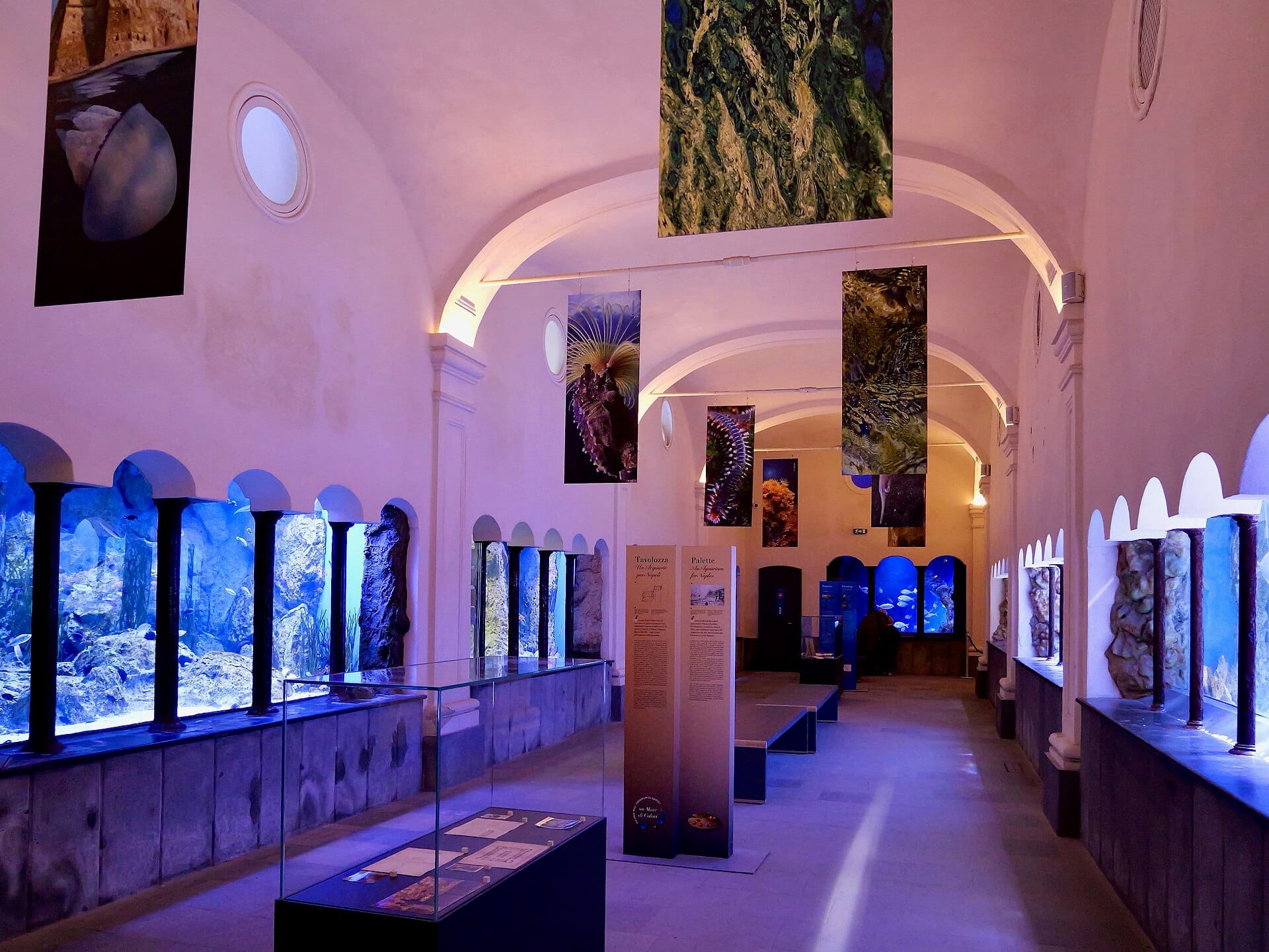
The building itself is worth attention. The exterior fits the grand institutional style of the late 19th century, sitting comfortably alongside the neoclassical character of the Villa Comunale park that surrounds it. Inside, the aquarium retains period details that feel genuinely old, not artificially restored. The low lighting around the tanks, the shape of the display cases, and the proportions of the rooms carry an atmosphere that modern aquariums rarely replicate.
Tickets & tours
Live prices and dates from our booking partner. If you book, we may earn a commission at no extra cost to you.
Pompeii and Mount Vesuvius tour with transportation
From 110 €Instant confirmationFree cancellationOrigins and legends of Naples walking tour
From 28 €Instant confirmationFree cancellationGuided walking tour of Naples city and Naples underground
From 45 €Instant confirmationFree cancellationMount Vesuvius and Herculaneum tour with transportation
From 100 €Instant confirmationFree cancellation
The Experience: What You See and How It Feels
The aquarium covers its 527 square meters across a series of connected rooms and tank alcoves. The tanks are not the floor-to-ceiling panoramic glass walls of contemporary facilities. They are older, closer, more intimate, giving you a face-to-face proximity to creatures that is almost disorienting. An octopus changing color a few centimeters away from your face, or a sea horse gripping a piece of vegetation with its tail, lands differently here than it would behind thick modern glass in a brightly lit gallery.
The smell is what visitors often mention first: salt water, cool and faintly biological, the way a harbor smells in early morning before the day heats up. The lighting is dim throughout, which keeps reflections off the tanks to a minimum and encourages you to slow down. Children tend to press their faces to the glass and stay there longer than parents expect.
Do not arrive expecting theatrical displays or feeding shows. The pace is quiet and unhurried. Staff are present but this is not a performance venue. The reward is the quality of observation you get when nothing is competing for your attention.
When to Visit and How to Get There
Morning visits are the most comfortable. The Villa Comunale park surrounding the station is pleasant in the first half of the day, with light coming off the sea and families walking dogs along the promenade. By midday in summer, the park becomes considerably hotter and more crowded, though the aquarium interior stays cool. On weekends, expect school groups and families with young children, particularly on Saturday mornings. Weekday afternoons tend to be quieter.
The station sits inside Chiaia, Naples' most polished waterfront district. The nearest metro connection is Mergellina on Line 2, roughly a ten-minute walk along the seafront. Several bus lines also run along Via Caracciolo, the coastal road directly adjacent to the park. From the historic center, the walk along the waterfront takes around 25 to 30 minutes and is pleasant in its own right.
Parking along Via Caracciolo is limited and metered. If you are arriving by car, allow extra time. Taxis and ride-hailing apps drop off easily at the park entrance on the waterfront side.
💡 Local tip
Pair the aquarium visit with a walk through Villa Comunale immediately after. The park runs along the waterfront and is one of the few green spaces in central Naples where you can sit near the sea. It takes less than ten minutes to cross, with the bay visible on one side the entire time.
Honest Assessment: What This Is and What It Is Not
If you are measuring this against large modern aquariums in other European cities, you will likely find the scale modest and the facilities dated. The Stazione Zoologica is not competing with those institutions and was never designed to. Its value is different: historical depth, scientific seriousness, and a direct connection to the specific sea ecosystem you are visiting Naples to experience.
Travelers who need scale, spectacle, or interactive digital installations will leave underwhelmed. Travelers who appreciate authentic institutional character, or who want a quiet hour away from the noise of the centro storico, will find it worthwhile. Parents with children under twelve often report it as a genuine highlight, partly because its smaller size means no one gets overwhelmed or lost.
It fits naturally into a Chiaia afternoon that also includes a walk along the waterfront toward Mergellina or a stop at the Villa Comunale gardens. Neither requires much additional time.
Photography and Practical Notes
The dim interior makes phone photography challenging without adjustment. Turn off flash entirely: it disturbs the animals and produces flat, washed-out images. Instead, switch your phone to night mode or manually increase exposure time. The tank glass picks up reflections easily, so shooting at a slight angle rather than straight-on removes most of the glare.
The building exterior photographs well in morning light, when the facade catches the early sun and the park behind you is still relatively empty. If you want a clean shot of the entrance without tourists in frame, before 9:30 in the morning is the most reliable window.
Accessibility details should be confirmed directly with the station, as the building's age means some areas may have limitations. Check the official site at szn.it. For visitors planning a broader day of Naples sightseeing, this attraction sits close enough to Castel dell'Ovo that both can reasonably be combined in a single morning.
Insider Tips
- The research station's scientific legacy is on display in some of the corridor spaces beyond the aquarium proper. Take a moment to read the historical panels about the bench-rental system Dohrn pioneered: it explains why researchers from Yale, Cambridge, and Berlin were all working in Naples in the 1880s.
- Weekday mornings between Tuesday and Thursday tend to see the fewest visitors. Saturday mornings attract school groups and families in significant numbers.
- The Villa Comunale park directly outside has shaded benches facing the Bay of Naples. Bring something to eat and sit there after the aquarium rather than heading immediately back into the city streets.
- If you are traveling with children, the smaller scale here is actually an advantage. The route through the aquarium is compact and linear, with no risk of losing track of small children in a crowd.
- In summer, the aquarium's cool interior is a genuine relief. Arriving around midday, when the heat outside is at its peak, turns what might feel like a brief cultural stop into a welcome break.
Who Is Stazione Zoologica Anton Dohrn (Aquarium) For?
- Families with children aged 4 to 12 looking for a calm, manageable attraction
- History and science travelers interested in 19th-century institutional heritage
- Marine biology enthusiasts wanting an honest look at Mediterranean species
- Visitors who want a quiet hour away from the noise of the historic center
- Anyone combining a waterfront walk through Chiaia with a cultural stop
Nearby Attractions
Other things to see while in Chiaia:
- Mergellina Harbor
Mergellina Harbor sits at the western edge of the Lungomare Caracciolo, where the city's grand seafront promenade meets Posillipo's rocky hills. It's a free, open harbor serving as both a working ferry port and a beloved local gathering place, best experienced in the early morning or at dusk when the light off the Bay of Naples turns the scene cinematic.
- Villa Comunale
Stretching nearly a mile along the Lungomare Caracciolo waterfront in Chiaia, Villa Comunale is Naples' most beloved public park. Free to enter, lined with century-old trees and classical sculptures, and home to Europe's oldest public aquarium, it rewards visitors at any hour of the day.
Planning a trip? Discover personalized activities with the Nomado app.