St John's Cathedral: Brisbane's Gothic Revival Landmark
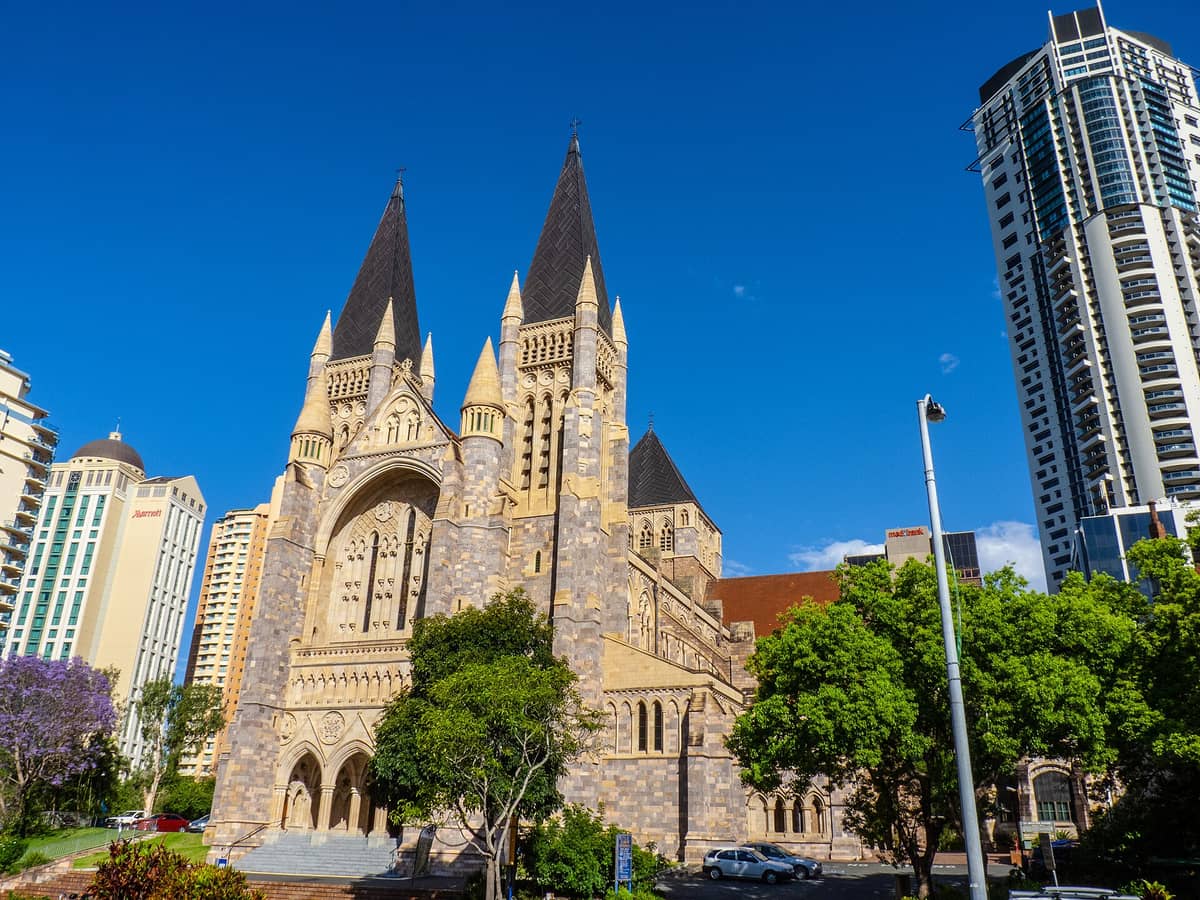
St John's Cathedral is Brisbane's most architecturally ambitious religious building, a Gothic Revival structure with a fully stone-vaulted ceiling built over more than a century. Free to enter and a short walk from Central Station, it offers a rare moment of quiet at the edge of the CBD.
Quick Facts
- Location
- 405 Ann Street, Brisbane CBD, between the CBD and Fortitude Valley
- Getting There
- Central Station, approximately 5-minute walk
- Time Needed
- 30–60 minutes for a self-guided visit; longer for services or guided tours
- Cost
- Free entry; special events may be ticketed separately
- Best for
- Architecture lovers, history enthusiasts, quiet reflection, first-time Brisbane visitors
- Official website
- www.stjohnscathedral.com.au
What St John's Cathedral Actually Is
St John's Cathedral is the Anglican cathedral church of Brisbane, sitting on Ann Street at the top of the CBD's northern slope. It is the only cathedral in Australia with a fully stone-vaulted ceiling throughout the nave, aisles, and chapels. That distinction matters architecturally: most cathedrals of this scale in Australia use plaster or timber to imitate vaulting. Here, the stone is structural.
The building's completion in 2009 closed a construction arc that began with the laying of the foundation stone in 1901, making it one of the longest cathedral building projects in modern history. Work proceeded in three distinct phases: the initial nave from 1906 to 1910, a second phase between 1964 and 1968, and the final western towers and facade completed between 1989 and 2009. The result is a building that reads as a single coherent design despite more than a century of construction.
💡 Local tip
Arrive between 9:30 am and 11 am on a weekday if you want the interior to yourself. Morning light enters from the east through the apse windows, illuminating the stone vaulting at a low angle that afternoon visits simply don't offer.
Inside the Cathedral: What to Look For
The moment you step through the main entrance and your eyes adjust from Queensland sunlight to interior shade, the scale of the stone vaulting registers immediately. The ribs rise from clustered columns and meet overhead in a pattern that draws the eye toward the high altar. The stone is sandstone from Helidon, west of Brisbane, while the exterior also incorporates other materials across the long construction timeline, yet the tonal consistency across the building is striking.
Walk slowly through the nave and look at the carved details in the capitals of the columns, where individual stonemasons left their mark across different decades. The older eastern end shows the slightly warmer patina of stone that has been aging since the Edwardian period, while the newer western sections are noticeably crisper and paler. Rather than feeling inconsistent, this gradation gives the building a quiet layering that rewards attention.
The stained glass windows are worth examining individually. Several were added across the twentieth century by different artists, and their styles shift noticeably from Victorian pictorial work in the apse to more abstracted mid-century panels further west. If the light is flat outside due to cloud cover, the colours deepen and become easier to read without glare.
Tickets & tours
Live prices and dates from our booking partner. If you book, we may earn a commission at no extra cost to you.
Luggage Storage in Brisbane
From 5 €Instant confirmationFree cancellationBrisbane's dark stories true crime tour
From 21 €Instant confirmationFree cancellationFull-day Mount Tamborine winery tour from Brisbane with lunch
From 140 €Instant confirmationFree cancellationNorth Stradbroke Island small groups day tour
From 79 €Instant confirmationFree cancellation
How the Experience Changes Through the Day
Early mornings, from opening at 9:30 am to around 11 am, are the quietest period. The cathedral functions as an active place of worship, so there is always a low-level background of purpose to the building, whether a sacristan moving through the aisles, candles being lit at a side chapel, or the faint sound of the organ being tested. These are not distractions. They make the visit feel like contact with a living building rather than a museum exhibit.
Midday brings more foot traffic, partly from CBD workers on lunch breaks and partly from tourists working through the central city. The cathedral handles this well because of its size, and the stone keeps the interior significantly cooler than the street outside, which matters considerably in Brisbane's summer months when temperatures regularly reach the high twenties. By 2 pm in summer, stepping inside offers genuine relief.
Late afternoon visits, particularly from around 3 pm onward, shift the interior light toward amber through the west-facing windows near the newer facade. If there is a choral evensong or organ recital scheduled, this is often when it occurs. Check the cathedral's official website before visiting if you want to time your arrival around a musical service, as the acoustic quality of the stone vault during choral performance is the single most memorable thing this building can offer a visitor.
Historical and Cultural Context
The decision to build a stone cathedral in subtropical Brisbane at the turn of the twentieth century was deliberate and assertive. Anglican authorities wanted a building that would match the ambitions of the colony-turned-state, and Anglican authorities wanted a building that would match the ambitions of the colony-turned-state, and the French and English Victorian Gothic Revival styles chosen by architect John Loughborough Pearson (whose original design was continued after his death by his son Frank) reflected the ecclesiastical architecture of the British world at that moment. Brisbane is on the traditional lands of the Turrbal and Jagera peoples, and the cathedral stands on land that had been dramatically transformed by colonial settlement in the decades before construction began. That context is worth holding alongside the building's undeniable beauty. For more on Brisbane's colonial-era built environment, the Brisbane heritage and history guide covers the CBD's key historic sites together.
The cathedral's position in the city has always been slightly set back from the commercial core, which is part of why it remains legible from Ann Street despite the towers that have grown around it. Brisbane's CBD has densified significantly since the 1980s, and the cathedral's elevated position on the Ann Street ridge means the twin western towers remain visible from several vantage points in the surrounding blocks.
Getting There and Practical Logistics
The address is 405 Ann Street, Brisbane. Central Station is the nearest rail stop, roughly a five-minute walk west along Ann Street. The TransLink network serves Central Station with frequent trains from all suburban lines. Multiple bus routes also run along Ann Street and adjacent streets. If you are walking from Queen Street Mall, the cathedral is about ten minutes north on a slight uphill grade.
Opening hours for visitors are 9:30 am to 4:30 pm daily. The cathedral does not charge an admission fee for general visits. Note that if a service or private event is underway, certain areas of the building may be inaccessible or visitors may be asked to wait quietly at the back. This happens rarely on weekday mornings but more often on Sunday.
Accessible entrances are available on the north side via the car park and on the south side through St Martin's courtyard. If you are arriving by car, Ann Street has limited street parking but there are commercial car parks within a block or two on either side.
⚠️ What to skip
Photography inside the cathedral is generally permitted for personal use, but use of flash or tripods during services is not appropriate. During special services or events, photography may be restricted entirely. When in doubt, ask a staff member at the door.
What the Cathedral Is Not
This is not a major visitor attraction in the theme-park sense. There is no guided audio tour, no cafe inside, and no gift shop comparable to what you would find at famous European cathedrals. If you are expecting the scale and exhibition content of, say, a national museum, adjust your expectations. The visit is self-directed and quiet by nature.
It is also worth being honest about the immediate surroundings. Ann Street at this point is a busy arterial road, and the approach from Central Station along the footpath is functional rather than scenic. The cathedral reveals itself gradually: the facade only comes fully into view once you reach the forecourt. First-time visitors sometimes underestimate the building from a distance before being surprised by the interior.
Visitors who want a full half-day of historic CBD exploration can pair this stop with Brisbane City Hall a short walk south, and Anzac Square directly across the road from Central Station. The three sites together cover the civic, commemorative, and ecclesiastical layers of early twentieth-century Brisbane within a comfortable walking radius.
Insider Tips
- If you want to experience the acoustic of the stone vault, look up any scheduled choral evensong or organ recital on the cathedral's website before you visit. The sound in that space during live performance is qualitatively different from anything the building offers during a quiet daytime visit.
- The south side approach through St Martin's courtyard is quieter and more atmospheric than arriving directly off Ann Street. It also gives you a clearer view of the building's exterior massing before you enter.
- In Brisbane's summer heat (December to February), the stone interior stays several degrees cooler than outside. The cathedral can serve as a genuine mid-morning cooling stop if you are walking the CBD.
- Look at the floor as you move through the nave. Memorial stones and inscriptions mark the floor in several locations, offering a compressed version of Queensland Anglican history that most visitors walk straight over.
- Weekday late mornings (around 10:30 am to 11:30 am) often see small guided tours offered by cathedral volunteers. These are informal, free, and usually far more informative than any printed material available at the entrance.
Who Is St John's Cathedral For?
- Architecture and design enthusiasts interested in Gothic Revival stonework
- History-focused travellers building a picture of colonial-era Brisbane
- Visitors seeking a quiet, unhurried indoor space away from the commercial CBD
- Travellers combining the cathedral with a broader historic city walk
- Anyone in Brisbane during a choral or organ performance season
Nearby Attractions
Other things to see while in Brisbane CBD:
- ANZAC Square & Shrine of Remembrance
ANZAC Square and its Shrine of Remembrance sit at the geographic and emotional heart of Brisbane's CBD, offering free access to one of Queensland's most significant commemorative sites. From the flame-lit colonnade to the underground Memorial Galleries, this 1929 landmark rewards both quiet reflection and architectural curiosity.
- Brisbane City Hall
Brisbane City Hall is the Queensland capital's most distinguished civic building, a neoclassical sandstone structure with an 87-metre clock tower and a 31-metre copper-domed auditorium. Free general entry, a central CBD location on King George Square, and genuine architectural grandeur make it a rewarding stop for history-minded travellers and anyone curious about what Brisbane looked like before the glass towers arrived.
- Brisbane Customs House
Perched on the northern bank of the Brisbane River at 399 Queen Street, Customs House is one of Queensland's most celebrated examples of Victorian Free Classical architecture. Built between 1886 and 1889, it has served as a working customs facility, a university function centre, and today operates as a heritage event venue and restaurant that welcomes casual visitors during business hours. Entry to the main spaces costs nothing.
- Brisbane Riverwalk
The Brisbane Riverwalk is a free, 870-metre floating walkway connecting Howard Smith Wharves near the CBD to New Farm, with separated pedestrian and cycling lanes, uninterrupted river views, and easy links to some of the city's best precincts. Whether you walk it at dawn for the quiet or at dusk for the light show on the water, it consistently delivers.
Planning a trip? Discover personalized activities with the Nomado app.