Place des Arts: Montreal's Cultural Heartbeat
Place des Arts is Montreal's flagship performing arts complex, home to six performance venues and the anchor of the Quartier des Spectacles. Whether you're catching a symphony, attending a festival, or simply crossing the esplanade on your way through downtown, this is where Montreal's cultural life concentrates.
Quick Facts
- Location
- 175 Sainte-Catherine Street West, Quartier des Spectacles, Montreal
- Getting There
- Place-des-Arts station (Green Line) connects directly to the complex — no outdoor walking required
- Time Needed
- 30 min to browse the esplanade; 2–3 hours for a performance
- Cost
- Free to enter public areas; performance tickets vary by event
- Best for
- Classical music, contemporary dance, theatre, architecture, and festival-season crowds
- Official website
- www.placedesarts.com
What Place des Arts Actually Is
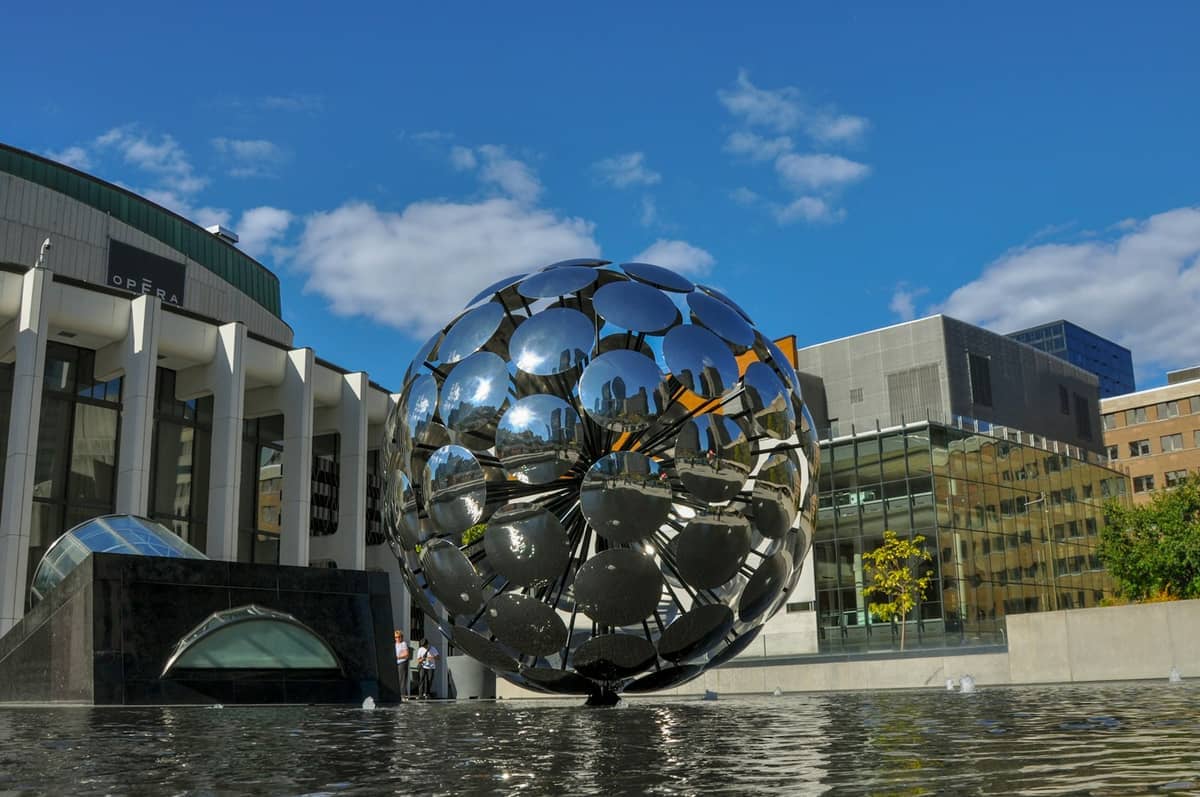
Place des Arts is not a single theatre. It is a multi-venue performing arts complex spanning several interconnected buildings in the heart of Montreal's Quartier des Spectacles, with its principal address at 175 Sainte-Catherine Street West. The complex houses six performance halls, most notably Salle Wilfrid-Pelletier, which opened on September 21, 1963, and was the long-time home of the Orchestre symphonique de Montréal. The OSM now performs at Maison symphonique, also on the Place des Arts campus. Other resident companies include Les Grands Ballets Canadiens, Opéra de Montréal, and the Orchestre Métropolitain.
The surrounding esplanade and the Maison symphonique — a concert hall inaugurated in 2011, with a second public entrance at 1600 Saint-Urbain Street — extend the footprint of the complex northward. The result is a campus-like cluster of venues that serves as both a destination for ticketed performances and a public gathering space that spills out into the wider Quartier des Spectacles district.
ℹ️ Good to know
There is no general admission fee to enter the lobbies or walk the esplanade. Ticket prices vary entirely by event. Check the Place des Arts website directly for current programming and pricing before your visit.
The Architecture and Its Context
When Salle Wilfrid-Pelletier opened in 1963, it was Montreal's first purpose-built concert hall and one of the most significant cultural infrastructure projects in Quebec's post-war period. The original building reflects the modernist civic ambitions of that era: broad concrete facades, a formal esplanade designed for public gatherings, and an interior scaled for grand orchestral performance. The hall seats roughly 3,000 people and was designed with acoustics for full orchestral and operatic productions.
The complex grew incrementally over the following decades. The Maison symphonique, designed by architects Jack Diamond and Yvanhoe Chevalier, represents the most recent major addition. Its exterior glass panels and warm wood-clad concert hall interior contrast sharply with the original 1963 building, giving the complex a layered architectural timeline that rewards attention. For anyone interested in Montreal's built environment, Place des Arts reads as a compressed version of the city's architectural history over 60 years. The Montreal architecture guide provides broader context for how this complex fits into the city's urban development.
Tickets & tours
Hand-picked options from our booking partner. Prices are indicative; availability and final rates are confirmed when you complete your booking.
Montreal evening cruise on the St. Lawrence River
From 54 €Instant confirmationFree cancellation3-hour e-bike guided tour in Montreal
From 68 €Instant confirmationFree cancellationWalking tour of Old Montreal
From 20 €Instant confirmationFree cancellationMontreal helicopter tour
From 156 €Instant confirmationFree cancellation
The Esplanade: Public Space as Performance
The esplanade in front of Place des Arts is genuinely worth visiting even if you have no ticket. On weekday mornings, it is largely quiet — a few commuters cutting across, workers from nearby offices eating lunch, the low hum of the Quartier des Spectacles infrastructure around it. The scale of the open plaza becomes apparent: it is one of the larger pedestrian spaces in central Montreal.
The transformation happens in summer. The esplanade becomes a festival venue in its own right, hosting outdoor stages, food stands, and large crowds during events like the Montreal Jazz Festival. During peak festival weeks, the crowd density is high and the atmosphere loud. If you are sensitive to noise or prefer a quieter visit, early morning before 10 a.m. or a weekday afternoon in spring or autumn will serve you better. The Montreal Jazz Festival uses Place des Arts as one of its main hubs each summer, with free outdoor stages alongside ticketed indoor shows.
In winter, the esplanade quiets considerably but does not go dark. The Quartier des Spectacles maintains a program of light installations and outdoor projections through the colder months, and the area around Place des Arts forms part of that illuminated circuit. Temperatures in January and February regularly drop below -10°C, so a winter visit rewards warm layering and brevity unless you are heading directly into a venue.
💡 Local tip
For the best daytime photography of the esplanade, arrive before 9 a.m. when the plaza is nearly empty and the light falls across the concrete at a low angle. By mid-morning on weekdays, construction activity in the surrounding Quartier can add visual and audio clutter.
Attending a Performance: What to Expect Inside
Each of the six halls at Place des Arts has its own character. Salle Wilfrid-Pelletier is the largest and most formal, with tiered seating, a grand proscenium, and acoustics calibrated for orchestral and operatic work. Théâtre Maisonneuve, seating roughly 1,500, is used for a broader range of programming including popular music, dance, and variety. The Cinquième Salle and Théâtre Jean-Duceppe are more intimate spaces suited to contemporary theatre and smaller productions.
The lobbies are polished but not pretentious. On performance evenings, they fill with a genuine cross-section of Montreal audiences: families in jeans, older couples in formal wear, students from nearby UQAM, and tourists who have stumbled into a world-class programme. French is the primary language you will hear in conversations around you, though English signage is consistent throughout the complex.
Children under two are admitted free to Place des Arts-presented shows when sitting on an accompanying adult's lap, though they still require a ticket issued by the box office. For productions by independent companies programming the venues, parental policies may differ. Confirm directly with the box office when booking.
⚠️ What to skip
Place des Arts does not operate on a single unified schedule. There is no 'always open' public attraction inside the buildings — access depends on what is programmed on a given day. Check placedesarts.com before visiting to confirm what is on and whether box offices or specific venues are open.
Getting There and Moving Around
The Place-des-Arts métro station sits on the Green Line and connects directly to the complex via an interior passage, which matters in winter when temperatures can drop sharply. You can arrive from the station and reach the theatre lobbies without stepping outside. Station entrances are located at 1555 Jeanne-Mance, 155 President-Kennedy Avenue, 1520 De Bleury Street, and at 2020 De Bleury Street, which has elevator access for visitors with mobility needs. The station operates from approximately 5:47 a.m. to between 12:52 and 1:29 a.m., depending on the day.
If you are arriving by bike, the Quartier des Spectacles has cycling infrastructure connecting to the broader Montreal network. The city's BIXI bike-share stations are within easy reach. For those relying on car travel, paid parking garages exist in the immediate area, though finding street parking during festival season or on performance evenings is reliably difficult. The guide to getting around Montreal covers transit and cycling options in more detail.
Place des Arts and the Quartier des Spectacles
Place des Arts anchors the eastern end of the Quartier des Spectacles, a designated cultural district that stretches across roughly one square kilometre of central Montreal. The district hosts more than 80 cultural venues and is the site of major annual festivals. Place des Arts functions as the district's institutional backbone: it is the venue with the most programming, the most recognizable address, and the longest history.
Walking north on Saint-Urbain from the Maison symphonique entrance brings you toward the Musée d'art contemporain de Montréal, which shares this part of the district. Walking south on Jeanne-Mance takes you toward Sainte-Catherine Street and deeper into downtown. The broader Montreal itinerary options connect easily to a Place des Arts visit, since the Quartier des Spectacles sits within walking distance of Old Montreal to the south and the Latin Quarter to the east.
Honest Assessment: Who Will Get the Most Out of This Visit
If you are in Montreal primarily to eat, walk neighborhoods, or explore parks, Place des Arts will not detain you for long without a ticket to something. The exterior and esplanade are worth 20 to 30 minutes of your time as part of a broader Quartier des Spectacles walk, but the real value of this attraction is its programming. Montreal runs world-class orchestral, dance, and theatre productions through these halls, and ticket prices are frequently more accessible than equivalent venues in London, Paris, or New York.
Travellers who are drawn to the performing arts should check what is on during their travel dates before booking anything else. A single evening at Salle Wilfrid-Pelletier for an OSM concert, or a contemporary dance production at Théâtre Maisonneuve, will likely rank among the most memorable experiences of a Montreal trip. The Montreal festivals guide is particularly relevant if your dates fall in summer, when Place des Arts serves as a hub for multiple overlapping festivals simultaneously.
Visitors who are not interested in ticketed performances and are looking for a daytime attraction with visual payoff on its own terms may find the Quartier des Spectacles as a whole more rewarding than Place des Arts specifically. The complex was built to host performances, not to be observed from the outside.
Insider Tips
- The Maison symphonique interior can be seen on guided tours when the hall is not in use. Check the Place des Arts website for tour availability, as these are not widely advertised and sell out quickly.
- Discounted last-minute tickets are sometimes available through the Place des Arts box office on the day of a performance. Arrive in person rather than waiting for online availability, which may not reflect walk-up seats.
- The underground passage from Place-des-Arts métro station avoids the outdoor cold entirely in winter. Enter from the station, follow signs for Place des Arts, and you can reach the main lobbies in dry warmth — useful after an evening show when temperatures can be well below freezing.
- During Montreal's major summer festivals, the free outdoor stages on the esplanade can be just as compelling as ticketed shows inside. Arrive by 7:30 p.m. for a free outdoor concert if you want a position with a clear sightline rather than standing behind the crowd.
- The Cinquième Salle is one of Montreal's best intimate performance spaces and frequently programmes adventurous contemporary work at lower price points than the main halls. It is worth checking specifically rather than only browsing headline shows.
Who Is Place des Arts For?
- Classical music and opera lovers wanting to hear the Orchestre symphonique de Montréal in its home hall
- Festival visitors during summer who want a central base for outdoor programming across the Quartier des Spectacles
- Architecture enthusiasts interested in Quebec's post-war modernism and the contrast with the 2011 Maison symphonique
- Couples or solo travellers looking for a high-quality evening cultural experience at accessible price points
- Winter visitors who want a warm, stimulating indoor destination connected directly to the metro
Nearby Attractions
Other things to see while in Quartier des Spectacles:
- Musée d'art contemporain de Montréal
Founded in 1964, the Musée d'art contemporain de Montréal is a major Canadian museum dedicated exclusively to contemporary art. Currently operating from a temporary location inside Place Ville Marie, it offers a surprisingly accessible and often thought-provoking experience in the heart of downtown Montreal.