Pinball Hall of Fame: Las Vegas's Most Playable Museum
Free to enter and loaded with hundreds of working pinball and arcade machines spanning decades of design history, the Pinball Hall of Fame sits at the south end of the Las Vegas Strip. Bring quarters. Plan to stay longer than you think.
Quick Facts
- Location
- 4925 Las Vegas Blvd South, at the south end of the Strip across from the Welcome to Fabulous Las Vegas sign and near Mandalay Bay
- Getting There
- Free on-site parking; RTC Deuce bus stops on Las Vegas Blvd nearby; walkable from Mandalay Bay
- Time Needed
- 1 to 2.5 hours depending on how competitive you get
- Cost
- Free entry; games from $0.25 per play, with most between $0.25 and $0.50 and some newer machines up to $1. Budget $5–$15 in tokens for a full session
- Best for
- Retro gaming fans, families, couples looking for something different, budget travelers
- Official website
- www.pinballmuseum.org
What the Pinball Hall of Fame Actually Is
The Pinball Hall of Fame is a working museum of pinball and arcade machines, located at 4925 Las Vegas Blvd South, a few blocks south of Mandalay Bay. It opened at this dedicated Strip-side location on April 15, 2021, giving one of the world's largest public pinball collections a permanent, purpose-built home after years at various off-Strip locations.
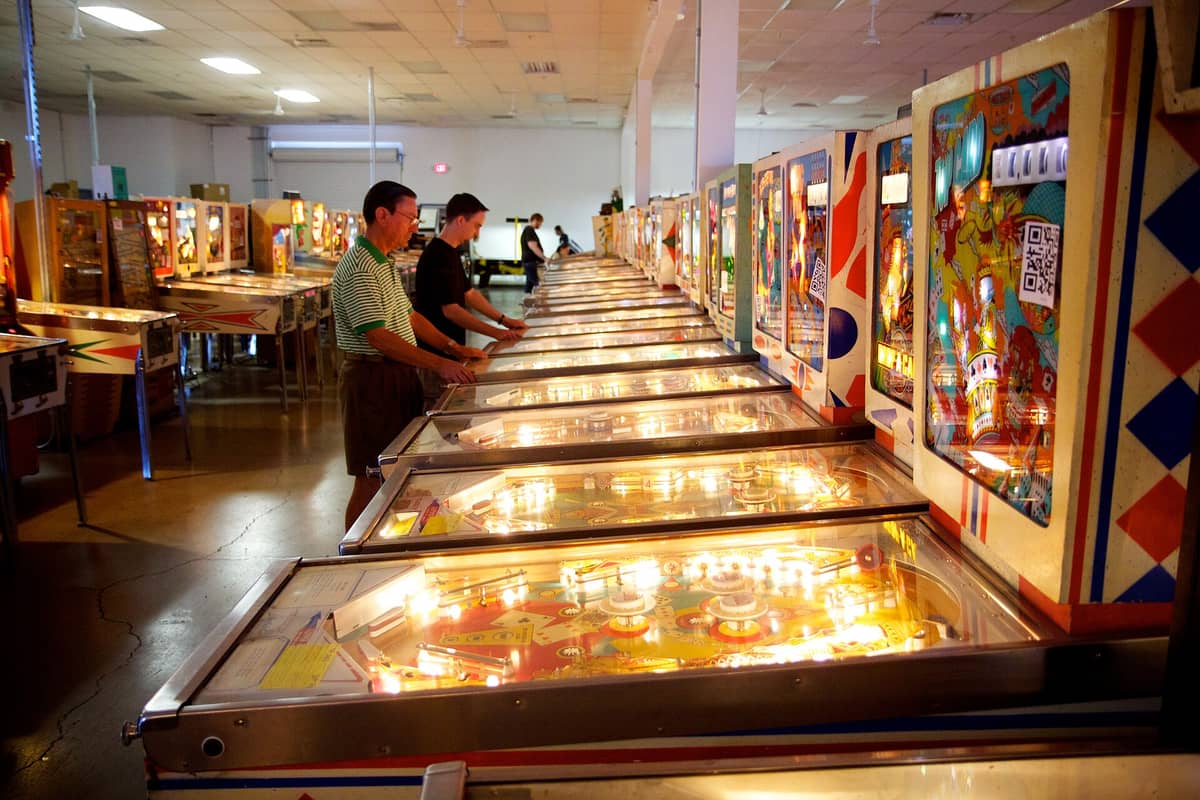
The collection spans from early electromechanical machines of the 1950s and 60s through the golden solid-state era of the 1980s and 90s, and up to modern digital tables. Many machines on display are genuinely rare. You will find titles here that haven't been in public operation anywhere else for decades. What makes this place unusual even among arcades is the preservation philosophy: most machines are kept in working condition and available for actual play, not sealed behind glass.
Entry is free. You pay only for what you play, with most games costing between $0.25 and $0.50 per play. A change machine on-site handles tokens, typically sold at four for $1. Some newer or more elaborate machines cost up to $1 per play. Net proceeds, after covering operating expenses, support the Salvation Army and other non-denominational charities, which gives the whole operation an unusually straightforward sense of purpose for Las Vegas.
💡 Local tip
Bring cash. The token machines accept bills, but having a pocketful of quarters already speeds things up and keeps the momentum going between machines.
The Layout and What You'll Find Inside
The building is a single-story warehouse-style space with wide open aisles. Machines are organized loosely by era and type, though seasoned visitors tend to just wander in arcs across the floor, stopping wherever something catches their eye. The lighting is intentional: dim enough to let the backglasses glow and the playfields shimmer, but bright enough that you can actually read the scorecards without squinting.
The sound is what hits you first: dozens of machines playing their attract modes simultaneously, a layered wall of electronic bells, chimes, speech samples, and the sharp mechanical crack of flippers. It's loud by most standards, but the noise feels organized rather than chaotic. Each machine has its own sonic signature, and once you're playing, the surrounding sounds fade into background texture.
On the floor you'll typically find machines from manufacturers including Williams, Bally, Gottlieb, and Stern, covering themes from classic Western to licensed pop culture. Some of the early electromechanical units are striking as objects: all chrome bumpers, hand-painted backglasses, and mechanical scoring reels that click audibly as your score rises. Compared to these, the digital voice callouts of a 1990s machine feel almost jarring.
ℹ️ Good to know
Out-of-order machines are a reality in any working arcade collection. At any given visit, a small number of machines may be under maintenance. Staff do keep up with repairs, so availability changes between visits.
Tickets & tours
Hand-picked options from our booking partner. Prices are indicative; availability and final rates are confirmed when you complete your booking.
Go City | Las Vegas All-Inclusive Pass
From 140 €Instant confirmationFree cancellationGolden Eagle West Rim helicopter tour with Hoover Dam and Lake Mead
From 401 €Instant confirmationFree cancellationGrand Canyon 6-in-1 tour
From 417 €Instant confirmationFree cancellationHighlights Over the Grand Canyon air tour from Las Vegas
From 195 €Instant confirmationFree cancellation
How the Experience Changes by Time of Day
Mornings, particularly on weekdays, are the quietest window. By 10:00 a.m. when the doors open, you may find only a handful of other visitors, which means popular machines are accessible without waiting and you can take your time learning the rules of an unfamiliar table. The atmosphere is closer to a private collection than a public attraction.
Afternoons pick up noticeably, especially on weekends. Families with children tend to arrive between noon and 3:00 p.m., drawn in partly by the free entry and partly by the novelty of physical, tactile gaming in an era dominated by touchscreens. The energy shifts from contemplative to competitive. Lines form briefly at the most celebrated machines.
Evenings are the most charged. On Friday and Saturday nights, the venue stays open until 10:00 p.m., and the crowd skews older: couples on an unconventional date night, groups of friends in their 30s and 40s chasing nostalgia, and occasional tourists who wandered in skeptically and are now two hours deep into a Twilight Zone machine. The dim lighting and glowing backglasses look their absolute best after dark. If you're visiting for atmosphere as much as gameplay, this is the session to choose.
Getting There and Practical Logistics
The Pinball Hall of Fame sits directly on Las Vegas Boulevard South, across from the iconic Welcome to Fabulous Las Vegas sign and within easy walking distance of Mandalay Bay. If you're staying anywhere along the Strip, the RTC Deuce bus runs the length of Las Vegas Blvd and stops nearby, making a token-funded detour easy to work into an afternoon.
Driving is straightforward: free on-site parking is available directly adjacent to the entrance, which is genuinely unusual for anything this close to the Strip corridor. If you're combining this with a stop at the Welcome to Las Vegas sign or Mandalay Bay, you can park once and walk between all three without moving the car.
The building is single-story with an open floor plan, which makes navigation straightforward for most visitors. For specific accessibility questions, including step-free entry or restroom facilities, the venue can be reached directly at +1 702-597-2627 before your visit.
Hours are Sunday through Thursday, 10:00 a.m. to 9:00 p.m., and Friday through Saturday, 10:00 a.m. to 10:00 p.m. These hours are generally consistent year-round, but it is always wise to confirm on the official website before a visit. For context on planning your broader day on the Strip, the Las Vegas Strip walking guide covers how to sequence the south end efficiently.
Historical and Cultural Context
Pinball has an unusual legal history in the United States. For much of the 20th century, it was banned in New York City and several other major cities on the grounds that it was a game of chance rather than skill, making it morally equivalent to gambling. The ban in New York wasn't lifted until 1976. Against this backdrop, a city like Las Vegas, built on legalized gambling, becoming home to one of the world's most serious pinball preservation efforts carries a certain historical irony.
The collection reflects the full arc of pinball manufacturing, from purely mechanical designs with no electronics through to machines with full digital displays, licensed soundtracks, and multiscreen experiences. For anyone interested in the history of game design, industrial design, or American popular culture of the postwar period, the floor functions as a kind of timeline you can actually interact with.
Las Vegas has developed a credible cluster of offbeat museums in recent years. The Pinball Hall of Fame fits alongside institutions like the Mob Museum and the Neon Museum as places that use physical objects to tell stories about American culture, rather than spectacle for its own sake.
Photography and Who Should Skip It
Photography is generally welcome. The backglasses of pinball machines, hand-painted with vivid illustrated scenes, are photogenic objects in their own right. In the evening lighting, long-exposure shots of the playfields and their lighting effects can produce genuinely striking images. A wide-angle lens captures the sweep of the floor well; a 35mm or 50mm equivalent works better for individual machine portraits.
Who should think twice before making this a priority: travelers who have no connection to arcade gaming history and find the idea of paying to play quarter machines less appealing than the free-entry framing suggests. The experience is fundamentally interactive. If you're not going to play, you're essentially walking through a warehouse of antique machines, which has its own interest but won't hold attention for long. The same applies to very young children who lack the coordination for pinball, though many classic video arcade games in the collection are accessible to kids.
If the Pinball Hall of Fame's mix of free entry and budget-friendly entertainment appeals to you, it's worth browsing the broader free things to do in Las Vegas for other options in the same spirit.
Insider Tips
- The machines in the oldest section, the early electromechanical tables from the 1950s and 60s, are often overlooked by visitors rushing toward recognizable titles. These are among the rarest machines on the floor and genuinely worth a few minutes even if you don't play.
- Weekday mornings between 10:00 a.m. and noon are the least crowded window by a significant margin. If you want unrestricted access to the most popular machines without hovering, this is the time to come.
- Token machines take bills, but the denominations affect your flexibility. Breaking a $5 gives you more token options than a $20 if you're unsure how long you'll stay.
- Some machines have their difficulty settings adjusted lower than factory defaults to encourage play and reduce frustration for casual visitors. Don't be surprised if you perform better than expected on unfamiliar tables.
- The venue is a legitimate charity operation: after covering operating costs, net proceeds go to the Salvation Army and other non-denominational charities. This is not marketing language. The setup is genuinely non-commercial in structure, which explains why the per-play prices have remained low relative to commercial arcades.
Who Is Pinball Hall of Fame For?
- Retro gaming enthusiasts who want to play machines they haven't seen since childhood, or have never seen outside of photographs
- Budget travelers looking for a legitimate two-hour activity that won't cost more than $10–$15 all in
- Couples wanting something more interactive and low-key than another casino floor or show
- Families with older children and teenagers who can engage with the machines independently
- Design and cultural history buffs interested in the evolution of game design and mid-20th century American popular culture
Nearby Attractions
Other things to see while in The Strip:
- Adventuredome Theme Park at Circus Circus
Tucked behind the Circus Circus casino on the north end of the Strip, the Adventuredome is a full-scale indoor theme park sheltered beneath a giant pink dome. With roller coasters, family rides, and midway games all under climate control, it offers a legitimate amusement park experience without the desert heat.
- Allegiant Stadium
Home to the Las Vegas Raiders and UNLV Rebels, Allegiant Stadium is a 65,000-seat architectural statement just west of the Strip. Whether you're catching an NFL game, a major concert, or booking a guided tour, here's everything you need to know before you go.
- Bellagio Conservatory & Botanical Garden
Inside the Bellagio Hotel & Casino, the Conservatory & Botanical Garden is a sprawling indoor garden roughly 1,200 square meters in size, covered by a soaring glass ceiling and redesigned five times a year for each season and the Lunar New Year. Admission is complimentary and the garden is typically open around the clock; limited Golden Hour events may require an MGM Rewards Gold or higher card. Confirm current hours before you go.
- Fountains of Bellagio
The Fountains of Bellagio choreograph hundreds of water jets to music across a man-made lake on the Las Vegas Strip. Shows run every 15 to 30 minutes, admission is free, and the experience is genuinely different depending on whether you watch at noon or midnight.