Petronas Twin Towers: What to Expect Before You Go
The Petronas Twin Towers defined Kuala Lumpur's skyline when they opened in 1998 and have anchored the KLCC district ever since. This guide covers what the visit actually feels like, how to get timed tickets, the best hours to go, and what most visitors overlook.
Quick Facts
- Location
- Kuala Lumpur City Centre (KLCC), Kuala Lumpur
- Getting There
- KLCC station, Kelana Jaya LRT Line — direct access via underground concourse
- Time Needed
- 1.5 to 2.5 hours including queue and both decks
- Cost
- Adults RM98 / Children RM49 (Skybridge + Observation Deck); book online in advance
- Best for
- Architecture enthusiasts, first-time visitors to KL, photography
- Official website
- www.petronastwintowers.com.my
Why the Petronas Twin Towers Still Matter
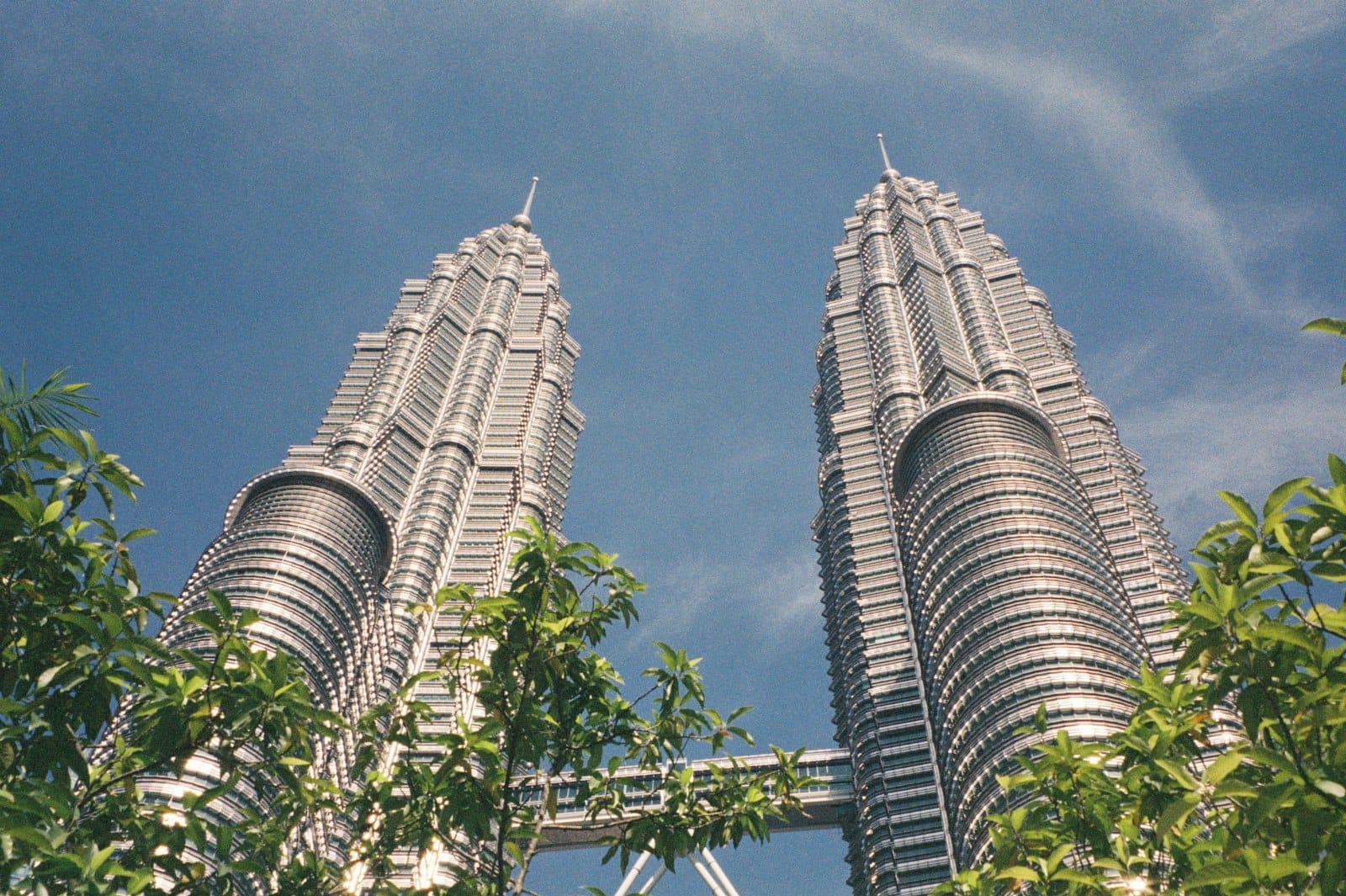
When the Petronas Twin Towers were completed in 1998, they became the tallest buildings in the world, a record they held until 2004. That statistical footnote has long been superseded, but the towers remain architecturally significant in ways that raw height never captures. Standing at 451.9 metres across 88 floors each, they were designed by Argentine-American architect Cesar Pelli, whose brief was to embed Malaysian identity into a postmodern supertall. The result is a floor plan derived from an eight-pointed star, a form rooted in Islamic geometric tradition, visible when you look straight down the atrium or study the building's cross-section.
The exterior cladding of stainless steel and glass catches light differently throughout the day: a cool silver-blue in the morning haze, a sharp metallic sheen at midday, and a warm gold tone in late afternoon when the sun angles low from the west. At night, exterior lighting turns the spires into landmarks visible from almost anywhere in the city. For a traveler seeing Kuala Lumpur for the first time, the towers serve as a genuine orienting structure: once you've located them, the city's geography starts to make sense.
💡 Local tip
Tickets for the Skybridge (Level 41) and Observation Deck (Level 86) sell out days in advance during school holidays and long weekends. Book on the official website before you arrive in KL, not the morning of your visit.
The Visit in Practice: Skybridge and Observation Deck
The ticketed experience has two components sold together: the Skybridge connecting the two towers at Levels 41 and 42, and the Observation Deck at Level 86 of Tower 2. You begin at the ground-floor ticket counter or, if pre-booked, proceed to the designated check-in lane. Security screening is thorough: large bags, tripods, and selfie sticks are not permitted beyond the lobby, so plan accordingly if you're bringing camera gear.
The Skybridge at Level 41 is where most visitors spend the bulk of their time. It's a double-decked bridge 58.4 metres long, attached to the towers at one end each rather than fixed to both simultaneously, an engineering solution designed to absorb differential sway. Walking across it, you can feel the deliberate engineering underfoot: the bridge floats slightly rather than feeling rigidly anchored. The view from here is lateral rather than aerial: you're looking out at the KLCC park directly below, the Mandarin Oriental to your left, and the continuous spread of the city. It's more intimate than the upper deck and, for many visitors, more interesting.
Level 86 gives you the full aerial panorama. On a clear day, you can identify the KL Tower to the southwest, the green patch of the Lake Gardens further west, and the grid of Putrajaya's federal precinct to the south. Smog and haze are genuine factors in Kuala Lumpur, particularly between June and September when transboundary haze from Sumatra drifts in. On hazy days, visibility drops significantly and the distant skyline flattens into grey. The observation windows are angled glass; reflections can be problematic for photography without a polarising filter or the trick of pressing your lens directly against the glass.
⚠️ What to skip
Between June and September, regional haze can reduce visibility to a few kilometres. Check the Air Pollutant Index (API) for Kuala Lumpur before booking if long-range views are your priority.
Tickets & tours
Hand-picked options from our booking partner. Prices are indicative; availability and final rates are confirmed when you complete your booking.
Petronas Twin Towers and Kuala Lumpur Tower observation deck tickets
From 34 €Petronas Twin Towers skip-the-line and top ten wonders private tour from Kuala Lumpur
From 148 €Instant confirmationFree cancellationPrivate day trip to Putrajaya, KL City, Batu Caves and fireflies tour
From 109 €Instant confirmationFree cancellationKuala Lumpur private tour with Petronas Twin Towers and Batu Caves
From 64 €Instant confirmationFree cancellation
When to Go: Light, Crowds, and Haze
The towers open for visitors from 9:00 AM to 9:00 PM daily (closed on Mondays and during certain public holidays). The first session of the day, typically around 9:00 AM, offers the clearest air and smallest crowds. Mid-morning light gives the exterior a cool, photogenic quality, though the interior observation windows face west, meaning afternoon light streams directly in and creates interior glare.
Sunset visits, roughly 6:30 to 7:30 PM depending on the time of year, are the most popular slot and sell out fastest. The transition from golden hour to the city lighting up below is genuinely rewarding, but expect the decks to be fully occupied during this window. If you want photographs without strangers in frame, the early morning session is the practical choice.
Weekday morning visits from Tuesday to Thursday are consistently the least crowded periods. Malaysian public school holidays and the months of December and January bring large domestic visitor numbers. Chinese New Year and Hari Raya periods create significant surges, and the towers may implement crowd controls or limit ticket availability.
Getting There and Getting In
The KLCC LRT station on the Kelana Jaya Line connects directly to the towers via an underground concourse. The walk from the station to the ticket hall takes around five minutes and is fully air-conditioned, which matters in Kuala Lumpur's heat. Taxis and ride-hailing apps drop off at the Suria KLCC mall entrance on Jalan Ampang; from there, the tower lobby entrance is a short walk through the mall's lower ground floor.
The towers sit at the centre of the KLCC district, which means combining your visit with the adjacent KLCC Park, the Aquaria KLCC aquarium, or a meal in the mall is straightforward. Many visitors also walk south toward KLCC Park after their tower visit, particularly in the early evening when the park's fountains and light displays run.
ℹ️ Good to know
The ticket office opens at 8:45 AM. Walk-up tickets for the same day are sometimes available when online slots are sold out — arrive before 9:00 AM and join the queue at the ground floor counter. There is no guarantee of availability, but it works more often than traveler forums suggest.
The Surroundings: KLCC as a Destination in Itself
The base of the towers anchors Suria KLCC, one of Kuala Lumpur's premier shopping malls with six floors of retail, dining, and the Petrosains interactive science museum on Level 4. Petrosains is Petronas-run and focuses on the petroleum industry's science and history; it's well-suited to families with children between roughly 8 and 14, with hands-on exhibits and a simulated oil platform environment.
For shoppers, Suria KLCC covers most mainstream international brands alongside Malaysian retailers. The food court on Level 2 is competitively priced for a mall of this calibre. If you're planning a broader shopping itinerary, the Kuala Lumpur shopping mall guide maps out how KLCC compares to Bukit Bintang options like Pavilion and Lot 10.
The KLCC area at ground level also repays walking. Jalan Ampang to the east is lined with mid-century embassies and colonial-era bungalows in various states of preservation, a quiet architectural counterpoint to the towers above. This stretch rarely appears in visitor itineraries but adds texture to an area that can otherwise feel purely corporate.
Photography Notes and Practical Logistics
The most reproduced photograph of the Petronas Twin Towers is taken from inside KLCC Park, looking north toward the towers reflected in the park's central pool. This framing works best at dawn when the pool surface is still and before joggers and families arrive. By 8:00 AM on weekends the park fills quickly. A wide-angle lens in the 16 to 24mm range on full-frame captures both towers without distortion if you position yourself at the pond's southern edge.
From street level, Jalan P. Ramlee to the west offers a slightly different angle, though street furniture and traffic complicate clean compositions. The elevated walkway connecting KLCC to the Mandarin Oriental provides a useful middle-height perspective that compresses the towers against each other. At night, a tripod is ideal for the park shot, but security does not permit tripods inside the towers themselves.
Visitors interested in combining the towers with other architectural landmarks should note that the Menara KL Tower sits about 1.5 kilometres to the southwest and offers a perspective looking back at the Twin Towers from a different vantage. The two visits pair well if you want competing skyline views. Separately, Merdeka 118, now the second tallest building in the world, is visible on the horizon from the Petronas observation deck and has its own public viewing floor.
Who This Attraction Is and Isn't For
First-time visitors to Kuala Lumpur should consider this a worthwhile experience: the towers are genuinely significant buildings with a story worth understanding, not just a backdrop for photographs. Architecture students and anyone interested in postcolonial urban development will find the design decisions interesting enough to research before going.
Travelers who have already visited Dubai's Burj Khalifa or Shanghai's observation decks may find the experience somewhat modest by comparison. The observation deck is well-maintained but not technologically spectacular; there is no glass floor panel or external walkway. If high-altitude thrills are the draw, the KL Tower's Sky Box offers an outdoor glass platform that competes more directly with that kind of experience.
Visitors with significant mobility limitations should note that the experience involves queuing, security screening, and elevator transitions between floors. The route is fully covered and air-conditioned. Wheelchair users are accommodated, but the queue process can take 30 to 60 minutes on busy days and there is no dedicated fast-track for accessibility needs beyond elevator priority.
Insider Tips
- The outdoor KLCC Park fountain show runs nightly at 8:00 PM and 9:00 PM. Position yourself along the south edge of the reflecting pool well before showtime; latecomers find all the good sightlines occupied.
- Walk-up same-day tickets do exist at the ground floor counter, but the window opens at 8:45 AM and a line forms before that. Arrive by 8:15 AM if you're attempting this.
- The Skybridge at Level 41 is structurally more interesting than the observation deck at Level 86, and many visitors who rush past it to reach the top later wish they had spent more time here. The bridge's sway-absorption engineering is visible in the connecting hinges at each end.
- Petrosains Discovery Centre inside Suria KLCC is consistently underestimated. The entrance fee is modest and it occupies a full afternoon if you have children. Pre-book separately as it operates on its own ticketing system.
- For the cleanest exterior photographs from the park, arrive at dawn on a weekday, ideally after overnight rain, which settles the dust and improves air clarity significantly.
Who Is Petronas Twin Towers For?
- First-time visitors to Kuala Lumpur wanting to understand the city's layout from above
- Architecture and design enthusiasts interested in Islamic-influenced supertall design
- Families with children who can combine the towers with Petrosains and KLCC Park
- Photographers targeting both exterior and aerial city shots
- Travelers building a full KLCC district day that includes the mall, aquarium, and park
Nearby Attractions
Other things to see while in KLCC:
- Aquaria KLCC
Located beneath the Kuala Lumpur Convention Centre, Aquaria KLCC is Malaysia's largest urban aquarium, housing over 5,000 aquatic and terrestrial animals across carefully themed zones. The centrepiece is a 90-metre curved underwater tunnel where sand tiger sharks and sawfish glide overhead. It makes for a reliably engaging few hours, especially when the midday heat outside makes outdoor sightseeing uncomfortable.
- KLCC Park
KLCC Park is a 50-acre landscaped garden at the foot of the Petronas Twin Towers, offering a free lagoon pool, a sculpted fountain with nightly light shows, shaded jogging paths, and a children's playground. It is one of the few places in Kuala Lumpur where green space, architecture, and family-friendly amenities converge without an entrance fee.
- Petrosains Discovery Centre
Petrosains Discovery Centre is an interactive science museum inside Suria KLCC dedicated to the science of petroleum, technology, and the natural world. Spanning nearly 7,500 square meters across Level 4 of the mall, it offers hands-on exhibits, immersive rides, and educational experiences suited to children and adults alike.
- Suria KLCC
Suria KLCC is Kuala Lumpur's most recognizable shopping mall, occupying the base of the Petronas Twin Towers. Beyond retail, it houses a science discovery center, an aquarium, a concert hall, and some of KL's best casual dining — making it worth a visit even if shopping isn't your priority.