Palm Court & Museum Garage: When Parking Becomes Architecture
In Miami's Design District, even parking garages are worth looking at. Palm Court Garage and Museum Garage are two distinctly designed structures that double as public art landmarks, anchoring one of the most architecturally ambitious retail and cultural neighborhoods in South Florida.
Quick Facts
- Location
- Miami Design District — Palm Court Garage: 140 NE 39th St, Miami, FL 33137; Museum Garage: 90 NE 41st St, Miami, FL 33137
- Getting There
- Metrobus Route 3 along Biscayne Blvd to NE 36th St, then a short walk west into the Design District
- Time Needed
- 15–30 minutes to explore exteriors; longer if you're walking the full Design District
- Cost
- US$3 for 0–4 hours; US$6 for 4–6 hours; US$25 for 6+ hours (daily max). Entry and payment are fully contactless.
- Best for
- Architecture enthusiasts, design lovers, photographers, and anyone exploring the Design District on foot
- Official website
- www.miamidesigndistrict.net/visitor-info
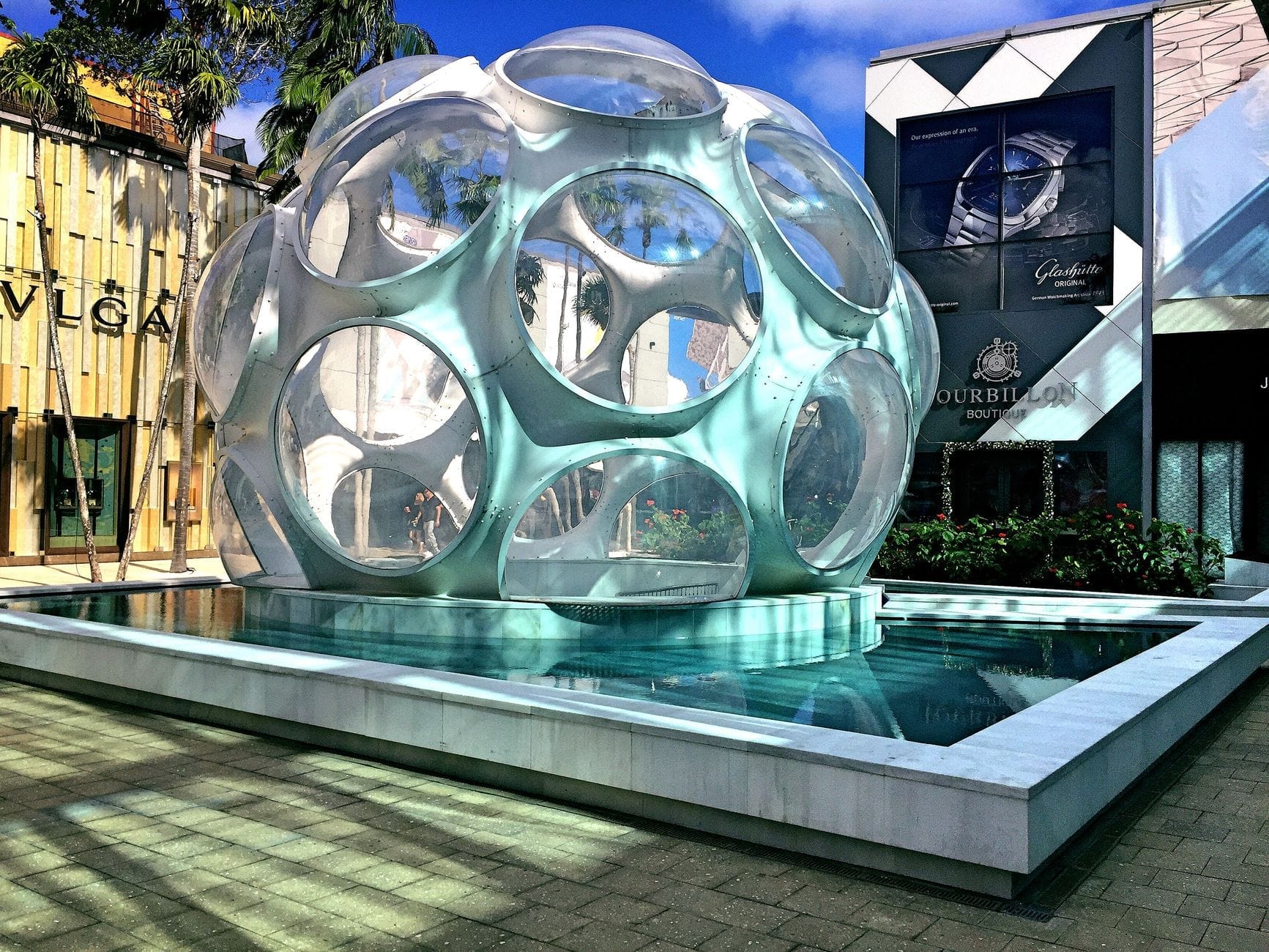
Two Garages That Refuse to Be Ordinary
Most cities treat parking structures as necessary eyesores. Miami's Design District took the opposite approach. Palm Court Garage and Museum Garage are two of the most architecturally deliberate parking structures in the United States, and together they say something meaningful about a neighborhood that has staked its identity on the idea that design is everywhere, not just inside the boutiques and galleries.
The Palm Court Garage, at 140 NE 39th Street, was designed by Miami-based architecture firm Arquitectonica in the Miami Design District and features a sculptural façade of precast concrete panels that catch light differently as the sun moves across the sky. In the morning, the geometry reads sharp and graphic. By late afternoon, shadows pool in the relief surfaces and the structure takes on a more textured, almost tactile quality. It is a building that rewards more than a passing glance.
The Museum Garage, at 90 NE 41st Street, goes further. Conceived by architecture studio WORKac and involving multiple collaborating design firms, its façade is a patchwork of competing visual languages stacked and layered across the building's surface. Cars in 1950s illustration style, tropical foliage, a whimsical tower. The effect is deliberately collage-like, a self-referential commentary on Miami's own eclectic identity. It has capacity for around 800 vehicles. For more context on the neighborhood surrounding both structures, the Miami Design District is worth exploring before or after your visit.
💡 Local tip
Photography tip: The Museum Garage's façade photographs best in the hour before sunset, when warm light brings out the color and depth of its layered panels. Stand on the opposite side of NE 41st Street for a full composition.
What to Actually Expect on the Ground
Visiting both garages as architecture is a straightforward exercise. Neither requires an entry fee to appreciate from the street — you only pay parking rates if you're leaving your car. Walking the two-block stretch between them gives you a clear sense of how the Design District stages its own identity: luxury storefronts at street level, outdoor art installations between buildings, and overhead a sky that on clear winter days turns an almost theatrical shade of blue against the pale concrete and glass.
On weekday mornings before around 11 AM, the area is quiet enough to stand back and photograph the facades without crowds or delivery vehicles disrupting the frame. Weekends draw more foot traffic as shoppers, design professionals, and tourists fill the lanes between the blocks. Art Basel week in December transforms the entire district into something closer to a fair, with queues, temporary installations, and a corresponding spike in parking demand — plan to arrive early or use transit if you're visiting during that period.
Neither building has a formal visitor entrance for sightseers. You are, in all practical terms, looking at functioning urban infrastructure. That is part of the point. The Design District is making an argument that commercial and utilitarian spaces can carry aesthetic weight, and both garages deliver on that argument convincingly.
Tickets & tours
Hand-picked options from our booking partner. Prices are indicative; availability and final rates are confirmed when you complete your booking.
Wynwood Art District's history tour with sweets tasting
From 56 €Instant confirmationFree cancellationEverglades admission ticket with airboat ride and wildlife show
From 24 €Instant confirmationFree cancellationKey West day trip with glass bottom boat ride
From 110 €Instant confirmationFree cancellationEverglades airboat ride with Biscayne Bay boat tour and transportation
From 67 €Instant confirmationFree cancellation
Parking and Practical Logistics
If you are driving to the Design District, both garages operate on a fully contactless system. Your license plate is scanned on entry and payment is made on exit or processed online. There are no tickets to lose. Rates are shared across the district's parking network: US$3 for 0–4 hours, US$6 for 4–6 hours, and US$25 for 6+ hours (daily max). For a typical Design District visit of two to three hours, the US$3 rate is usually sufficient.
Palm Court Garage opens daily at 7:00 AM and operates until 3:00 AM. Museum Garage opens earlier, at 5:00 AM, and closes at 10:00 PM. If you are planning a late evening in the district, Palm Court Garage is the better option for overnight or late-night parking.
Museum Garage includes EV charging stations, a practical detail worth knowing if you are driving an electric vehicle in a city where the summer heat makes EV range planning relevant. Public restrooms for visitors are available on the second floor of the Palm Court building adjacent to Palm Court Garage — a detail that most visitors will appreciate after spending time walking the district's open-air streets in July humidity.
ℹ️ Good to know
Arriving by transit: Metrobus Route 3 runs along Biscayne Boulevard. Alight at NE 36th Street and walk west along NE 38th or 39th Street to reach Palm Court Garage in about five minutes. Museum Garage is two blocks further north.
The Design District Context: Why These Structures Exist
The Miami Design District's transformation from a mid-century furniture and décor wholesale district into one of the most concentrated collections of luxury retail and contemporary art in the Southeast United States did not happen by accident. Developer Craig Robins spent decades acquiring and repositioning the neighborhood, and the architectural ambition of its infrastructure was always part of the plan. The garages are not afterthoughts — they are programmatic decisions that reinforce the district's identity as a place where form is inseparable from function.
Arquitectonica, the firm behind Palm Court Garage, is a Miami institution. Founded here in 1977, the firm helped define what contemporary Miami architecture could look like, earning international recognition for work that often blends bold geometry with subtropical context. Their presence in the Design District carries local resonance. WORKac, the New York-based studio behind Museum Garage, brought an explicitly conceptual approach — the collage façade references, among other things, the idea of the parking structure as urban accumulation, layers of activity and imagery compressed into a single surface. For travelers who want broader architectural context, the Art Deco Miami guide covers how the city's relationship with bold visual architecture extends back nearly a century.
How the Experience Shifts by Time of Day
Early morning, between 8 and 10 AM, is the most photogenic window. Light comes in low from the east and rakes across the relief surfaces of Palm Court Garage with enough contrast to make the concrete geometry read clearly. The streets are largely empty, the retail is not yet open, and the silence gives the architecture room to exist on its own terms.
Midday is functional and busy. Delivery activity, valet operations for nearby restaurants and boutiques, and foot traffic from Design District visitors create a lively street-level environment. The light is overhead and flat, which flattens the garage façades photographically but makes it easier to see the full scale of each building without squinting.
The hour before sunset is the most atmospheric time to visit Museum Garage specifically. The collage façade catches warm golden light across its multiple surfaces, and the visual complexity of the design becomes easier to parse as shadows create definition between its layered elements. If the weather is cooperating, this is the window worth aiming for.
⚠️ What to skip
Summer afternoons from June through September bring intense heat and near-daily thunderstorms, typically arriving between 3 and 5 PM. Plan outdoor Design District walks for mornings or early evenings, and carry water.
Is This Worth Your Time? An Honest Assessment
To be straightforward: if you are visiting Miami with limited time and your priorities are beaches, food, or nightlife, Palm Court Garage and Museum Garage are not independent destinations. They are architectural points of interest within a broader Design District walk. The value proposition is not the structures alone — it is what they represent within the context of a neighborhood that rewards slow exploration on foot. Pair them with the galleries, the outdoor art installations, and a meal, and the Design District becomes a genuinely compelling half-day. For help building that itinerary, the best museums in Miami guide covers nearby institutions worth combining with a Design District visit.
Travelers who follow design, architecture, or contemporary art will find both garages legitimately interesting. Architecture students and professionals, in particular, should not skip Museum Garage — WORKac's approach to the façade program is discussed in design publications and represents a real contribution to the conversation about what civic infrastructure can be. Nearby, the Institute of Contemporary Art Miami offers free admission and is a natural companion stop within the same neighborhood.
Those with no interest in architecture or design theory may find the experience underwhelming as a standalone stop. The garages do not have interior exhibitions, guided tours, or visitor programming. What they offer is purely visual and contextual. If that sounds thin for your travel style, focus your time on the Wynwood Walls a short drive south, which offers a denser, more immersive encounter with Miami's art and design identity.
Insider Tips
- For the cleanest photographs of Museum Garage's collage façade, cross NE 41st Street entirely and use a moderate focal length rather than shooting from directly below. The full composition only becomes legible at distance.
- The Design District's outdoor art installations shift seasonally, so the walk between Palm Court and Museum Garage often includes rotating sculptural work that is not documented on the official map. Keep your eyes at street level and between buildings.
- If you are parking for less than four hours, the US$3 flat rate makes this one of the most affordable places to leave a car in Miami's urban core. It is a genuinely useful base if you are also visiting the Institute of Contemporary Art Miami or Superblue nearby.
- The second-floor restrooms in the Palm Court building are publicly accessible and a practical resource during long Design District walks — most visitors do not know they exist.
- During Art Basel week in December, the entire Design District operates at elevated capacity. Arrive before 10 AM or use Metrobus Route 3 to avoid spending your visit hunting for parking in the very garages you came to see.
Who Is Palm Court & Museum Garage For?
- Architecture and design enthusiasts who appreciate how built infrastructure can carry aesthetic ambition
- Photographers looking for graphic, large-scale urban subjects with strong natural light potential
- Travelers doing a full Miami Design District walk who want to understand the neighborhood's conceptual framework
- Art Basel Miami Beach visitors combining the district's cultural programming with parking logistics
- Anyone driving to the Design District who wants to get more than utility out of where they leave the car
Nearby Attractions
Other things to see while in Miami Design District:
- Institute of Contemporary Art Miami (ICA)
The Institute of Contemporary Art, Miami is a major art museum in the United States that charges nothing at the door. Located in the Miami Design District, it presents rotating exhibitions of contemporary work alongside a permanent collection that is unusually strong for a museum this size.