Osaka City Central Public Hall: Nakanoshima's Architectural Crown
Standing on the slender island of Nakanoshima between two rivers, Osaka City Central Public Hall is one of the finest Neo-Renaissance buildings in Japan. Entry to the ground floor is free, and the building rewards a slower look than most visitors give it.
Quick Facts
- Location
- 1-1-27 Nakanoshima, Kita-ku, Osaka 530-0005
- Getting There
- Naniwabashi Station (1 min walk), Yodoyabashi Station (5 min), Kitahama Station (6 min)
- Time Needed
- 30–60 minutes for exterior and free interior areas
- Cost
- Free for general viewing; some guided tours may be charged
- Best for
- Architecture lovers, history enthusiasts, riverside walkers, photographers
- Official website
- osaka-chuokokaido.com/en
What Is the Osaka City Central Public Hall?
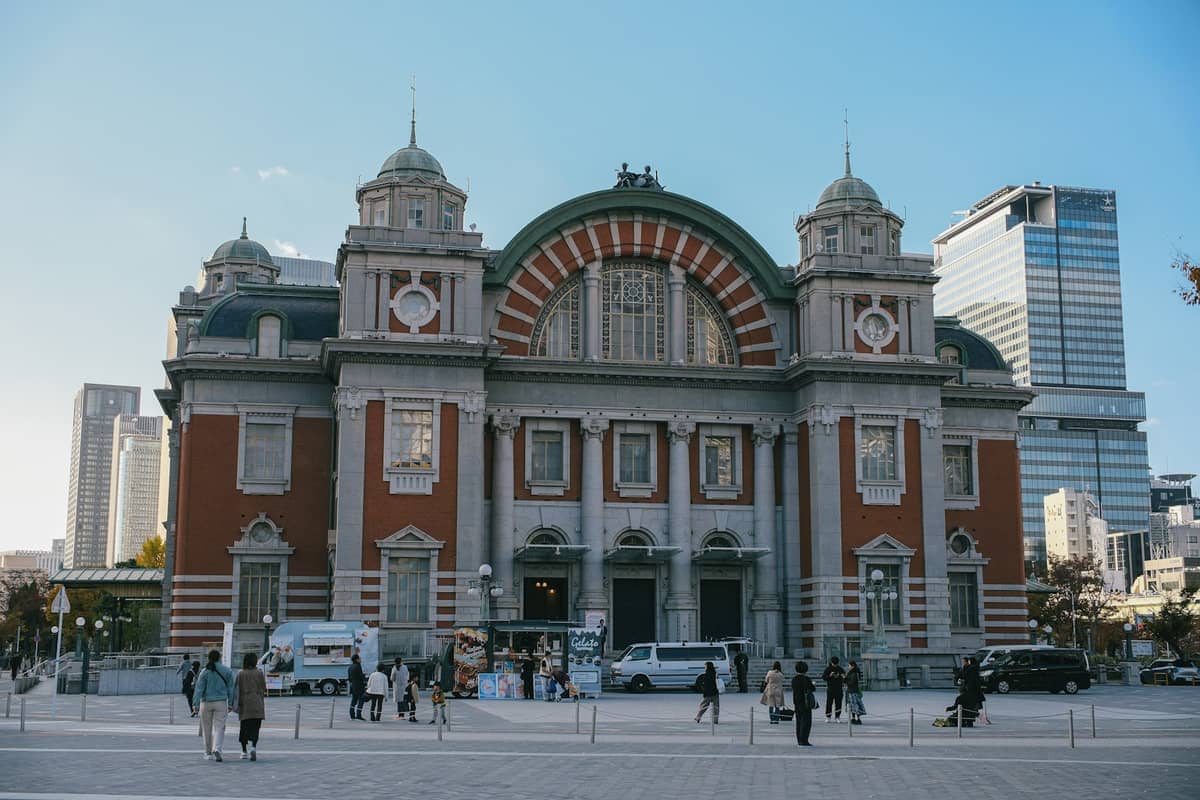
The Osaka City Central Public Hall (大阪市中央公会堂) occupies a commanding position on Nakanoshima, the narrow river island that divides the Dojima and Tosabori rivers in central Osaka. Completed in 1917, this Neo-Renaissance building has served the city for over a century as a civic gathering place, concert venue, and symbol of Osaka's early-20th-century confidence as a commercial metropolis. The official address is 1-1-27 Nakanoshima, Kita-ku, and the building is open daily from 9:30 to 21:30, with a regular closure on the fourth Tuesday of each month (or the following weekday if that Tuesday falls on a public holiday) and a year-end break from December 27 to January 4.
General admission to the public areas is free, which makes it one of the more rewarding architectural stops in a city that charges admission almost everywhere else. The building is wheelchair accessible, with designated spaces available on site.
💡 Local tip
The closest station is Naniwabashi on the Osaka Metro Sakaisuji Line, just a one-minute walk from the main entrance. If you're approaching from Yodoyabashi or Kitahama, allow five to six minutes on foot through Nakanoshima Park.
The Architecture: What You're Actually Looking At
The building's facade is dense with ornamental detail that rewards a slow, close inspection. Terracotta-red brick contrasts with copper-green domes, and the main entrance is framed by arched windows stacked in the Roman manner. The roofline is punctuated by two circular towers capped with domes that have oxidized to a patina the color of old jade. The whole composition has a solidity and deliberate grandeur that was very much intentional: when it opened, Osaka was one of Japan's primary industrial and trading cities, and this hall was meant to look the part.
The original design was by Okano Sadajirō, who won the architectural competition, though the project was completed under the supervision of Tatsuno Kingo's firm after Okano's early death — the same office responsible for Tokyo Station. That lineage is visible: both buildings share a fondness for brick, dome work, and the Neo-Renaissance vocabulary that Japanese civic architecture borrowed from European models in the late 19th and early 20th centuries. The Central Public Hall was designated an Important Cultural Property of Japan in 2002, a recognition that reflects both its architectural integrity and its historical continuity.
From the riverside path along the Tosabori, the building presents its best angle: the full facade reflected in the water on still mornings, flanked by ginkgo trees that turn gold in November. The approach from Naniwabashi Bridge is more theatrical: you come off the bridge and the building fills the view end-on, which is close to the effect the original planners intended.
Tickets & tours
Hand-picked options from our booking partner. Prices are indicative; availability and final rates are confirmed when you complete your booking.
Osaka local food tour in Dotonbori and Shinsekai
From 51 €Instant confirmationFree cancellationGuided day tour from Osaka to Nara Park, Arashiyama and Fushimi Inari
From 59 €Instant confirmationFree cancellationHimeji, Nara and Kobe full-day tour from Osaka
From 76 €Instant confirmationFree cancellationDay trip to Hiroshima and Miyajima by bullet train from Osaka
From 287 €Instant confirmationFree cancellation
Inside: The Public Areas
The ground floor interiors open to free public access are worth entering even if you have no particular interest in civic architecture. The entrance hall has high coffered ceilings, polished stone floors, and decorative plasterwork that has been carefully preserved and restored. The atmosphere is noticeably quieter than the streets outside: sound is absorbed by the heavy construction, and the interior light in the morning has a quality that photographers find difficult to replicate in the afternoon.
A small exhibition area near the entrance typically covers the history of the building and its role in Osaka's civic life. Displays include photographs from the original construction period and documentation of the major restoration project that ran from 1999 to 2002, during which the building was comprehensively renovated while preserving its heritage features. The restoration uncovered elements of the original decorative scheme that had been obscured by decades of later modifications.
ℹ️ Good to know
The main auditorium and event halls are in active use for concerts, ceremonies, and public functions. On days when events are scheduled, access to the upper floors and performance spaces may be restricted. Check the official website calendar before visiting if you want to see specific interior areas.
Time of Day: How the Experience Changes
Early morning, roughly 9:30 to 11:00, is the most rewarding time to visit. The crowds on Nakanoshima at that hour are almost entirely composed of commuters and joggers, and the public hall sits in relative calm. The eastern facade catches morning light cleanly, and the terracotta brickwork reads warmly before the sky turns flat midday white. If the Tosabori River is calm, the reflection from the riverside path is genuinely striking.
Midday brings tour groups and school parties. The interior remains quiet by Osaka standards, but the outdoor plaza and the bridge approaches get noticeably more crowded between 11:00 and 14:00. Late afternoon recovers some of the morning's calm: the copper domes catch the low western light and shift toward a warmer tone. By evening, the building is lit artificially and takes on a different quality, floodlit from below in a way that emphasizes the dome profiles. The evening lighting is photogenic but flatter in texture than natural light.
The Nakanoshima Context: Where It Sits and Why It Matters
The Central Public Hall doesn't stand alone. It anchors the western end of a corridor of significant civic and cultural buildings along Nakanoshima island. The Nakanoshima Park stretches immediately to the east, a long narrow green space of roses and shade trees that fills the gap between the public hall and the Osaka Prefectural Nakanoshima Library, another early-20th-century Neo-Renaissance building that forms an almost complementary pair with the hall. Walking this stretch is one of the better short urban walks in Osaka, connecting architecture, riverside views, and open space in about twenty minutes.
To the west, the National Museum of Art Osaka is a short walk away, its underground galleries a complete architectural contrast to the hall's confident above-ground mass. The combination of the public hall, the park, and the museum makes Nakanoshima a coherent half-day itinerary that covers architecture, fine art, and riverside walking without requiring transport between stops.
For a broader view of the island's character and its place in the city, the Nakanoshima neighborhood guide covers the full range of options, including the Nakanoshima Museum of Art Osaka at the western tip of the island.
Photography: Practical Notes
The building is a genuinely photogenic subject, but it requires some thought to frame well. The full facade is wide, and standard smartphone lenses struggle to capture it without distortion at close range. If you have a wide-angle lens or a perspective-correction option, the main entrance frontal shot works best from the far end of the plaza, roughly 30 to 40 meters back. The riverside angle from the Tosabori path is narrower and more manageable.
The dome detail is best captured with a longer focal length from Naniwabashi Bridge or the opposite bank. Interior photography is permitted in the public exhibition areas; flash and tripods are typically not allowed, so high-ISO performance matters in the morning entrance hall light. The interior light is warmest between 10:00 and 11:30 on clear days.
💡 Local tip
In late November, the ginkgo trees along the Nakanoshima riverside path turn bright yellow. The combination of gold foliage and the terracotta-and-copper building behind it is one of the better autumn photography compositions in central Osaka. Timing the visit for this period requires checking the annual foliage forecast.
Who Will Get the Most Out of This Visit
Travelers with an interest in architecture, urban history, or the Meiji and Taisho periods of Japanese development will find the most to engage with here. The building is also genuinely useful as a quiet interior respite on a hot day or when rain sets in: the entrance hall and exhibition areas are air-conditioned, open until 21:30, and cost nothing to enter.
For those on a tight itinerary focused purely on Osaka's food, temple, or shopping circuits, the Central Public Hall is not the most urgent stop. It is an architecture and civic history attraction, not a sensory spectacle. Travelers looking for dramatic visual contrast rather than historical context, or those who find 20th-century civic buildings less compelling than traditional Japanese design, may find the nearby Shitennoji Temple or the castle area better suited to their priorities.
If this kind of architectural and cultural texture appeals, the Kitahama Retro District a short walk east of Nakanoshima offers more early-20th-century commercial and institutional buildings, and the best museums in Osaka guide covers the full range of options across the city.
Insider Tips
- The fourth Tuesday of each month is a regular closure day. If your visit falls near a public holiday in the same week, the closure shifts to the next weekday. Check the official site calendar before going out of your way.
- The building is in active use as an event venue. On days with concerts or ceremonies, some interior areas will be off-limits. The outdoor facade and ground-floor exhibition are almost always accessible during opening hours.
- The Tosabori riverside path between Naniwabashi and Kitahama Station runs directly behind the building and offers the best water-reflection angles. It is almost never crowded and takes about ten minutes to walk in full.
- Naniwabashi Station on the Osaka Metro Sakaisuji Line delivers you within a one-minute walk of the entrance, but many visitors arrive via Yodoyabashi or Kitahama instead. Naniwabashi is the correct stop if the hall is your primary destination.
- The Osaka Amazing Pass includes free entry to various attractions in the city, but since the Central Public Hall's general viewing is already free, the pass offers no additional value here specifically. Budget time for the nearby National Museum of Art Osaka, which does charge entry and is covered by the pass.
Who Is Osaka City Central Public Hall For?
- Architecture and design travelers interested in Meiji and Taisho-era civic buildings
- History-focused visitors exploring Osaka's role as a modern industrial city
- Photographers working the Nakanoshima riverside, especially in autumn foliage season
- Travelers wanting a free, air-conditioned cultural stop between Umeda and Kitahama
- Anyone building a self-guided Nakanoshima walking itinerary combining the park, museums, and riverside
Nearby Attractions
Other things to see while in Nakanoshima:
- Kitahama Retro District
The Kitahama Retro Building is a beautifully preserved early 20th-century Western-style structure on the banks of the Dojima River, housing a British tearoom and cake shop. It stands as one of Osaka's most photogenic historical buildings, offering afternoon tea in a setting that feels entirely removed from the modern city just outside.
- Nakanoshima Museum of Art Osaka
The Nakanoshima Museum of Art Osaka (NAKKA) opened in February 2022 as the city's most significant new cultural institution in decades. Housed in a bold matte-black cube on Nakanoshima island, it focuses on modern and contemporary art and sits a short walk from some of Osaka's most elegant civic architecture. Here is everything you need to plan a visit.
- Nakanoshima Park
Nakanoshima Park occupies a narrow sandbank between the Dojima and Tosabori rivers in central Osaka, offering a free, unhurried escape from the city's commercial energy. The park is anchored by a rose garden and framed by some of Osaka's most significant Meiji and Taisho-era civic buildings, making it as much an architectural walk as a garden visit.
- National Museum of Art, Osaka
Built entirely below ground on Nakanoshima island, the National Museum of Art, Osaka is one of Japan's leading contemporary art institutions. Its sculptural steel entrance rises from the riverbank like a modern landmark, while the real experience unfolds in the quiet, gallery-lit floors beneath.