New York Hall of Science (NYSCI): The Complete Visitor Guide
The New York Hall of Science sits inside Flushing Meadows-Corona Park in a building originally constructed for the 1964 World's Fair. It combines serious interactive science with one of the largest outdoor science playgrounds in the United States, making it a genuine full-day destination for families and curious adults alike.
Quick Facts
- Location
- 47-01 111th Street, Flushing Meadows-Corona Park, Queens, NY 11368
- Getting There
- 7 train to 111th Street (about a 5-minute walk); Q23/Q58 bus to Corona Ave & 108th St
- Time Needed
- 2.5 to 4 hours for exhibits; allow a full day with the Science Playground and mini golf
- Cost
- General Admission: Adults $22, Children/Students/Seniors $19. NYSCI Plus (all add-ons): pricing and inclusions vary; check the official site for current details. Free Fridays 2–5 PM (reservation required)
- Best for
- Families with kids, school groups, science enthusiasts, rainy-day visits
- Official website
- nysci.org
What the New York Hall of Science Actually Is
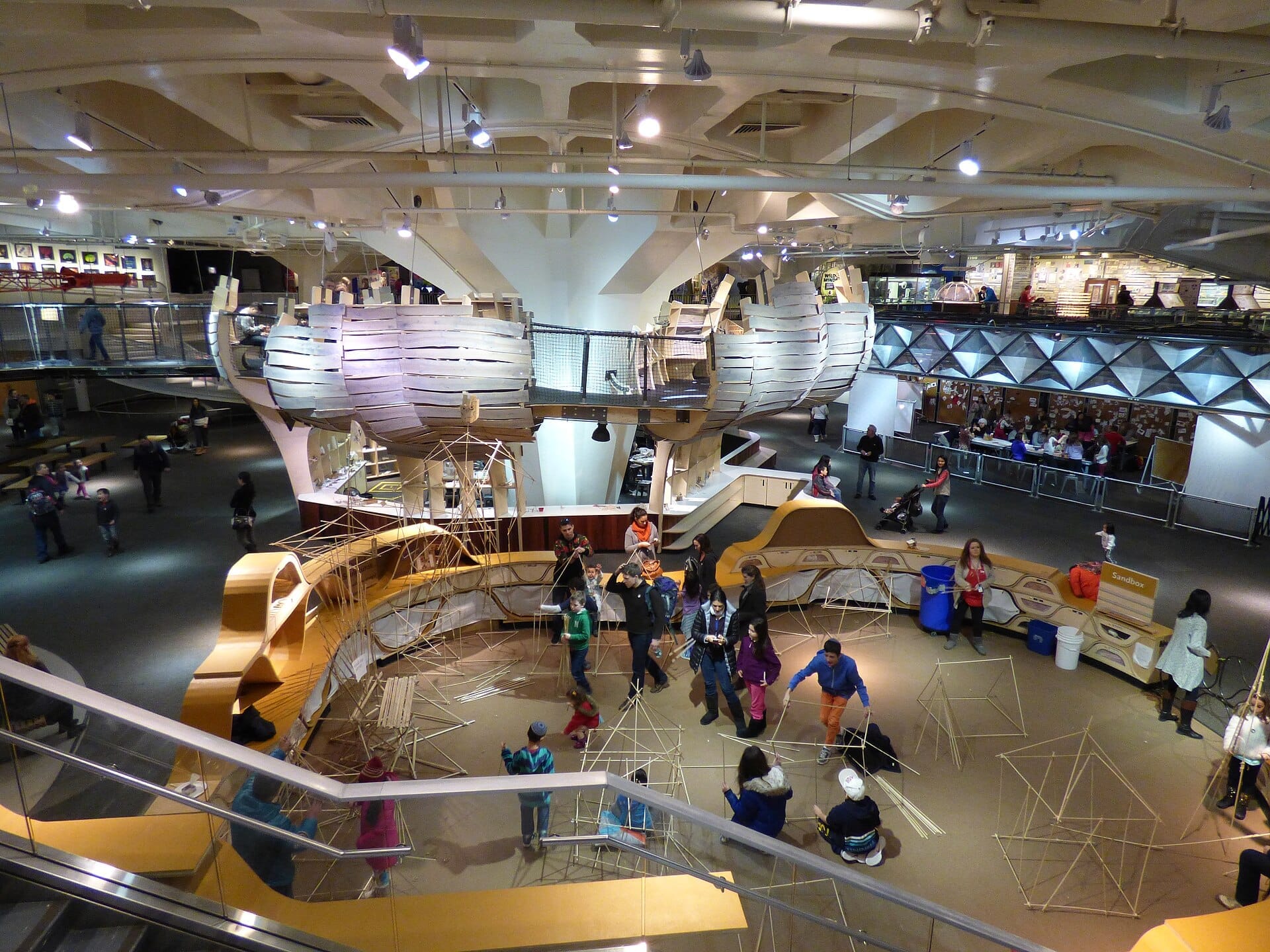
The New York Hall of Science, known locally as NYSCI, is a hands-on science and technology museum in Flushing Meadows-Corona Park, Queens. It is not a traditional museum where you read labels and keep your hands to yourself. Nearly every exhibit is built for physical interaction: you adjust pulleys, redirect light beams, feel the physics of pendulums, and build structures under timed conditions. The emphasis is on learning by doing, which makes it unusually engaging for children but also more interesting for adults than a conventional exhibit hall.
The building itself carries significant architectural and historical weight. It was constructed for the 1964 New York World's Fair and is one of the few structures from that era still standing in the park. The original hall features soaring undulating concrete walls studded with colored glass, a distinctive mid-century modernist design that looks unlike anything else in New York. Annex expansions completed in the mid-1990s and early 2000s significantly increased the usable space, but the original 1964 structure remains the visual anchor of the complex.
💡 Local tip
If you plan to use the Science Playground and Rocket Park Mini Golf, buy the NYSCI Plus ticket upfront rather than adding them individually. It works out cheaper and saves a second queue at the admissions desk.
The Building and Its World's Fair Origins
Flushing Meadows-Corona Park was transformed twice by World's Fairs, in 1939 and again in 1964. The 1964 fair brought NASA exhibits, the IBM Pavilion, and the original Hall of Science, which showcased American scientific achievement at the height of the Space Race. When the fair closed, most pavilions were demolished. NYSCI was repurposed as a public science museum, reopening in 1967 and gradually evolving into the institution it is today.
The original concrete shell, designed by architect Harrison and Abramovitz, uses a hyperbolic paraboloid form that gives the exterior walls their rippled, organic appearance. Inside, the ceiling height in the original hall is dramatic, and the colored glass filters daylight into the space in ways that shift noticeably through the afternoon. If you arrive before noon on a clear day, the morning light through the west-facing panels is worth pausing to notice.
The park surrounding NYSCI contains other remnants of the World's Fair era, including the Unisphere, a 12-story steel globe that is one of the largest representations of Earth in the world. Visiting NYSCI fits naturally into a broader exploration of Flushing Meadows-Corona Park, and the two together make a logical pairing for anyone spending a day in Queens.
Tickets & tours
Hand-picked options from our booking partner. Prices are indicative; availability and final rates are confirmed when you complete your booking.
Escape Tour self-guided, interactive city challenge in New York
From 30 €Instant confirmationEscape Tour self-guided, interactive city challenge in New York
From 30 €Instant confirmationSpirit of New York Dinner Cruise
From 161 €Instant confirmationFree cancellationNew York City Highlights bike tour
From 70 €Instant confirmationFree cancellation
Inside the Exhibits: What to Expect Floor by Floor
The permanent collection spans topics from microbiology and genetics to sports science, connected design, and mathematics in everyday life. The Connected Worlds exhibit, which occupies the main hall's upper level, uses floor-to-ceiling projection to create an immersive ecological simulation where visitors physically redirect water flows and observe how ecosystems respond. It is technically impressive and tends to hold children's attention longer than most static displays.
The Marvelous Molecules and Seeing the Light sections are strong examples of the museum's hands-on philosophy. Seeing the Light in particular uses optical illusions, prisms, and shadow experiments in a dark-walled gallery that encourages experimentation rather than passive observation. Younger children tend to move through it quickly and return repeatedly. Older visitors and adults often slow down here because the demonstrations are genuinely surprising even with a working knowledge of optics.
The sports science area uses motion capture, reaction-time tests, and biomechanics stations to connect physics with athletic performance. It draws a steady crowd of older kids and teenagers who might otherwise disengage from a science museum. Be aware that certain popular interactive stations develop queues by late morning on weekends, particularly during school holidays. Arriving at opening gives you at least 45 minutes before the main crowd arrives.
ℹ️ Good to know
Opening hours: Tuesday 10:00–14:00; Wednesday through Sunday 10:00–17:00 (last entry 16:00). The museum is closed Monday. Community Hours (free general admission, reservation required) run Fridays 14:00–17:00, with tickets released each Friday at 10:00.
The Science Playground and Rocket Park Mini Golf
NYSCI's outdoor Science Playground spans approximately 60,000 square feet, making it one of the largest science-themed outdoor play areas in the United States. The equipment is not decorative: giant slides demonstrate inclined planes, water channels illustrate fluid dynamics, and rope structures teach load distribution. It is designed for children roughly between ages 6 and 12, though younger children with supervision manage most of it, and the equipment is robust enough that it rarely feels precious.
The playground is only included with the NYSCI Plus ticket or as a separate add-on. On warm weekends between April and October, it fills quickly. The surface underfoot is rubberized, which matters for toddlers, and there is partial shade from overhead structures, but full-sun days in July and August make the metal equipment uncomfortably hot by early afternoon. Mornings are cooler and the equipment surfaces are more manageable.
Rocket Park Mini Golf wraps around decommissioned rockets from the Space Race era, including an actual Rocket Park that NYSCI maintains as part of its World's Fair legacy. The course is nine holes, designed with a science theme, and is accessible to most ages. At $7 per person as an add-on (or $6 for members), it is reasonable as a side activity, though not worth a dedicated trip on its own. The rockets themselves are worth seeing regardless of whether you play the course.
Getting There and Practical Logistics
The 7 train stops at 111th Street, which puts you about a three-minute walk from NYSCI's entrance. This is by far the simplest approach from Manhattan or most of Queens. The 7 train runs frequently and connects directly to Times Square, Grand Central, and the rest of the 42nd Street corridor. The Q23 and Q58 buses stop at Corona Avenue and 108th Street, and the Q48 stops at 111th Street and Roosevelt Avenue. Bus routes are more useful if you are coming from other parts of Queens rather than from Manhattan.
If you drive, parking is available in a dedicated NYSCI lot with an entrance from 46th Avenue and 111th Street. Rates are currently $15 per standard vehicle and $20 for group vehicles during museum hours, though these figures are subject to change and should be confirmed on the official site before your visit. Parking is free for certain membership tiers. The lot fills on busy weekend mornings during school holidays, so arriving before 10:30 is advisable.
Queens offers a range of other destinations worth combining with a NYSCI visit. The neighborhood of Flushing to the north has some of the best Chinese and Korean food in New York City. The Queens Night Market runs seasonally nearby in Flushing Meadows and is a strong evening addition. For more context on the area's attractions and food landscape, see our full guide to Flushing and Queens.
Timing Your Visit: Morning vs. Afternoon
Weekday mornings are the quietest window, particularly Tuesday through Thursday. School groups arrive in organized waves between 10:00 and 11:30, which can create concentrated noise and competition for exhibit stations in certain galleries, but they generally cycle out by 12:30. If you arrive at opening and move through the main exhibits first, you will stay ahead of the group traffic for most of your visit.
Weekend afternoons are the most crowded period. Families arrive throughout the morning and the main hall peaks between 11:00 and 14:00. Friday afternoons during Community Hours are free but reservation-only, and they draw a mix of local families and budget-conscious visitors. The exhibits are the same during those hours, but the atmosphere is noticeably more relaxed than a Saturday afternoon. The tradeoff is that free admission does not include Rocket Park Mini Golf, 3D theater shows, the Science Playground, or other ticketed programs and workshops.
💡 Local tip
Sensory Sensitive Hour runs on Saturdays from 10:00 to 11:00, with sounds reduced and lighting dimmed throughout the museum. Families with children who are sensitive to noise or bright lights should plan specifically around this window.
Honest Assessment: Who Will Get the Most Out of NYSCI
NYSCI is best understood as a children's science museum with programming and exhibits serious enough to hold adult interest. Parents and accompanying adults will find it genuinely engaging rather than merely tolerant. The Connected Worlds projection installation and the optics gallery in particular have enough depth to reward adult attention. That said, the overall experience is calibrated toward ages roughly 5 to 14, and visitors without children in that range may find the ratio of depth to activity somewhat thin compared to a research-driven museum.
Adults traveling without children are not the target audience, and the museum does not pretend otherwise. If your interest is in serious science history, the Apollo-era rocket park is worth fifteen minutes of genuine attention, but the broader museum is unlikely to satisfy visitors looking for exhibition content at the level of, say, the American Museum of Natural History.
For families planning a broader Queens itinerary, NYSCI pairs well with a walk around Flushing Meadows or a meal in Flushing proper. Those building a multi-day NYC trip with children should also look at our guide to New York City with kids and the American Museum of Natural History in Manhattan for a strong science-focused contrast.
Insider Tips
- Free Friday Community Hours tickets are released every Friday at 10:00 on the NYSCI website and run out fast. Set a reminder for exactly 09:00 if you want them, especially during school holidays.
- The Science Playground equipment gets uncomfortably hot to the touch on sunny summer afternoons. If you are visiting in July or August with young children, do the playground first thing in the morning and save the indoor exhibits for the heat of the day.
- The NYSCI movie theater shows short-format science films. The additional cost is $6, but it provides a useful 20-minute reset for tired children without pulling anyone out of the museum.
- The rockets in Rocket Park are genuine NASA-era hardware, including several Atlas and Redstone rocket bodies. Even if you skip the mini golf, walking through the park before or after your museum visit is worth five minutes of unhurried attention.
- Weekday school group traffic concentrates in a predictable wave between 10:00 and 11:30. Arriving at opening and heading to the upper-level Connected Worlds exhibit first keeps you ahead of the groups for the first hour.
Who Is New York Hall of Science For?
- Families with children ages 5 to 14 looking for a full-day activity with indoor and outdoor components
- Parents who want an educational experience that holds their own attention, not just the children's
- School holiday visits when indoor entertainment is a priority
- Budget travelers who can plan around free Friday Community Hours
- Anyone with an interest in 1964 World's Fair history or Space Race architecture and hardware
Nearby Attractions
Other things to see while in Flushing:
- Flushing Meadows Corona Park
Flushing Meadows Corona Park is Queens' largest park and one of New York City's most historically significant public parks. Built on a former ash dump and transformed for two World's Fairs, it holds the iconic Unisphere, multiple museums, a zoo, tennis stadiums, and wide open lawns where the borough's diverse communities gather every weekend.
- Queens Night Market
Held every Saturday evening from April through late October, Queens Night Market brings together more than 100 vendors in the parking lot behind the New York Hall of Science in Flushing Meadows Corona Park. Entry is free, the food is cheap, and the cultural range is unmatched anywhere in the city.
- Rockaway Beach
Rockaway Beach and Boardwalk stretches for miles along the Atlantic Ocean in Queens, offering free swimming, legal surfing, and a genuine seaside atmosphere that feels worlds away from Midtown. It's accessible by subway, ferry, or LIRR, making it a realistic half-day from almost anywhere in the city.